Leasehold
Jul 16, 2026
How Noise Affects Property Development Feasibility
How noise influences planning, costs and design in UK property development and why early noise assessments protect viability.

Noise can make or break a property development project. Here's why it matters:
To avoid setbacks, noise should be assessed during the feasibility stage. This involves identifying sources (e.g., traffic, industrial), conducting surveys, and comparing results to established standards. Early planning helps developers integrate cost-effective solutions like building orientation, upgraded glazing, or mechanical ventilation. Delays in addressing noise often lead to higher costs and planning risks.
In short, noise isn’t just a technical problem - it’s a financial and planning challenge that needs early attention to keep projects viable.
Noise doesn’t just create discomfort - it can make a development project entirely unworkable. From the earliest stages, noise considerations shape site design, determine whether a location is suitable, and heavily influence costs. Regulations play a central role in defining how these challenges are addressed, linking noise mitigation directly to financial planning.
In England, developers must navigate a web of noise regulations. Key frameworks include the National Planning Policy Framework (NPPF), the Noise Policy Statement for England (NPSE), and standards like BS 4142, which collectively set out how noise must be assessed and managed. Charrette Law highlights the importance of these rules:
"The National Planning Policy Framework (NPPF) explicitly states the need to avoid noise giving rise to significant adverse impacts on health and the quality of life due to new development." [3]
The Agent of Change principle, introduced in the 2018 NPPF, places responsibility on developers to mitigate noise when building near existing noisy businesses. This means developers must cover the costs of noise reduction measures, while the existing businesses are not required to alter their operations. What might seem like a straightforward site can quickly become far more costly to develop.
Additionally, local authorities provide a 21-day public consultation period, during which noise is often a primary concern for community objections [3]. Without a professional noise impact assessment accompanying a planning application, Environmental Health Officers may raise formal objections. This makes a thorough assessment essential to avoid delays or rejections.
The financial implications of noise go far beyond the cost of initial surveys. Mitigation measures such as acoustic glazing, mechanical ventilation, and sound barriers can significantly increase construction expenses. For example, if windows need to remain closed to meet noise standards, alternative ventilation systems must be installed, adding to the overall budget. As Polaris Acoustics explains:
"Leaving noise until the end of the design process often results in more expensive and less elegant solutions." [2]
Here’s a breakdown of how noise mitigation can drive up costs:
| Mitigation Area | Typical Cost Impact |
|---|---|
| Building fabric | Enhanced acoustic glazing and specialised window frames |
| Ventilation | Mechanical extract or heat recovery systems |
| External barriers | Acoustic fencing, louvres, or plant screens |
| Site layout changes | Repositioning buildings or reducing density |
| Plant equipment | Quieter units or custom attenuators for building systems |
Noise also impacts end-user satisfaction. Properties that fail to meet internal noise standards, such as those outlined in BS 8233:2014, are harder to sell and more likely to attract complaints after completion. Some councils even mandate a post-completion noise assessment to confirm that the development meets the promised standards [4], adding yet another layer of cost. By addressing noise considerations early, developers can integrate these requirements into feasibility studies and avoid costly surprises later.
Noise Assessment Process in Property Development Feasibility
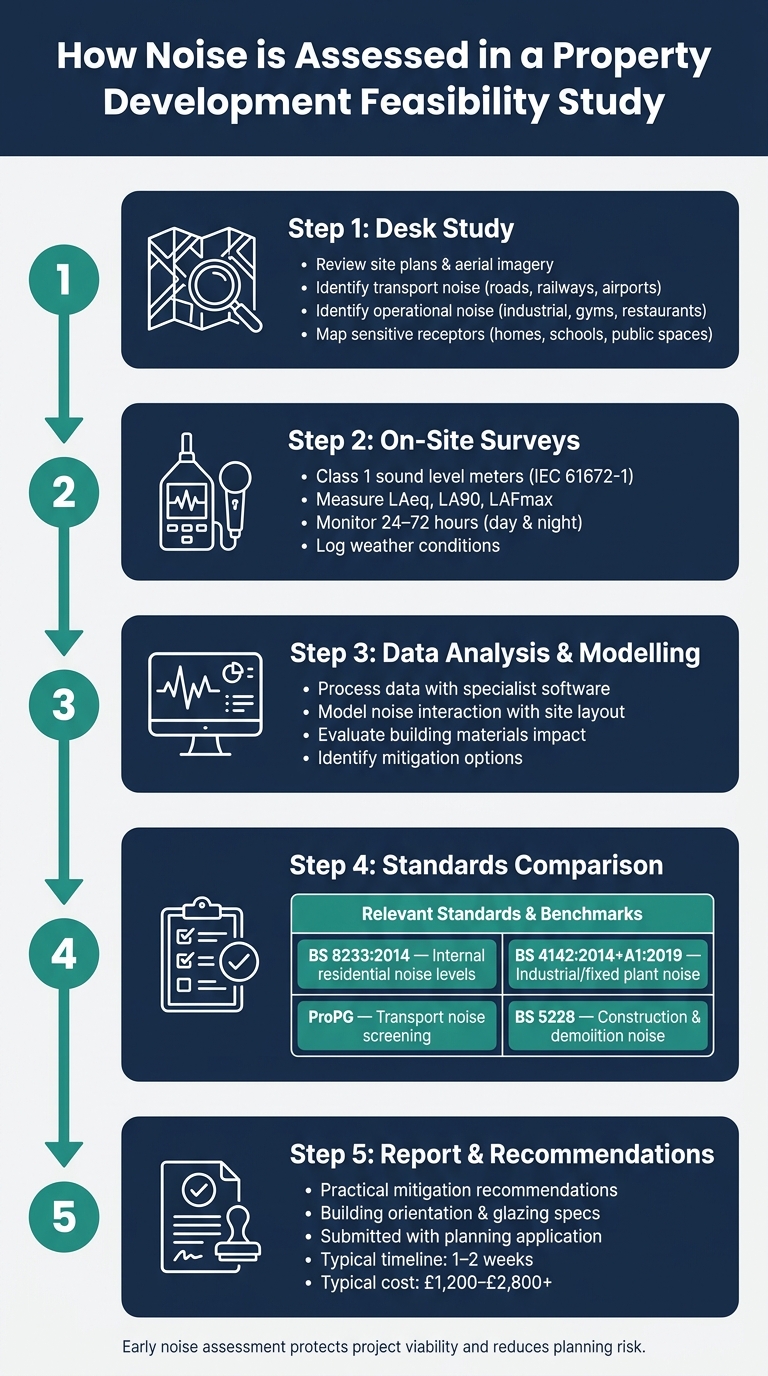
Assessing noise during a feasibility study involves a combination of desk-based research, on-site measurements, and technical analysis. Addressing noise issues early on can help avoid costly setbacks later in the project.
The process begins with a desk study. This involves reviewing site plans, aerial imagery, and any existing planning feedback to identify potential noise issues without needing to visit the site. Consultants focus on two main types of noise:
Another key step is identifying sensitive receptors - nearby homes, schools, or public spaces that might either be affected by the development or pose challenges to it. As Polaris Acoustics highlights:
"Planners and design teams risk late objections, ineffective or excessive mitigation solutions and redesign when noise isn't quantified early." [6]
This initial analysis shapes the scope of the survey and helps determine where and how on-site noise measurements will be conducted.
Following the desk study, the next step is conducting on-site surveys. Class 1 sound level meters (compliant with IEC 61672-1 standards) are installed at strategic locations, such as building façades or open areas away from reflective surfaces. These devices measure key acoustic metrics, including:
Surveys generally run for at least 24 hours to capture both daytime and night-time conditions. For more complex sites, monitoring may extend up to 72 hours to account for fluctuations [1]. Weather conditions are carefully logged because factors like strong winds or heavy rain can compromise the accuracy of the data and must be excluded from the analysis.
It's important to differentiate between measuring noise levels and interpreting their impact. Polaris Acoustics explains this distinction:
"A noise survey measures the acoustic environment. A noise assessment explains whether that environment is acceptable for the proposed development." [2]
Once the data is collected, it is processed using specialised software to model how noise interacts with the proposed site layout and building materials. This modelling helps refine the development strategy, allowing consultants to suggest practical solutions - such as repositioning buildings or recommending specific glazing options - before submitting planning applications. The entire process, from initial measurements to a planning-ready report, typically takes one to two weeks [1]. Costs for a baseline survey and report typically range from £1,200 to £2,800+, depending on the complexity of the site [5].
Different standards apply depending on the type of noise being assessed. Below is a summary of key standards:
| Standard | What It Covers |
|---|---|
| BS 8233:2014 | Internal noise levels for residential spaces and outdoor amenity areas |
| BS 4142:2014+A1:2019 | Assessing industrial or fixed plant noise |
| ProPG | Screening risks for new residential developments near transport noise |
| BS 5228 | Noise and vibration from construction and demolition activities |
The findings from these assessments play a crucial role in shaping design decisions and securing planning approvals.
Evaluating noise against established standards plays a key role in securing planning approval and maintaining the value of a development. Once noise data is collected and analysed, it must be compared to specific benchmarks that can significantly influence planning outcomes. These standards often guide necessary adjustments during the development process.
Local Planning Authorities (LPAs) use thresholds outlined in BS 8233:2014 to determine whether a development meets acceptable acoustic standards.
| Location | Target Noise Level | Time Period |
|---|---|---|
| Outdoor living space | 55 dB LAeq | Day (07:00–23:00) |
| Habitable room (internal) | 35 dB LAeq | Day (07:00–23:00) |
| Habitable room (internal) | 30 dB LAeq | Night (23:00–07:00) |
| Inside dwelling (sleep disturbance) | 45 dB LAFmax | Night (23:00–07:00) |
Night-time noise limits are particularly stringent, as planning authorities treat sleep disturbance as a serious health issue. Even if a development meets daytime noise targets, failing to comply with the night-time LAFmax limit can result in planning objections.
Noise assessments must be carried out by qualified professionals, typically members of the IOA (Institute of Acoustics) or ANC (Association of Noise Consultants) [4]. Submitting unqualified assessments risks rejection by the council's Environmental Health team.
When a development fails to meet noise thresholds, developers must follow a structured approach to noise management [4]:
"In requiring good acoustic design, there is a hierarchy of noise management measures that LPAs should encourage, including... Maximising the spatial separation of noise source(s) and receptor(s) [and] Using the layout of the scheme to reduce noise propagation across the site." - Bracknell Forest Council [4]
This means integrating noise reduction strategies early in the design process to avoid costly changes later. Practical steps involve repositioning buildings, altering their orientation, or using parts of the development to shield more sensitive areas. For instance, placing non-sensitive rooms like bathrooms and kitchens on the noisier side of a building can help protect bedrooms and living spaces without adding significant costs.
If meeting noise standards requires windows to remain closed, developers must include a reliable ventilation and overheating strategy, as outlined in Approved Document O. Leeds City Council highlights this point:
"The design should minimise the need for fixed glazing to achieve internal noise levels that would be acceptable... Any mitigation measures that require windows to be kept closed... shall include a ventilation strategy." [7]
Key decisions about building height, façade materials, and boundary treatments need to be made early in the planning process. Delaying these decisions is a frequent and expensive mistake. Additionally, some LPAs require post-completion noise testing to verify that the final construction meets the predicted noise levels. This emphasises the importance of designing solutions that work in practice, not just on paper.
Once noise thresholds are analysed, the focus shifts to applying specific measures that align with these standards, all while keeping costs and timelines in check. The good news? Most noise challenges can be addressed effectively if tackled early on.
"Noise is cheaper to solve before layouts harden." - Polaris Acoustics [8]
The most cost-effective way to manage noise is by optimising the internal layout right from the design stage. Placing less noise-sensitive spaces - like kitchens, bathrooms, and circulation areas - on the noisier side of a building creates a natural shield for bedrooms and living rooms. This simple adjustment can significantly reduce the need for costly acoustic treatments later.
In cases where layout adjustments aren't enough, installing upgraded glazing becomes essential. Glazing should be specified with a clear composite performance rating (Rw/DnT,w + Ctr), especially in areas exposed to low-frequency noise, such as near railway lines. To avoid delays, it's critical to specify both the performance ratings and installation locations upfront, ensuring smooth compliance with planning conditions [8].
When windows must remain closed to meet internal noise standards, integrating a Mechanical Ventilation with Heat Recovery (MVHR) system ensures proper ventilation while maintaining acoustic performance. This step requires early collaboration with mechanical and electrical engineers to account for ceiling void space and minimise fan noise.
Beyond the building's interior, site planning can also play a big role in controlling noise.
Noise management can start at the site level by positioning non-sensitive areas - like car parks, bin stores, or public circulation spaces - along the noisier boundaries. This creates a natural buffer before introducing any physical barriers. External amenity spaces, for example, should aim to achieve noise levels of 50–55 dB LAeq,16h [6].
If physical barriers are necessary, they must be imperforate and have a surface mass of at least 10–12 kg/m² to be effective [9]. A combination of an earth bund with a timber or masonry screen can work well, even on limited site space. However, it's important to address a common misunderstanding:
"It is a common misconception that trees/bushes act as acoustic barriers. In fact, bands of trees/bushes up to around 25m deep have no significant acoustic properties. However, the visual screening they provide can often help residents to believe that the noise is less." - Cass Allen [9]
While landscaping doesn't offer technical acoustic benefits, it can still provide psychological relief and improve the overall aesthetic. For balconies facing noisy areas, solid screens or wintergardens are practical solutions that maintain architectural appeal while delivering effective noise reduction. Addressing these strategies early in the design phase helps avoid expensive retrofitting later.
| Mitigation Strategy | Cost Impact | Design/Timeline Impact |
|---|---|---|
| Layout and orientation | Low (if done early) | High - requires early planning |
| Upgraded glazing | Moderate | Minimal - needs specific procurement |
| MVHR systems | Moderate to high | Requires M&E coordination; affects ceiling voids |
| Acoustic barriers/bunds | Moderate | Affects site density and landscaping budget |
| Structural isolation (e.g., floating floors) | High | Significant if added late in the design process |
Noise issues have a direct impact on both development value and land appraisal, creating challenges that developers must address early in the process. These challenges arise in two main ways: first, the additional costs of mitigation measures such as acoustic glazing, MVHR systems, and specialised plant enclosures drive up construction costs per unit. Second, design constraints like setbacks, buffer zones, and less-than-ideal floor plans reduce site density and the overall developable footprint. Together, these factors put pressure on the residual land value - the amount left after subtracting development costs and profit from the Gross Development Value (GDV). A site that may initially seem appealing can quickly lose its viability once noise mitigation expenses are factored in.
Delaying noise-related solutions only compounds these issues. The longer noise assessments are postponed, the higher the costs and the more complicated the design process becomes. Planning risk adds another layer of financial uncertainty. Without a strong Noise Impact Assessment (NIA), or if one is missing altogether, objections from an Environmental Health Officer (EHO) could lead to delays or even a project refusal. These delays come with mounting costs, including finance charges, holding costs, and professional fees. On top of this, the 21-day public consultation period allows formal noise objections to be raised, further increasing the risk of setbacks [3]. This highlights the importance of addressing noise concerns early, not just as a technical step but as a financial strategy to protect the project.
Investing in a Noise Impact Assessment early on can prevent these risks. Baseline surveys for such assessments typically start at around £1,200 + VAT. By integrating acoustic evaluations into the initial feasibility appraisal, developers can refine cost estimates and safeguard project margins. This approach also helps avoid delays during the critical 21-day consultation period. Tackling noise issues upfront ensures smoother project timelines and protects profitability.
"A noise impact assessment isn't just a formality - it's a key requirement that could determine the success or failure of your application." - Hawkins Environmental [1]
Noise plays a crucial role in shaping the success of any property development. From the initial site evaluation to the final sound testing stages, how noise is managed directly impacts costs, timelines, and planning outcomes.
Delaying noise assessments can lead to expensive and inefficient fixes later on. Conducting these assessments early allows for practical adjustments, such as repositioning buildings, refining room layouts, or revising ventilation strategies, all before changes become prohibitively expensive. This underscores a key takeaway: addressing noise proactively is essential to maintaining the viability of a project. A thorough assessment isn’t just about presenting data - it’s about offering actionable solutions to ensure compliance and smooth project execution.
If your project involves noise-sensitive developments like residential housing or noise-generating activities such as industrial plants, kitchens, or delivery yards, commissioning a Noise Impact Assessment (NIA) is a smart move. It's best to address this early on, ideally during pre-application discussions with your local planning authority or Environmental Health Team. Tackling noise considerations at the design stage allows you to incorporate cost-effective solutions, avoid delays in the planning process, and ensure your project meets the necessary acoustic standards before finalising layouts.
To reduce noise without embarking on a full-scale redesign, focus on small, affordable fixes that address specific problem areas. For doors, draught-proofing strips, acoustic seals, or door sweeps can cut down noise levels by about 3–5 dB. When it comes to windows, options like draught-proofing or hanging heavy curtains can make a noticeable difference.
Outside, try scheduling noisy activities during less disruptive times or using temporary enclosures to contain the sound. Indoors, even simple adjustments - like adding rugs or rearranging furniture - can absorb some noise. However, if you’re looking for more reliable results, professional acoustic treatments might be worth considering.
If external noise levels go beyond 40dB LAeq (measured over eight hours) or 55dB LAFmax (exceeding ten instances in a single night), Approved Document O (AD-O) assumes windows will stay shut during sleeping hours to meet noise targets. In such cases, developers are required to provide alternatives, such as mechanical ventilation with heat recovery (MVHR) systems. These solutions help maintain a balance between managing noise, ensuring proper cooling, and adhering to compliance standards.
Survey Merchant provides vetted RICS surveyors across 100+ UK locations at fixed fees:
→ Level 2 Home Survey (HomeBuyer Report)
→ Level 3 Building Survey (full structural survey)
→ RICS Red Book property valuations
→ Party wall surveyors — notices, awards & schedules of condition
→ Expert witness surveyors — CPR Part 35 reports for property disputes