Leasehold
Jul 16, 2026
Maximising Small Site Potential
Design and construction tactics for delivering quality homes on constrained UK urban plots, with planning and cost insights.

Small urban sites in the UK offer a practical way to build homes without expanding into green spaces. However, these plots come with challenges like tight access, proximity to neighbours, and regulatory hurdles. Developers must use site-specific designs and efficient construction methods to overcome these obstacles. Key strategies include using vertical and subterranean space, adopting modern materials like Structural Insulated Panel Systems (SIPS), and incorporating features like MVHR systems and green roofs for better energy performance.
Small sites help create walkable neighbourhoods, reduce carbon emissions, and preserve natural spaces. While they lack the economies of scale seen in large developments, recent policy changes, such as the "medium development" category and planning exemptions, are reducing barriers for small developers. With proper planning and innovative solutions, small sites can play a vital role in meeting the UK's housing demand.
Developers face unique challenges when working on small sites, which demand tailored approaches. These compact urban plots - defined under the London Plan as typically no larger than 0.25 hectares - call for creative design solutions to deliver quality housing. Such developments can enhance walkable neighbourhoods and help curb urban sprawl [7].
When dealing with limited site depth, making the most of vertical and subterranean space becomes crucial. Multi-storey buildings can be aligned with existing taller structures, ensuring they remain discreet by maintaining a separation distance of at least 20 metres [4]. Additionally, partially submerging a building - around one metre below ground - can optimise interior space and natural light without exceeding height restrictions or affecting nearby residences [4]. As Mohsin Cooper aptly states:
There is always a solution to be found for a tricky site no matter how tight you are for space [4].
To maximise floor area on constrained plots, innovative construction techniques come into play. For instance, Structural Insulated Panel Systems (SIPS) allow for thinner walls while maintaining high insulation standards, as demonstrated in the Springfield Road project in Brighton [4]. These systems also enhance efficiency, with the structural frame typically accounting for 28% of the total construction budget [5]. Privacy concerns can be addressed by orienting large windows towards internal courtyards or using opaque glazing in sensitive areas, ensuring plenty of daylight while avoiding overlooking issues [1][4].
Sustainability is naturally woven into small site designs. Features like passive solar strategies, sedum roofs, and Mechanical Ventilation with Heat Recovery (MVHR) systems help lower energy consumption while meeting modern thermal standards [1][4]. Making use of existing urban infrastructure also reduces embodied carbon. On plots where traditional gardens are impractical, alternatives such as roof terraces, internal courtyards, and deep window ledges that double as green spaces provide high-quality amenities [1].
While small sites lack the economies of scale seen in larger projects, they avoid many of the viability challenges and regulatory delays associated with major regeneration schemes [7]. In the UK, construction costs typically range from £1,750 to over £3,000 per square metre, with professional fees adding about 15%, and an 8% contingency recommended for statutory consents [6]. Remarkably, successful residential projects have been achieved on sites with access points as narrow as 2–3 metres, proving that careful planning can overcome even the most severe constraints [4]. These approaches highlight the stark differences from strategies used for larger developments, which will be discussed in the next section.
When it comes to large developments (50+ units), the planning process requires a much more comprehensive approach than smaller projects. These large-scale sites demand meticulous master planning to incorporate critical infrastructure like sewers, water systems, and transport networks. Without such planning, technical issues can easily arise, creating costly setbacks [8]. This contrasts sharply with the tailored, agile solutions often used for smaller developments.
Randy Jenniges, PE, Director of Land Development at SEH, highlights the importance of thorough site evaluations:
In every development, we walk the site with the owner. It is amazing how many times we pick up on small details that become amenity features or we identify elements that will prove challenging and costly and may need to be reimagined [8].
One of the key advantages of large developments lies in economies of scale. By spreading fixed costs - such as legal, accounting, and consulting fees - across a greater number of units, the per-unit expense drops significantly [11]. For instance, in one project, reconfiguring the site layout by reducing intersections from seven to three and shortening the street by 275 metres resulted in 20 additional premium lots and savings of £900,000 [8]. While infrastructure costs for large sites can reach up to £510 per square metre, denser planning can cut upfront infrastructure costs by 38% and reduce public service delivery costs by 10% [9][10].
Large-scale developments also provide unique opportunities to incorporate environmentally friendly features on a broader scale. These projects can accommodate wildlife corridors, wetlands for stormwater management, and green infrastructure across the entire site [12]. A prime example is Atlanta’s Grant Park Gateway project, which transformed an 8-acre car park into a facility with 1,017 parking spaces, a 2.5-acre green roof, and a total of 8.6 acres of green space [12].
Another benefit of large sites is their ability to navigate regulatory processes more efficiently. Although they are subject to rigorous environmental impact assessments, the regulatory framework for these projects often offers streamlined procedures compared to smaller developments [2].
Phased development is another strategy that works particularly well for large sites. By planning infrastructure for the entire site upfront, developers can secure long-term cost and regulatory advantages [9]. Additionally, Registered Providers often favour affordable housing schemes with over 100 homes, as smaller projects require similar management resources without the same economies of scale [2]. This makes large sites especially suitable for mixed-tenure developments, which smaller plots often struggle to deliver viably. Together, these factors highlight the distinct strengths and challenges that large-scale projects bring to the table compared to their smaller counterparts.
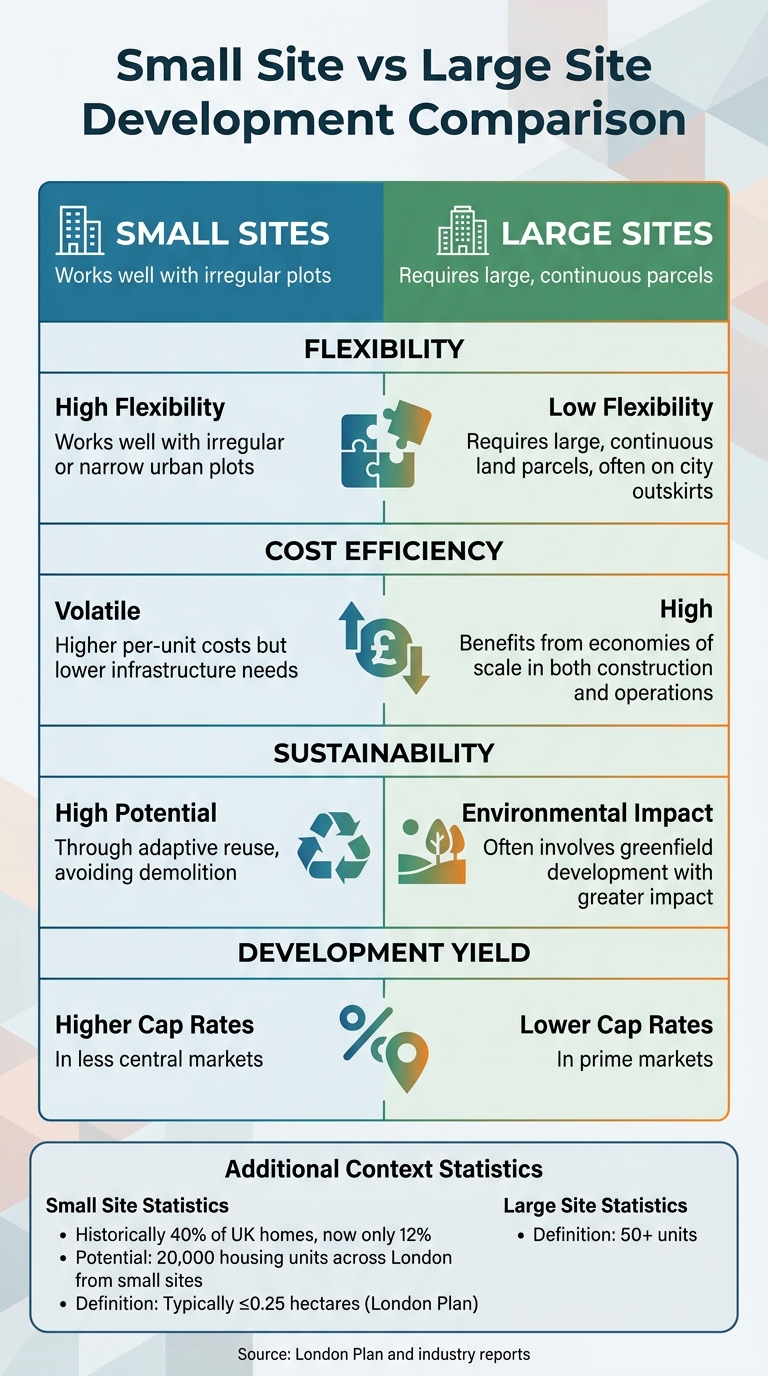
Small vs Large Site Development: Key Differences in UK Housing
Small and large sites each bring their own set of strengths and challenges to the table. Small sites, for example, are great at blending into existing neighbourhoods and turning underutilised urban spaces into housing opportunities [13][14]. As Chloë Phelps, CEO of Grounded, points out:
Small sites can create really great homes that slot into existing communities, they often don't require demolition, and can create the sort of housing stock that is (relatively) affordable to maintain with low service charges [13].
However, small sites are also more vulnerable to unexpected costs. With fewer homes to distribute expenses across, even minor surprises can eat into profits. Phelps elaborates:
Small sites are sensitive to unexpected costs that can quickly erode profit margins. They have the same amount of constraints and project requirements as a big development, but the number of homes, fees and costs are much lower [13].
On the other hand, large developments have the advantage of scale. By spreading fixed costs over a greater number of units, they can reduce construction costs per square foot [11][16]. This ability to dilute expenses often makes large projects more cost-effective.
A great example of how small sites can be approached innovatively is the 1047 Commonwealth Avenue project in Boston. Designed by French 2D and Neshamkin French Architects, the project transformed a one-storey car showroom into five floors of micro-units. By reusing the existing structure as a podium, developers sidestepped costly and unpredictable below-ground work [14].
When it comes to development yield, small sites in less central markets often offer higher cap rates. However, this comes with added risk, as these markets tend to be less liquid [16]. Historically, small builders were responsible for 40% of homes in the UK, but that figure has dwindled to just 12% today [13]. Despite this, the Greater London Authority estimates that small sites could provide 20,000 housing units across London [13].
Here’s a side-by-side look at how small and large site developments compare:
| Criterion | Small Site Development | Large Site Development |
|---|---|---|
| Flexibility | High; works well with irregular or narrow urban plots [13][14] | Low; requires large, continuous land parcels, often on city outskirts [11] |
| Cost Efficiency | Volatile; higher per-unit costs but lower infrastructure needs [11][13] | High; benefits from economies of scale in both construction and operations [11] |
| Sustainability | High potential through adaptive reuse, avoiding demolition [13][15] | Often involves greenfield development, which can have a greater environmental impact [11][15] |
| Development Yield | Higher cap rates in less central markets [16] | Lower cap rates in prime markets [16] |
This comparison highlights how the size of a site shapes development strategies and outcomes in very distinct ways.
Small sites play a key role in increasing housing supply, particularly when developers navigate their unique challenges effectively. Unlike larger developments that thrive on economies of scale, small sites bring adaptability and the ability to integrate more seamlessly into urban environments.
Unlock small site potential with early feasibility studies and focused planning. Recent policy changes have made smaller developments more viable by cutting red tape and lowering upfront costs. For example, the introduction of the "medium development" category (10–49 homes), Section 106 exemptions for sites with 10 or fewer units, and proposed Biodiversity Net Gain exemptions for sites under 0.2 hectares have all simplified processes for small-scale projects [2][3].
Site-specific design is the key to success. Instead of relying on generic solutions, developers should create designs that respect and work with the site’s natural constraints. As Sean Hill of RISE Design Studio puts it:
Don't fight the site. Let the constraints guide the form. The best results don't impose - they emerge [1].
This mindset, paired with construction innovations like Structural Insulated Panels (SIPS), enables high-quality housing even on challenging urban plots. Combining tailored design with supportive policies creates a solid foundation for successful small-site projects.
To make the most of these opportunities, developers should prioritise early feasibility assessments, leverage available policy exemptions, and foster collaboration with planning authorities and local communities. While delays in planning can sometimes slow progress, optimising conditions for small and medium-sized enterprises (SMEs) in housebuilding could boost their output by up to five times [2]. By blending thoughtful design with strategic planning, small sites can evolve into valuable urban assets.
Before starting work on a small urban site, it’s important to carry out key surveys. Land and topographical surveys are essential for mapping boundaries, terrain, and existing features. In addition, structural monitoring surveys might be needed to evaluate the site's condition and track any changes during construction. Depending on the location, environmental surveys may also be required to identify contamination risks or ecological restrictions.
These surveys play a crucial role in ensuring the project meets planning and safety regulations while making the most of the site's possibilities.
To make the most of limited floor space on a small plot while keeping things amicable with neighbours, think about smart ways to use space. For instance, converting underused areas like garages into living spaces can add functionality without expanding outward. Designing compact and efficient layouts can ensure every square metre is used effectively, all while respecting property boundaries. Also, keep in mind legal considerations such as the UK’s ten-year rule, which might allow some modifications to become permissible over time.
Small housing developments in the UK could see cost reductions thanks to a proposed planning exemption. This rule would exclude sites under 0.2 hectares from the requirement to deliver the mandatory 10% biodiversity net gain. Set to come into effect in 2026, the change is designed to streamline the planning process and reduce expenses for smaller projects.
Survey Merchant provides vetted RICS surveyors across 100+ UK locations at fixed fees:
→ Level 2 Home Survey (HomeBuyer Report)
→ Level 3 Building Survey (full structural survey)
→ RICS Red Book property valuations
→ Party wall surveyors — notices, awards & schedules of condition
→ Expert witness surveyors — CPR Part 35 reports for property disputes