Leasehold
Aug 2, 2026
When to Get an Asbestos Survey
Find out when to arrange a Management or Refurbishment & Demolition asbestos survey to meet UK legal duties, protect occupan

Asbestos surveys are legally required for many properties in the UK, especially those built or refurbished before 2000. These surveys help identify asbestos-containing materials (ACMs) and ensure safe management or removal to protect health and comply with the Control of Asbestos Regulations 2012 (CAR 2012). Ignoring this responsibility can lead to fines, imprisonment, or serious health risks from asbestos exposure, which causes diseases like mesothelioma and lung cancer.
Here’s when you need an asbestos survey:
There are two main types of surveys:
Act promptly to stay compliant, protect occupants, and avoid financial and legal consequences.
Understanding when to arrange an asbestos survey is crucial for avoiding legal trouble, safeguarding health, and managing expenses. Here are some key situations where an asbestos survey becomes essential.
If you're considering purchasing a property built or refurbished before 2000, it's wise to assume asbestos might be present unless proven otherwise. Without a survey, you risk inheriting the responsibility and costs of managing or removing any asbestos-containing materials (ACMs) discovered later. Mortgage lenders and solicitors often require an asbestos report before releasing funds [5]. As RB Asbestos explains:
"If you purchase the property without a survey and later find out it contains ACM's, then it becomes your problem" [7].
Failing to provide an asbestos report during a sale can lead to complications. Buyers may assume the worst-case scenario, potentially lowering the property's valuation or even derailing the deal. Additionally, property insurers are tightening their requirements; by 2026, many commercial insurers will require a digital copy of the Asbestos Register for policy renewals [1].
Before starting any renovation or repair work that could disturb the building's structure - whether it's removing a wall, replacing flooring, or upgrading systems - Regulation 5 of the Control of Asbestos Regulations 2012 mandates identifying any asbestos presence [1]. This requires a Refurbishment and Demolition (R&D) Survey, which is more thorough than a basic Management Survey.
An R&D survey involves intrusive methods, such as opening walls, lifting floorboards, and inspecting hidden spaces, to locate ACMs. Since this process can release asbestos fibres, the area must be vacated and later deemed safe for reoccupation [2]. Skipping this step not only breaks the law but also endangers contractors, occupants, and others by exposing them to harmful fibres.
Utility companies increasingly require up-to-date asbestos surveys before installing equipment or cables in older buildings [7]. Local authorities may also demand a survey as part of planning permission for extensions or modifications [7].
Demolishing a building without conducting a Refurbishment and Demolition Survey is a serious legal violation. According to the Health and Safety Executive (HSE):
"There is a legal requirement for all ACMs to be removed, as far as reasonably practicable, before major refurbishment or demolition" [2].
This survey ensures all ACMs are identified and safely removed before demolition begins. Ignoring this requirement can result in prohibition notices from the HSE, halting work and causing significant financial losses [5].
If you own, manage, or maintain a non-domestic building constructed before 2000 - such as offices, shops, warehouses, or schools - you have a legal "Duty to Manage" asbestos under Regulation 4 of the Control of Asbestos Regulations 2012 [1]. This duty also extends to shared areas in residential properties, like stairwells, boiler rooms, and lift shafts [1].
A Management Survey is necessary to create an Asbestos Register and Management Plan. These documents must be updated regularly and shared with anyone who might come into contact with ACMs, such as contractors or maintenance workers [2]. Inspections should be carried out at least annually to monitor the condition of identified materials [7].
Lease agreements and property sales often require clear asbestos documentation. Landlords and sellers are responsible for providing up-to-date asbestos information to tenants and buyers. In cases where tenants take on maintenance duties, the legal responsibility for managing asbestos typically shifts to them [7]. Without a survey, tenants may unknowingly face health risks and future costs.
For tenants leaving a lease, failing to maintain asbestos records can result in hefty penalties during the dilapidations process, particularly if ACMs have been damaged during their tenancy [7]. Landlords must ensure common areas meet asbestos management requirements [7]. Similarly, sellers who fail to disclose known ACMs risk legal challenges down the line [7]. Providing a current asbestos report promotes transparency, protects all parties, and helps transactions move forward without unnecessary delays.
The Control of Asbestos Regulations 2012 (CAR 2012) lays out clear responsibilities for building managers to safeguard occupants from asbestos exposure.
Regulation 4 of CAR 2012 places the duty to identify and manage asbestos on individuals such as property owners, landlords, employers, and facility managers. These dutyholders are required to:
Failing to comply with these duties can have serious consequences. Penalties include fines of up to £20,000, unlimited fines for severe breaches, or even imprisonment for up to two years. The Health and Safety Executive (HSE) can also issue prohibition notices, halting building operations until the asbestos risks are properly addressed. In cases of gross negligence, company directors may face personal criminal charges, and insurers might refuse claims or renewals if a valid asbestos survey or management plan is missing.
Not all buildings require an asbestos survey. Properties built after 2000 are generally considered asbestos-free due to the UK’s ban on asbestos use. Similarly, private homeowners in single-family properties are usually exempt from maintaining an asbestos register under Regulation 4. However, if construction work is planned, the responsibility for managing asbestos risks typically shifts to the contractor under the Construction (Design and Management) Regulations 2015.
The duty to manage asbestos applies specifically to non-domestic buildings - such as offices, schools, hospitals, and warehouses - as well as the shared areas of domestic buildings like foyers, stairwells, boiler rooms, and lift shafts. If there’s uncertainty about whether a property falls under these categories, it’s safer to assume asbestos might be present and arrange for a survey.
Understanding these legal obligations is essential when choosing a survey provider, which we’ll discuss in the next section.

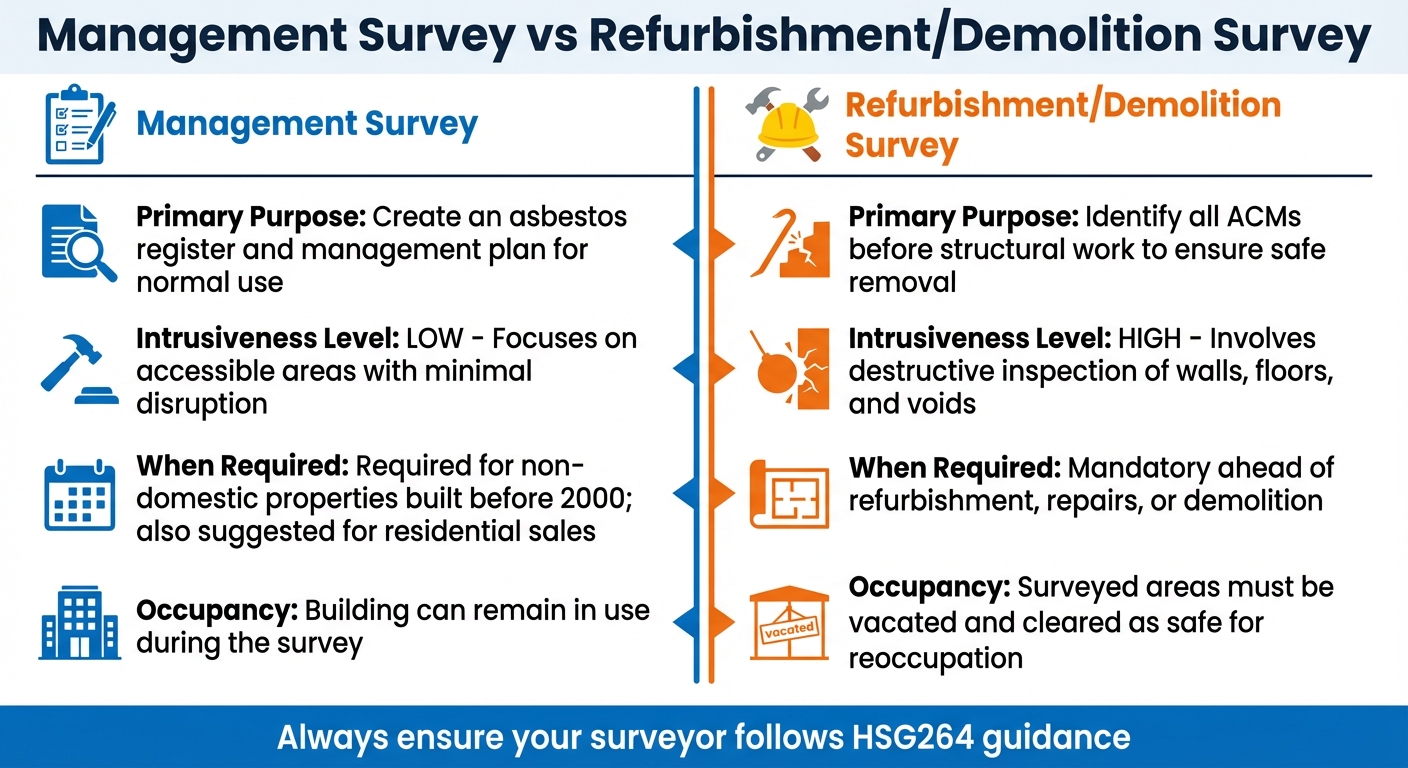
Management vs Refurbishment/Demolition Asbestos Survey Comparison
Navigating legal requirements for asbestos surveys can feel overwhelming, but Survey Merchant makes the process straightforward. By connecting property owners and buyers to accredited asbestos surveyors across the UK, the platform ensures projects stay safe and compliant. Their network includes BOHS-accredited surveyors operating from 29 offices and covering over 605 locations [6]. All the surveyors are technically competent and independent, with testing carried out in UKAS-accredited laboratories [2].
For those working to tight deadlines, Survey Merchant delivers quick and efficient service. Quotes are provided on the same day - often within just 15 minutes - and come with fixed pricing and no hidden charges [6]. Once the survey is completed, reports are typically available within 22 to 24 hours [6]. This speed helps avoid delays in property transactions or renovation projects. Plus, with a 4.9/5 Trustpilot rating from over 1,200 reviews, it’s clear that customers appreciate the reliability [6].
Survey Merchant doesn’t stop at asbestos surveys. They also offer services like Level 2 HomeBuyer Reports, Level 3 Building Surveys, and Fire Risk Assessments [6]. This one-stop-shop approach is especially handy for property owners juggling multiple compliance needs, whether prepping a building for sale or managing non-domestic premises. From routine checks to demolition preparation, their tailored solutions cover every stage.
Survey Merchant doesn’t just provide fast quotes - they help you pick the right survey for your needs. Here’s a quick breakdown of the two main asbestos survey types available through their network:
| Feature | Management Survey | Refurbishment/Demolition Survey |
|---|---|---|
| Primary Purpose | Create an asbestos register and management plan for normal use [2][4] | Identify all ACMs before structural work to ensure safe removal [2][3] |
| Intrusiveness Level | Low; focuses on accessible areas with minimal disruption [2][8] | High; involves destructive inspection of walls, floors, and voids [2][3] |
| When Required | Required for non-domestic properties built before 2000; also suggested for residential sales [4][3] | Mandatory ahead of refurbishment, repairs, or demolition [2][3] |
| Occupancy | Building can remain in use during the survey [2] | Surveyed areas must be vacated and cleared as safe for reoccupation [2] |
Important: Always ensure your surveyor follows the guidance in "Asbestos: The survey guide" (HSG264). Reports should be thorough, with no unapproved caveats or disclaimers [2]. Double-check that all areas have been accessed to avoid leaving any hazardous materials undetected.
This guide has highlighted key situations where asbestos surveys are crucial for maintaining property safety and meeting legal requirements. Whether you're buying a property built before 2000, planning renovations, or managing non-domestic premises, an asbestos survey can uncover hidden dangers before they become serious issues. Tragically, asbestos-related illnesses claim over 5,000 lives annually in the UK - more than fatalities from road accidents [9].
The Control of Asbestos Regulations 2012 mandates that dutyholders in non-domestic properties manage asbestos and identify all materials containing it before any refurbishment or demolition work begins [1]. Ignoring these responsibilities can lead to hefty fines or prohibition notices. Furthermore, most commercial lenders and insurers insist on up-to-date asbestos reports before releasing funds or providing coverage. Without a survey, you risk delays in transactions and a potential drop in property value.
For routine occupation and maintenance, a Management Survey is appropriate. However, if structural work is planned, a Refurbishment/Demolition Survey is essential. Survey Merchant makes the process straightforward by connecting you with accredited surveyors across the UK. Their network ensures compliance and safety by offering impartial, high-quality surveys tailored to your specific property requirements.
Acting promptly with a professional asbestos survey safeguards everyone involved. Protect your property, ensure compliance, and avoid unnecessary risks by scheduling your survey with certified experts.
If your property was constructed before the year 2000 - especially prior to 1985 - there’s a strong chance it might contain asbestos. To ensure safety and adhere to regulations, it’s wise to arrange an asbestos survey before starting any renovations or when buying such a property.
A Management survey focuses on buildings currently in use. Its goal is to identify asbestos-containing materials (ACMs), assess their condition, and ensure they are managed safely during everyday use or routine maintenance. This type of survey is non-intrusive, making it suitable for occupied spaces.
A Refurbishment & Demolition survey, on the other hand, is necessary before carrying out significant work such as renovations or demolitions. This survey is more intrusive, as it aims to locate all ACMs to guarantee safety during construction activities. In many cases, it is also a legal requirement for such projects.
Under the Control of Asbestos Regulations 2012, the responsibility for managing asbestos in shared areas usually falls on the landlord or managing agent. This includes arranging asbestos surveys and keeping detailed records. However, the exact responsibility can depend on the terms outlined in the lease or contract. It's always a good idea to carefully review these documents to confirm who is accountable.
Survey Merchant provides vetted RICS surveyors across 100+ UK locations at fixed fees:
→ Level 2 Home Survey (HomeBuyer Report)
→ Level 3 Building Survey (full structural survey)
→ RICS Red Book property valuations
→ Party wall surveyors — notices, awards & schedules of condition
→ Expert witness surveyors — CPR Part 35 reports for property disputes