Building Surveying
Aug 2, 2026
Survey trends in 2026: what property professionals need to know
Discover key survey trends in 2026 that property professionals need to know. Learn how AI, skills shortages, and sustainability impact decision-making.

Survey trends in 2026 are defined by three converging forces: accelerating AI adoption, a deepening skills shortage, and tightening sustainability requirements across the UK property sector. Property professionals and market analysts who understand these shifts now will make better decisions on technology investment, recruitment, and client reporting throughout the year. The RICS Surveying Skills Survey 2026 confirms that AI readiness and sustainability competency are the two most critical skill areas for surveyors globally this year. These are not distant concerns. They are reshaping how surveys are commissioned, conducted, and interpreted right now.
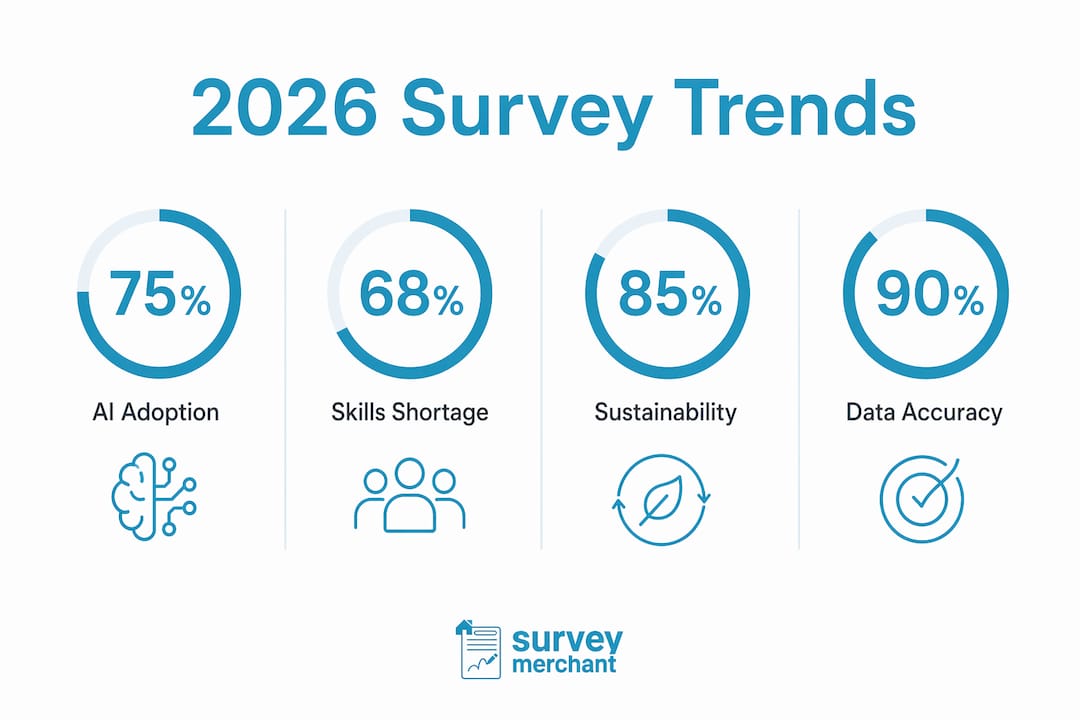
The defining characteristic of 2026 surveying practice is the gap between ambition and execution. Nearly 75% of firms have not moved beyond early discussions on AI adoption within construction surveying. That figure is striking because it means the majority of the sector is still at the talking stage while market expectations are already shifting. Property professionals who act now gain a real competitive advantage over peers who are still deliberating.
The three pillars driving change in 2026 are digital transformation, workforce capability, and environmental compliance. Each one affects how surveys are planned, delivered, and reported. Building Information Modelling (BIM), drone surveys, and IoT sensor integration are no longer experimental. They are entering standard practice for firms that want to deliver faster, more accurate outputs. Sustainability metrics are moving from optional additions to required components of survey reports, driven by regulatory pressure on energy efficiency and carbon performance.

The June 2026 RICS UK Residential Market Survey points to weak momentum in the housing market, with tentative signs of easing downturn. That context matters for market analysts because reduced transaction volumes increase pressure on surveyors to demonstrate clear value through technical quality and speed of delivery.
AI adoption in surveying is real but uneven. The firms making the most progress are those treating AI as a tool for specific tasks rather than a wholesale replacement for professional judgement. The most practical applications in 2026 include automated defect detection in building surveys, AI-assisted valuation modelling, and natural language processing for faster report generation.
Building Information Modelling is the digital backbone connecting these tools. BIM allows surveyors to work from shared, data-rich models rather than static drawings, which reduces errors and speeds up site assessments. When combined with real-time data feeds from IoT sensors, BIM models can flag structural changes or environmental risks before a surveyor even visits a site.
The ethical dimension of AI use is now a formal concern. The RICS Responsible Use of AI standard sets out requirements for ethical and transparent AI use by members. That standard matters because it shapes how firms document AI-assisted decisions and communicate them to clients.
Key areas where digital tools are delivering measurable gains in 2026:
Pro Tip: Before adopting any AI tool, check whether it aligns with the RICS Responsible Use of AI standard. Documenting your AI-assisted decisions protects you professionally and builds client confidence.
The skills shortage is the most immediate operational challenge facing property professionals in 2026. 68% of quantity surveying and construction professionals report that skills shortages are reducing their operational capacity. That is not a marginal problem. It means firms are turning down work, extending delivery timelines, and stretching existing staff.
The skills gap has two layers. The first is a straightforward shortage of qualified surveyors, driven by an ageing workforce and insufficient graduate pipeline. The second is a competency gap within the existing workforce, where professionals lack the digital and AI literacy that modern surveying practice now demands. Both layers require different responses.
The next generation of surveyors brings essential AI and technology expertise that experienced professionals often lack. That creates an opportunity for firms willing to build mixed teams that pair technical knowledge with field experience. Collaboration with universities and apprenticeship programmes is the most direct route to widening the talent pipeline.
Practical steps firms are taking to address the shortage:
Pro Tip: Use surveyor networking events to identify professionals with emerging digital skills. Informal networks surface talent that formal recruitment often misses.
Sustainability is no longer a background consideration in property surveying. Regulatory pressure on energy efficiency, embodied carbon, and building performance is translating directly into what surveyors are expected to assess and report. The shift is most visible in commercial property, where tenants and investors increasingly require sustainability data as part of due diligence.
Industry and government ambitions for sustainable housing and infrastructure delivery depend on competent professionals who can assess and verify environmental performance. That places surveyors at the centre of the sustainability agenda, not at the edges. The surveyor’s role now includes advising clients on retrofit requirements, energy performance certificate (EPC) ratings, and compliance with evolving building regulations.
The four areas where sustainability is reshaping survey outputs in 2026:
Cross-sector collaboration between construction, surveying, and regulatory bodies is the mechanism through which these standards get implemented consistently. Without that alignment, sustainability requirements risk becoming a patchwork of inconsistent local interpretations.
The most significant shift in 2026 data collection techniques is the move from periodic inspection to continuous monitoring. Traditional surveying relied on a snapshot taken during a single site visit. New methods combine that visit with ongoing data streams that track building performance between inspections.
Drones and IoT sensors are the two technologies driving this change. Drones capture high-resolution imagery and thermal data across large or complex sites in a fraction of the time required for manual inspection. IoT sensors embedded in structures monitor temperature, humidity, movement, and air quality in real time, alerting surveyors to anomalies before they become defects.
| Method | Primary benefit | Key limitation |
|---|---|---|
| Drone surveys | Rapid coverage of large or inaccessible areas | Requires CAA authorisation and weather dependency |
| IoT sensor networks | Continuous real-time structural monitoring | High installation cost and data management complexity |
| BIM-linked data feeds | Integrated project-wide data visibility | Requires all parties to adopt compatible platforms |
| Photogrammetry | Accurate 3D modelling from photographs | Processing time and specialist software required |
| Thermal imaging | Identifies heat loss and moisture ingress invisibly | Interpretation requires trained specialist |
Data security is the principal challenge accompanying these methods. Large datasets from drone surveys and sensor networks require secure storage, clear data ownership agreements, and compliance with UK GDPR. Firms that treat data governance as an afterthought create liability for themselves and their clients. For a broader view of construction survey methods, the range of approaches available in 2026 is wider than most property professionals realise.
Adapting to 2026 survey trends requires deliberate choices about technology, training, and the professional networks you rely on. The firms and analysts gaining ground are not necessarily the largest. They are the ones making consistent, targeted investments in the right capabilities.
The UK building surveyor jobs market reflects these shifts directly. Roles requiring BIM competency and sustainability knowledge command higher salaries and attract stronger candidate pools than generalist positions.
The most effective response to 2026 survey trends combines targeted technology adoption, workforce investment, and sustainability integration into a single coherent strategy.
| Point | Details |
|---|---|
| AI adoption is early-stage | Nearly 75% of firms remain at the discussion phase, creating an advantage for those who act now. |
| Skills shortage is operational | 68% of professionals report reduced capacity, making recruitment and upskilling urgent priorities. |
| Sustainability is now mandatory | EPC ratings, embodied carbon, and climate risk are becoming standard survey report components. |
| New data methods change the baseline | Drones, IoT sensors, and BIM integration are shifting surveys from snapshots to continuous monitoring. |
| Collaboration drives delivery | Cross-sector partnerships between industry, government, and education are the route to meeting housing targets. |
The conversation around AI and digital tools in surveying tends to focus on what technology can do. The harder question is what happens to the firms that wait. Having worked closely with the UK property and construction sector, I have seen the same pattern repeat: firms delay technology adoption until a competitor or a client forces the issue. By then, the cost of catching up is higher than the cost of starting early would have been.
What concerns me more than the technology gap is the cultural one. Many experienced surveyors treat AI as a threat to professional judgement rather than a support for it. That framing is wrong, and it is holding the sector back. The RICS Responsible Use of AI standard exists precisely to address this. It gives professionals a framework for using AI transparently without surrendering their professional accountability.
The skills shortage is real, but the next generation entering the profession carries digital fluency that experienced surveyors lack. The firms that build genuinely mixed teams, pairing that fluency with field experience, will outperform those that treat the two as separate camps. Sustainability is the same story. Surveyors who can assess and report on environmental performance are not just meeting a regulatory requirement. They are becoming indispensable to clients navigating a property market where green credentials affect asset value directly.
The property professionals who will look back on 2026 as a turning point are the ones treating these trends as interconnected, not as separate workstreams.
— Surveymerchant
Property professionals need surveyors who are already working to 2026 standards, not catching up to them. Surveymerchant connects you with qualified, RICS-accredited surveyors across the UK who apply current data collection methods, sustainability assessment, and digital reporting to every instruction.

Whether you need a commercial property survey that includes sustainability metrics and compliance checks, or building surveying services that incorporate drone data and thermal imaging, Surveymerchant matches you with the right specialist for your project. Every surveyor on the panel is vetted for technical competency and professional standing. The process is straightforward: describe your property and requirements, and Surveymerchant identifies the most suitable qualified professional from its network.
The main trends are AI adoption, skills shortages, sustainability integration, and advanced data collection methods including drones and IoT sensors. RICS identifies AI readiness and sustainability competency as the two priority skill areas for surveyors globally this year.
68% of quantity surveying and construction professionals report that skills shortages are reducing their operational capacity. This leads to longer delivery timelines and increased demand for surveyors with digital and AI literacy.
Drone surveys are increasingly standard for large, complex, or inaccessible sites in 2026. They require Civil Aviation Authority (CAA) authorisation and are most effective when combined with thermal imaging and photogrammetry for detailed analysis.
A current survey should address EPC ratings, climate risk factors such as flood and overheating risk, and where relevant, embodied carbon and green certification compliance such as BREEAM or Passivhaus.
Ask specifically about the data collection techniques used, whether outputs comply with RICS standards, and whether the surveyor holds current CPD in BIM, AI tools, or sustainability assessment. Surveymerchant’s panel is vetted against these criteria.
Survey Merchant provides vetted RICS surveyors across 100+ UK locations at fixed fees:
→ Level 2 Home Survey (HomeBuyer Report)
→ Level 3 Building Survey (full structural survey)
→ RICS Red Book property valuations
→ Party wall surveyors — notices, awards & schedules of condition
→ Expert witness surveyors — CPR Part 35 reports for property disputes