Building Surveying
Jul 16, 2026
Foundation Survey: A UK Homeowner's Guide for 2026
Need a foundation survey? Our UK guide explains when you need one, what's checked, potential costs, and how to find a qualified surveyor for your property.

You're probably here because something has unsettled you. A crack has appeared above a window. A door sticks for no obvious reason. Or you're buying a house and the survey mentions “possible movement”, which is one of those phrases that can make any buyer's stomach drop.
The good news is that foundation problems aren't all the same, and a foundation survey isn't just a scary extra cost. It's a way to replace worry with evidence. In the UK, where homes range from recent new-builds to much older stock, that matters. Recent weather patterns have made it even more relevant. Long dry spells can shrink some soils, while heavy rain and poor drainage can change how the ground behaves around a property.
A proper survey helps you answer the questions that matter. Is this crack cosmetic or structural? Is the movement historic or active? Is the house still a sensible purchase? And if there is a problem, what should happen next?
A buyer views a Victorian terrace, falls in love with the kitchen, then notices a diagonal crack near the rear extension. The estate agent shrugs and says it's “probably just age”. That answer might be true. It might also be completely wrong. What the buyer really needs is not reassurance from guesswork, but a professional opinion grounded in how the building and the ground are behaving together.
That's where a foundation survey becomes useful. It gives context. It helps separate harmless surface cracking from evidence that the structure may have moved, and it does so before you commit to a purchase or spend money in the wrong place.

The scale of the issue is easy to underestimate. The 2021 Census recorded 23.7 million households in England and Wales, with 63% being owner-occupied, which shows how large and varied the housing stock is and why condition surveys matter so much in practice, as noted in the 2021 Census figures referenced here.
Some of those homes are modern and straightforward. Many are not. Older properties, altered properties, homes on sloping sites, and houses affected by drainage or trees all need more careful interpretation than a quick glance can provide.
Most first-time buyers aren't asking for a technical lecture. They want clear answers to practical questions:
A crack is only a clue. The important job is working out why it appeared, whether it's changing, and what that means for the building.
If you're still at the stage of choosing a general pre-purchase report, this UK homebuyers' guide to surveys helps clarify the difference between common survey options before you decide whether a targeted foundation inspection is needed.
Foundation risk isn't just about old houses and long-standing defects. Weather now plays a bigger role in the timing and urgency of movement concerns. Hot, dry periods can affect shrinkable soils. Prolonged rain can expose drainage weaknesses and saturate the ground around footings. That means today's sensible buyer looks not just at the crack, but at the recent conditions around the property as well.
When people say “foundation issue”, they often mean three quite different things. If you can tell them apart in broad terms, survey reports become much less intimidating.
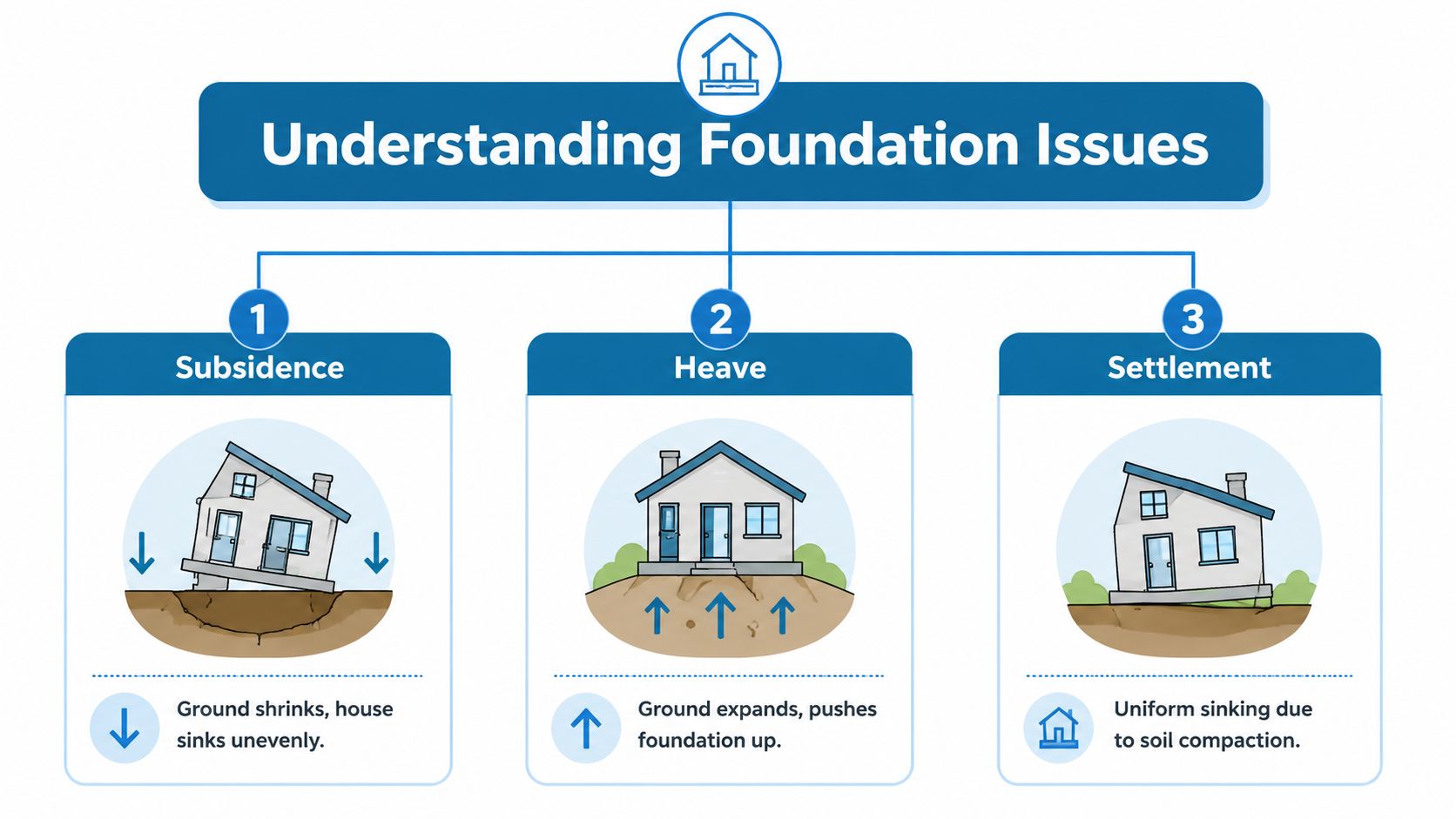
A house sits on soil, not on certainty. Think of the ground as the platform carrying the building. If that platform stays stable, the house usually behaves. If it shrinks, swells, washes out, or compresses unevenly, the structure above starts to show stress.
The three terms most buyers hear are:
In the current climate, subsidence is the one many owners worry about first. The Association of British Insurers reported that subsidence claims reached £153 million in 2022, the highest annual figure in its series, underlining how hotter, drier summers can increase soil shrinkage and movement risk, as referenced in this ABI-related summary.
Later in the section, it helps to see the issue explained visually. This short video gives a useful overview of how movement can present in homes:
You don't need to diagnose the cause on your own, but you can notice the warning signs.
Practical rule: Look for patterns, not single symptoms. One hairline crack in old plaster may mean very little. Several related signs in one area deserve attention.
Climate makes those patterns more important. After a dry summer, clay-heavy ground can contract. After intense rainfall, water can collect where drainage is poor, softening support around the building or changing pressure against walls. If the property also has retaining structures or level changes in the garden, it's worth understanding broader external warning signs too. This guide to signs of retaining wall failure and prevention is useful because boundary movement and drainage stress can sometimes accompany foundation-related concerns.
A common mistake is to wait until cracking becomes dramatic. In reality, earlier review is often more useful because the surveyor can assess subtle indicators before finishes are patched over or the pattern becomes harder to interpret.
Some situations call for more than watchful waiting. If you're buying, selling, or already living in a property with clear risk factors, a targeted foundation survey can save a lot of uncertainty.
A specialist look is sensible when several clues line up at once. Typical triggers include:
If you're dealing with a steep or awkward plot, it also helps to understand how design and terrain interact. These examples of home designs for sloping blocks aren't UK-specific guidance, but they do illustrate why levels, retaining structures, and water management matter so much on non-flat sites.
This is the point that many buyers miss. A standard condition-focused survey may flag cracking or possible movement, but it won't always answer the specific question, “Do I need a deeper foundations investigation?”
That gap matters in the UK. Much property advice still doesn't clearly explain when to move from a general RICS inspection to a more targeted approach. At the same time, around 229,000 dwellings were completed in 2023-24 alongside a very large stock of pre-1945 homes, which makes that decision more important than many buyers realise, as noted in this summary of the knowledge gap around survey escalation.
A targeted foundation survey is often the better option when:
If your main concern is the stability of the building, ask for a survey that answers that exact concern. Don't assume a general report will automatically do it.
The inspection itself is usually more methodical, and less dramatic, than people expect. A surveyor isn't guessing from one crack. They're building a chain of evidence from the site, the structure, and the likely ground conditions.
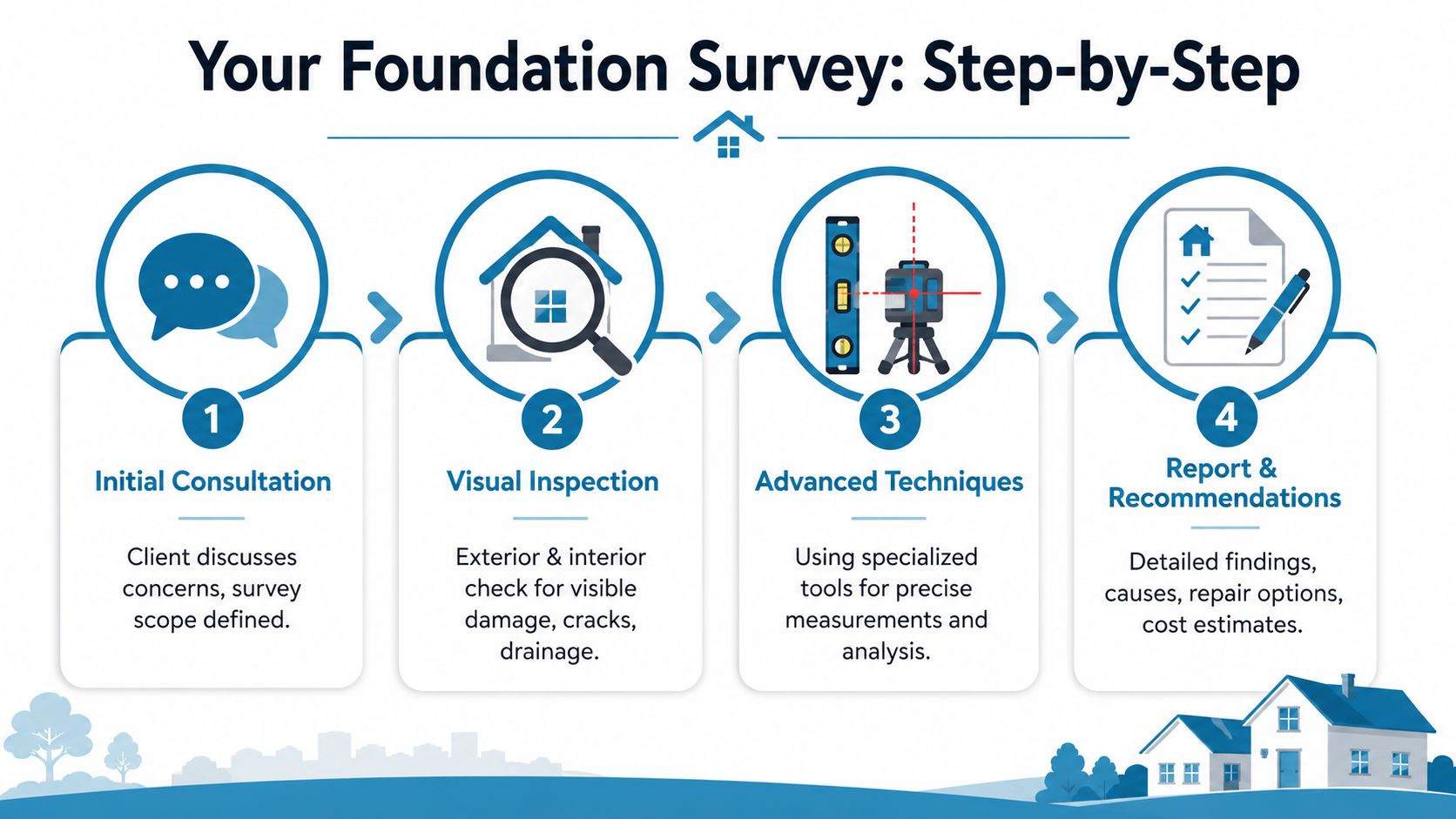
A foundation survey often starts with a careful visual inspection inside and outside the property. The surveyor checks the building as a whole, not just the most obvious crack. They'll look at wall lines, openings, floor levels, roof alignment, drainage details, external ground levels, nearby trees, and any signs of previous repair.
Inside, they're asking practical questions. Are cracks tapered or straight? Are they local to an extension junction? Do doors catch because of poor fitting, or because the frame has distorted with movement? Are there signs of recent redecoration that may be hiding earlier damage?
For new-build and construction-related work, the meaning of a foundation survey is more technical. It is an as-built control exercise that records the foundation's actual horizontal position and elevation, then compares that with the approved design so errors can be corrected before they carry through the rest of the build, as described in this explanation of what a foundation survey records in practice.
Sometimes a visual inspection is enough to say, “This looks minor and historic.” Sometimes it isn't.
Where the evidence is unclear or the risk is higher, surveyors may recommend further steps such as:
If subsidence is part of the concern, this article offering expert guidance on subsidence checks gives a helpful picture of the evidence surveyors and specialists look for before anyone jumps to expensive conclusions.
Good surveying narrows uncertainty step by step. The aim isn't to make the problem sound bigger. It's to find the smallest investigation that still gives a reliable answer.
That's especially relevant when climate is involved. A crack that appeared after drought may need monitoring through a wetter season. A house affected by flooding may need the surveyor to focus more closely on drainage routes, soft ground, and whether the distress is isolated or part of a broader movement pattern.
Survey reports can sound technical, but most findings fall into a few recognisable categories. What matters is whether the issue is cosmetic, historic but stable, or active enough to justify more investigation or repair.
If a report says movement appears historic, that usually means the surveyor can see evidence that the building moved in the past but doesn't currently show clear signs of active progression. That's not the same as saying “ignore it”, but it often points towards monitoring, maintenance, or local repair rather than major structural work.
If the wording suggests ongoing movement cannot be ruled out, take that seriously. It means the surveyor has seen enough warning signs that they won't give a clean bill of health without more evidence.
Terms that often worry buyers include:
The report is not just naming a defect. It is helping you decide whether to monitor, repair, renegotiate, or walk away.
The table below is designed to help you interpret the logic of common findings. Because remedial costs vary widely by location, access, design, specification, and the true cause of movement, treat the cost column as a prompt for getting specific quotations rather than a fixed pricing guide.
| Finding | Common Cause | Recommended Action | Estimated Remedial Cost |
|---|---|---|---|
| Minor hairline internal cracks | Plaster shrinkage, seasonal movement, ordinary ageing | Redecorate if appropriate, monitor for change | Varies |
| Localised stepped cracking in brickwork | Differential movement, thermal movement, local foundation stress | Surveyor review, possible crack monitoring, check drains and surrounding ground | Varies |
| Cracks concentrated around an extension junction | Different foundation behaviour between old and new parts | Investigate junction, assess ties and support, monitor or repair as advised | Varies |
| Doors and windows sticking with related cracking | Frame distortion linked to building movement or joinery movement | Check pattern of distortion, inspect associated walls and openings | Varies |
| Uneven floors with no obvious recent cracking | Historic settlement, altered structure, timber issues, or local support changes | Combine structural assessment with floor and subfloor inspection | Varies |
| Suspected subsidence linked to dry weather and shrinkable soil | Soil shrinkage following prolonged dry conditions | Monitor, investigate drainage and vegetation, consider specialist structural advice | Varies |
| Movement associated with water ingress or drainage defects | Leaking drains, poor surface water disposal, saturated ground | Repair drainage first, then reassess structural effects | Varies |
| Significant ongoing movement | Active structural movement requiring a designed remedy | Structural engineer input, possible stabilisation or underpinning depending on cause | Varies |
The key point is that cause drives cost. Cosmetic repairs are one thing. Correcting drainage defects is another. Underpinning, if ever needed, is a completely different category of work and should never be assumed from cracking alone.
For buyers, the smartest move is usually to ask three follow-up questions after reading the report. What is the most likely cause? What further evidence is needed, if any? What practical decisions should I make before exchange?
A foundation survey doesn't just describe the building. It affects what you can negotiate, what your lender may ask for, and how insurers view the risk.
If you're buying a property and the survey identifies possible movement, the report can become part of the price discussion. A buyer may ask for further investigation before exchange, seek a reduction to reflect likely repairs, or request that specific defects are addressed first. Sellers also benefit from clarity, because vague concerns often derail transactions more than properly documented ones.
Mortgage lenders may take a cautious view where structural movement is suspected. They may want confirmation that the issue is historic, evidence of monitoring, or a plan for remedial works. Insurers may also ask questions about past subsidence, drainage problems, or previous underpinning.
That's one reason professional property advice depends so heavily on reliable national data and consistent reference points. In the UK, that framework has deep roots. The first full UK Census was taken in 1801, and the longer development of official statistics, including the growth of the Office for National Statistics from the 1830s and later changes in 1941, helped create the baseline information surveyors use to compare local conditions against broader housing and demographic patterns, as summarised in this note on the historical foundation of UK statistical infrastructure.
In day-to-day terms, that means a surveyor isn't judging your house in isolation. They're placing it within known patterns of property type, construction era, setting, and market context. That reduces risk in advice, and it gives buyers and owners something far stronger than opinion alone.
A sound report can support a confident purchase. A cautious report can still be valuable, because it tells you where the fundamental uncertainty lies before you take legal responsibility for the property.
Not every surveyor handles movement issues in the same way. Some are excellent at general pre-purchase surveys but won't carry out deeper defect diagnosis. Others specialise in building pathology, structural defects, measured surveys, or subsidence-related inspections. Matching the right professional to the actual concern matters.

Start with professional standing and relevant experience. In the UK, many suitable professionals will be chartered through bodies such as RICS or associated with other recognised technical institutions. You also want to know they carry professional indemnity insurance and regularly inspect the kind of property you're dealing with.
A useful checklist looks like this:
If you want a broad primer on the role itself, this article to learn about building surveyors from Templeton Built gives a useful overview of what surveying professionals do, even though the regulatory setting differs from the UK.
Many buyers get stuck because they don't know whether they need a Level 2 survey, a Level 3 survey, a defect report, or a more focused foundations inspection. That's where a matching service can help, provided the panel is properly vetted and the instruction is allocated to someone with the right discipline and experience.
If you're comparing professionals, this guide to choosing a property surveyor is a practical place to start. It helps you ask better questions before you commit.
The aim isn't to find the cheapest name on a list. It's to find someone who can look at the evidence calmly, explain it clearly, and help you make a confident decision in a changing climate where ground conditions don't always behave the way older rule-of-thumb advice assumes they will.
If you need help finding the right surveyor without spending days comparing firms, Survey Merchant can connect you with a suitably qualified UK property professional for your situation, whether you need a general survey, a defect-focused inspection, or advice on suspected movement.
Survey Merchant provides vetted RICS surveyors across 100+ UK locations at fixed fees:
→ Level 2 Home Survey (HomeBuyer Report)
→ Level 3 Building Survey (full structural survey)
→ RICS Red Book property valuations
→ Party wall surveyors — notices, awards & schedules of condition
→ Expert witness surveyors — CPR Part 35 reports for property disputes

