Leasehold
Jul 16, 2026
Guide to Core Surveying Principles
Legal, technical and ethical rules that ensure accurate, defensible UK property surveys and protect buyers from costly surprises.

Property surveying in the UK involves assessing land, buildings, and their value. It ensures secure property decisions by focusing on three principles:
Surveyors play a key role in boundary disputes, property valuations, and pre-purchase inspections. Updated RICS standards, like the April 2026 Home Survey Standard, ensure high-quality, reliable services. Skipping a survey can lead to costly repairs, with 17% of buyers facing unexpected bills over £12,000. Hiring a qualified surveyor helps avoid risks and makes property investments secure.
Property surveys play a crucial role in UK conveyancing, boundary agreements, and resolving disputes. When disagreements arise over boundaries or party walls, surveyor reports often become essential in determining outcomes.
The Party Wall etc. Act 1996 provides clear guidance for managing works involving shared walls or nearby boundaries. It highlights the importance of surveyors in settling disputes before they escalate to court. This framework also ties into the intricate process of boundary determination, which requires a detailed and methodical approach.
Boundary determination involves piecing together evidence from various sources, such as Land Registry title plans, original conveyance documents, Ordnance Survey maps, historical records, and physical markers on the property. Surveyors must weigh each piece of evidence carefully and within its legal framework.
It's worth noting that HM Land Registry operates under a "general boundaries" system, meaning most title plans only indicate approximate boundary locations, not their exact legal positions [2]. Many property owners only discover this nuance when disputes occur. As Stokemont explains:
"A surveyor can provide a professional opinion as to the likely position of the boundary based on the evidence available, but that does not, by itself, create a legally determined boundary." [4]
When parties cannot settle boundary disagreements, courts may ultimately decide the matter. This legal complexity demands that surveyors maintain high professional standards while navigating these disputes.
Surveyors in the UK operate within a framework shaped by the Royal Institution of Chartered Surveyors (RICS), which sets ethical and technical standards for the profession. With over 134,000 members worldwide, RICS ensures surveyors adhere to principles of integrity, competence, and professionalism, as outlined in its Rules of Conduct [3].
For valuations, the RICS Red Book (Global Standards) provides a mandatory structure to guarantee that assessments are consistent, transparent, and defensible in legal contexts. As RICS states:
"Our development and enforcement of leading international standards protects consumers and businesses by ensuring the utmost level of professionalism is employed across the built and natural environment." [3]
Staying updated with these standards is not just a recommendation but a necessity for chartered surveyors practising in the UK.
Surveying relies on control points - fixed reference positions tied to a datum - that act as the foundation for all measurements. These points ensure precision by adhering to the principle of working from whole to part, which prevents errors from compounding as the survey progresses. Typical surveying measurements achieve an accuracy of 10 parts per million, while high-precision work can reach 2 parts per million. To safeguard against errors, surveyors often take redundant measurements, allowing them to cross-check data and identify inconsistencies early. This methodical approach helps keep potential inaccuracies in check.
Surveyors encounter three main types of errors, each requiring specific management techniques to minimise their impact.
| Type of Error | Description | Management Strategy |
|---|---|---|
| Blunders | Mistakes caused by human error, such as misreading instruments | Routine checks and independent verification |
| Systematic Errors | Persistent errors often linked to equipment or environmental factors | Regular calibration and refined techniques |
| Random Errors | Unpredictable errors due to uncontrollable variables, distributed randomly | Repeated measurements and statistical tools |
Blunders are straightforward to address through regular checks and independent verification. Systematic errors, however, are trickier and can quietly accumulate over time. A notable example involves a tunnelling project that veered off course by several metres because temperature variations caused laser beams to bend. This systematic error went unnoticed until independent verification brought it to light [5].
"The understanding and management of errors is therefore possibly the single most important skill that a professional surveyor must possess." - Civil Engineering X [5]
To handle random errors, surveyors turn to statistical methods like least-squares adjustment, which reconciles conflicting measurements to determine the most reliable positions for new points. Proper instrument calibration and careful selection further enhance data accuracy and reliability.
The reliability of survey data depends heavily on the tools and techniques employed. Modern instruments like total stations, GNSS receivers, and 3D laser scanners each play a critical role:
"Modern 3D laser scanners fire millions of laser pulses per second, measuring the distance to every surface they hit." - Blackacre Chartered Surveyors & Valuers
The Royal Institution of Chartered Surveyors (RICS) sets a standard accuracy of ±5mm for measured surveys, which these technologies easily achieve, even on complex structures. Calibration is crucial to prevent systematic errors caused by instrument drift. High-precision equipment for establishing control points can cost between £3,000 and £15,000, but this investment is essential when survey accuracy forms the basis for legal or construction decisions.
In surveying, ethical integrity is just as important as technical accuracy. Together with legal and technical precision, ethical practices form the backbone of dependable surveying work. This is why the Royal Institution of Chartered Surveyors (RICS) enshrined ethical standards in its Rules of Conduct, effective from February 2022. These rules include five essential principles: honesty and integrity, professional competence, diligent service, respect and inclusion, and acting in the public interest [7].
"Behaving ethically is at the heart of what it means to be a professional; it distinguishes professionals from others in the marketplace." - RICS [7]
The trust placed in a surveyor hinges on their ability to deliver unbiased and accurate assessments. This means being truthful and independent, even when the results may be unpopular. As the International Federation of Surveyors (FIG) states:
"Surveyors have a duty to the truth." [9]
Conflicts of interest are a critical concern in this regard. For example, if a surveyor has previously worked with a developer, they must disclose that relationship before taking on a related project. A notable case, Eiger v Ridge (April 2026), highlighted this issue. Ridge and Partners, acting as an Independent Monitoring Surveyor for a lender, failed to disclose their prior involvement in preparing cost appraisals for the same development. The court ruled this non-disclosure, coupled with a lack of independent benchmarking, to be professional negligence [11]. The takeaway? Early disclosure is essential to maintaining independence and client trust, which ultimately strengthens the credibility of the survey process.
Surveyors should only take on work they are qualified to handle and must regularly update their skills through Continuing Professional Development (CPD), including mandatory ethics training every three years. Before accepting a project, surveyors should ask themselves: Do I have the expertise, time, and resources to deliver this work to a high standard? If the answer is no, the ethical choice is to decline or refer the work elsewhere [9].
The "Ethics, Rules of Conduct and professionalism" competency is a required Level 3 standard for all RICS Chartered assessments [7]. As the field of surveying incorporates emerging technologies like AI tools, drone inspections, and retrofit assessments, surveyors must not only understand these tools but also recognise their limitations. This ensures that technological advancements are used responsibly and effectively.
Clarity is key when outlining the scope of a survey. The engagement letter should clearly define the inspection's extent, highlight any inaccessible areas, and specify the reporting level (1, 2, or 3) to avoid misunderstandings [1][8]. The RICS "traffic light" condition rating system further simplifies findings, making them easier for clients without technical expertise to grasp [8].
Confidentiality is another cornerstone of ethical surveying. Information about a client’s affairs must remain privileged during and after the engagement, unless disclosure is legally required [9]. A good practice is to always name the specific client in reports - e.g., "Ms R. A. Patel" - to prevent the document from being treated as general correspondence. This reduces the risk of third-party reliance claims [12]. Additionally, survey files should be retained for at least 15 years to comply with the legal "long stop" limitation period for negligence claims [10]. By adhering to these ethical standards, surveyors can confidently apply their expertise across a variety of projects.
Level 2 vs Level 3 Property Survey: Which Do You Need?
Building on the legal, technical, and ethical framework, let’s explore how these principles come into play across different types of surveys.
Boundary surveys highlight the challenge of aligning legal boundaries with the physical world. For instance, Land Registry title plans only show approximate boundaries, not their exact legal positions [4]. To put this into perspective, a line on a 1:1,250 scale Ordnance Survey map can represent roughly 0.5 metres in reality [13]. That small difference could lead to a fence, wall, or extension being incorrectly positioned.
Surveyors use advanced tools like Total Stations and GPS receivers to achieve centimetre-level accuracy. When applying for a Determined Boundary under Section 60 of the Land Registration Act 2002, the measurements must be precise to within ±10mm [15].
Ethics play a major role here, especially in boundary surveys intended for litigation. In such cases, surveyors act as expert witnesses under Civil Procedure Rules (CPR) Part 35. Their duty to the court takes precedence over any obligations to the client:
"An expert's overriding duty is to help the court on matters within their expertise. This duty overrides any obligation to the person from whom the expert has received instructions or by whom they are paid." - Civil Procedure Rules (CPR) Part 35.3 [14]
This combination of technical precision and ethical responsibility also underpins the practices used in residential pre-purchase surveys.
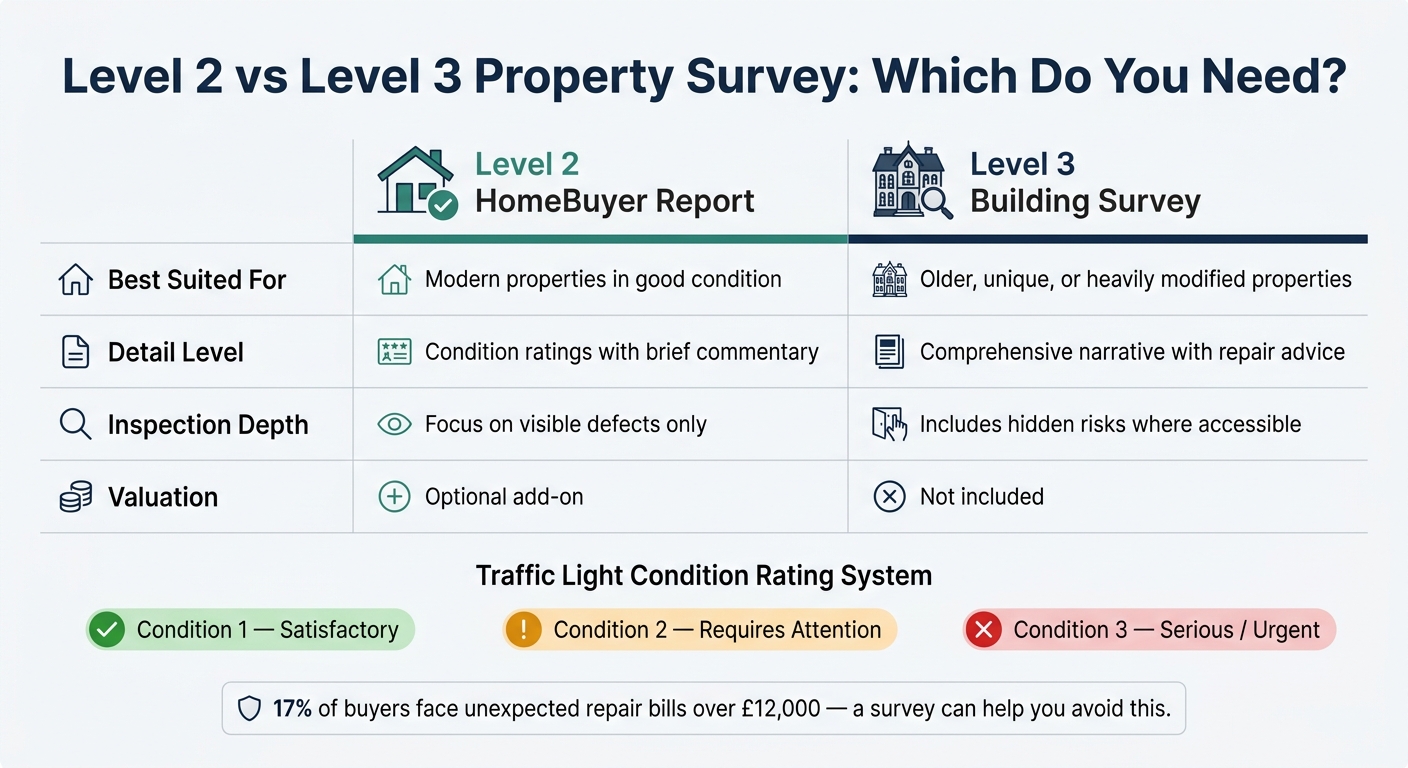
For many homebuyers, a pre-purchase survey is their first introduction to the world of surveying. Whether it’s a Level 2 HomeBuyer Report or a Level 3 Building Survey, the focus is on thorough inspection, honest reporting, and clear communication.
The RICS Home Survey Standard, updated to its 2nd edition in April 2026, outlines the requirements surveyors must meet. This update reflects input from over 1,400 homeowners and 325 industry professionals, ensuring both public expectations and professional expertise are addressed. Notably, the 2026 revision includes specific guidance for "additional risk" properties, such as historic homes and new-build snagging inspections.
| Feature | Level 2 HomeBuyer Report | Level 3 Building Survey |
|---|---|---|
| Best suited for | Modern properties in good condition | Older, unique, or heavily modified properties |
| Detail level | Condition ratings with brief commentary | Comprehensive narrative with repair advice |
| Inspection depth | Focus on visible defects | Includes hidden risks where accessible |
| Valuation | Optional | Not included |
Both reports use a traffic light system - Condition 1 (satisfactory), Condition 2 (requires attention), and Condition 3 (serious/urgent) - to make technical findings easier for clients to understand.
Beyond general surveys, specialist services also rely on these core principles.
Specialist instructions like Red Book valuations, party wall agreements, dilapidations, and lease extensions require tailored application of legal, technical, and ethical standards.
For example, in party wall matters, surveyors must carefully distinguish between original structural elements and later finishes, such as render or cladding [4]. Misjudging these details can lead to disputes. In dilapidations, surveyors apply building pathology to assess defects and determine what repairs tenants are responsible for at the end of a lease [16]. Similarly, Red Book valuations must adhere to RICS Valuation – Global Standards, ensuring strict impartiality and the expertise of a Registered Valuer, particularly when reports are used for secured lending or legal purposes.
In all these cases, surveyors must work strictly within their areas of expertise, ensuring that their skills match the complexity of the task at hand.

Survey Merchant bridges the gap between property owners, buyers, and qualified surveyors across the UK. Whether you need a Level 2 HomeBuyer Report for a modern flat, a Level 3 Building Survey for a Victorian terrace, or specialist services like Red Book valuations, party wall agreements, or lease extension advice, the platform ensures you’re matched with the right professional.
All surveyors on the platform carry professional indemnity insurance, offering impartial recommendations tailored to client needs. For those requiring expert witness reports or project management, Survey Merchant can connect you with surveyors who have the necessary credentials. This service is a practical example of how survey principles translate into accessible, reliable support for property-related decisions.
Property surveying relies on three key pillars: legal knowledge, technical precision, and ethical standards. Together, these elements create a solid framework for making well-informed decisions. Legal expertise ensures reports hold up under scrutiny, technical accuracy guarantees dependable findings, and ethical practices build trust with clients.
Skipping a survey can be a costly mistake. On average, buyers face £6,000 in unexpected repair costs, with 17% encountering bills exceeding £12,000 [17]. A surveyor following RICS standards can spot potential problems, explain their consequences, and recommend solutions.
As RICS states:
"As a Royal Charter, we are required to act in the public interest. Our standards lay out the ethical, conduct and competence requirements expected for our members." [1]
This commitment highlights the essential role surveyors play in property transactions. Whether it's a Level 2 HomeBuyer Report, a Red Book valuation, or a party wall agreement, these core principles remain consistent. Surveyors are also taking on broader advisory roles, helping clients prioritise repairs, plan for long-term upkeep, and navigate increasingly complex building safety regulations [18].
Hiring a qualified surveyor is the best way to protect your property investment.
Choosing the right survey - Level 2 or Level 3 - largely depends on the property's age, condition, and complexity.
Land Registry plans operate under the General Boundaries Rule, as outlined in the Land Registration Act 2002. These plans rely on Ordnance Survey maps, which depict general topographical features but do not define precise legal boundaries. Since these maps are scaled for general purposes, they come with inherent accuracy limitations. Consequently, the red line on a title plan indicates the general extent of a property rather than its exact legal boundary.
To ensure a surveyor is properly qualified, consult the official RICS Membership Directory to verify their active status and designation, such as AssocRICS, MRICS, or FRICS. You can request their membership ID to confirm these credentials, which are renewed every year on 1 January.
It's also important to check for independence. Ask if they have any ties to the estate agent, seller, or mortgage lender to avoid potential conflicts of interest. For added assurance, Survey Merchant pre-screens all panel members to ensure they meet professional standards and comply with RICS regulations.
Survey Merchant provides vetted RICS surveyors across 100+ UK locations at fixed fees:
→ Level 2 Home Survey (HomeBuyer Report)
→ Level 3 Building Survey (full structural survey)
→ RICS Red Book property valuations
→ Party wall surveyors — notices, awards & schedules of condition
→ Expert witness surveyors — CPR Part 35 reports for property disputes