Paying too much for a surveyor is surprisingly common. Many property buyers collect one or two quotes, pick the middle option, and hope for the best. The result? Either overpaying for a report that covers far less than expected, or choosing a cheap survey that misses a structural problem worth thousands to fix. Surveying fees are not standardised across the UK, and the variation between providers can be significant. This guide walks you through every stage of the process, from understanding cost drivers to requesting quotes and negotiating terms, so you can choose the right surveyor at a fair price with confidence.
Table of Contents
Key Takeaways
| Point |
Details |
| Know cost drivers |
Factors like property size, type, and location significantly affect surveying fees. |
| Benchmark market rates |
Comparing quotes and researching current market fees ensures you pay a fair price. |
| Scrutinise quotes |
Always check for detailed breakdowns, hidden costs, and ask for sample reports. |
| Negotiate and clarify |
Negotiating fees and confirming clear terms can save money and hassle. |
| Value over price |
Choosing by quality and detail often protects you better than simply picking the lowest fee. |
Understanding what impacts surveying service costs
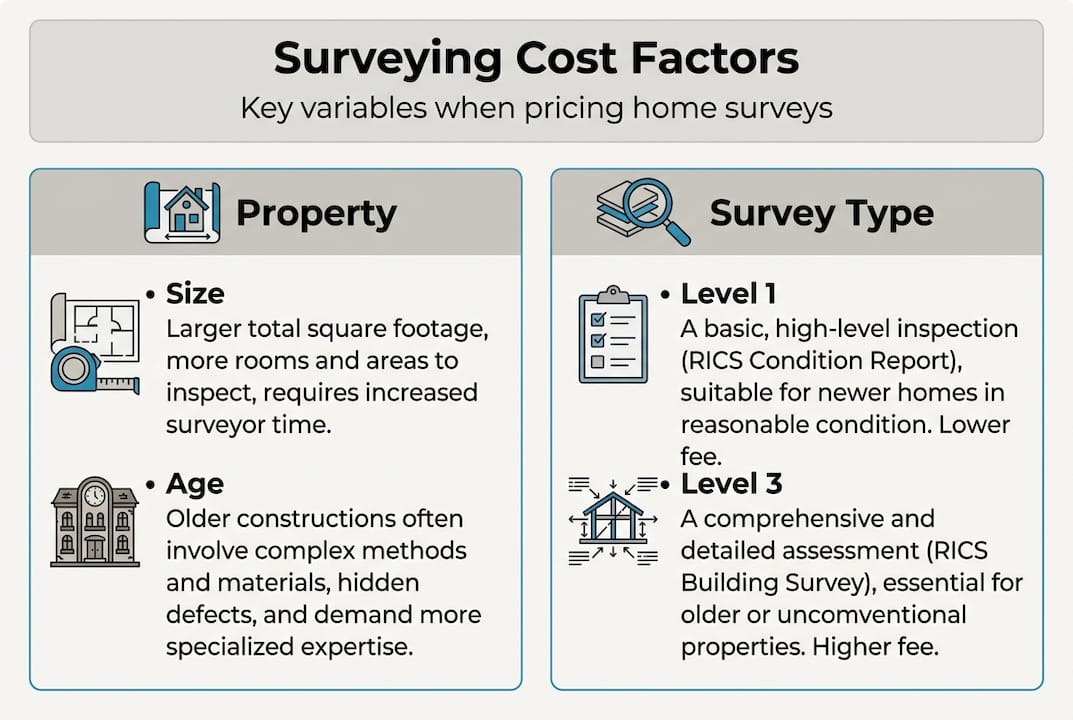
Before you can evaluate any quote, you need to understand what shapes the price. Surveying costs vary based on property size, type, location, and complexity, which is why two seemingly similar properties can attract very different fees.
The survey type is one of the biggest cost variables. A Condition Report (RICS Level 1) is the most basic option and typically the cheapest, suited to newer homes in good condition. A HomeBuyer Report (RICS Level 2) goes deeper and is the most widely requested. A Building Survey (RICS Level 3) is the most thorough and is recommended for older, larger, or unusual properties. Each step up in report depth brings a meaningful increase in price, because more time, expertise, and analysis are involved.
Property size matters too. A two-bedroom flat and a six-bedroom Victorian terrace are not comparable jobs. Larger properties take longer to inspect, require more detailed write-ups, and often surface more issues that need careful assessment. Location also plays a role. Surveyors in London and the South East generally charge more than those in the Midlands or North, reflecting local operating costs and demand.

Here is a general overview of average price ranges to give you a starting point:
| Survey type |
Small flat |
Mid-size house |
Large or period property |
| Condition Report (Level 1) |
£200 to £350 |
£300 to £500 |
£400 to £600 |
| HomeBuyer Report (Level 2) |
£400 to £600 |
£500 to £750 |
£700 to £1,000 |
| Building Survey (Level 3) |
£500 to £750 |
£700 to £1,200 |
£1,000 to £1,800 |
These are indicative ranges. Your actual quote will depend on specifics.
Several factors are frequently overlooked when budgeting:
- Listed building status: Surveys on listed properties require additional expertise and time, raising fees noticeably.
- Remote or rural locations: Travel costs and limited local surveyor availability can push prices up.
- Urgency: Requesting a report within a very short turnaround often incurs a premium.
- Specialist assessments: Damp surveys, structural engineer input, or drainage inspections are usually charged separately.
- Commercial properties: These are priced very differently from residential and depend heavily on floor area and use class.
Matching the survey level to your property is critical. Choosing a Level 1 report on a 1930s semi to save money is a risk that can cost far more in missed defects later.
Researching market rates and setting a fair budget
With a grasp on key price drivers, the next step is to see what surveyors actually charge and how to set your own fee expectations. Knowing average fees before you contact anyone puts you in a much stronger position and helps you spot when a quote is genuinely competitive or suspiciously low.
Sources for up-to-date fee benchmarks include RICS guidance, independent property advice sites, and detailed resources such as this UK building survey costs guide, which covers both standard surveys and specialist work including party wall surveyor fees. Market research and comparison are essential for establishing fair surveying fees. Local estate agents are also a surprisingly useful source; they deal with surveyors regularly and often know current going rates in your area.
Here is how prices typically compare across survey type and region:
| Survey type |
London and South East |
Midlands and North |
Scotland and Wales |
| HomeBuyer Report (Level 2) |
£550 to £900 |
£400 to £650 |
£350 to £600 |
| Building Survey (Level 3) |
£800 to £1,800 |
£600 to £1,200 |
£500 to £1,100 |
| Party wall survey (per award) |
£700 to £1,500 |
£500 to £1,000 |
£400 to £900 |
Follow these steps to benchmark and budget effectively:
- Research average fees for your specific survey type and region using trusted online resources.
- Shortlist at least three surveyors who are RICS-accredited and cover your property’s location.
- Request itemised quotes from each, not just a headline figure.
- Compare line by line and note what each quote includes and excludes.
- Question significant variances, especially if one quote is substantially lower than others without explanation.
Pro Tip: Always ask whether the quoted fee includes VAT, any travel charge, and the cost of re-inspection if required. These additions can add 20 to 30% to a headline price.
Setting your budget should not mean anchoring it to the cheapest quote. Instead, set a realistic range based on the market averages for your property and survey type, and treat that range as your guide when evaluating what you receive.
Requesting and evaluating quotes from surveyors
Once you have a budget, it is time to reach out to surveyors and get tailored quotes. How you request a quote affects the quality of the response you receive. Vague requests attract vague proposals.
Follow this process for sharper results:
- Provide key property details upfront: address, type, approximate age, size in square metres or bedrooms, and any known issues.
- State the survey level you want, or ask for their recommendation if you are unsure.
- Specify your timeline so they can factor in any urgency premium.
- Ask for a written quote with a full breakdown, not just a price over the phone.
- Request their qualifications and professional indemnity insurance details at this stage.
When you receive quotes, look beyond the total fee. A good quote will include a clear scope of work, the exact report format, estimated delivery time, what is excluded, and the terms for cancellation or rescheduling. Vague or one-line proposals are a warning sign.
Comparing quotes accurately means comparing like for like. Detailed quote comparisons reveal which surveyors offer genuine value for the services provided. If one surveyor quotes £600 and another quotes £950, the difference may reflect a more thorough report, faster delivery, or local specialist knowledge rather than simple overcharging.
A cheaper survey that misses a significant defect, such as failing roof structure or serious damp penetration, can cost you thousands more to address after purchase. The fee you save upfront rarely compensates for the risk you absorb.
Pro Tip: Ask each surveyor for survey report examples or sample outputs before committing. A detailed, clearly written sample report signals a thorough, professional approach. It also helps you judge how useful the final document will actually be when making property decisions.
Negotiating fees and finalising agreement terms
Armed with multiple quotes, you are ready to move into negotiation and secure the most suitable deal. Negotiation in this context is not about grinding a surveyor down to the lowest possible number. It is about achieving transparent, fair terms for a service you can rely on.
Negotiation and understanding terms can lead to better fees and help you avoid hidden costs. Practical tactics include bundling services if you need more than one type of assessment, mentioning that you are comparing quotes from other surveyors, and asking whether the fee can be adjusted if the property turns out to be smaller or simpler than expected.
Timeline flexibility can also work in your favour. If you are not in a rush, a surveyor may offer a slightly reduced fee in exchange for fitting your job around their existing schedule.
Before signing anything, confirm these terms in writing:
- Scope of the survey: exactly what is and is not covered
- Total fee and payment schedule: deposit, balance, and when it is due
- Report delivery timeframe: how many working days after inspection
- Cancellation policy: what happens if the sale falls through
- Dispute resolution process: who to contact if you have concerns about the report
- Report format: PDF, online portal, printed copy, or a combination
The small print matters. Some surveyors include clauses that limit their liability significantly or charge extra for follow-up queries after the report is issued. These are worth reading carefully, not skipping.
Pro Tip: Always get fee confirmation in writing before the inspection date. A verbal agreement about price is very difficult to enforce if a dispute arises later. A short email confirmation is sufficient, but it must clearly state the agreed fee and scope.
For a more detailed look at how survey findings feed into building survey negotiation tips on property price, the process often goes further than most buyers realise. Understanding building survey report details also helps you use your report as a negotiation tool with the seller, not just a risk assessment document.
A fresh perspective: Why value matters more than just price in surveying
Here is something worth saying plainly: the cheapest survey is almost never the best investment. That might sound obvious, but it still catches people out. When buyers are already stretched by deposits and legal fees, trimming £150 from a survey feels sensible. What it actually does is transfer risk.
Surveyors see this pattern repeatedly. A client opts for a basic report on a 1960s detached house to save money. The report comes back with green flags. Months later, they discover significant subsidence that a more thorough survey would have flagged. The repair bill runs to five figures.
Experienced buyers focus on three things beyond price: the thoroughness of the report format, the surveyor’s communication during and after inspection, and complete transparency on fees. When all three are present, the surveying cost insights make far more sense in context.
For a critical asset like a property, the upfront investment in quality information is not a luxury. It is the foundation of every sensible decision you make afterwards.
Find trusted surveyors and get transparent pricing
Choosing the right surveyor does not need to feel like guesswork. At Survey Merchant, we connect you with qualified, RICS-accredited surveyors across the UK, with clear pricing and no hidden surprises.

Whether you are buying your first home or managing a portfolio of investment properties, our panel of trusted surveyors covers everything from HomeBuyer Reports to specialist structural assessments. If you are in the north west, the Liverpool property surveyors on our panel are ready to help. Request a quote today and get transparent, itemised pricing from professionals who put accuracy and your peace of mind first.
Frequently asked questions
What is the average cost for a home building survey in the UK?
Average UK building survey costs range from £400 to £1,500 depending on property type, size, and location, with more complex or larger homes sitting at the higher end.
Does the cheapest surveyor always offer the best value?
No. Value matters far more than price alone; a cheaper report that misses critical defects can cost you far more in repairs and renegotiation than the amount you saved on the fee.
Are surveyor fees negotiable in the UK?
Yes, in most cases they are. Negotiation is key to securing better terms; comparing multiple quotes and clarifying scope gives you a solid basis to discuss pricing directly with your preferred surveyor.
What should I look for in a surveyor’s quote?
Look for a clear breakdown of services, delivery timelines, exclusions, and cancellation terms. Asking for detailed quote comparisons and sample reports will help you judge quality before you commit.
Recommended