Building Surveying
Sep 9, 2026
Japanese Knotweed Survey: Your Complete UK Guide (2026)
Need a Japanese knotweed survey? Our guide covers the process, costs, and critical mortgage implications for UK property buyers, sellers and owners.

You’ve found a house you like. The survey is booked, the mortgage application is moving, and then someone mentions Japanese knotweed. Sometimes it’s a note on the TA6 form. Sometimes it’s a valuer’s comment. Sometimes it’s a patch of unfamiliar growth near a boundary that nobody can identify with confidence.
That’s usually the moment buyers and sellers start hearing half-truths. “It kills mortgages.” “It always ruins the deal.” “It’s only a problem if it’s touching the house.” None of those shortcuts are good enough when money, lending decisions, and legal disclosures are involved. A proper japanese knotweed survey is not just about naming a plant. It’s about measuring risk, documenting extent, and giving lenders, solicitors, valuers, buyers, and owners something they can act on.
A good survey removes guesswork. It tells you whether the plant is present, how far it extends, how close it is to structures and boundaries, what that means under current professional guidance, and what sort of treatment or monitoring will be needed if it’s confirmed.
A lot of property problems are local. Japanese knotweed isn’t. It has become a national issue because it combines aggressive spread, difficult control, and real financial consequences in a way few garden plants ever do.

The scale matters. Japanese Knotweed is one of the UK's most economically damaging invasive species, costing the British economy an estimated £166 million annually. Experts suggest there could be an infestation for every 10 square metres across the UK, and a fragment as small as 0.6 grams can establish a new plant, according to TP Knotweed’s summary of key Japanese knotweed facts.
That combination explains why delay is risky. If such a small fragment can create a new infestation, casual cutting, strimming, or moving soil without specialist advice can make matters worse rather than better. On residential sites, that often happens through well-meant garden clearance or during small building works where nobody has yet pinned down exactly what is growing and where.
A buyer doesn’t need to be alarmist to be concerned. They just need to understand that knotweed affects more than appearance. It can influence valuation comments, mortgage conditions, legal disclosures, neighbour relations, and future saleability.
Practical rule: If knotweed is suspected during a purchase, treat identification as a due diligence issue, not a gardening issue.
Three things make a professional survey worthwhile early:
Homeowners sometimes hope winter dieback means the problem has gone. It hasn’t. The visible canes may die back seasonally, but the management issue remains if the underground material is still active.
That’s why a japanese knotweed survey is often the turning point. It converts a stressful rumour into a practical file: identification, mapped extent, risk context, and a route forward. For a buyer, that may save a transaction. For a seller, it may prevent one from collapsing late.
The phrase “mortgage problems” is too vague to help anyone. Lenders don’t all react in the same way, and valuers aren’t merely asking whether knotweed exists. They’re asking how the risk has been evidenced, how it’s being managed, and whether the lending position is still acceptable.

The important shift in recent years is this: presence alone doesn’t tell the whole story. Many UK buyers are unaware that even low-risk knotweed can trigger lender conditions. Under RICS guidance, some lenders now require 5–10-year insurance-backed management programmes before approving a mortgage, which can add £1,500–£4,000 in upfront costs to the property purchase, as set out in the RICS Japanese knotweed guidance paper from October 2022.
That’s where deals often wobble. A buyer has budgeted for survey fees, legal costs, and moving costs, but not for a management programme that a lender may insist on before funds are released. Sellers are often surprised too, particularly where they thought a small patch near a boundary was too minor to matter.
A lender may ask for:
For anyone unfamiliar with how inspection issues affect property finance, a broad homeowner resource like this Utah home inspection guide is a useful reminder that lenders and buyers rarely react to defects in isolation. They react to uncertainty, documentation gaps, and future cost exposure.
The direct treatment cost is only part of the picture. Buyers can also face delay, revised lender conditions, renegotiation with the seller, and a more cautious valuation stance. Even where the sale still proceeds, the transaction can become slower and more document-heavy.
A knotweed issue doesn’t always kill a purchase. Lack of a credible paper trail is what usually causes the real trouble.
There’s also a remortgage angle that many owners don’t see coming. A property that was bought years ago without a knotweed issue can become harder to refinance if the problem appears later or is newly disclosed. That can affect timing, product choice, and negotiating power with the lender.
If you’re trying to understand how the valuer’s role differs from a full condition report, this guide on what a mortgage valuation is helps clarify why a lender’s valuation is not a substitute for specialist investigation.
You don’t commission a japanese knotweed survey because the subject is fashionable. You commission one when a property decision needs certainty and the available information isn’t good enough.
A standard home survey may flag suspicious vegetation or record that further investigation is needed. That’s useful, but it isn’t the same as a specialist knotweed inspection. If knotweed is in play, the transaction usually needs a report that deals with identity, extent, risk, and management in a form that solicitors and lenders can rely on.
For buyers, the sensible triggers are usually obvious once you know what to look for:
Sellers benefit from acting before the property goes to market. A clear report and, where needed, a management plan can stop the deal from turning into a last-minute dispute about price and disclosure.
Owners should also instruct if they suspect growth on their land or believe a neighbouring infestation is encroaching. The key is to document what is happening, not what each side assumes is happening. Early evidence is far easier to work with than an argument after movement of soil, broken fences, or an aborted sale.
If you’re still deciding whether this is a specialist issue or part of a wider pre-purchase brief, this guide on which property survey you need helps separate general survey choices from cases where a dedicated invasive plant report is the right tool.
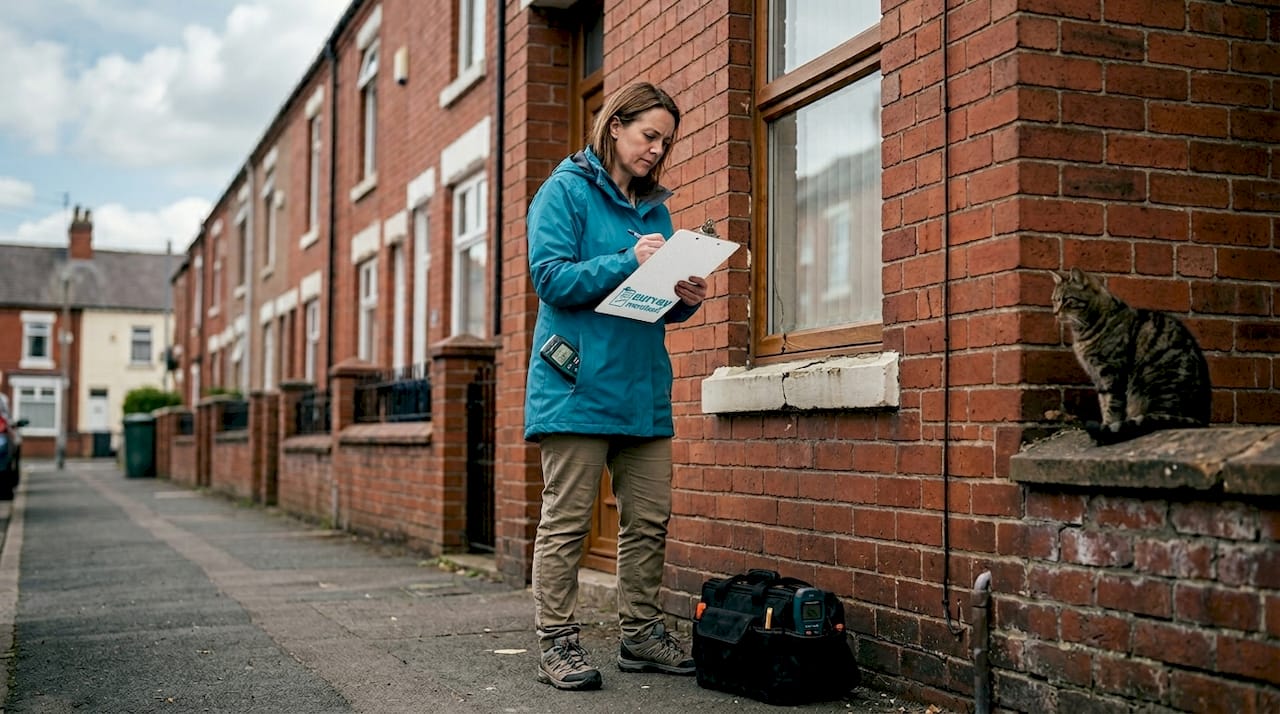
A proper japanese knotweed survey is a site investigation, not a glance over the fence. The difference matters because lenders and solicitors need documented findings, and treatment contractors need enough information to design the right response.

Timing affects confidence. The 7-metre rule is a key UK benchmark: any incidence of knotweed within 7 metres of a building is typically categorised as high risk by RICS guidance. Optimal detection is in August and September when the plant's creamy-white flowers make it easy to spot, as noted by Japanese Knotweed Killers in its overview of survey requirements.
Late summer is often the clearest survey window because identification is easier. That said, experienced surveyors don’t only work when the flowers are out. They assess visible canes, leaf shape, stem habit, site history, previous disturbance, and where the pattern of growth suggests spread beyond the obvious stand.
The visible plant is only one part of the job. A surveyor also needs to consider the likely rhizome exclusion zone, which is the mapped area used to reflect potential underground spread and associated risk.
What gets checked on site usually includes:
A useful visual overview of the field process sits below.
Misidentification is common. So is under-mapping. Someone sees one clump at the end of the garden and assumes that’s the whole issue. In practice, the survey has to ask harder questions. Is that the only stand, or just the visible part? Has previous cutting spread fragments? Is the neighbouring plot the source? Is the infestation close enough to trigger a materially different lending response?
Survey quality turns on measurement and judgement together. You need both.
That’s why the on-site process is methodical. The report must stand up in practice, where buyers renegotiate, solicitors raise enquiries, valuers revisit assumptions, and contractors price treatment from the information provided.
Clients often receive the report and go straight to the conclusion page. That’s understandable, but it can lead to the wrong takeaway. A knotweed report is not a pass or fail document alone. It’s a decision document.
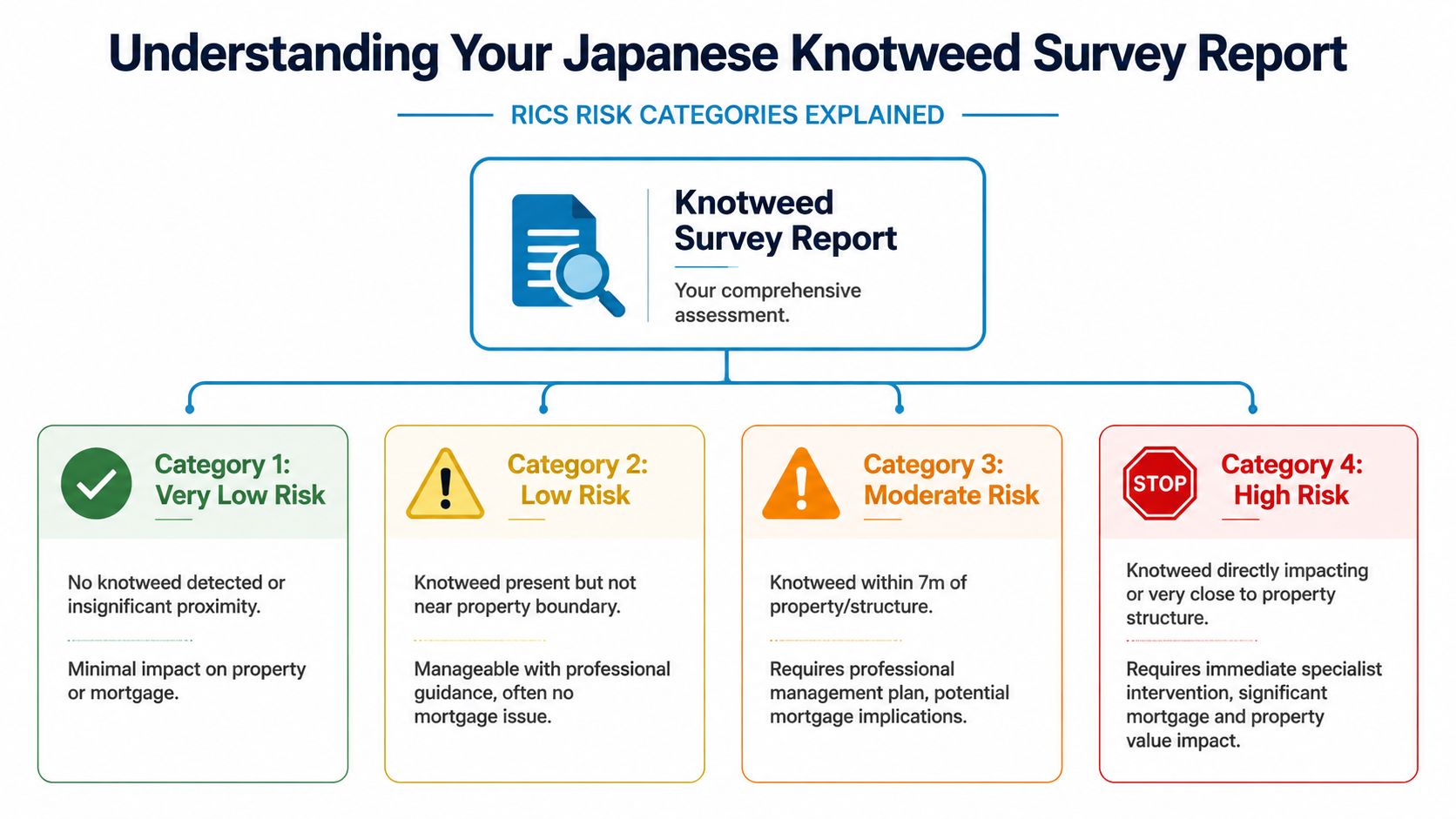
The first thing to read is the overall risk conclusion, but don’t stop there. You need to understand what drove it. The risk category is usually shaped by proximity, likely underground extent, relationship to structures and boundaries, and whether the site circumstances suggest active management is required.
In plain English, the categories usually work like this:
| Report element | What it means in practice |
|---|---|
| Very low or no meaningful risk | No knotweed identified, or the evidence found does not create a material property concern. |
| Low risk | Knotweed may be present in a way that still needs management, but the immediate property impact is limited. |
| Moderate risk | The location and extent raise practical concerns for lending, saleability, or future spread. |
| High risk | The infestation is close enough or significant enough that specialist intervention becomes central to the property decision. |
The category matters because it shapes what comes next. A buyer may proceed unchanged, proceed with conditions, renegotiate, or pause while a treatment framework is put in place.
A few report terms tend to cause unnecessary anxiety:
Don’t read “management plan” as bad news. Read it as the mechanism that turns an unmanaged risk into a documented one.
The strongest reports are clear about limits as well as findings. If access was restricted, the report should say so. If neighbouring land appears relevant but couldn’t be inspected, that should be stated. Good reporting doesn’t pretend to know more than the evidence supports.
Once knotweed is confirmed, the discussion usually shifts fast from diagnosis to remedy. Most owners want a simple answer, but there isn’t one universal solution. The right route depends on site use, timing, lending pressure, disturbance plans, and how quickly certainty is needed.
In broad terms, the usual options are herbicide treatment or physical excavation and removal. Each has practical advantages and obvious downsides.
Herbicide-led management is often the less disruptive route where time is available and the site doesn’t need immediate clearance for construction or sale-critical works. It can fit well on residential land where the aim is controlled reduction with an auditable management record. The trade-off is patience. It relies on proper follow-up and clean documentation.
Excavation is the route people ask for when they want speed and finality. It can make sense where groundworks are already planned or where a development site needs physical removal as part of a wider programme. The trade-off is cost, logistics, and the need to handle contaminated material correctly. It’s not a casual dig-and-skip exercise.
A useful comparison point from another surveying discipline is this overview of Richmond Tree Experts survey costs. It shows how survey and remediation costs often depend less on the label of the issue and more on access, scope, reporting standard, and what the client needs the document to achieve.
Where management rather than immediate excavation is chosen, monitoring is the backbone of the process. Effective management requires structured quarterly monitoring during the growing season (spring to autumn) to track treatment impact and plan strategy. Irregular monitoring and incomplete rhizome removal are documented as common mistakes that cause up to 40% of treatment failures, according to the Japanese Knotweed Agency guide on effective monitoring.
That’s why decent programmes are specific, not vague. They record location, growth pattern, changes in vigour, and comparable photographs from repeat visits. For property purposes, that record matters almost as much as the treatment itself because lenders, future buyers, and valuers want evidence that the issue is being managed competently.
A practical route after a positive report often looks like this:
If you need a japanese knotweed survey, the first job is choosing a surveyor or specialist who can produce a report that’s useful in a property transaction. Price matters, but competence, clarity, and turnaround matter more when a chain is waiting.
Ask direct questions before you book:
A cheap report that leaves solicitors asking more questions isn’t cheap. It just spreads the cost into delay and uncertainty.
A smooth process starts with a clear brief. Say whether you are buying, selling, remortgaging, or dealing with suspected encroachment from neighbouring land. Share any existing photos, survey comments, or TA6 disclosure wording. If a valuer or solicitor has raised a specific concern, pass that on too.
Then make sure the right specialist is being instructed for the actual problem, not just the nearest available general surveyor. If you need help finding a suitable chartered professional in your area, this guide to finding RICS surveyors near you is a sensible starting point.
The best outcome is simple. You get a report that identifies the issue properly, states the risk in plain English, and gives everyone in the transaction the same factual basis for the next decision.
If you need a japanese knotweed survey, Survey Merchant can help you find a vetted, appropriately qualified surveyor from a nationwide UK panel. That means clearer reporting, competitive pricing, and a faster route to the practical advice you need for a purchase, sale, remortgage, or ongoing property management.
Survey Merchant provides vetted RICS surveyors across 100+ UK locations at fixed fees:
→ Level 2 Home Survey (HomeBuyer Report)
→ Level 3 Building Survey (full structural survey)
→ RICS Red Book property valuations
→ Party wall surveyors — notices, awards & schedules of condition
→ Expert witness surveyors — CPR Part 35 reports for property disputes