Leasehold
Jul 16, 2026
Ultimate Guide to Lease Extension Negotiations
Step-by-step UK guide to extending leaseholds: check eligibility, get a RICS valuation, serve a Section 42 notice, negotiate

Extending your lease in the UK is essential to maintaining your property's value and marketability. If your lease drops below 80 years, costs rise sharply due to "marriage value" charges, and mortgages become harder to secure. This guide explains the process, from confirming eligibility to finalising agreements, so you can navigate lease extensions confidently.
Key Takeaways:

UK Lease Extension Process: 3-Step Guide from Eligibility to Completion
Extending a lease involves a clear process with specific legal requirements. Each step must be handled carefully to avoid costly errors - like serving an incorrect notice, which can prevent you from making another claim for a full year.
Before starting, confirm that your lease qualifies for a statutory extension. To be eligible, the original lease must have been granted for longer than 21 years. You can find this information in your lease document. From January 2025, the two-year ownership rule will no longer apply, meaning you can extend your lease immediately after purchase [2].
Statutory extensions apply to residential flats (which get a 90-year extension) and houses (which get a 50-year extension). However, properties owned by charitable housing trusts, the National Trust, the Crown Estate, or those with commercial leases are excluded. To identify your freeholder, you can obtain a copy of the freehold title from the Land Registry for about £7 [2]. This ensures your Section 42 Notice is sent to the correct party. Once eligibility is confirmed, the next step is to conduct a detailed lease valuation to calculate the premium.
A professional valuation is essential to determine the premium you'll need to pay for the extension. This isn't the same as a standard property valuation - it involves a detailed calculation based on three factors: the current value of lost ground rent (the term), compensation for the freeholder delaying possession by an additional 90 years (the reversion), and, for leases under 80 years, the marriage value (50% of the increase in property value) [8].
It's best to hire a RICS-qualified surveyor with expertise in leasehold enfranchisement. Fees typically range from £400 to £1,500 + VAT, depending on whether you need a desktop or physical valuation [8]. Ashley Connell, a solicitor specialising in leasehold enfranchisement, explains:
"A valuation is not a standard market valuation of the sellable value of the property, but rather a breakdown of complex calculations to determine how much compensation is due to the landlord." [7]
This valuation provides a realistic figure for negotiations, breaking down the premium into its individual components. Avoid relying on online calculators, as they are rarely accepted in tribunals [8]. It's also worth noting that any improvements you've made to the property, such as a new kitchen, are excluded from the valuation to ensure fairness. Once you have the valuation, you can formally begin the extension process by serving a Section 42 Notice.
The Section 42 Notice is the formal document that starts your statutory lease extension claim. It must include your full details, the property address, the current lease terms, your proposed premium, any suggested terms, your solicitor's details, and a response deadline of at least two months [5].
Mistakes in the notice can invalidate it, delaying the process and preventing further claims for a year [6]. Serving this notice also locks in the valuation date, protecting you from market changes or further reduction in the lease term [11]. The freeholder then has two months to reply with a Section 45 Counter-Notice [5].
It's strongly advised to have a solicitor draft and serve the notice using secure delivery methods, like special delivery or courier, to ensure proof of receipt. Expect solicitor fees to range from £500 to £3,000, along with the freeholder's reasonable professional costs (usually £800 to £1,500) and a £20 Land Registry fee [5].
Once your Section 42 Notice has been served and the freeholder responds with a Section 45 Counter Notice, the negotiation process begins. This stage is crucial, as the freeholder's proposed premium may differ significantly from your initial offer. How you respond can determine whether you reach an agreement quickly or face a drawn-out tribunal process. Effective negotiation is key to securing a lease extension that aligns with your RICS valuation and safeguards your investment.
Start by comparing the freeholder's counteroffer with your RICS valuation report. If the difference is relatively small - around £1,500 or less - it might be more practical to accept the offer instead of incurring additional negotiation costs. As Andrew Boast from SAM Conveyancing points out:
"You should weigh the cost-benefit of negotiating, as 3 hours of negotiating could equal £1,000."
[12]
Engage your RICS surveyor to handle negotiations with the freeholder's surveyor, focusing on resolving differences over issues like ground rent or marriage value. To keep costs manageable, agree on a time cap of three hours, as surveyors typically charge between £150 and £300 per hour [12][14].
Ashley Connell, a leasehold enfranchisement solicitor at Hetts, advises aiming for a balanced approach:
"A favourable outcome would typically involve securing a mid-range value as determined by their valuation, rather than aiming for the lower end."
[9]
Pushing too hard for the lowest premium can backfire, leading to prolonged negotiations and higher expenses. Keep in mind that you have a six-month deadline from receiving the Counter Notice to either finalise an agreement or apply to the First-tier Tribunal. Missing this deadline will result in your claim being withdrawn, forcing you to wait 12 months before reapplying [9][14].
If negotiations fail within the required timeframe, the next step is escalating the matter to the Tribunal.
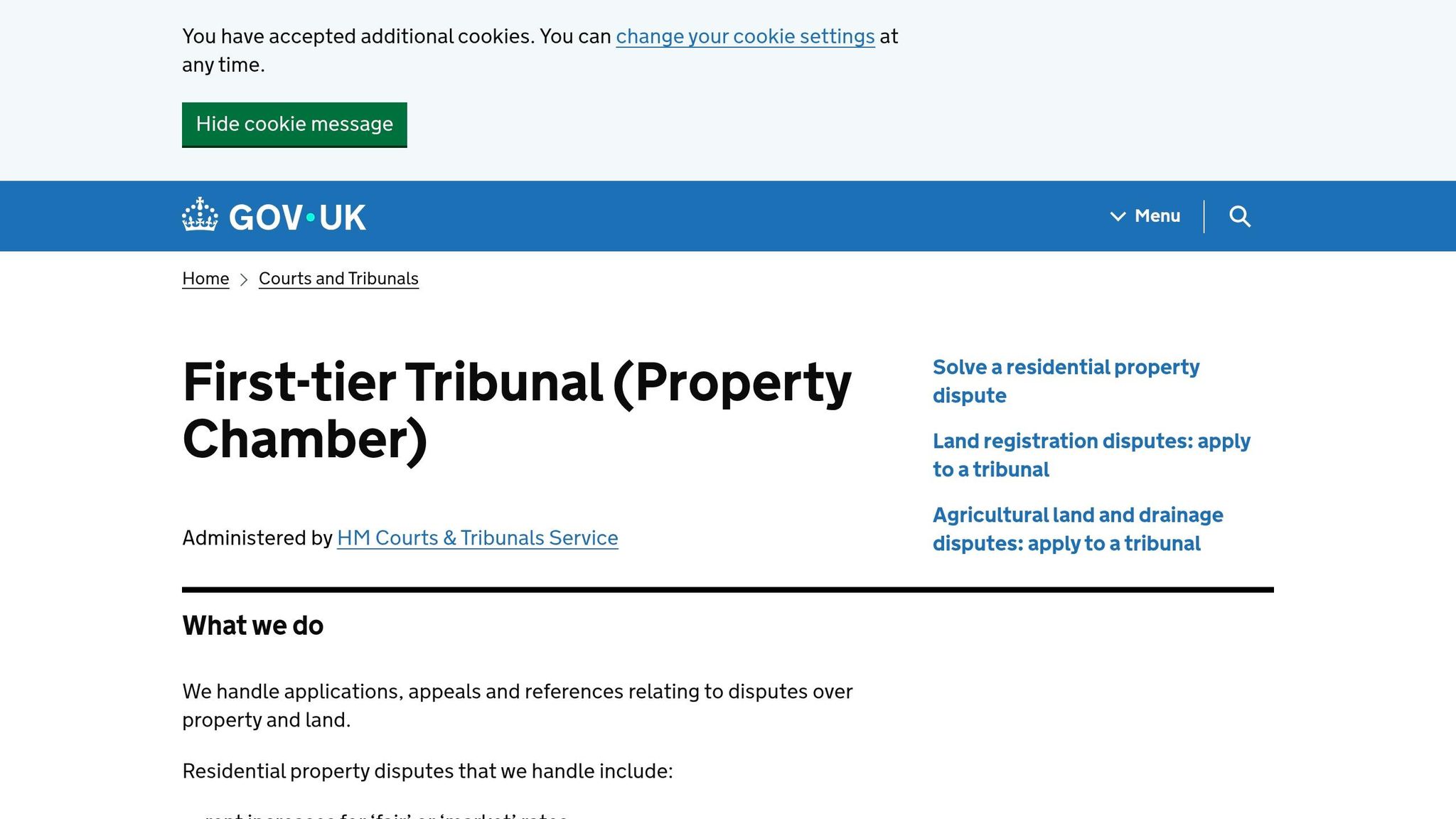
Should negotiations stall after the mandatory two-month period, you can apply to the First-tier Tribunal (Property Chamber). The application fee is £100, with an additional £200 if the case proceeds to a hearing [15][19]. The Tribunal panel typically includes a lawyer (acting as chairman), a professional valuer, and a layperson [19]. It has the authority to determine the premium, adjust lease terms, and decide cost allocations [20].
Each party is responsible for their own legal fees, as the Tribunal does not award costs. This often motivates freeholders to settle before proceedings begin. Andrew Boast highlights this dynamic:
"The prospect of the freeholder incurring their own legal costs for a Tribunal can be a significant motivator for them to find a settlement."
[15]
Barrister fees for representation at the Tribunal can range from £300 to over £500 per hour [15]. To protect your claim, ensure your Tribunal application is filed before the six-month deadline. If an agreement is reached later, you can withdraw the application. Reviewing past Tribunal decisions on the government website can also provide valuable insights into premium valuations and common disputes [15].
Certain mistakes can derail your claim, so it’s important to stay vigilant. Missing the six-month deadline means starting the process over and waiting 12 months before reapplying. Setting reminders well in advance can help you avoid this costly oversight.
Another frequent error is submitting a "low-ball" initial offer in your Section 42 Notice. Offers should be grounded in a formal RICS valuation to prevent inflated counteroffers [12][16].
If your lease is nearing the 80-year mark, act quickly. Once it drops below this threshold, marriage value applies, which can add thousands to the premium [18][13]. Additionally, ensure your surveyor exclusively represents leaseholders. As Linz, CEO of Homehold, explains:
"A negotiator who only works for leaseholders is likely to be happy to push harder for a fair premium."
[17]
Property surveyors play a key role in determining the premium for your lease extension by evaluating three main factors: lost ground rent, reversionary loss, and - if your lease has less than 80 years remaining - 50% of the marriage value [21]. The marriage value refers to the financial uplift created by extending the lease, which is legally divided equally between you and the freeholder.
A RICS-qualified surveyor provides a detailed valuation report that serves as the foundation for your Section 42 notice. This report includes a valuation range, outlining both the best- and worst-case scenarios to guide negotiations. As Lease Extension UK points out:
"Valuing a lease extension premium is extremely specialist work requiring a complex calculation which should be undertaken by a suitably qualified and experienced surveyor." [22]
If discussions with the freeholder hit a deadlock, your surveyor can step in as an expert witness at the First-tier Tribunal, presenting evidence to support your proposed premium. Surveyor fees for these services typically start at £360 [13], and you may also need to cover the freeholder's reasonable valuation costs, which generally range between £600 and £1,500+. Fortunately, around 95% of lease extension negotiations are resolved without requiring a tribunal hearing [22]. To make the process smoother, platforms like Survey Merchant can help you find experienced local surveyors.

Navigating the complexities of lease extensions often requires expert guidance. Survey Merchant connects property owners with a network of specialist RICS-certified surveyors across the UK who are well-versed in lease extension valuations. Their panel of experts, which is regularly reviewed, provides accurate and clear reports while tackling intricate valuation issues.
Through Survey Merchant, you can access desktop valuations starting from £360 to £400 [13], engage surveyors to negotiate with freeholder representatives at hourly rates ranging from £150 to £300 [12], and even secure expert witness services if your case proceeds to the Tribunal.
These professionals specialise in calculating premiums, challenging inflated valuations, and advising on the best timing to avoid the 80-year marriage value threshold. Their expertise complements your solicitor's role in managing the legal paperwork and updating Land Registry records. By working with local experts via Survey Merchant, you ensure that your valuation reflects specific lease terms and real market conditions - details that generic online calculators simply can't capture.
Once negotiations are complete, the next step is to formalise the lease extension and handle the necessary legal updates.
After agreeing on the premium, the freeholder’s solicitor usually prepares a new lease or a "deed of variation" to reflect the agreed terms. It’s essential to have your solicitor review this draft to ensure it aligns with the agreement and avoids any unfavourable clauses. Both you and the freeholder (or your respective legal representatives) must then sign the finalised document as a formal deed. Make sure the new lease reduces the ground rent to a "peppercorn" (essentially zero) and extends the lease by 90 years [4].
Once the agreement is signed, your solicitor will transfer the premium and any outstanding fees to the freeholder’s solicitor. The premium can range from £5,000 to over £100,000, depending on factors like the property’s value and the remaining lease term [4]. Additional costs include:
As Ashley Connell, Leasehold Enfranchisement Solicitor, notes:
"The leaseholder pays the freeholder's legal costs however the costs have to be reasonable" [24].
Paula Higgins, CEO & Founder of HomeOwners Alliance, adds:
"If the landlord does require a deposit, this will have to be paid within 14 days, so it's important to have this money readily available" [3].
Once all payments are settled, the final step is to update the Land Registry records to reflect the new lease terms.

Your solicitor will handle the registration of the updated lease with HM Land Registry. This involves replacing the existing leasehold title with one that includes the extended term and revised ground rent. The process typically requires submitting a certified copy of the new lease, an SDLT certificate (if applicable), and any documentation showing the landlord’s mortgagee consent, where necessary.
Due to backlogs, the Land Registry can take 12 to 20 weeks to complete this process. However, if you’re in the middle of a sale or remortgage, your solicitor can request an expedited registration. This step is crucial to ensure your property remains both saleable and mortgageable. If you have an existing mortgage, your lender may also require a "deed of substituted security" to transfer the charge from the old lease to the new one.
Extending your lease can have a major impact on your finances, so it’s crucial to approach the process carefully. Start by confirming your eligibility and arranging funding to cover both the premium and professional fees. From the outset, it’s wise to enlist the help of specialist RICS surveyors and solicitors to avoid expensive errors [10][25]. Acting early - especially before your lease dips below 80 years - can save you tens of thousands of pounds by avoiding the added cost of marriage value [13].
The statutory route under the Leasehold Reform Act 1993 offers a level of security that informal negotiations simply can’t match. This legal framework guarantees a 90-year extension, eliminates ground rent, and allows disputes to be taken to the First-tier Tribunal if needed [1][10]. Paula Higgins highlights the risks of cutting corners, warning that it could cost far more in the long run and even make your property unsellable [3]. Be prepared for the statutory process to take between 6 and 12 months [1].
A professional valuation is another key step in the process. While online calculators might seem convenient, they’re often inaccurate and won’t hold up as evidence in a tribunal setting [12]. An RICS valuation, on the other hand, gives you a solid foundation for your offer and could even save you money if the freeholder accepts it without commissioning their own valuation [23].
The lease extension landscape is shifting with the gradual rollout of the Leasehold and Freehold Reform Act 2024. Notably, the two-year ownership requirement will be abolished from 31 January 2025 [2]. Looking further ahead, reforms expected in 2026 may remove marriage value entirely and extend standard lease terms to 990 years [2]. Given these upcoming changes, acting now ensures you protect your property’s value and maintain its marketability in the long term.
If your lease is nearing the 80-year mark, it’s usually wise to extend now to sidestep the extra costs tied to the marriage value. However, if your lease still has plenty of years left - well over 80 - and you’re not planning to sell or remortgage anytime soon, waiting for the 2026 reforms could work in your favour. That said, keep in mind that these reforms may face delays and come with some legal uncertainties.
When starting the lease extension process, the freeholder might ask for a deposit. This is usually meant to cover expenses like legal and valuation fees. It's commonly requested either at the beginning of negotiations or when a formal notice is served.
To speed up the Land Registry process, make sure all your paperwork is accurate and complete from the start. Stay proactive by checking in with the Land Registry regularly to track your application's progress and quickly resolve any issues that might arise. Partnering with skilled conveyancing solicitors and professional surveyors can also help. Their expertise can simplify valuations and legal procedures, helping to minimise potential delays.
Survey Merchant provides vetted RICS surveyors across 100+ UK locations at fixed fees:
→ Level 2 Home Survey (HomeBuyer Report)
→ Level 3 Building Survey (full structural survey)
→ RICS Red Book property valuations
→ Party wall surveyors — notices, awards & schedules of condition
→ Expert witness surveyors — CPR Part 35 reports for property disputes