KEY TAKEAWAYS
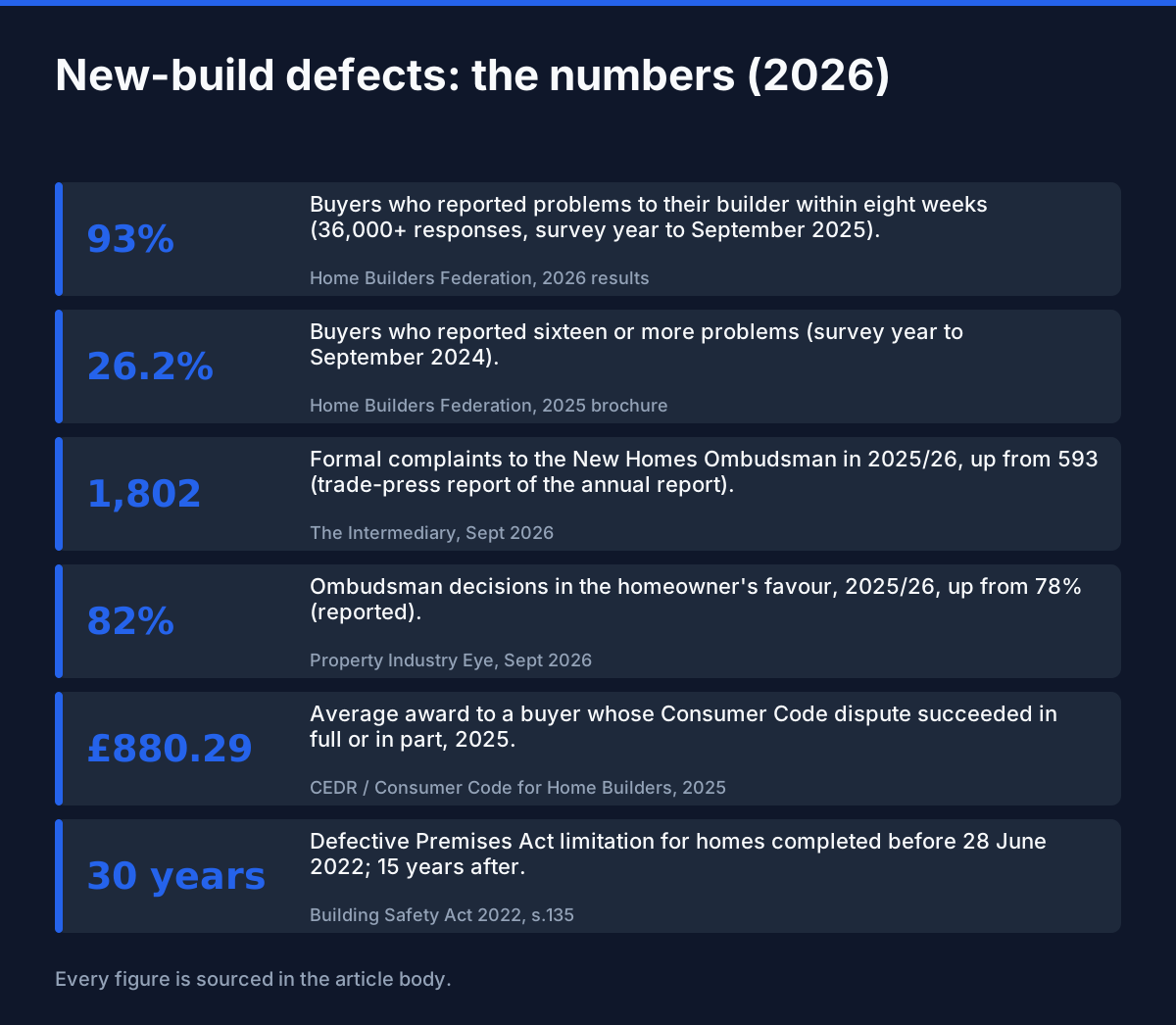
- → 26.2% Share of new-build buyers who reported sixteen or more problems to their builder, survey year October 2023 to September 2024 (39,000 responses). (HBF CSS and Star Ratings 2025 brochure, 2024)
- → 1,802 Formal complaints to the New Homes Ombudsman Service in 2025/26, up from 593 the year before, as reported by The Intermediary from the Service's annual report. (The Intermediary, NHOS annual report coverage, 2026)
- → 82% Share of New Homes Ombudsman decisions in 2025/26 that went in the homeowner's favour, up from 78%, as reported by Property Industry Eye from the Service's annual report. (Property Industry Eye, NHOS annual report coverage, 2026)
- → £880.29 Average award to a home buyer whose Consumer Code for Home Builders dispute succeeded in full or in part in 2025; the scheme's total awards were £135,565 across the year. (CEDR Consumer Code dispute resolution report 2025, 2025)
- → 25.6 days Average time to resolve a logged defect across more than 200 builders using the Clixifix defect-management platform, as published by the Consumer Code for Home Builders in 2024 (vendor data). (Consumer Code article on Clixifix snagging data, 2024)
- → 30 years Limitation period for a Defective Premises Act claim on a home completed before 28 June 2022, after section 135 of the Building Safety Act 2022; claims accruing after that date have 15 years. (Building Safety Act 2022, section 135, 2022)
- → 35% Share of nine-month survey respondents in 2021-22 who reported sixteen or more different problems, as analysed by the Competition and Markets Authority in its 2024 housebuilding market study. (CMA housebuilding market study, final report, 2022)
A buyer with a snag list running past a hundred items wants to know two things: whether the house is unusually bad, and whether complaining will change anything. Snagging companies answer the first with round numbers nobody can trace; developers answer the second with a complaints procedure. The primary data sit in a trade-body survey, two dispute schemes' annual reports, a competition inquiry and the statute book. This guide puts them on one page for England and Wales, with every figure linked to its document.
The short version is that a long list is the norm. 93% of buyers reported problems to their builder within eight weeks of moving in during the survey year to September 2025 (HBF Customer Satisfaction Survey, 2026 results, 2025), and in the previous survey year 26.2% reported sixteen or more. Complaints that reach an ombudsman succeed more often than not, but awards are measured in hundreds of pounds because the schemes direct repairs rather than pay damages. What changes the outcome, on the published case studies, is a written record of the defects and the dates, which is why the independent inspection matters more than the length of the list. The site's guide to new-build snagging inspections covers how an inspection is carried out; this page is about the numbers.
1 How Many Snags Is Normal? 93% Report Problems, a Quarter Report 16 or More
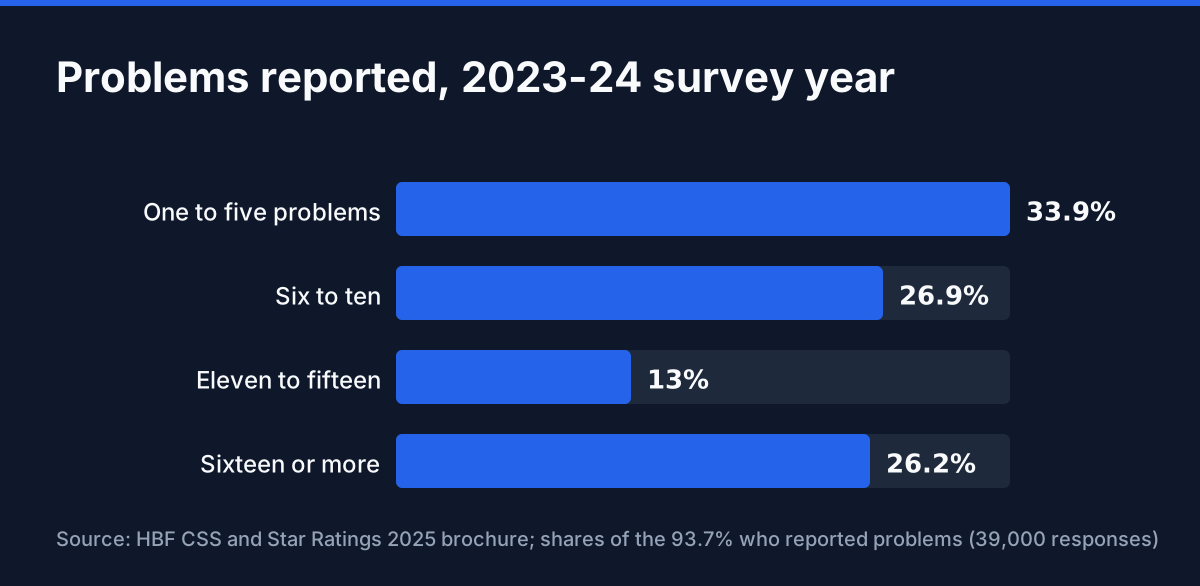
Nearly every new-build buyer reports problems: 93% in the survey year to September 2025 and 93.7% the year before. Of those, 33.9% had one to five problems, 26.9% six to ten, 13% eleven to fifteen and 26.2% sixteen or more. A list in the tens is ordinary; what matters is what is on it.
| MEASURE | FIGURE | SOURCE |
|---|---|---|
| Reported any problems to the builder, survey year to September 2025 | 93% | HBF Customer Satisfaction Survey, 2026 results |
| Reported any problems, survey year to September 2024 | 93.7% | HBF CSS and Star Ratings 2025 brochure |
| One to five problems, year to September 2024 | 33.9% | HBF CSS and Star Ratings 2025 brochure |
| Six to ten problems, year to September 2024 | 26.9% | HBF CSS and Star Ratings 2025 brochure |
| Eleven to fifteen problems, year to September 2024 | 13% | HBF CSS and Star Ratings 2025 brochure |
| Sixteen or more problems, year to September 2024 | 26.2% | HBF CSS and Star Ratings 2025 brochure |
| One to five problems, year to September 2025 | 31% | HBF Customer Satisfaction Survey, 2026 results |
| Six to ten problems, year to September 2025 | 24% | HBF Customer Satisfaction Survey, 2026 results |
| Eleven to fifteen problems, year to September 2025 | 12% | HBF Customer Satisfaction Survey, 2026 results |
| Said there were more problems than they expected, year to September 2024 | 33.9% | HBF CSS and Star Ratings 2025 brochure |
| Reported fewer snags than expected (HBF release, March 2026) | one in five | HBF survey release, March 2026 |
| Nine-month respondents reporting sixteen or more problems, 2021 to 2022 (CMA) | 35% | CMA housebuilding market study, final report |
| Customers dissatisfied with both defects and their rectification, 2021 to 2022 (CMA) | 12% | CMA housebuilding market study, final report |
| Range of that share across the eleven largest builders (CMA) | 1% to 24% | CMA housebuilding market study, final report |
| Satisfied with the quality of their home, year to September 2025 | 90% | HBF Customer Satisfaction Survey, 2026 results |
| Would recommend their builder, year to September 2025 | 93% | HBF Customer Satisfaction Survey, 2026 results |
| Eight-week survey responses behind the 2026 results | 36,000 | HBF Customer Satisfaction Survey, 2026 results |
| Snag count quoted by the HomeOwners Alliance (its own figure) | over 150 snags | HomeOwners Alliance snagging guide |
The figures come from the National New Homes Customer Satisfaction Survey, sent eight weeks after completion by the warranty providers for the HBF and verified by Ipsos. The survey year to September 2025 drew over 36,000 eight-week responses; the year before drew 39,000(HBF CSS and Star Ratings 2025 brochure, 2024). The same questionnaire found 90% satisfied with the quality of their home, 93% willing to recommend their builder and 92% willing to buy a new build again: buyers expect snags, and most get them fixed. The band that answers whether a home is unusual is the top one. In the year to September 2024, 26.2% reported sixteen or more problems and 33.9% said the number was above what they had expected (HBF CSS and Star Ratings 2025 brochure, 2024); the HBF's 2026 release put the share with fewer snags than expected at one in five(HBF survey release, March 2026, 2025). The HomeOwners Alliance's over 150 snags(HomeOwners Alliance snagging guide, 2025) is the Alliance's own figure, not a survey result. A snagging list for a new build typically runs to the length those bands describe.
The Competition and Markets Authority's housebuilding market study, published in February 2024 on data for 2021 to 2022, is the only independent reading of the same survey, and it used the nine-month wave. There, 35% of respondents reported sixteen or more different problems (CMA housebuilding market study, final report, 2022), and on the CMA's composite test of customers dissatisfied with both the defects and their rectification, 12% qualified overall but the share ranged from 1% to 24% across the eleven largest builders. That range is the most useful number here: quality is a builder-level variable, not a market constant, so a buyer should compare their list with their builder's rating before the national bands.
2 How Many New Homes Are Built, and How Many Are Covered by a Code or Ombudsman?
England completed 143,770 new-build dwellings in the year to June 2026 (MHCLG housing supply indicators, April to June 2026, 2026) and Wales 1,190 in the April to June quarter. NHBC warranties cover 70%+ of UK new homes; the New Homes Quality Code, with 581 registered developers, covers over half of new homes sold (NHQB release of the NHOS annual report, 2026). The statutory ombudsman remains prospective.
| MEASURE | FIGURE | SOURCE |
|---|---|---|
| New-build completions, England, year to June 2026 | 143,770 | MHCLG housing supply indicators, April to June 2026 |
| New-build completions, England, April to June 2026 (seasonally adjusted) | 35,800 | MHCLG housing supply indicators, April to June 2026 |
| New dwellings completed, Wales, April to June 2026 | 1,190 | Welsh Government new house building, April to June 2026 |
| Homes registered with NHBC, UK, 2025 | 115,350 | NHBC registrations release, February 2026 |
| Homes completed under NHBC cover, UK, 2025 | 122,012 | NHBC registrations release, February 2026 |
| Share of UK new homes with an NHBC warranty | 70%+ | NHBC New Home Statistics Review Q1 2025 |
| NHBC gross claims reserves at March 2025 (claims paid not disclosed) | £423.9 million | NHBC Annual Report and Accounts 2024/25 |
| Developers registered with the New Homes Quality Board, year to March 2026 | 581 | NHQB release of the NHOS annual report |
| Share of new homes sold under the Code (NHQB wording) | over half | NHQB release of the NHOS annual report |
| Share of new homes sold under the Code (as reported by The Intermediary) | 65% | The Intermediary, NHOS annual report coverage |
| Statutory new homes ombudsman provisions, Building Safety Act 2022 | prospective | Building Safety Act 2022, ombudsman provisions |
The denominator matters because the complaint figures below are small against it. MHCLG counted 143,770 new-build completions in England in the year to June 2026, 35,800 of them in the April to June quarter; the Welsh Government counted 1,190 in the same quarter. NHBC registered 115,350 homes across the UK in 2025 and recorded 122,012 completions under its cover (NHBC registrations release, February 2026, 2025); its statistics review puts its market share at 70%+. Roughly every tenth completion, on those figures, is a home whose buyer will report sixteen or more problems: thousands of households a year.
Coverage is the second denominator. The New Homes Quality Board's register grew to 581 developers in the year to March 2026, from four hundred and sixty-one, which the Board describes as over half of new homes sold; The Intermediary puts it at more than 65%, leaving around a third of new homes outside the voluntary scheme (The Intermediary, NHOS annual report coverage, 2026). The Building Safety Act 2022 provisions that would let ministers require every developer to join a statutory scheme are shown on legislation.gov.uk as prospective(Building Safety Act 2022, ombudsman provisions, 2026), two and a half years after the CMA recommended activating them. A buyer whose developer is not on the register has the warranty provider's resolution service and the courts, which is why a survey on a new build is the only independent record of its condition at completion. NHBC's annual report discloses £423.9 million of gross claims reserves (NHBC Annual Report and Accounts 2024/25, 2025) but not how many claims were made or paid, so no public figure says what share of Buildmark claims succeed; a building defect report is what turns a warranty dispute into something the insurer can assess.
3 Does Complaining Work? 82% and 57% of Decisions Favour the Buyer, Awards in the Hundreds
More often than not, on the published figures. The New Homes Ombudsman closed 904 cases in the year to March 2026 and settled 575 by early resolution (NHQB release of the NHOS annual report, 2026); trade-press reports of its annual report put decisions in the homeowner's favour at 82%. The Consumer Code scheme found fully or partly for the buyer in 57% of cases, with an average award of £880.29.
| MEASURE | FIGURE | SOURCE |
|---|---|---|
| New Homes Ombudsman: cases closed, year to March 2026 | 904 | NHQB release of the NHOS annual report |
| New Homes Ombudsman: cases settled by early resolution (from one hundred and eighty-six) | 575 | NHQB release of the NHOS annual report |
| New Homes Ombudsman: formal complaints received (reported; from five hundred and ninety-three) | 1,802 | The Intermediary, NHOS annual report coverage |
| New Homes Ombudsman: decisions in the homeowner's favour (reported) | 82% | Property Industry Eye, NHOS annual report coverage |
| New Homes Ombudsman: compensation awarded across the year (reported) | £215,000 | The Intermediary, NHOS annual report coverage |
| New Homes Ombudsman: rise in final decisions issued (reported) | 236% | The Intermediary, NHOS annual report coverage |
| New Homes Ombudsman: rise in snagging enquiries (reported) | 205% | The Intermediary, NHOS annual report coverage |
| New Homes Ombudsman: maximum award under the scheme rules | £75,000 | RICS Property Journal, March 2023 |
| New Homes Ombudsman case: damp and mould confirmed by a snagging report and specialist evidence | £6,158 | NHOS case study: delayed repairs, damp and mould |
| New Homes Ombudsman case: inconvenience where accepted snags took too long to fix | £250 | NHOS case study: numerous snags |
| Consumer Code: enquiries, year to March 2026 | 1,970 | Consumer Code Annual Report 2025/26 at a glance |
| Consumer Code: disputes referred to adjudication, 2025 | 336 | CEDR Consumer Code dispute resolution report 2025 |
| Consumer Code: fully in the buyer's favour, 2025 | 15% | CEDR Consumer Code dispute resolution report 2025 |
| Consumer Code: partly in the buyer's favour, 2025 | 31% | CEDR Consumer Code dispute resolution report 2025 |
| Consumer Code: fully in the builder's favour, 2025 | 34% | CEDR Consumer Code dispute resolution report 2025 |
| Consumer Code: fully or partly for the buyer, year to March 2026 | 57% | Consumer Code Annual Report 2025/26 at a glance |
| Consumer Code: total claimed by buyers, 2025 | £2,350,018.03 | CEDR Consumer Code dispute resolution report 2025 |
| Consumer Code: total awarded, 2025 | £135,565 | CEDR Consumer Code dispute resolution report 2025 |
| Consumer Code: average award to a successful buyer, 2025 | £880.29 | CEDR Consumer Code dispute resolution report 2025 |
| Consumer Code: scheme award cap | £50,000 | CEDR Consumer Code dispute resolution report 2025 |
| Consumer Code: decisions accepted by the buyer, 2025 | 43% | CEDR Consumer Code dispute resolution report 2025 |
| Consumer Code: decisions finding a breach of the complaints-procedure rule, 2025 | 66% | CEDR Consumer Code dispute resolution report 2025 |
Two schemes publish outcomes. The New Homes Ombudsman Service, which hears complaints against developers on the New Homes Quality Board's register, closed 904 cases in the year to March 2026 and resolved 575 through early resolution, up from one hundred and eighty-six, according to the Board's release of the annual report. The report file itself could not be opened, so the headline numbers come from the trade press and are labelled as such: formal complaints rose to 1,802 from five hundred and ninety-three (The Intermediary, NHOS annual report coverage, 2026), the share of decisions in the homeowner's favour rose to 82% from seventy-eight percent, final decisions rose by 236%, snagging enquiries by 205%, and compensation across the whole year came to £215,000. Set against 1,802 complaints that is a little over a hundred pounds each; the scheme's cap of £75,000(RICS Property Journal, March 2023, 2023) is rarely approached because the usual remedy is a direction to repair.
The older Consumer Code for Home Builders scheme, run by CEDR, publishes a fuller breakdown. In 2025 it received 336 referrals and adjudicated two hundred and sixty-eight (CEDR Consumer Code dispute resolution report 2025, 2025): 15% were decided fully for the buyer, 31% partly, and 34% fully for the builder, with the rest settled, withdrawn or invalid. Buyers claimed £2,350,018.03 and were awarded £135,565, an average of £880.29 per successful claim against a cap of £50,000; only 43% of buyers accepted the decision. The most common finding, in 66% of decisions, was a breach of the Code's complaints-procedure rule rather than a finding about the defect; the Code's summary for the year to March 2026 reports 1,970 enquiries and 57% of cases found fully or partly for the buyer (Consumer Code Annual Report 2025/26 at a glance, 2026). In both schemes the developer's complaint handling is what gets punished, and the award is small. The case studies show where evidence comes in: in an ombudsman case published in October 2025, a professional snagging report and independent specialist evidence confirmed damp, tanking and ventilation defects the developer had not resolved, and the buyer was awarded £6,158(NHOS case study: delayed repairs, damp and mould, 2025); where accepted snags were merely slow, the award for inconvenience was £250(NHOS case study: numerous snags, 2024). The site's guides to expert evidence in building defects claims and using an expert in mediation cover what such a report must contain and the early-resolution stage where most ombudsman cases now end.
4 How Long Should Fixes Take? 30 Days Under the Code, 25.6 Days on the Only Published Average
The New Homes Quality Code commits registered developers to resolving snags and defects within 30 calendar days wherever possible, and protects the buyer for two years after completion (NHQB, How am I protected, 2026). A formal complaint unresolved after 56 days can go to the ombudsman. The only published average fix time is 25.6 days, from the Clixifix platform's vendor data.
| MEASURE | FIGURE | SOURCE |
|---|---|---|
| Code commitment to resolve snags or defects | 30 calendar days | NHQB, How am I protected |
| Period of Code protection after completion | two years | NHQB, How am I protected |
| Time after which an unresolved complaint can go to the New Homes Ombudsman | 56 days | NHQB Homeowner Guide to Snagging |
| Average time to resolve a logged defect, Clixifix data across two hundred builders (vendor) | 25.6 days | Consumer Code article on Clixifix snagging data |
| Most-logged defect category on large developments, Clixifix twelve-month data (vendor) | 5,922 window defects | Consumer Code article on Clixifix snagging data |
| NHBC Buildmark builder warranty period (NHBC insurance in years three to ten) | two years | NHBC, making a Buildmark claim |
| Builder's final written response before NHBC's resolution service can be used | 30 days | NHBC Buildmark, first two years |
| Consumer Code adjudications reaching a proposed decision within eight weeks, 2025 | 96% | CEDR Consumer Code dispute resolution report 2025 |
Three clocks run in the first two years. The New Homes Quality Code, which binds the 581 registered developers, requires snags and defects to be resolved within 30 calendar days wherever possible, emergencies in hours, and covers the buyer for two years from completion; its complaints procedure then gives the developer 56 days before the buyer can go to the ombudsman. NHBC's Buildmark runs a builder warranty for two years, during which the builder must put right failures to meet NHBC's requirements, an obligation NHBC guarantees (NHBC, making a Buildmark claim, 2026); if the builder gives no final written response within 30 days of a formal complaint, the buyer can ask for NHBC's resolution service (NHBC Buildmark, first two years, 2026).
Whether developers meet those clocks is the question the published data answer worst. The Consumer Code published the Clixifix figure of 25.6 days as the average time to resolve a defect across the platform's two hundred-plus builder clients, with windows the most-logged category at 5,922 window defects on large developments (Consumer Code article on Clixifix snagging data, 2024). That average sits inside the Code's 30 calendar days, but it describes builders that log every defect, not the population that ends up at the ombudsman. The CMA found that homes with the most defects waited longest. The two-year window is the only period in which the fix is free, so every item should be reported in writing inside it and the inspection booked before it closes; the guide to suing a builder for poor workmanship sets out what happens when the window has passed, and what to expect from a property expert witness report describes the document an insurer, an ombudsman or a court will read.
5 What If the Developer Still Will Not Fix It? Limitation, Court Tracks and Expert Evidence
A Defective Premises Act claim now runs for 15 years from completion for homes completed after 28 June 2022, and 30 years for earlier homes (Building Safety Act 2022, section 135, 2022), a change the Supreme Court confirmed on 21 May 2025. Claims up to £10,000 go on the small claims track, where only £750 per expert is recoverable; the median wait for trial is 41.0 weeks.
| MEASURE | FIGURE | SOURCE |
|---|---|---|
| Commencement of the Building Safety Act 2022 limitation amendment | 28 June 2022 | Building Safety Act 2022, section 135 |
| Limitation for Defective Premises Act claims accruing after that date | 15 years | Building Safety Act 2022, section 135 |
| Limitation for Defective Premises Act claims that accrued before that date | 30 years | Building Safety Act 2022, section 135 |
| Supreme Court judgment confirming the retrospective period applies to dependent claims | 21 May 2025 | URS Corporation Ltd v BDW Trading Ltd [2025] UKSC 21 |
| Small claims track limit | £10,000 | Civil Procedure Rules, Part 26 |
| Fast track limit (one expert per party in up to two fields) | £25,000 | Civil Procedure Rules, Part 26 |
| Intermediate track limit (two experts per party) | £100,000 | Civil Procedure Rules, Part 26 |
| Expert's fee recoverable on the small claims track, per expert | £750 | Civil Procedure Rules, Practice Direction 27A |
| Median time from issue to trial, small claims, April to June 2026 | 41.0 weeks | MoJ Civil Justice Statistics, April to June 2026 |
| Median time from issue to trial, fast, intermediate and multi-track, April to June 2026 | 55.9 weeks | MoJ Civil Justice Statistics, April to June 2026 |
| Average expert witness hourly rate for report writing, 2025 (all disciplines) | £238.81 | Bond Solon Expert Witness Survey 2025 |
| Starting cost of a snagging survey quoted by the HomeOwners Alliance | £320 | HomeOwners Alliance snagging guide |
The two-year Code and warranty periods are not the end of the developer's liability. Section one of the Defective Premises Act 1972 requires work on a new dwelling to be done in a workmanlike manner with proper materials so that the dwelling is fit for habitation when completed, with the cause of action accruing at completion. The Building Safety Act 2022 rewrote the limitation period for that duty: for homes completed after 28 June 2022 it is 15 years, and for homes completed before it 30 years, applied retrospectively (Building Safety Act 2022, section 135, 2022). The Supreme Court in URS Corporation v BDW Trading, decided on 21 May 2025, confirmed that the longer period also reaches negligence and contribution claims that depend on the Act (URS Corporation Ltd v BDW Trading Ltd [2025] UKSC 21, 2025). For an owner whose structural or damp defect surfaced in year four or eight, that is the figure to check first. It is a fitness-for-habitation test, not a snagging test: cosmetic items do not qualify, and the claim turns on an expert's opinion of whether the dwelling was fit when completed, which is where a CPR Part 35 compliant expert report comes in.
The claim's value then decides how much expert evidence it can carry. Claims up to £10,000 go on the small claims track (Civil Procedure Rules, Part 26, 2026), where the practice direction caps the recoverable expert's fee at £750 per expert (Civil Procedure Rules, Practice Direction 27A, 2026); claims up to £25,000 go on the fast track, with one expert per party in no more than two fields; claims up to £100,000 go on the intermediate track, with two experts per party. On Ministry of Justice figures for April to June 2026 the median time from issue to trial was 41.0 weeks for small claims and 55.9 weeks for the other tracks (MoJ Civil Justice Statistics, April to June 2026, 2026). The Bond Solon survey of five hundred and twenty-five expert witnesses put the average hourly rate for report writing in 2025 at £238.81(Bond Solon Expert Witness Survey 2025, 2025), which is why the small claims cap bites and why a single joint expert is usually the proportionate route below the fast track limit. The HomeOwners Alliance puts the starting cost of a snagging survey at £320(HomeOwners Alliance snagging guide, 2025); the gap between that and an hourly litigation rate is the reason to inspect inside the two-year window, while the developer still has to fix what is found. The guides on who pays expert witness fees and how to instruct an expert witness surveyor cover the procedure from there.
Explore every figure in this article
Methodology
This page was researched on the second of October 2026 from primary sources: the Home Builders Federation's National New Homes Customer Satisfaction Survey results for the survey years to September 2024 and September 2025, the New Homes Quality Board's release of the New Homes Ombudsman Service annual report and its case studies and homeowner guide, CEDR's annual report for the Consumer Code for Home Builders dispute resolution scheme and the Code's own summary, NHBC's annual report, statistics review and Buildmark pages, the Competition and Markets Authority's housebuilding market study, the Building Safety Act 2022 and Defective Premises Act 1972 on legislation.gov.uk, the Supreme Court's judgment in URS v BDW on The National Archives' Find Case Law service, the Civil Procedure Rules on justice.gov.uk, the Ministry of Justice's Civil Justice Statistics Quarterly, the housing supply statistics of the Ministry of Housing, Communities and Local Government and the Welsh Government, and the Bond Solon expert witness survey. Figures that rest on secondary sources are named as such in the text: the New Homes Ombudsman's complaint counts, uphold rate and compensation total for the year to March 2026, which come from The Intermediary's and Property Industry Eye's reports of an annual report whose file is behind a link the fetch tools could not open; the ombudsman's award cap, from a RICS Property Journal article by the Service's then ombudsman; the Clixifix fix-time average, which is vendor data published by the Consumer Code; and the HomeOwners Alliance's snag count and survey cost. The HBF's 2024-25 sixteen-plus band could not be read from the published page and is omitted; the 2023-24 distribution is used for the full breakdown. Pre-2025 figures are dated in the text and in the tables. The recency sweep that preceded the research ran at full strength across Reddit, YouTube, TikTok and the open web with no leg reported as degraded, though its Reddit leg returned unrelated threads for one search and its YouTube leg returned a single result; nothing from either was used. Every source URL was fetched and checked by the automated verification script on the second of October 2026: all hosts were reachable and each figure was located in the page text, except that figures held inside PDF documents, which the script cannot read, were confirmed by extracting the PDF text and locating the exact value; a small number of hosts that block automated requests were confirmed by opening the page directly. That check is recorded against every fact in the fact sheet. The hero image was rendered by an image model from a text-free composition brief; the statistics card and the comparison chart were drawn locally from the fact sheet so that every number on them is the fact sheet's own. No warranty provider publishes the number or value of claims paid, so the warranty leg of the question is answered only by the scheme rules; the HBF survey is run by the warranty providers for the builders' trade body eight weeks after completion and verified by Ipsos; and the HBF, ombudsman and Consumer Code figures cover England, Scotland and Wales or the UK as a whole, while the completions figures are given for England and Wales separately.
- Sources consulted: 46
- Sources cited: 31
- Data freshness: current year: 28, last year: 29, older: 23
- Data range: 2021-10-01 to 2026-10-02
- Research date: 2026-10-02
- Update schedule: Annually in March (HBF results) and September (NHOS and Consumer Code annual reports)
- Limitations: No warranty provider publishes the number or value of claims paid, so the warranty leg of the question cannot be answered from public data; NHBC's annual report discloses registrations and reserves only. The headline New Homes Ombudsman figures for 2025/26 (complaint counts, uphold rate, compensation) rest on trade-press reports of an annual report whose PDF could not be opened, and are labelled as such. The HBF survey is run eight weeks after completion by the warranty providers for the builders' trade body (verified by Ipsos); its 2024-25 sixteen-plus band is not legible in the published page and the 2023-24 distribution is used for the full breakdown. The Clixifix fix-time average is vendor data. The HBF, NHOS and Consumer Code figures cover England, Scotland and Wales or the UK; the MHCLG and Welsh completions are for England and Wales separately.
Sources & References
- HBF Customer Satisfaction Survey, 2026 results. "HBF Customer Satisfaction Survey, 2026 results." hbf.co.uk/news/hbf-star-ratings-brochure-2026. Accessed 2026-10-02.
- HBF CSS and Star Ratings 2025 brochure. "HBF CSS and Star Ratings 2025 brochure." hbf.co.uk/documents/14428/HBF_CSS_and_Star_ratings_2025_brochure.pdf. Accessed 2026-10-02.
- HBF survey release, March 2026. "HBF survey release, March 2026." hbf.co.uk/news/new-build-homeowners-report-high-levels-of-satisfaction-2026/. Accessed 2026-10-02.
- NHQB release of the NHOS annual report. "NHQB release of the NHOS annual report." nhqb.org.uk/new-homes-ombudsman-service-reports-rise-in-complaint-volumes-and-re. Accessed 2026-10-02.
- The Intermediary, NHOS annual report coverage. "The Intermediary, NHOS annual report coverage." theintermediary.co.uk/2026/09/complaints-to-new-homes-ombudsman-rise-204-in-2025. Accessed 2026-10-02.
- Property Industry Eye, NHOS annual report coverage. "Property Industry Eye, NHOS annual report coverage." propertyindustryeye.com/complaints-against-housebuilders-triple-in-just-one-year. Accessed 2026-10-02.
- NHQB Homeowner Guide to Snagging. "NHQB Homeowner Guide to Snagging." nhqb.org.uk/wp-content/uploads/2026/02/A-homeowner-guide-to-snagging.pdf. Accessed 2026-10-02.
- NHQB, How am I protected. "NHQB, How am I protected." nhqb.org.uk/homebuyer/how-am-i-protected/. Accessed 2026-10-02.
- NHOS case study: delayed repairs, damp and mould. "NHOS case study: delayed repairs, damp and mould." nhqb.org.uk/case-study/delayed-repairs-leaks-mould-and-damp/. Accessed 2026-10-02.
- NHOS case study: numerous snags. "NHOS case study: numerous snags." nhqb.org.uk/case-study/pressure-to-complete-purchase-and-numerous-snags/. Accessed 2026-10-02.
- CEDR Consumer Code dispute resolution report 2025. "CEDR Consumer Code dispute resolution report 2025." consumercode.co.uk/wp-content/uploads/2026/09/CEDR-CCHB-Annual-Report-2025-vfn.p. Accessed 2026-10-02.
- Consumer Code Annual Report 2025/26 at a glance. "Consumer Code Annual Report 2025/26 at a glance." consumercode.co.uk/wp-content/uploads/2026/08/Consumer-Code_Annual-Report-2025-2. Accessed 2026-10-02.
- Consumer Code article on Clixifix snagging data. "Consumer Code article on Clixifix snagging data." consumercode.co.uk/snagging-using-data-to-drive-better-improvements-in-defect-ma. Accessed 2026-10-02.
- NHBC registrations release, February 2026. "NHBC registrations release, February 2026." nhbc.co.uk/insights-and-media/news/nhbc-reports-11-year-on-year-growth-in-uk-new. Accessed 2026-10-02.
- NHBC Annual Report and Accounts 2024/25. "NHBC Annual Report and Accounts 2024/25." nhbc.co.uk/kontentdocuments/6c80e4db-1395-42bc-ad5b-f2766b70824a/ARA24-25.pdf. Accessed 2026-10-02.
- NHBC New Home Statistics Review Q1 2025. "NHBC New Home Statistics Review Q1 2025." nhbc.co.uk/kontentdocuments/52cb13d7-e99c-4ad3-aafe-6c781b7ec07d/NHBC%20New%20ho. Accessed 2026-10-02.
- NHBC Buildmark, first two years. "NHBC Buildmark, first two years." nhbc.co.uk/homeowners/buildmark-cover/first-two-years. Accessed 2026-10-02.
- NHBC, making a Buildmark claim. "NHBC, making a Buildmark claim." nhbc.co.uk/homeowners/make-a-claim. Accessed 2026-10-02.
- Building Safety Act 2022, section 135. "Building Safety Act 2022, section 135." legislation.gov.uk/ukpga/2022/30/section/135. Accessed 2026-10-02.
- Building Safety Act 2022, ombudsman provisions. "Building Safety Act 2022, ombudsman provisions." legislation.gov.uk/ukpga/2022/30/part/5/crossheading/new-homes-ombudsman-scheme. Accessed 2026-10-02.
- Defective Premises Act 1972, section 1. "Defective Premises Act 1972, section 1." legislation.gov.uk/ukpga/1972/35/section/1. Accessed 2026-10-02.
- URS Corporation Ltd v BDW Trading Ltd [2025] UKSC 21. "URS Corporation Ltd v BDW Trading Ltd [2025] UKSC 21." caselaw.nationalarchives.gov.uk/uksc/2025/21. Accessed 2026-10-02.
- Civil Procedure Rules, Part 26. "Civil Procedure Rules, Part 26." justice.gov.uk/courts/procedure-rules/civil/rules/part26. Accessed 2026-10-02.
- Civil Procedure Rules, Practice Direction 27A. "Civil Procedure Rules, Practice Direction 27A." justice.gov.uk/courts/procedure-rules/civil/rules/part27/pd_part27. Accessed 2026-10-02.
- MoJ Civil Justice Statistics, April to June 2026. "MoJ Civil Justice Statistics, April to June 2026." gov.uk/government/statistics/civil-justice-statistics-quarterly-april-to-june-20. Accessed 2026-10-02.
- MHCLG housing supply indicators, April to June 2026. "MHCLG housing supply indicators, April to June 2026." gov.uk/government/statistics/housing-supply-indicators-of-new-supply-england-apr. Accessed 2026-10-02.
- Welsh Government new house building, April to June 2026. "Welsh Government new house building, April to June 2026." gov.wales/node/78914. Accessed 2026-10-02.
- CMA housebuilding market study, final report. "CMA housebuilding market study, final report." assets.publishing.service.gov.uk/media/65d8baed6efa83001ddcc5cd/Housebuilding_ma. Accessed 2026-10-02.
- Bond Solon Expert Witness Survey 2025. "Bond Solon Expert Witness Survey 2025." bondsolon.com/media/knsjspbj/expert-witness-survey-2025.pdf. Accessed 2026-10-02.
- HomeOwners Alliance snagging guide. "HomeOwners Alliance snagging guide." hoa.org.uk/advice/guides-for-homeowners/i-am-buying/need-snagging-list-new-build. Accessed 2026-10-02.
- RICS Property Journal, March 2023. "RICS Property Journal, March 2023." ww3.rics.org/uk/en/journals/property-journal/new-homes-quality-board-ombudsman-s. Accessed 2026-10-02.
Last updated: