KEY TAKEAWAYS
- → 62% Share of complaints the Housing Ombudsman upheld in 2025-26, nine percentage points lower than the 71% of 2024-25. (Housing Ombudsman, 2026)
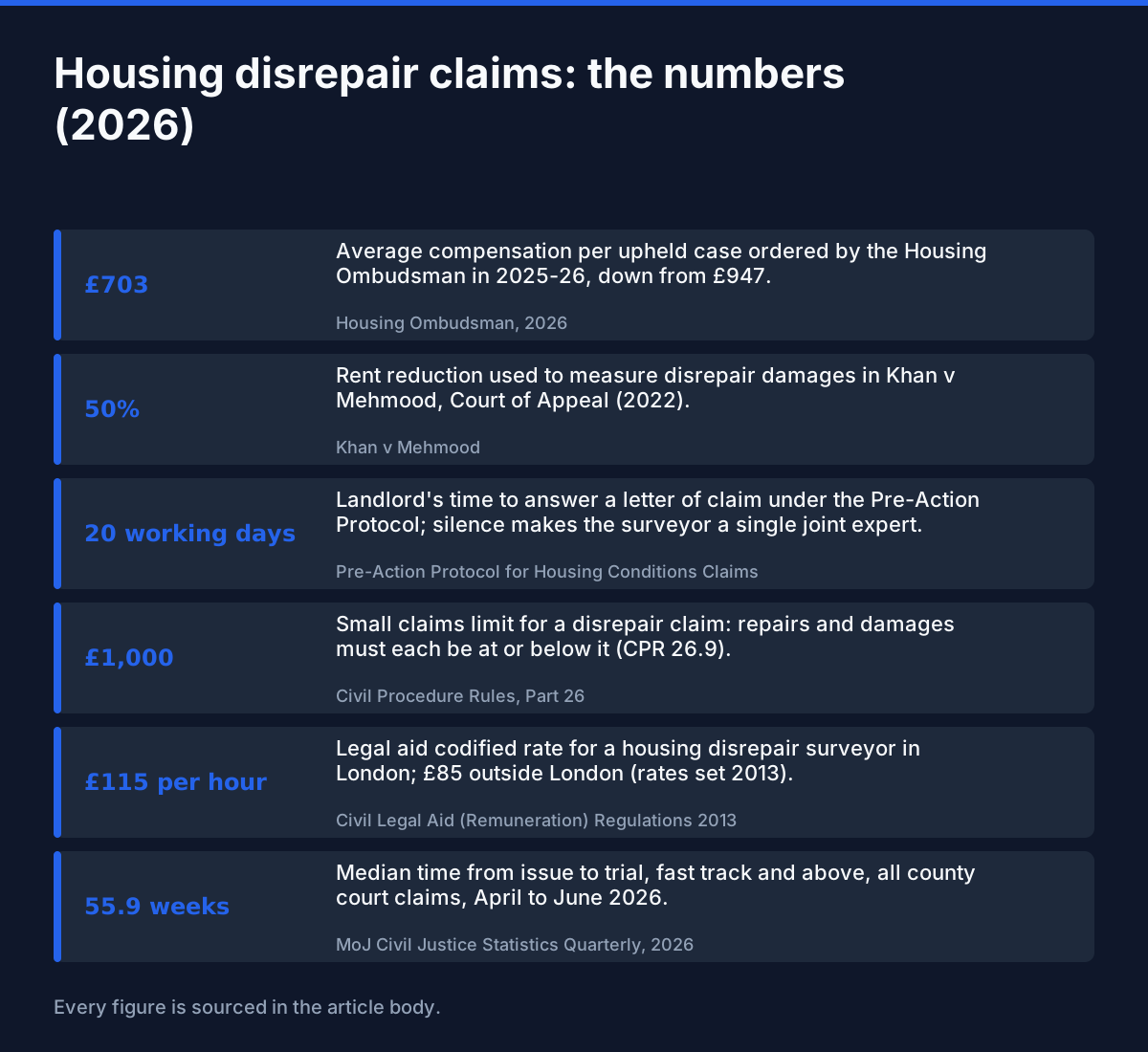
- → 50% Rent reduction used to measure general damages for disrepair in Khan v Mehmood, where the Court of Appeal also confirmed the ten per cent Simmons v Castle uplift applies to such awards (2022). (Khan v Mehmood, 2022)
- → 20 working days Time the Pre-Action Protocol gives a landlord to reply to a letter of claim; if it does not object to the proposed surveyor within that window, the surveyor is instructed as a single joint expert. (Housing Conditions Protocol, 2021)
- → £1,000 Small claims limit for a tenant's disrepair claim: both the estimated cost of repairs and any damages must be at or below this for the claim to stay in the no-costs track (CPR 26.9). (CPR Part 26, 2026)
- → £115 per hour Legal aid codified rate for a housing disrepair surveyor in London (£85 outside London), set in 2013 and still in force. (Legal aid remuneration regulations, 2013)
- → 392% Rise in disrepair claims against responding councils between 2020 and 2024 in a claimant law firm's freedom of information exercise, reported by Legal Futures; 78 of 317 English councils answered. (Legal Futures, 2024)
- → 30 November 2026 Date Awaab's Law phase two extends the social-landlord repair timescales from damp, mould and emergencies to seven further hazard groups. (MHCLG, 2026)
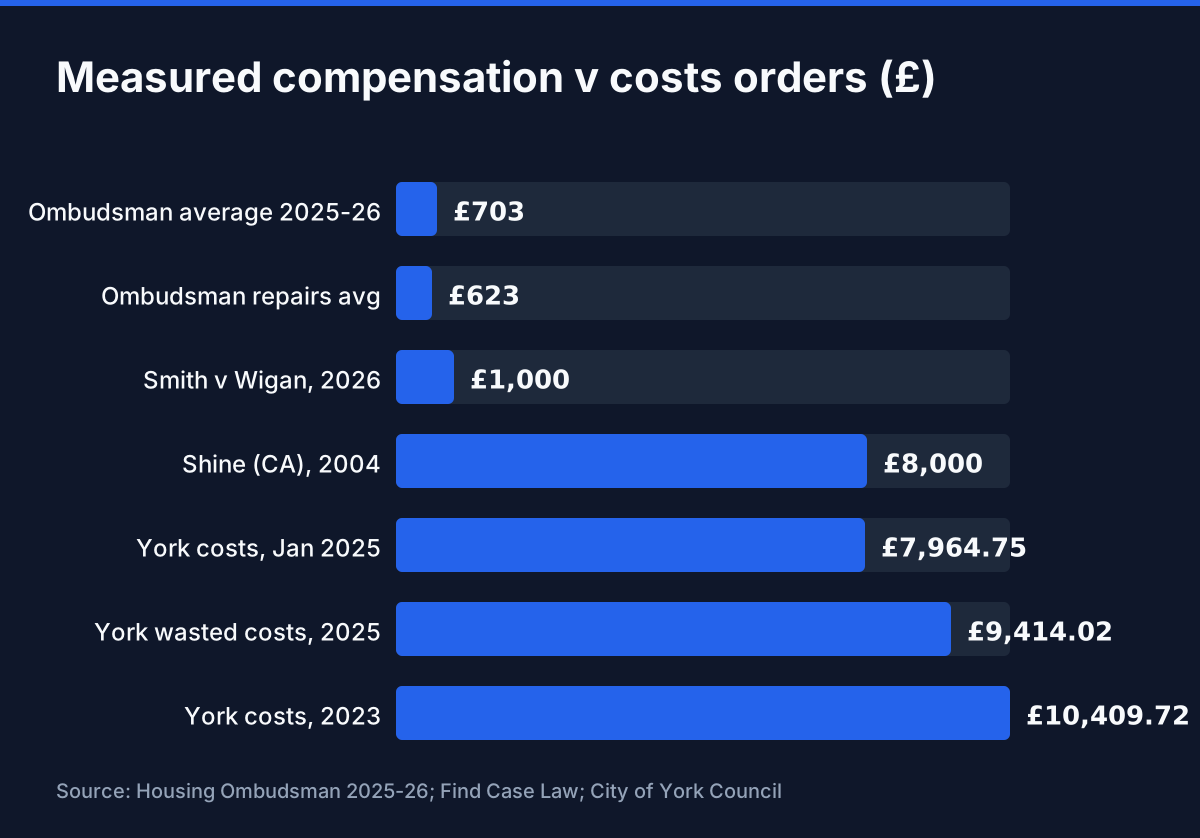
Nobody publishes what a housing disrepair claim is worth. The county courts keep no series of disrepair damages or settlements, so the figures that circulate are claimant-firm estimates with no visible source. The Housing Ombudsman ordered £4.8 million in compensation in the year to March 2026 at an average of £703 per upheld case, down from £947(Housing Ombudsman, Annual Complaints Review 2025-26, 2026). The courts measure general damages as a share of the rent, from a proposed 18% in a claim that settled at £1,000 plus repairs (Smith v Wigan, 2026) to 50% in the Court of Appeal (Khan v Mehmood, 2022). Costs surface only where they went wrong: £7,964.75 ordered against one unsuccessful tenant and £9,414.02 in wasted costs against a claimant firm (City of York Council, 2025).
This guide puts those numbers in one place for England and Wales: what complaints and claims resolve for, how damages are measured against rent, what the expert costs and when the Protocol says the report must arrive, what each side pays in fees and adverse costs, how long each route takes, and how large the problem is. It is written for the tenant weighing an offer, the landlord deciding whether to defend, and the solicitor or litigant in person instructing a housing disrepair expert witness. Every figure carries its source and year; older figures are dated, and law-firm research is labelled as such.
1 What Does a Housing Disrepair Complaint Resolve For? The Ombudsman's £703 Average
The only measured outcomes are the Housing Ombudsman's. In the year to March 2026 it made 8,783 determinations, upheld 62% of complaints, found severe maladministration 470 times and ordered £4.8 million in compensation, an average of £703 per upheld case (Housing Ombudsman, Annual Complaints Review 2025-26, 2026).
| HOUSING OMBUDSMAN MEASURE (YEAR TO MARCH 2026 UNLESS STATED) | VALUE | SOURCE |
|---|---|---|
| Determinations made | 8,783 | Housing Ombudsman |
| Category findings (up from the year before) | 20,016 | Housing Ombudsman |
| Complaints upheld | 62% | Housing Ombudsman |
| Complaints upheld, previous year | 71% | Housing Ombudsman |
| Severe maladministration findings | 470 | Housing Ombudsman |
| Severe maladministration findings, previous year | 714 | Housing Ombudsman |
| Severe maladministration findings about responsive repairs | 355 | Housing Ombudsman |
| Compensation ordered | £4.8 million | Housing Ombudsman |
| Compensation recommended in addition | £1.2 million | Housing Ombudsman |
| Average compensation per upheld case | £703 | Housing Ombudsman, Annual Complaints Review 2025-26 |
| Average compensation per upheld case, previous year | £947 | Housing Ombudsman |
| Average compensation, responsive repairs cases | £623 | Housing Ombudsman |
| Cases with a responsive repairs finding | 80% | Housing Ombudsman |
| Repairs complaints about condensation, damp and mould | 34% | Housing Ombudsman |
| Repairs complaints about leaks | 23% | Housing Ombudsman |
| Uphold rate, local authority landlords | 72% | Housing Ombudsman |
| Uphold rate, housing association landlords | 59% | Housing Ombudsman |
| Orders complied with on time | 99% | Housing Ombudsman |
| Households covered by member landlords | 5 million | Housing Ombudsman |
Two cautions before anyone treats £703 as the going rate. The Ombudsman is not the court: it investigates social tenants' complaints after the landlord's own procedure, awards on its own bands rather than the common law measure, and is closed to private tenants until the private-sector ombudsman expected in 2028(Renters' Rights Act roadmap, 2026). The direction is the clearest signal in the field: the uphold rate fell from 71% to 62%, severe maladministration from 714 to 470 and the average award from £947 to £703, in a year when findings rose to 20,016(Housing Ombudsman, 2026).
The composition matters to anyone instructing a surveyor. Responsive repairs featured in 80% of cases; within those, condensation, damp and mould made up 34% and leaks 23%, both upheld in more than three quarters of cases. Those are the defects where cause is contested, so a report that separates rising damp, penetrating damp and condensation, the method in the guide to how surveyors assess damp, decides most of what follows. Local authorities were found against more often than housing associations, 72% against 59%, and 99% of orders were complied with on time.
2 What Is a Disrepair Claim Worth in Court? Damages Measured as a Share of the Rent
Courts assess general damages for living with disrepair as a global sum cross-checked against the rent, not a fixed percentage. Reported measures run from a proposed 18% of an £80 weekly rent in Smith v Wigan, settled at £1,000 plus repairs (Smith v Wigan, 2026), to 50% in Khan v Mehmood, plus a 10% uplift (Khan v Mehmood, 2022).
| CASE OR GUIDANCE | FIGURE | SOURCE |
|---|---|---|
| Khan v Mehmood, Court of Appeal (2022): rent reduction used to value the disrepair | 50% | Khan v Mehmood |
| Khan v Mehmood (2022): monthly rent in the first year | £900 | Khan v Mehmood |
| Khan v Mehmood (2022): Simmons v Castle uplift confirmed for disrepair damages | 10% | Khan v Mehmood |
| English Churches v Shine, Court of Appeal (2004): damages for about seven years, substituted on appeal | £8,000 | English Churches v Shine |
| English Churches v Shine (2004): damages awarded by the trial judge | £19,000 | English Churches v Shine |
| English Churches v Shine (2004): average weekly rent | £50 | English Churches v Shine |
| English Churches v Shine (2004): the 'unofficial tariff' for discomfort, per year | £1,000 to £2,750 | English Churches v Shine |
| Smith v Wigan, Senior Courts Costs Office (2026): sum the claim settled for, plus repairs | £1,000 | Smith v Wigan |
| Smith v Wigan (2026): weekly rent | £80 | Smith v Wigan |
| Smith v Wigan (2026): rent diminution the claimant proposed | 18% | Smith v Wigan |
| Smith v Wigan (2026): claimant's original damages calculation | £1,304.96 | Smith v Wigan |
| Ombudsman loss-of-use measure: kitchen or bathroom, share of weekly rent | 30% | Housing Ombudsman guidance |
| Ombudsman loss-of-use measure: living room or bedroom, share of weekly rent | 20% | Housing Ombudsman guidance |
| Ombudsman loss-of-use measure: ceiling on the combined figure | 100% | Housing Ombudsman guidance |
| Ombudsman band: service failing with severe impact | £1,000+ | Housing Ombudsman guidance |
| Ombudsman band: service failing with moderate impact | Up to £600 | Housing Ombudsman guidance |
| Ombudsman rate: complete loss of heating or hot water | £15 per day | Housing Ombudsman guidance |
The method comes from Wallace v Manchester City Council (1998), restated in Shine (2004): the loss to a tenant who stays in occupation is "the loss of comfort and convenience" of living in the unrepaired home, expressed as a notional rent reduction, a global award for discomfort, or a mixture. In Shine the trial judge's £19,000 became £8,000 on appeal against a rent of about £50 a week, and the court recorded an "unofficial tariff" of £1,000 to £2,750 a year, now more than two decades old (English Churches v Shine, 2004). Khan v Mehmood (2022) marks the upper end: damages at 50% of a rent that began at £900 a month, with the 10% Simmons v Castle uplift applied.
The small case is the common case. Smith v Wigan (2026) involved a rent of £80 a week, a claimant calculation of £1,304.96 and a proposed diminution of around 18%; it settled at £1,000 plus repairs, and the fight moved to whether fast-track costs were recoverable (Smith v Wigan, 2026). The Ombudsman's February 2026 guidance is the only explicit scale written down since 2004: loss of use of a kitchen or bathroom at 30% of the weekly rent, a living room or bedroom at 20%, capped at 100%, plus bands of Up to £600 for a moderate service failing, £1,000+ for a severe one and £15 per day for a complete loss of heating or hot water (Housing Ombudsman guidance, 2026). Those are Ombudsman figures, not court awards; the period of disrepair the surveyor can evidence is the multiplier.
3 What Does the Expert Surveyor Cost, and When Must the Report Arrive?
The Protocol makes the surveyor a single joint expert by default if the landlord does not object within 20 working days of the letter of claim, requires inspection within 20 working days of the landlord's response and the report 10 working days after that, and splits the fee one half each (Housing Conditions Protocol, 2021). The only published rates are legal aid's, set in 2013.
| METRIC | VALUE | SOURCE |
|---|---|---|
| Protocol: landlord's time to reply to the letter of claim and object to the proposed expert | 20 working days | Housing Conditions Protocol |
| Protocol: property to be inspected after the landlord's response | 20 working days | Housing Conditions Protocol |
| Protocol: single joint expert's report sent to both parties after inspection | 10 working days | Housing Conditions Protocol |
| Protocol: each party's share of a single joint expert's inspection and report | one half | Housing Conditions Protocol |
| Legal aid codified rate, housing disrepair surveyor, outside London (set 2013) | £85 per hour | Legal aid remuneration regulations |
| Legal aid codified rate, housing disrepair surveyor, London (set 2013) | £115 per hour | Legal aid remuneration regulations |
| Average expert hourly rate, civil courts, all disciplines (Bond Solon 2025) | £253.73 | Bond Solon |
| Average expert hourly rate, all courts (Bond Solon 2025) | £238.81 | Bond Solon |
| Experts responding to the Bond Solon 2025 survey | 525 | Bond Solon |
| Lancastle v Curo (2025): tenant expert's repair estimate against a landlord estimate under the small claims limit | £2,760 | Lancastle v Curo |
| Lancastle v Curo (2025): expert's repair estimate in the second claim, later pleaded lower | £2,901 | Lancastle v Curo |
| Lancastle v Curo (2025): level to which the judge suggested the small claims threshold be revised | £3,000 | Lancastle v Curo |
| Lancastle v Curo (2025): window for the landlords' written questions to the expert, at the claimants' cost | 28 days | Lancastle v Curo |
| RICS practice alert on expert witnesses in housing disrepair and other high-volume cases | April 2025 | RICS |
No regulator publishes what disrepair surveyors charge; the figures above are the nearest published markers. The legal aid rates of £85 per hour outside London and £115 per hour in London are maximums for publicly funded work, set in December 2013 and never revised (Legal aid remuneration regulations, 2013); Bond Solon's survey of 525 experts put the civil-court average across every discipline at £253.73 an hour in 2025 (Bond Solon, 2025). The site's pages on expert witness costs and on what a housing disrepair expert report must show explain what drives a private quote. A single joint expert's fee is shared one half each; a party who insists on its own expert pays in full.
Timing is where the money is lost. In Lancastle v Curo (2025) the tenants' solicitors instructed their expert before the landlord's extended deadline had passed; the judge found Protocol breaches, including failing to give the expert the landlord's response, "at best a blunder that risks rendering the expert's evidence useless", and ordered that the claimants could not recover the expert's cost whatever the outcome (Lancastle v Curo, 2025). The estimates tell the second story: £2,760 for works the landlord put under the small claims limit, £2,901 in the other claim, and a judicial suggestion that the threshold should now be £3,000; the landlords were also given 28 days to put Part 35 questions to the expert at the claimants' expense. RICS's practice alert of April 2025 names the same pressures from the surveyor's side: pre-populated templates, fees tied to outcome, one expert across many claims (RICS, 2025). The report that survives is the one in the guide to the single joint expert: instructed through the Protocol, on a disclosed fee, after the landlord has replied.
4 What Are the Legal Costs, and Who Ends Up Paying Them?
A disrepair claim is a small claim only if repairs and damages are each at or below £1,000; above that it is fast track, band 4, and excluded from fixed recoverable costs by rule 45.1(4)(CPR Part 45, 2026), an exemption the Ministry of Justice has said runs to October 2028. Losing costs money: £7,964.75 and £10,409.72 against York tenants, £9,414.02 against a firm (City of York Council, 2025).
| METRIC | VALUE | SOURCE |
|---|---|---|
| Small claims limit for a disrepair claim: repairs and damages must each be at or below | £1,000 | CPR Part 26 |
| Fast track upper limit | £25,000 | CPR Part 26 |
| Intermediate track upper limit | £100,000 | CPR Part 26 |
| Fast track complexity band for complex possession and housing disrepair claims | band 4 | CPR Part 26 |
| Rule excluding residential disrepair claims from fixed recoverable costs | rule 45.1(4) | CPR Part 45 |
| Original delay to fixed costs for housing claims, from October 2023 | two years | Ministry of Justice |
| Date to which the Ministry of Justice has said the housing exemption runs, per its letter to housing practitioners | October 2028 | Anthony Collins Solicitors |
| Costs ordered against an unsuccessful York disrepair claimant, January 2025 | £7,964.75 | City of York Council |
| Costs in an unsuccessful no-win-no-fee claim against York, 2023 | £10,409.72 | City of York Council |
| Wasted costs ordered against a claimant firm after a failed York claim, July 2025 | £9,414.02 | City of York Council |
| Court issue fee, money claim just above the small claims limit | £80 | HMCTS fees EX50 |
| Court issue fee, money claim in the five-to-ten-thousand band | £455 | HMCTS fees EX50 |
| Court issue fee, county court claim for a non-money remedy such as an order for repairs | £387 | HMCTS fees EX50 |
| Fast track hearing fee | £619 | HMCTS fees EX50 |
| Small claims hearing fee, claim over three thousand pounds | £346 | HMCTS fees EX50 |
| Fee for an application on notice | £321 | HMCTS fees EX50 |
| Increase in housing and debt legal aid spending announced July 2025 | 24% | Ministry of Justice |
| Success fee cap from personal injury reform cited in the call for evidence as a possible model | 25% | MHCLG and MoJ call for evidence |
| Claims defended as a share of county court claims issued, April to June 2026 | 14% | MoJ Civil Justice Statistics |
| Closing date of the call for evidence on claims management in disrepair | 12 February 2026 | MHCLG and MoJ call for evidence |
Track allocation decides everything about costs. A disrepair claim stays in the small claims track, where each side bears its own costs, only if both the estimated repair cost and the damages are at or below £1,000; above that it goes to the fast track, up to £25,000, or the intermediate track, up to £100,000, with complex disrepair claims in band 4(CPR Part 26, 2026). The government's call for evidence says recoverable costs "can also encourage unmeritorious claims to be made as defendants can often choose to settle such claims rather than risk the expense of fighting"(MHCLG and MoJ call for evidence, 2025), which is why it floated raising the small claims limit and banning referral fees; the call closed on 12 February 2026 and no response had been published at the start of October 2026.
Fixed recoverable costs do not apply. rule 45.1(4) excludes any claim that includes residential disrepair from the fast and intermediate track fixed costs; the Ministry of Justice delayed them for housing by two years from October 2023 and then, in a letter reported by Anthony Collins Solicitors, extended the exemption to October 2028(Anthony Collins Solicitors, 2025). A defended claim is costed on the standard basis, which is what took Smith v Wigan to the costs office over a £1,000 settlement. The reader asking who pays expert witness fees gets the same answer: the loser, above the small claims line, subject to the Protocol breaches that can strip the fee away. The cases that go wrong are the no-win-no-fee ones: York reported £10,409.72 and £7,964.75 against tenants and £9,414.02 against their solicitors (City of York Council, 2025). Only 14% of county court claims are defended at all (MoJ Civil Justice Statistics, 2026); the rest settle, privately. Where the parties want a figure without a trial, an expert's report used in mediation is usually the cheaper route.
5 How Long Does a Housing Disrepair Claim Take?
The Protocol stage runs on working days: 20 working days for the landlord's response, 20 working days to inspect, 10 working days for the report (Housing Conditions Protocol, 2021). Issued claims run on quarters: the median time from issue to trial was 41.0 weeks for small claims and 55.9 weeks for fast track and above in April to June 2026, across all claim types (MoJ Civil Justice Statistics, 2026).
| STAGE OR MEASURE | TIME | SOURCE |
|---|---|---|
| Protocol: landlord's response to the letter of claim | 20 working days | Housing Conditions Protocol |
| Protocol: inspection after the landlord's response | 20 working days | Housing Conditions Protocol |
| Protocol: single joint expert's report after inspection | 10 working days | Housing Conditions Protocol |
| Median time from issue to trial, small claims, April to June 2026 (all claim types) | 41.0 weeks | MoJ Civil Justice Statistics |
| Median time from issue to trial, fast, intermediate and multi track, April to June 2026 (all claim types) | 55.9 weeks | MoJ Civil Justice Statistics |
| County court claims issued, April to June 2026 | 571,000 | MoJ Civil Justice Statistics |
| Claims that went to trial, April to June 2026 | 12,000 | MoJ Civil Justice Statistics |
| Awaab's Law: investigate and make safe an emergency hazard | 24 hours | MHCLG guidance |
| Awaab's Law: investigate a potential significant hazard | 10 working days | MHCLG guidance |
| Awaab's Law: written summary after the investigation | 3 working days | MHCLG guidance |
| Awaab's Law: safety work after the investigation concludes | 5 working days | MHCLG guidance |
| Awaab's Law: longer-term work physically started | 12 weeks | MHCLG guidance |
| Awaab's Law phase one in force (emergency hazards, damp and mould) | 27 October 2025 | MHCLG guidance |
| Awaab's Law phase two in force (seven further hazard groups) | 30 November 2026 | MHCLG |
| Awaab's Law phase three (all remaining HHSRS hazards except overcrowding) | 2027 | MHCLG guidance |
| Limitation period for a disrepair claim (three years where personal injury is claimed), per Shelter | 6 years | Shelter |
Three clocks run in a disrepair claim. The first is the Protocol's: the landlord has 20 working days to reply and to object to the proposed surveyor, failing which the surveyor becomes the single joint expert; inspection follows within 20 working days of that reply and the report within 10 working days of the inspection, so a compliant pre-action stage is measured in weeks (Housing Conditions Protocol, 2021), provided the letter of instruction is drawn as the guide to instructing an expert witness surveyor describes. The second is the court's: a median of 41.0 weeks from issue to trial for small claims and 55.9 weeks for the fast, intermediate and multi tracks in April to June 2026, across 571,000 claims issued and 12,000 trials of every kind (MoJ Civil Justice Statistics, 2026).
The third clock binds social landlords only. Since 27 October 2025, Awaab's Law has required them to investigate an emergency hazard and make the home safe within 24 hours, to investigate other potential significant hazards within 10 working days, to give a written summary within 3 working days, to carry out safety work within 5 working days of the investigation concluding and to start longer-term work within 12 weeks(MHCLG guidance, 2025). Phase two extends the timescales to excess cold and heat, falls, structural collapse, fire, electrical and hygiene hazards from 30 November 2026(MHCLG, 2026), and phase three reaches the remaining hazards in 2027. The requirement is implied into the tenancy, so a breach is actionable through the same Protocol and the surveyor's dating of when the landlord knew becomes the central question. A claim must be brought within 6 years of the breach, or three where personal injury is claimed, according to Shelter (Shelter, 2025).
6 How Big Is the Problem? Homes, Claims and Complaints by the Numbers
In 2024, 15% of English dwellings, 4.0 million, failed the Decent Homes Standard, rising to 22% in the private rented sector against 10% in social housing, and 5% of all homes had a damp problem (English Housing Survey, 2024). A claimant law firm's freedom of information research found claims against responding councils rose from 1,829 to 8,999 a year between 2020 and 2024 (Legal Futures, 2024).
| METRIC | VALUE | SOURCE |
|---|---|---|
| Dwellings failing the Decent Homes Standard, England, 2024 | 15% | English Housing Survey |
| Number of non-decent dwellings, 2024 | 4.0 million | English Housing Survey |
| Private rented dwellings that were non-decent, 2024 | 22% | English Housing Survey |
| Social rented dwellings that were non-decent, 2024 | 10% | English Housing Survey |
| Dwellings with a damp problem, 2024 | 5% | English Housing Survey |
| Private rented dwellings with a damp problem, 2024 | 10% | English Housing Survey |
| Social rented dwellings with a damp problem, 2024 | 7% | English Housing Survey |
| Dwellings with a category one HHSRS hazard, 2024 | 9% | English Housing Survey |
| Disrepair claims a year against responding councils, 2020 (law-firm FOI research) | 1,829 | Legal Futures |
| Disrepair claims a year against responding councils, 2024 (law-firm FOI research) | 8,999 | Legal Futures |
| Rise in claims over the period (law-firm FOI research) | 392% | Legal Futures |
| Responding councils' reported disrepair legal spend over the period (law-firm FOI research) | £25 million | Legal Futures |
| Councils that answered, of all councils in England | 78 | Legal Futures |
| Tenant satisfaction with the repairs service, median landlord, year to March 2025 | 73.6% | Regulator of Social Housing |
| Tenant satisfaction with complaints handling, median landlord, year to March 2025 | 35.5% | Regulator of Social Housing |
| Stage one complaints per thousand homes, median landlord, year to March 2025 | 53.5 | Regulator of Social Housing |
| Non-emergency repairs completed within target, median landlord, year to March 2025 | 82.5% | Regulator of Social Housing |
| Renters' Rights Act tenancy reforms in force | 1 May 2026 | Renters' Rights Act roadmap |
| Private-sector landlord ombudsman: expected year membership becomes mandatory | 2028 | Renters' Rights Act roadmap |
| Updated Decent Homes Standard: years proposed for coming into force | 2035 or 2037 | Renters' Rights Act roadmap |
| Maximum civil penalty for certain housing offences under the Renters' Rights Act | £40,000 | Renters' Rights Act roadmap |
| Homes (Fitness for Human Habitation) Act in force | 20 March 2019 | MHCLG |
| Awaab's Law power (Social Housing (Regulation) Act, section forty-two) in force | 20 September 2023 | legislation.gov.uk |
The stock explains the caseload. The English Housing Survey for 2024 found 15% of dwellings, 4.0 million, below the Decent Homes Standard, 22% in the private rented sector against 10% in the social sector; 5% of all homes had a damp problem, rising to 10% of private rented and 7% of social rented homes, and 9% carried a category one hazard (English Housing Survey, 2024). The Regulator's tenant satisfaction measures for the year to March 2025 show the median social landlord with 73.6% of tenants satisfied with repairs but only 35.5% satisfied with complaints handling, 53.5 stage one complaints per thousand homes and 82.5% of non-emergency repairs completed within target (Regulator of Social Housing, 2025).
The claim volumes are less secure. The only count anyone has produced is Pabla and Pabla's freedom of information exercise, reported by Legal Futures in November 2025: among the 78 councils that answered, annual claims rose from 1,829 to 8,999, a rise of 392%, with roughly £25 million spent on disrepair legal costs in figures that did not separate compensation, adverse costs and the councils' own fees (Legal Futures, 2024). It is a claimant firm's sample. The law has moved faster than the data: the Fitness for Human Habitation Act since 20 March 2019(MHCLG, 2019), the Awaab's Law power since 20 September 2023, the Renters' Rights Act's tenancy reforms from 1 May 2026, civil penalties of up to £40,000, a private-sector ombudsman expected in 2028, and a Decent Homes Standard consulted on for 2035 or 2037, with Awaab's Law for the private sector still subject to consultation on the roadmap updated at the start of October 2026 (Renters' Rights Act roadmap, 2026). Each change adds weight to the question a CPR Part 35 expert report exists to answer: what the hazard is, what caused it, when the landlord knew, and what it costs to put right.
Explore every figure in this article
Methodology
This page was researched on the second of October 2026 from primary sources: the Housing Ombudsman's Annual Complaints Review for the year to March 2026 and its compensation guidance of February 2026; judgments on The National Archives' Find Case Law service (Khan v Mehmood, English Churches Housing Group v Shine, Smith v Wigan Borough Council and Lancastle v Curo); the Pre-Action Protocol for Housing Conditions Claims and Parts 26 and 45 of the Civil Procedure Rules on justice.gov.uk, with the Ministry of Justice's 2023 note on fixed recoverable costs; the Civil Legal Aid (Remuneration) Regulations 2013 and the Social Housing (Regulation) Act 2023 on legislation.gov.uk; the English Housing Survey, the Regulator of Social Housing's tenant satisfaction measures, the Civil Justice Statistics Quarterly, the civil court fee schedule, the Awaab's Law guidance and phase-two announcement, the Renters' Rights Act roadmap and the MHCLG and Ministry of Justice call for evidence, all on gov.uk; a ministerial written statement on legal aid fees; the RICS practice alert of April 2025; the Bond Solon expert witness survey 2025; and two City of York Council statements on costs orders. Four figures rest on secondary sources and are named as such in the text: the claim-volume rise, the claim counts and the spend figure from Pabla and Pabla's freedom of information research as reported by Legal Futures; the extension of the fixed-costs exemption to October 2028, which comes from a Ministry of Justice letter to the Housing Law Practitioners Association reported by Anthony Collins Solicitors; and the limitation period, taken from Shelter. Pre-2025 figures, including the 2013 legal aid rates and the 2004 tariff, are dated in the text and in the tables. The recency sweep that preceded the research ran across Reddit, YouTube, TikTok and the open web over a ninety-day window; its YouTube leg was marked unreliable by the sweep's own relevance guard on every query and was discounted, while the Reddit, TikTok and web legs ran at full strength and surfaced the September 2026 Ombudsman review and the October 2026 roadmap update used here. Every source URL was fetched and checked by the automated verification script on the second of October 2026: all hosts were reachable and each figure was located in the page text, except that figures held inside PDF documents, which the script cannot read, were confirmed by extracting the PDF text and locating the exact value; a small number of hosts that block automated requests were confirmed by opening the page directly. That check is recorded against every fact in the fact sheet. The hero image was rendered by an image model from a text-free composition brief; the statistics card and the comparison chart were drawn locally from the fact sheet so that every number on them is the fact sheet's own. No court or government body publishes a series of housing disrepair damages, settlements or claim volumes, so the Ombudsman figures describe complaints rather than county court claims, the reported judgments are the handful that reached a published decision, the time-to-trial and court-fee figures cover all claim types, and the Bond Solon hourly average covers every expert discipline.
- Sources consulted: 44
- Sources cited: 31
- Data freshness: 2026: 50, 2025: 28, 2024 and older: 31
- Data range: 2004-04-07 to 2026-10-01
- Research date: 2026-10-02
- Update schedule: Quarterly, next with the Civil Justice Statistics for July to September 2026 and any government response to the December 2025 call for evidence
- Limitations: No court or government body publishes a series of housing disrepair damages, settlements or claim volumes. The Housing Ombudsman figures describe complaints to the Ombudsman, not county court claims; the reported judgments are the handful that reached a published decision; the claim-volume rise and the £25 million spend come from a claimant law firm's freedom of information exercise answered by 78 of 317 councils and are labelled as such; the legal aid surveyor rates date from 2013; the Bond Solon hourly average covers every expert discipline; and the Ministry of Justice time-to-trial figures cover all county court claims, not disrepair alone.
Sources & References
- Housing Ombudsman. "Housing Ombudsman, Annual Complaints Review 2025-26." housing-ombudsman.org.uk/annual-complaint-review-reports/annual-complaints-revie. Accessed 2026-10-02.
- Housing Ombudsman. "Housing Ombudsman, Annual Complaints Review 2025-26 (announcement)." housing-ombudsman.org.uk/2026/09/15/housing-ombudsmans-annual-complaints-review-. Accessed 2026-10-02.
- Housing Ombudsman guidance. "Housing Ombudsman, compensation guidance (February 2026)." housing-ombudsman.org.uk/landlords-info/guidance-notes/compensation-guidance/. Accessed 2026-10-02.
- Khan v Mehmood. "Khan v Mehmood [2022] EWCA Civ 791." caselaw.nationalarchives.gov.uk/ewca/civ/2022/791. Accessed 2026-10-02.
- English Churches v Shine. "English Churches Housing Group v Shine [2004] EWCA Civ 434." caselaw.nationalarchives.gov.uk/ewca/civ/2004/434. Accessed 2026-10-02.
- Smith v Wigan. "Smith v Wigan Borough Council [2026] EWHC 660 (SCCO)." caselaw.nationalarchives.gov.uk/ewhc/scco/2026/660. Accessed 2026-10-02.
- Lancastle v Curo. "Lancastle v Curo Group (Albion) Ltd [2025] EWCC 48." caselaw.nationalarchives.gov.uk/ewcc/2025/48. Accessed 2026-10-02.
- Housing Conditions Protocol. "Pre-Action Protocol for Housing Conditions Claims (England)." justice.gov.uk/courts/procedure-rules/civil/protocol/prot_hou. Accessed 2026-10-02.
- CPR Part 26. "Civil Procedure Rules, Part 26." justice.gov.uk/courts/procedure-rules/civil/rules/part26. Accessed 2026-10-02.
- CPR Part 45. "Civil Procedure Rules, Part 45." justice.gov.uk/courts/procedure-rules/civil/rules/part45-fixed-costs. Accessed 2026-10-02.
- Ministry of Justice. "Ministry of Justice, Extending Fixed Recoverable Costs: a note on the new rules (May 2023)." justice.gov.uk/__data/assets/pdf_file/0011/177644/frc-public-notice-updated.pdf. Accessed 2026-10-02.
- Anthony Collins Solicitors. "Anthony Collins Solicitors, reporting the Ministry of Justice's letter to the Housing Law Practitioners Association." anthonycollins.com/blog/102kq77/disrepair-claims-fixed-recoverable-costs-exempti. Accessed 2026-10-02.
- Legal aid remuneration regulations. "Civil Legal Aid (Remuneration) Regulations 2013, Schedule 5." legislation.gov.uk/uksi/2013/422/schedule/5. Accessed 2026-10-02.
- Bond Solon. "Bond Solon Expert Witness Survey 2025." bondsolon.com/media/knsjspbj/expert-witness-survey-2025.pdf. Accessed 2026-10-02.
- RICS. "RICS practice alert, expert witnesses in housing disrepair (April 2025)." rics.org/content/dam/ricsglobal/documents/regulation/HDR-expert-witness-practice. Accessed 2026-10-02.
- City of York Council. "City of York Council, 31 January 2025." york.gov.uk/news/article/1615/court-charges-tenant-7-964-75-for-failed-disrepair. Accessed 2026-10-02.
- City of York Council. "City of York Council, 10 July 2025." york.gov.uk/news/article/1719/solicitor-to-pay-9k-after-failed-disrepair-claim. Accessed 2026-10-02.
- HMCTS fees EX50. "HM Courts and Tribunals Service, civil court fees EX50 (from 13 July 2026)." gov.uk/government/publications/fees-in-the-civil-and-family-courts-main-fees-ex5. Accessed 2026-10-02.
- Ministry of Justice. "Ministry of Justice written statement, 2 July 2025." questions-statements.parliament.uk/written-statements/1818610. Accessed 2026-10-02.
- MHCLG and MoJ call for evidence. "MHCLG and Ministry of Justice, call for evidence on housing disrepair claims (December 2025)." gov.uk/government/calls-for-evidence/housing-disrepair-claims/housing-disrepair-. Accessed 2026-10-02.
- MHCLG and MoJ call for evidence. "MHCLG and Ministry of Justice, call for evidence on housing disrepair claims." gov.uk/government/calls-for-evidence/housing-disrepair-claims. Accessed 2026-10-02.
- MoJ Civil Justice Statistics. "Ministry of Justice, Civil Justice Statistics Quarterly, April to June 2026." gov.uk/government/statistics/civil-justice-statistics-quarterly-april-to-june-20. Accessed 2026-10-02.
- MHCLG guidance. "MHCLG, Awaab's Law guidance for social landlords (updated July 2026)." gov.uk/government/publications/awaabs-law-guidance-for-social-landlords/awaabs-l. Accessed 2026-10-02.
- MHCLG. "MHCLG, Awaab's Law phase two announcement (13 July 2026)." gov.uk/government/news/safer-homes-for-4m-tenants-with-quicker-action-on-dangero. Accessed 2026-10-02.
- English Housing Survey. "English Housing Survey 2024-25, housing quality." gov.uk/government/statistics/chapters-for-english-housing-survey-2024-to-2025-he. Accessed 2026-10-02.
- Legal Futures. "Legal Futures, reporting Pabla and Pabla's FOI research (November 2025)." legalfutures.co.uk/latest-news/foi-data-shows-big-rises-in-housing-disrepair-cla. Accessed 2026-10-02.
- Regulator of Social Housing. "Regulator of Social Housing, Tenant Satisfaction Measures 2024-25." gov.uk/government/statistics/tenant-satisfaction-measures-202425/tenant-satisfac. Accessed 2026-10-02.
- Renters' Rights Act roadmap. "MHCLG, Renters' Rights Act 2025 implementation roadmap (updated 1 October 2026)." gov.uk/government/publications/renters-rights-act-2025-implementation-roadmap/im. Accessed 2026-10-02.
- MHCLG. "MHCLG, guide to the Homes (Fitness for Human Habitation) Act 2018." gov.uk/government/publications/homes-fitness-for-human-habitation-act-2018/guide. Accessed 2026-10-02.
- legislation.gov.uk. "Social Housing (Regulation) Act 2023, section 42." legislation.gov.uk/ukpga/2023/36/section/42. Accessed 2026-10-02.
- Shelter. "Shelter, compensation for poor repairs and conditions." england.shelter.org.uk/housing_advice/repairs/compensation_for_disrepair_and_poo. Accessed 2026-10-02.
Last updated: