Valuation
Jul 16, 2026
Help to Buy valuation: what you need to know
Learn everything about the help to buy valuation process. Discover how it affects your equity loan repayments and save money today!

A Help to Buy valuation is a mandatory, RICS-approved property assessment that determines the current market value of your home for the purpose of calculating your equity loan repayment. The repayment is not fixed at your original purchase price. It is calculated as a percentage of whichever is greater: the current market valuation or your sale price. Homes England, the government body administering the scheme, requires this valuation before authorising any repayment or redemption. With demand for RICS valuations rising in 2026 as thousands of buyers reach their five-year equity loan anniversary, understanding the process now could save you significant time and money.
A Help to Buy scheme valuation is not the same as a standard estate agent appraisal or an automated online estimate. Homes England will only accept a valuation carried out by a fully independent, RICS-qualified surveyor. This distinction matters because the figure produced directly determines how much you repay on your equity loan.
The RICS valuation requirements are specific and non-negotiable:
Estate agent valuations fail these criteria because agents have a commercial interest in the transaction. Automated valuations, such as those produced by online portals, do not involve a physical inspection and are therefore not accepted. Only a formal RICS property valuation meets the standard required by Homes England.
Pro Tip: Book your RICS surveyor at least four to six weeks before you anticipate needing the report. Qualified surveyors with Help to Buy experience are in high demand, particularly during busy transaction periods.

The repayment calculation under the Help to Buy equity loan scheme follows a straightforward but often misunderstood rule. Repayments are based on the current market valuation or the agreed sale price, whichever is the greater figure, multiplied by your original loan percentage.
For most buyers outside London, the equity loan was 20% of the purchase price. For buyers in London, it was 40%. Those percentages apply to the current value, not the price you originally paid. This means:
“The repayment amount is not fixed. It moves with the market, which means a property that has risen significantly in value will result in a considerably larger repayment than the original loan figure.”
This is the aspect of the scheme that surprises many homeowners most. If you borrowed £40,000 on a £200,000 property and the home is now worth £280,000, your repayment on a 20% loan is £56,000, not £40,000. The RICS valuation is the mechanism that establishes this figure with legal certainty.
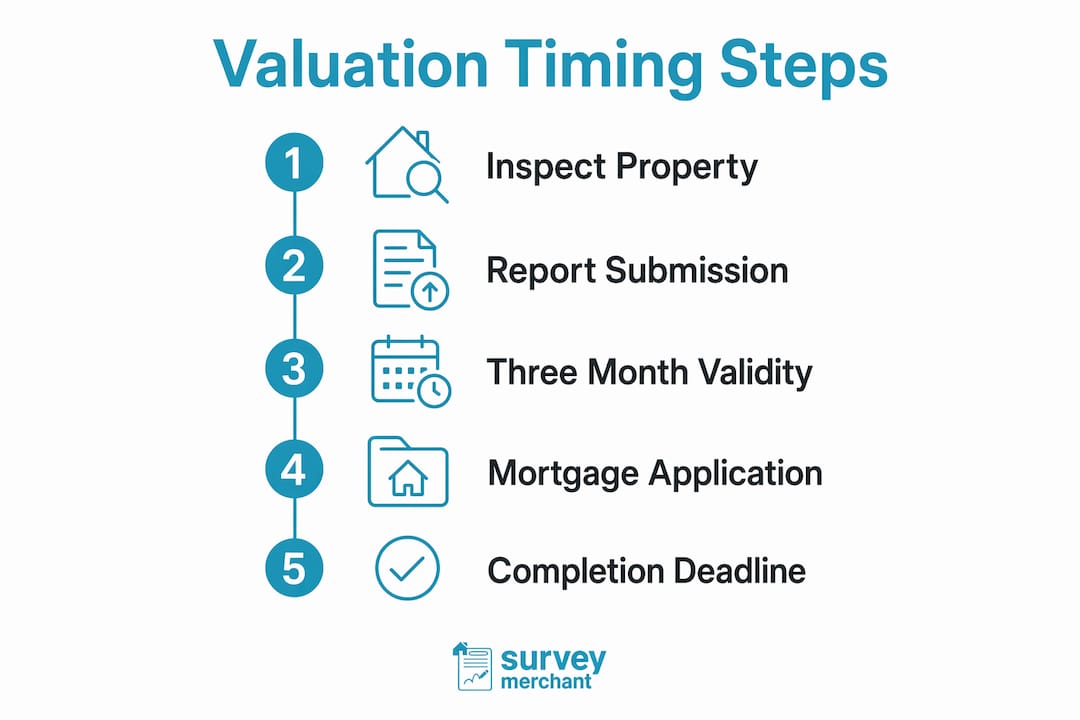
Timing is the single most misunderstood aspect of the property valuation for Help to Buy. The rules are strict, and missing a deadline can mean commissioning an entirely new valuation at additional cost.
| Timing rule | Detail |
|---|---|
| Valuation validity period | Three months from the date of the physical inspection |
| Submission deadline | Report must be submitted to Homes England within five working days of receipt |
| Desktop valuation window | Available after three months if the original surveyor updates the report with current comparable data |
| Full re-inspection required | If six months pass without completion, a completely new valuation must be commissioned |
| Authority to Complete timing | The ATC must align with your solicitor’s completion timetable |
The three-month validity window sounds generous, but it disappears quickly once legal processes, mortgage applications, and Homes England administration are factored in. Solicitors typically need several weeks to prepare the required undertakings, and mortgage lenders have their own processing timelines.
If your transaction runs beyond three months, a desktop valuation may be accepted. However, this is not simply a market report. The desktop valuation must be conducted by the same surveyor who carried out the original inspection, with reference to the original report and updated comparable sales data. If the original surveyor is unavailable, a full re-inspection is required.
Pro Tip: Coordinate your valuation booking date with your solicitor and mortgage adviser before instructing a surveyor. Aligning all three parties from the start is the most reliable way to keep the transaction within the three-month window.
Homeowners reaching their five-year anniversary face a decision point: sell the property, staircase by repaying part of the equity loan, or remortgage while retaining the loan. Each route requires a RICS valuation, and each has different timing pressures. Preparing early makes the difference between a smooth process and a costly delay.
The practical steps to manage your Help to Buy property assessment effectively are:
The remortgage route is often underestimated in complexity. When you remortgage without repaying the equity loan, the new lender must consent to the existing Homes England charge remaining on the property. This requires its own administrative process, and the RICS valuation is still needed to confirm the current equity position. A RICS valuation for Help to Buy is therefore relevant whether you are selling, staircasing, or simply switching mortgage products.
A Help to Buy valuation is a RICS-certified, independent property assessment that determines your equity loan repayment based on current market value, not your original purchase price.
| Point | Details |
|---|---|
| RICS valuation is mandatory | Only an independent RICS surveyor with a physical inspection meets Homes England’s requirements. |
| Repayment moves with the market | You repay the original loan percentage of the current value or sale price, whichever is greater. |
| Three-month validity window | The valuation expires three months after inspection; submit to Homes England within five working days. |
| Staircasing needs separate valuations | Each partial repayment step requires its own RICS valuation, valid for three months. |
| Early planning prevents extra costs | Coordinating surveyor, solicitor, and lender timelines from the start avoids repeat valuations. |
The most consistent problem I see with Help to Buy valuations is not the valuation itself. It is the assumption that the valuation is the last step rather than the first. Homeowners instruct a surveyor after they have already accepted an offer or confirmed a remortgage in principle, leaving almost no margin within the three-month window for the legal and administrative work that follows.
The five-working-day submission rule catches people off guard every time. You receive the report, assume you have time to review it, pass it to your solicitor, and then discover that Homes England’s clock started the moment the report was dated. Solicitors who are unfamiliar with Help to Buy redemptions sometimes add to the delay by treating the submission as a routine step rather than a deadline.
My strong recommendation is to treat the valuation as the trigger for everything else, not the conclusion of your preparation. Book the surveyor the moment you have a realistic transaction date in mind. Brief your solicitor on the five-day rule before the report arrives. And if you are staircasing, do not attempt to manage multiple valuation windows simultaneously without a clear written schedule shared across all parties.
The financial stakes are real. A missed window means a repeat valuation fee, potential delays to your mortgage offer, and in some cases a renegotiation of the sale. None of these outcomes are inevitable with proper coordination. The homeowners who navigate this process without difficulty are almost always the ones who started planning three months before they needed to.
— Surveymerchant

Surveymerchant connects you with accredited RICS surveyors who specialise in Help to Buy valuations across the UK. Every surveyor in the network understands Homes England’s specific report requirements, including the comparable property criteria and the signed, headed-paper format that administrators require. Booking through Surveymerchant means you receive a compliant valuation report that will not be rejected on technical grounds. Transparent pricing and straightforward online booking make it simple to schedule your inspection well within the required window. Whether you are selling, remortgaging, or staircasing, explore Surveymerchant’s RICS valuation services to get started with a qualified surveyor today.
A Help to Buy valuation is a formal RICS-approved property assessment carried out by an independent, qualified surveyor to establish the current market value of your home. Homes England uses this figure to calculate how much you owe when repaying your equity loan.
Estate agent valuations are not accepted because agents have a commercial interest in the transaction and do not conduct the physical inspection or comparable analysis required by Homes England. Only a RICS-qualified, independent surveyor meets the scheme’s criteria.
The valuation is valid for three months from the date of the physical inspection. You must submit the report to Homes England within five working days of receiving it.
If the three-month window passes, the original surveyor may be able to produce a desktop valuation update using current comparable data. If six months have elapsed without completion, a full new inspection is required, which incurs additional cost and time.
Yes. Each partial repayment increment under the staircasing process requires its own RICS valuation, valid for three months from the inspection date. Repayments must be made in minimum increments of 10% of the outstanding equity loan.
Survey Merchant provides vetted RICS surveyors across 100+ UK locations at fixed fees:
→ Level 2 Home Survey (HomeBuyer Report)
→ Level 3 Building Survey (full structural survey)
→ RICS Red Book property valuations
→ Party wall surveyors — notices, awards & schedules of condition
→ Expert witness surveyors — CPR Part 35 reports for property disputes