Valuation
Jul 16, 2026
RICS Valuation for Help to Buy: 2026 Guide
Get your essential rics valuation for help to buy in 2026. Our guide covers the process, costs, and finding a qualified surveyor to avoid delays.

You've probably reached the same point many Help to Buy owners do. The mortgage is changing, a sale is moving forward, or you want to clear the equity loan and move on. Then the administrator asks for a RICS valuation, and suddenly what seemed like a straightforward transaction turns into a compliance exercise with deadlines, paperwork, and real financial consequences if it goes wrong.
That's where most delays begin. Not because the valuation itself is especially mysterious, but because homeowners are often given partial advice. They hear “book a surveyor” and assume any valuer will do, any report format will be accepted, and any sensible estimate of value is enough. It isn't.
A rics valuation for help to buy is a formal, scheme-specific valuation with strict requirements. If the report is missing the right evidence, signed incorrectly, produced by the wrong professional, or submitted too late, it can be rejected. That usually means extra cost, more waiting, and fresh pressure on the rest of your transaction.

If you're also preparing to market the property, it helps to think about the transaction as a whole. Good presentation and clear marketing can help sell homes faster with video, but the Help to Buy side still depends on a compliant valuation report that stands up to scrutiny.
The practical approach is simple. Treat the valuation as a controlled process, not a box-ticking task. Book the right surveyor, check the report before submission, and manage the timing so the valuation doesn't expire while your solicitor or lender is still working through the file.
If you're repaying, staircasing, remortgaging, or selling, the valuation is usually the first item that determines everything else. Solicitors can't complete on assumptions. The administrator won't work from an estate agent's opinion. Your repayment figure depends on the value in the formal report.
That matters because Help to Buy wasn't a fixed cash loan in the usual sense. It was an equity loan, so the amount due moves with the property's market value. The valuation isn't there for curiosity. It's there to calculate what share is being redeemed.
Most owners only go through this process once. They don't spend their time comparing Red Book reports, checking whether comparable evidence is based on sold prices, or verifying whether a valuer is properly independent. By the time they realise those details matter, they've often already booked the wrong person or started too early.
A calm, practical approach works better than rushing. Start with the end date you're trying to hit, then work backwards. If you need funds released for redemption, or your buyer is pressing for exchange, the valuation has to line up with that timetable.
Practical rule: The report is not just about value. It is also about acceptance. A realistic figure in the wrong format can still fail.
In practice, clients want answers to four things:
That's the useful way to look at a rics valuation for help to buy. Not as theory, but as a transaction document with strict rules around independence, evidence, timing, and format.
A Help to Buy owner often gets caught at the same point. The repayment is planned, the solicitor is lined up, and then the administrator rejects the valuation because the report was done by the wrong professional, dated too early, or written in the wrong format.
A Help to Buy RICS valuation is the formal market value used for an equity loan transaction. It must be prepared by an independent chartered surveyor who is qualified to provide a compliant report for the scheme. That report is then used to calculate what is due on redemption, whether you are repaying in full or in part.

For clients, the main point is simple. This is not a pricing opinion for marketing a sale, and it is not a lender's brief inspection for mortgage purposes. It is a transaction document that has to stand up to review by the Help to Buy administrator.
That difference affects everything. The surveyor has to inspect the property properly, analyse comparable evidence, and give a reasoned market value that can be relied on. If the figure looks plausible but the report does not meet the scheme rules, it can still be rejected. That is where time is lost and costs start repeating.
The useful question is not just, “What is my home worth?” It is, “Will this report be accepted first time?”
The valuation reflects the property's current open market value on the date of inspection. To reach that opinion, the surveyor considers the condition, size, layout, location, and the best available comparable sales evidence. Improvements may affect value. Asking prices and owner expectations do not set it.
This is one reason automated estimates are a poor substitute for this job. Anyone interested in evaluating property appraisal models can see the gap between an automated estimate and a surveyor's inspected, evidence-based opinion.
Independence also matters. The surveyor should have no personal interest in the outcome and no sales incentive tied to the figure. In practice, that protects you as much as it protects the administrator, because a report that looks biased is far more likely to be queried.
If you want background on how formal valuation reports are structured, this guide to a Red Book valuation explains the wider framework.
A Help to Buy RICS valuation is best understood as an acceptance document, not just a valuation document.
That is the distinction that avoids trouble. A valid report gives you a market value, but a usable report also fits the scheme's rules on independence, timing, wording, and presentation. Miss any of those points and you may need to instruct a second valuation, pay another fee, and reset your timetable.
A common failure point looks like this. The owner books a valuation, leaves the report sitting for a week, then discovers the administrator wants extra paperwork, the lender is slower than expected, and the valuation is close to expiry before the file is even moving properly.
That is avoidable if you manage the valuation as a timed process rather than a single appointment.
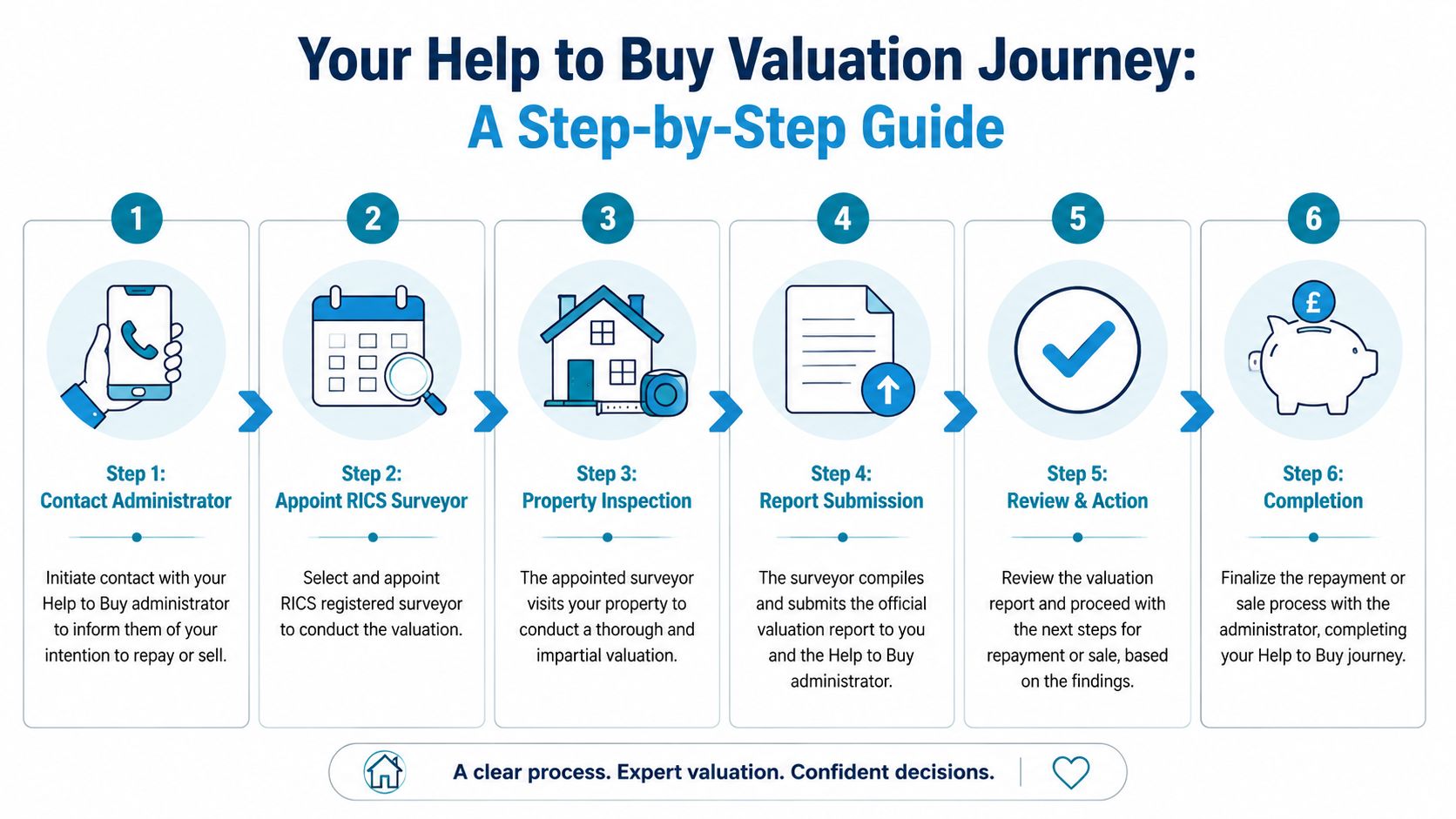
Confirm what you are doing before you book
Redemption, staircasing, remortgage, and sale do not run on the same timetable. Get clarity first, because the valuation is only one document in a wider file.
Instruct a surveyor who handles Help to Buy work regularly
A general valuation is not always enough. Help to Buy has its own reporting expectations, and that is where unsuitable instructions create expensive rework. If you are unclear on the difference, this guide explains how a mortgage valuation differs from a RICS valuation.
Book the inspection at the right point, not necessarily the earliest slot
Too early and the report may expire mid-transaction. Too late and your solicitor, lender, or administrator may be waiting on it. The right booking date depends on how quickly the rest of the matter is likely to move.
Prepare the property and your paperwork
Make sure the surveyor can inspect all rooms and note any extensions, alterations, or major improvements clearly. The inspection is not a marketing exercise, but missing facts can lead to corrections later.
A short explainer can help if you want a visual overview of the process in action:
Attend the inspection and answer factual questions directly
The surveyor will inspect, assess condition, and gather comparable sales evidence. Clear answers help avoid basic errors in the report, especially on accommodation, tenure, and improvements.
Review the finished report before it is sent on
Check names, address, date, signatures, and the stated purpose. Small admin mistakes cause a surprising number of rejections, and they are much easier to correct on the same day than a week later.
Submit it promptly with the rest of the required documents
The report does not work in isolation. Delays usually happen because the valuation is ready but the accompanying paperwork is not.
The timing issue catches owners more often than the valuation figure itself. Help to Buy valuations expire after three months. If the matter drifts, an update may be possible for a short period before expiry, but once that window is missed you can be back to paying for a fresh inspection and report, as noted in Nuven Surveyors' Help to Buy guidance.
The practical answer is to work backwards from your target date.
If you need the valuation for a redemption, ask your solicitor and lender how long they realistically need. If you are selling, factor in the pace of the chain. If you are remortgaging, check how quickly the lender is issuing documents. The surveyor's part is usually the fastest stage. The risk sits in everything that follows.
A reliable working routine looks like this:
The owners who avoid repeat fees usually do one thing well. They treat the valuation date as the start of a countdown, not the end of a task.
A report can read well, carry a sensible figure, and still be rejected.
That usually happens because the document misses one of the administrator's formal checks. In practice, owners lose time over small preventable issues: the wrong file format, weak comparable evidence, an unsigned report, or a surveyor who does not handle Help to Buy instructions regularly. The aim is not just to get a valuation. It is to get one accepted first time.
Cost matters here as well. The HomeOwners Alliance guide to Help to Buy valuations notes that owners often pay again when they instruct the wrong surveyor or submit a report that does not meet the scheme's requirements. That is why I advise clients to check compliance points before they book, not after the PDF lands in their inbox.
A compliant Help to Buy valuation needs to do two jobs at once. It must give a properly reasoned market value, and it must present that conclusion in the format the administrator expects.
At minimum, the report should include:
Clients often ask whether a lender's valuation will do. It will not. A lender's inspection serves a different purpose, and this guide to what a mortgage valuation is and how it differs explains the distinction.
Use this before you submit anything:
| Requirement | Why it matters in practice |
|---|---|
| Report on headed paper | It shows the document is a formal professional report, not an estimate |
| Signed and dated by the RICS valuer | It confirms responsibility for the opinion and records the valuation date |
| Non-editable PDF | It avoids questions about whether the report has been changed after issue |
| Clear property overview | It helps the administrator match the report to the correct home |
| Sales history included where relevant | It avoids follow-up queries where the property's history affects review |
| At least three nearby sold comparables | This gives the valuation evidence behind the figure |
| Explanation of how value was reached | The administrator needs reasoning, not just a number |
| Prepared by an independent surveyor familiar with Help to Buy | Wrong instruction is one of the fastest ways to end up paying twice |
One more practical point. Read the report the day it arrives. Check the address, tenure, parking, extensions, and any obvious factual point that could cause a query. If something is wrong, it is far easier to correct it before submission than after a rejection notice arrives.
The usual failure point is not the valuation figure itself. It is the instruction, evidence, or paperwork around it.

A common pattern looks like this. The owner books the cheapest quote, assumes any RICS valuer will know the scheme, then submits the report near the expiry date of a redemption figure or mortgage offer. One query comes back. The report needs amending or reissuing. Suddenly the whole repayment timetable slips, and the extra cost is far higher than the initial saving.
That is why this part of the process needs handling like a checklist, not a box-ticking exercise.
The first mistake is relying on an estate agent's market appraisal. That may help set an asking price, but it does not meet Help to Buy requirements. The administrator wants an independent valuation report prepared for this purpose.
The second is choosing on fee alone. Lower cost is not automatically a problem, but it often goes with vague answers about comparables, turnaround times, or Help to Buy experience. If the report is rejected, you usually pay twice. Once for the first valuation, and again for a correction, update, or replacement.
The third is weak sales evidence. Reports commonly run into trouble where the comparables are not genuinely local, are based on asking prices rather than completed sales, or do not match the subject property closely enough on type, size, tenure, condition, or parking. House Survey's Help to Buy valuation guidance also highlights poor comparable evidence as a frequent reason reports are queried or rejected.
A fourth issue is timing. Valuations for Help to Buy have a limited shelf life, so booking too early can be just as awkward as booking too late. In practice, the safest approach is to line up the valuation with the point at which your solicitor, lender, and repayment paperwork can use it.
Before you book, ask the valuer or valuation service these questions:
Do you carry out Help to Buy valuations regularly?
You want someone who understands the reporting requirements from the outset.
Will the report include sold comparables, not asking prices?
This is a basic quality check. If the answer is hesitant, keep looking.
How local and how similar will the comparables be?
Good valuers should be able to explain their selection logic clearly.
What is your current turnaround time for inspection and report issue?
This helps you plan around solicitor and lender deadlines.
If the administrator raises a query, do you handle clarifications promptly?
Delays often happen after the report is issued, not before.
Will the final report be signed, dated, and issued as a non-editable PDF?
Small formatting points still matter.
If you want a simpler route, a managed Help to Buy valuation service can reduce the risk of instructing someone who does not handle this type of work properly.
The inspection is not the end of your job. It is the point where a quick review can save a week or two later.
Check the report as soon as it arrives. Confirm the property address, tenure, floor area if stated, parking arrangement, extensions, and any obvious features that affect value. If the flat includes a balcony, allocated parking, or a long lease extension, and that detail is missing or described incorrectly, raise it immediately.
Do not try to steer the valuation by sending a list of optimistic portal listings. If you have relevant sold evidence, pass it over before the inspection and let the surveyor decide whether it is useful. That is a better way to help without undermining the independence of the report.
One final point. Leave contingency in your timeline. Even a well-prepared instruction can produce a follow-up query, and the owners who avoid costly delays are usually the ones who allowed for that possibility before they submitted anything.
The difficult part of this process isn't understanding that you need a valuation. It's finding a surveyor who can produce one in the correct format, with the right evidence, on the right timescale.
One way to reduce that risk is to use a service that matches the instruction to an appropriately qualified surveyor rather than leaving the homeowner to vet the market alone. Survey Merchant's valuation service works on that basis, connecting owners with RICS-qualified professionals for scheme-specific valuation work.
That matters in practical terms because the homeowner usually wants three things at once. They want independence, local market knowledge, and a report that won't create an avoidable rejection. A managed process can help line those up more efficiently than ringing around at random.
This doesn't remove the need to review the report when it arrives. It does make the front end of the instruction cleaner. You're less likely to waste time with a surveyor who doesn't handle Help to Buy work, doesn't understand the format required, or can't fit the timetable.
The primary benefit is transaction control. When the valuation process is organised properly from the outset, solicitors, lenders, and administrators have a better chance of moving in step rather than waiting on corrective paperwork.
If the valuation is higher than you expected, your repayment figure will usually rise because the equity loan is tied to the current value rather than the original amount borrowed. If it is lower, the amount due may be lower as well. The key point is that your expectation doesn't control the figure. The evidence in the report does.
You can raise concerns if you believe there is a clear factual error or the comparable evidence is unsuitable. In practice, challenges succeed when they are specific and evidence-based. General disagreement rarely gets far. If there is a genuine issue, act quickly while the file is still live.
No. A mortgage valuation is produced for the lender's lending decision. A Help to Buy valuation is a separate instruction for equity loan administration. They serve different purposes, so one usually can't be substituted for the other.
If you need a compliant Help to Buy valuation and want the instruction handled by a qualified surveyor panel, Survey Merchant can help you arrange the right report for redemption, remortgage, sale, or staircasing without the usual guesswork around format, independence, and timing.
Survey Merchant provides vetted RICS surveyors across 100+ UK locations at fixed fees:
→ Level 2 Home Survey (HomeBuyer Report)
→ Level 3 Building Survey (full structural survey)
→ RICS Red Book property valuations
→ Party wall surveyors — notices, awards & schedules of condition
→ Expert witness surveyors — CPR Part 35 reports for property disputes