We use cookies to improve your experience on our site, analyze site traffic, and assist in our marketing efforts. By clicking "Accept all," you agree to the storing of cookies on your device. You can choose to "Reject all" non-essential cookies. For more information, please read our Cookie Policy.
One in Three Landlords Selling or Considering It: What Landbay's Renters' Rights Act Survey Means for Buyers of Former Rental Homes — and What a Survey Should Check (November 2026)
Landbay finds 33% of landlords are selling or considering it. What buyers of former rental homes should check, from damp and deferred maintenance to EICRs and Building Regulations sign-off, and when to choose a Level 2 or Level 3 survey.
One in three landlords has decided to sell, or is considering selling, rental property. That is the headline finding of a Landbay survey of around 2,000 landlords, reported by Landlord Today on 2 November 2026, roughly a year after the Renters' Rights Act became law. For anyone house-hunting right now it matters more than it might first appear, because some of the homes coming onto the market over the coming year are likely to be former rentals rather than long-term owner-occupied homes.
That changes what buyers need to look for. A property that has been let for years, sometimes to several different households, can carry a different risk profile from one that has been lived in and maintained by its owner. This article sets out what the survey actually shows, why the pressure on landlords is building now, and what a survey should check before you commit to buying a former rental home.
Key Takeaways
A Landbay survey of around 2,000 landlords found 33% have decided to sell or are considering selling properties, one year on from the Renters' Rights Act becoming law.
36% have increased rents, 34% have changed tenant referencing or affordability requirements, and 29% have reduced plans to buy more rental property. 28% reported no significant changes.
A new landlord registration service, higher income tax on rental income from April 2027 and an average new mortgage rate at a three-year high of 5.89% (Moneyfacts) are adding to the pressure.
Former rental homes can be good purchases, but buyers should check for deferred maintenance, undocumented alterations and missing safety paperwork.
Choose between a RICS Home Survey Level 2 and a Level 3 building survey according to the property's age, alterations and condition.
What the Landbay Survey Found
The findings describe a sector that is adjusting rather than panicking. Alongside the 33% who are selling or weighing it up, 36% of landlords have increased rents, 34% have changed their referencing or affordability checks, 29% have pulled back from buying additional rental property, 16% are making more use of letting agents or other professional support and 13% are setting aside more money to cover costs. Just over a quarter, 28%, reported no significant changes at all.
A Landbay spokesperson said: "One year on from the Renters' Rights Act becoming law, we are beginning to understand how landlords have responded", with "more than half reporting a negative impact on their businesses."
The survey also asked about the new landlord registration service. More than 90% of landlords are aware it is being introduced, 65% expect it to raise their costs and 44% expect to spend more time managing their properties. Some 26% say it may make them more likely to sell. On readiness, 59% describe themselves as very or quite prepared, while 24% say they are not very prepared or not prepared at all.
One caveat is important: the survey measures intentions as well as decisions. Not every landlord who is "considering" a sale will list a property, so the 33% figure should not be read as a third of rental homes coming to market.
Why the Pressure Is Building Now
The Renters' Rights Act's main tenancy changes, including the abolition of Section 21 "no-fault" evictions in England, took effect on 1 May 2026. The Budget on 28 October 2026 then announced that income tax on rental income will rise to 24%, 44% and 49% from April 2027.
The wider market is subdued too. HMRC recorded 94,800 UK residential transactions in September 2026, down 4% on a year earlier. Savills forecast on 4 November 2026 that UK house prices will fall 1.5% in 2027, with no sustained recovery until 2028. Moneyfacts puts its Average New Mortgage Rate at 5.89%, the highest for three years. Forecasts are not guarantees, but together these figures point to a market in which sellers, landlords included, may need to be realistic on price, and in which buyers have good reason to be sure of exactly what they are buying.
What a Survey Should Check on a Former Rental Home
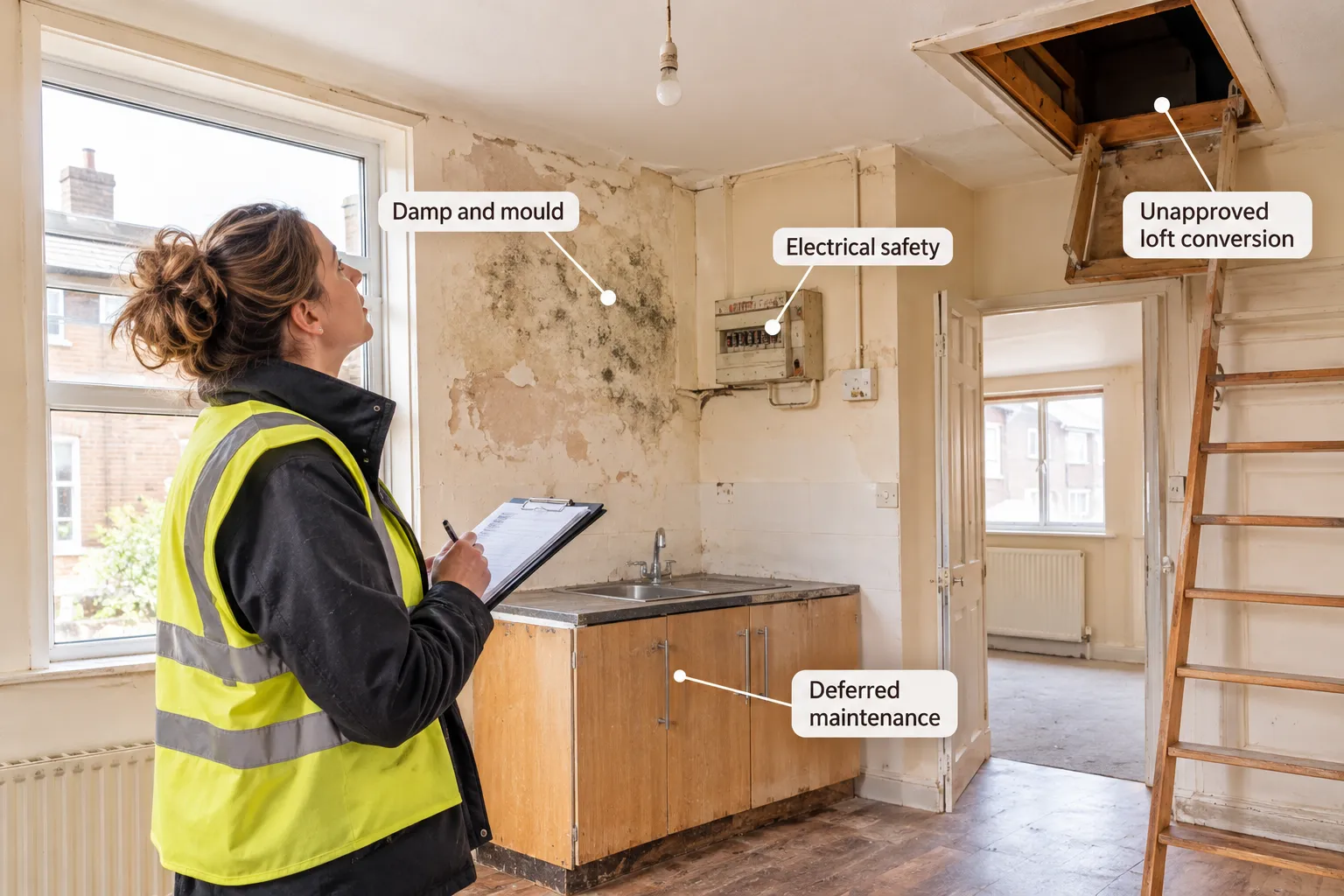
A former rental can be an excellent purchase, and many are well maintained. But years of tenanted use can also mean wear, repairs that were put off, and occasionally alterations that were never properly signed off. The points below are general professional guidance rather than statistics.
Fabric and finishes
Deferred maintenance to roofs, gutters, windows and external walls.
Damp, condensation and mould, particularly in bathrooms, kitchens and poorly ventilated bedrooms.
Tired kitchens and bathrooms, and heating systems nearing the end of their working life.
Alterations and compliance
Former HMO layouts, added en-suites or loft rooms that may lack Building Regulations sign-off.
The Electrical Installation Condition Report (EICR) and gas safety certificates: ask the seller for copies.
Fire doors and smoke or heat alarms, especially if the property was let room by room.
The EPC rating, which affects running costs and future resale appeal.
Any licensing history, such as HMO or selective licensing.
For flats
The remaining lease length.
Service charges and ground rent terms.
Any building-safety issues affecting the block.
If the property is being sold with a tenant still in place, take legal advice before you exchange contracts.
Level 2 or Level 3: Which Survey Suits a Former Rental?
Survey type
Best suited to
Why
RICS Home Survey Level 2
Conventional, reasonably modern homes in apparently good condition
Gives condition ratings and flags visible defects, without the depth needed for older or altered properties
RICS Home Survey Level 3 (building survey)
Older, extended, altered or visibly neglected former rentals
A more detailed inspection and report, including the likely causes of defects and advice on repairs
A former rental that has been extended, subdivided or converted, or that shows obvious signs of neglect, will usually justify a Level 3 survey. If the property is well kept with a straightforward layout and no major alterations, a Level 2 survey may be enough. Either way, the paperwork checks above still apply.
What to Do Now
Ask early whether the property has been let, for how long, and whether it was ever licensed as an HMO.
Request the EICR, gas safety certificates, EPC and any Building Regulations completion certificates before you commit.
Match the survey level to the property, not just to the budget.
Use the survey findings to renegotiate, or to plan and cost repairs, before exchange.
Speak to a qualified mortgage broker about affordability at current rates, and to a solicitor if a tenant is in place.
Frequently Asked Questions
Does the Landbay survey mean a third of rental homes will be sold? No. It found that 33% of landlords have decided to sell or are considering selling properties. It measures intentions as well as firm decisions, and some landlords will not follow through.
Why are landlords reassessing now? The Renters' Rights Act's main tenancy changes took effect on 1 May 2026, a landlord registration service is being introduced, income tax on rental income is due to rise from April 2027 and mortgage rates are at a three-year high.
Is a former rental home a worse purchase? Not necessarily. Many are well maintained. The key is to verify condition and paperwork rather than assume the best or the worst.
What documents should I ask the seller for? The EICR, gas safety certificates, the EPC, Building Regulations completion certificates for any alterations, and licensing history if the property was ever an HMO.
Should I always get a Level 3 survey on an ex-rental? Not always, but lean towards it if the property is older, has been extended or converted, or shows visible signs of neglect.
Conclusion
Landbay's findings suggest landlord sentiment has shifted since the Renters' Rights Act became law, and that more former rental homes may come up for sale. For buyers that is an opportunity as well as a risk: these properties can offer value, but years of tenanted use can hide maintenance backlogs and undocumented changes. Before you make an offer, ask for the safety certificates, check the EPC and any lease details, and commission the survey level that matches the property's age and condition. The Survey Merchant can connect you with a local RICS surveyor to help you buy with confidence.
Related guides
No items found.
Book a RICS surveyor
Survey Merchant provides vetted RICS surveyors across 100+ UK locations at fixed fees: