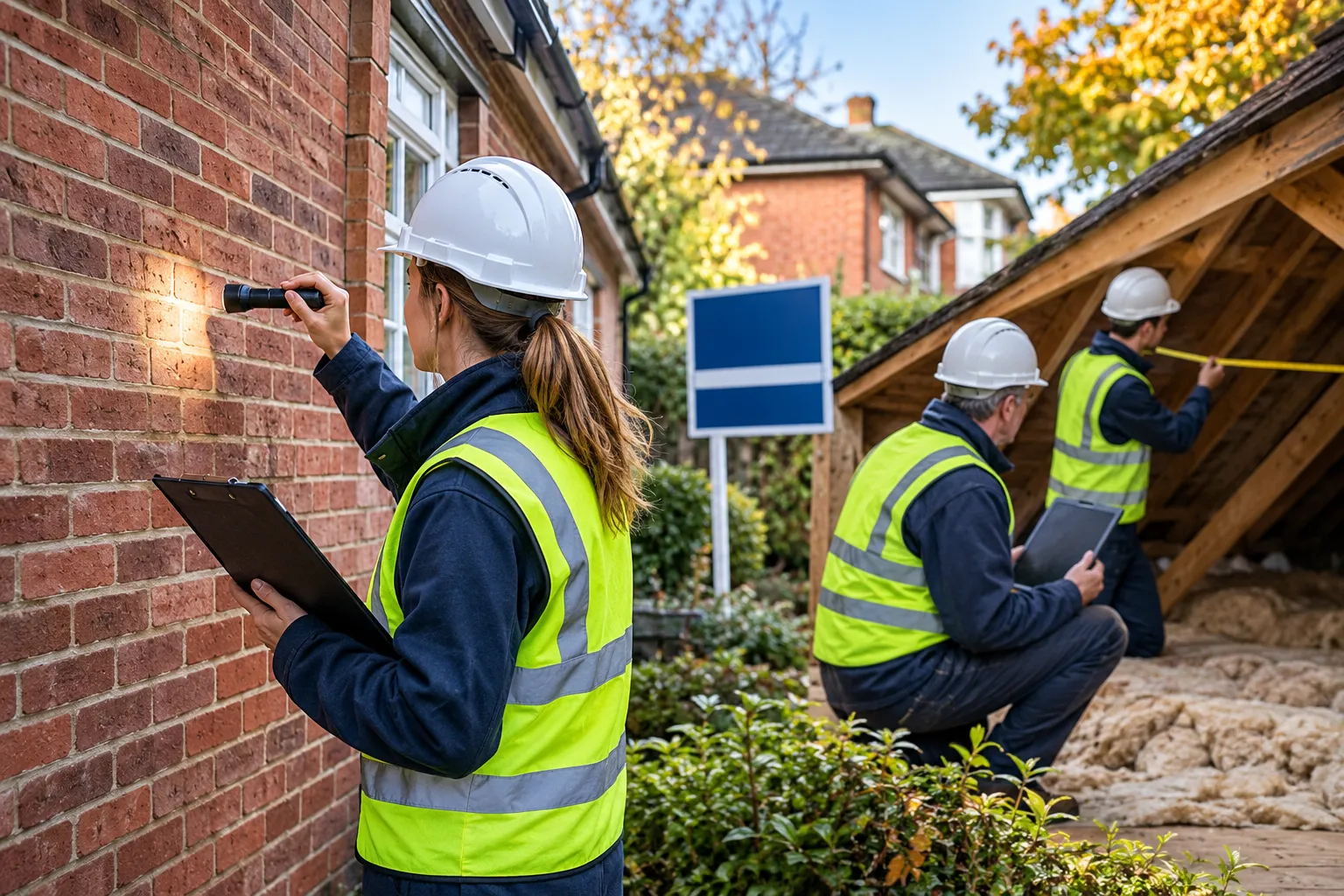
A building survey in Sheffield costs roughly £400–£600 for a RICS Level 2 HomeBuyer survey and £600–£1,200 for a Level 3 Building Survey, with the fee set by the property's value, size and age rather than its postcode. Sheffield is a hilly city of Victorian and Edwardian terraces, stone-built villages on the Peak District fringe, interwar semis, large post-war estates and converted industrial buildings, and each type brings its own risks. This guide explains what a building survey in Sheffield costs, which survey level suits which kind of home, the defects surveyors look for across the city, and how long the process takes from booking to report.
How much does a building survey cost in Sheffield?
Survey fees in Sheffield sit close to the national ranges. As a general picture, a Level 2 HomeBuyer survey on a conventional three-bedroom semi costs around £400–£600, and a Level 3 Building Survey on an older, larger or altered house runs from about £600 to £1,200. Large Victorian villas in Nether Edge, Broomhill and Ranmoor, stone houses on the western edge of the city and properties that have been heavily extended tend toward the upper end, because the inspection and the report both take longer.
What moves the fee is the time a competent inspection needs. A hillside terrace in Walkley or Crookes may be modest in size, but its retaining walls, stepped gardens, cellar and shared roof all demand attention that a flat-site semi does not. The national house survey cost guide sets out the price bands in more detail, and the same Level 2 and Level 3 ranges apply in Sheffield.
Which survey level suits Sheffield housing stock?
The RICS Home Survey Standard sets out three levels. Level 1 is a basic condition report and is rarely the right choice for a Sheffield purchase. Level 2 suits conventional houses in reasonable condition, which covers many of the city's interwar semis in Ecclesall, Greenhill, Woodseats and Firth Park and much of the later estate housing. Level 3, the former full structural survey, is the sensible choice for anything pre-1919, anything stone-built, anything converted or extended, and anything the viewing has already given you doubts about.
In practice that means a Level 3 survey is usually recommended for the Victorian and Edwardian terraces of Crookes, Walkley, Heeley, Sharrow, Meersbrook and Hillsborough, for the larger period villas of Nether Edge and Broomhill, for stone-built houses in Stannington, Dore, Totley and the villages toward Bradfield, and for any period property that has spent years as a student let around Broomhill, Crookesmoor or Ecclesall Road. The guide to what a Level 3 survey covers explains the difference in depth.
Defects a Sheffield building survey looks for
Sheffield's hills shape its defects. Many terraces and semis are built on sloping sites with retaining walls to the front, rear or side, and those walls are often a century old, built in coursed stone or brick with no formal drainage behind them. A surveyor will look for leaning, bulging and displaced copings, for vegetation and water staining that point to a saturated backfill, and for cracking where a house has been built hard against a cut slope. Serious movement in a retaining wall is usually referred for a structural engineer's report, because the repair can cost more than many internal defects combined.
The city's older housing is mostly brick with stone heads, sills and quoins, with full stone construction common on the western fringe. Typical findings include:
- Roofs and chimneys: Welsh slate and later concrete-tile roofs on terraces that often share a continuous roof with neighbours; nail fatigue, slipped slates, failed back gutters and chimney stacks with weathered pointing and flaunching are routine, and valleys between stepped terraces are a common leak path.
- Damp in cellars and solid walls: coal cellars below pavement level, bridged or missing damp-proof courses, raised external ground on the uphill side of the house and cement render or pointing trapping moisture in stone or soft brick walls.
- Sulphate attack and ground floors: solid concrete floors laid on colliery shale or ash fill in some interwar and post-war houses can heave and crack when the fill reacts with the concrete, lifting skirtings and pushing out external walls at low level.
- Interwar semis: corroded cavity wall ties, asbestos-containing materials in soffits, garages and flues, timber bay windows and flat roofs over bays and porches reaching the end of their lives.
- Post-war estates: Gleadless Valley, the Manor, Parson Cross and Arbourthorne include some non-traditional construction types; where a house is a designated type under the Housing Defects Act 1984, lenders will usually want evidence of a certified repair, and the surveyor will say so clearly.
- Flats and conversions: converted mills and works around Kelham Island and the city centre, and purpose-built blocks, raise questions about external wall systems, fire safety and service charges that a flat survey needs to address alongside the condition of the unit itself.
Two ground factors deserve a mention. Parts of eastern and south-eastern Sheffield, toward Handsworth, Woodhouse, Mosborough and the Rother Valley, lie within the Coal Authority's reporting areas, so a mining report is a standard part of the conveyancing searches and a surveyor will look for the cracking and distortion that past shallow workings can cause. The River Don and its tributaries, the Sheaf, the Porter and the Loxley, flooded badly in June 2007 and parts of the lower Don valley flooded again in November 2019, so low-lying property near those watercourses should be checked against the Environment Agency's flood maps and insured accordingly.
How long does a building survey take in Sheffield?
Across the Sheffield market, a surveyor can usually be booked within one to two weeks, with the inspection itself taking two to three hours for a Level 2 survey and most of a day for a Level 3 survey on a larger period house. The written report typically follows within five to ten working days. Hillside properties with several retaining walls, extensive outbuildings or a cellar that has been converted can take longer to inspect, and a surveyor who finds significant movement may recommend a follow-up engineer's inspection before exchange.
Most buyers instruct the survey as soon as the offer is accepted, which leaves time to negotiate on price or ask the seller to carry out repairs before contracts are exchanged. Where the survey identifies a single serious issue, such as a failing retaining wall or suspected sulphate attack, a targeted specialist report is often a sensible next step rather than walking away.
Choosing a surveyor in Sheffield
Look for a RICS-regulated chartered surveyor who works regularly in South Yorkshire and understands the local stock, from stone-built cottages in the Peak fringe villages to the brick terraces of the inner suburbs and the estates of the east. Ask whether the surveyor has experience of sloping sites and retaining walls, how the report rates defects, and whether the fee includes a follow-up call to talk through the findings. A local surveyor should also be comfortable commenting on mining reports, flood risk and the particular lender requirements that attach to non-traditional construction, and should say plainly when an engineer or specialist is needed.
Book a building survey in Sheffield with Survey Merchant
Survey Merchant provides RICS chartered surveyors across Sheffield and South Yorkshire as part of a national panel of 2,400+ surveyors. Fixed fees are quoted up front for Level 2 and Level 3 surveys, the surveyor matched to the job has experience of the local housing stock, and reports follow the RICS Home Survey Standard. See the building surveying services for the full range of surveys, or compare with the companion guide to a building survey in Leeds if you are buying elsewhere in Yorkshire. To arrange a survey or get a fixed-fee quote, call 0204 579 8270 or contact Survey Merchant.