We use cookies to improve your experience on our site, analyze site traffic, and assist in our marketing efforts. By clicking "Accept all," you agree to the storing of cookies on your device. You can choose to "Reject all" non-essential cookies. For more information, please read our Cookie Policy.
RICS Skills Report 2026: 55% of Surveyors Say Firms Can't Meet Demand — What the Surveyor Shortage Means for UK Homebuyers (October 2026)
RICS Skills Report 2026 (15 Oct 2026): 55% of surveyors say shortages cut capacity to meet demand and only 15% feel AI-ready. How UK homebuyers should book, choose and check a surveyor this autumn.
Fifty-five percent. That is the share of surveying professionals telling RICS they cannot keep up with demand right now, according to the RICS Skills Report 2026 published on 15 October 2026. If you are trying to buy a home this autumn, that single number could decide whether your purchase completes on time or stalls for weeks. The RICS Skills Report 2026 surveyor-shortage data lands at an awkward moment: mortgage rates are above 5%, homes are taking 67 days on average to sell, and the Autumn Budget on 28 October 2026 adds further uncertainty to an already slow market.
This is not a one-off blip. It is the second consecutive RICS report confirming the profession is stretched thin, and the shortage is now creeping into senior and experienced roles, not just graduate positions. For homebuyers, that means longer waits, more competition for good surveyors, and a stronger case for booking early and choosing wisely.
Key Takeaways
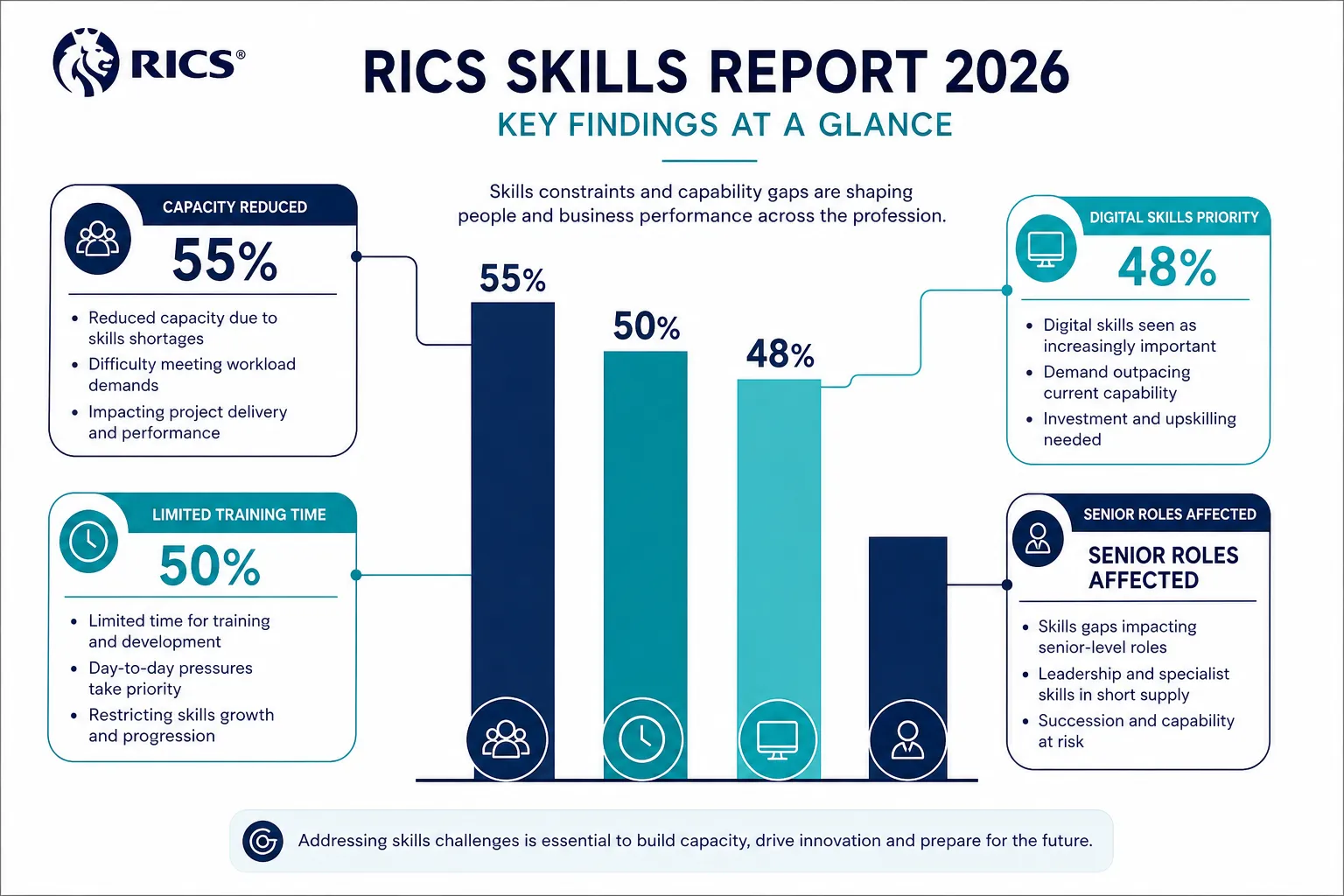
The RICS Skills Report 2026 (15 October 2026) found 55% of respondents say skills shortages are reducing their capacity to meet demand.
Half of respondents report they lack time or resources to train existing staff, and only 15% of surveyors feel ready for AI tools.
The shortage is spreading to experienced and senior surveyors, according to PrimeResi's analysis of the report.
Slower home sales (Zoopla, 1 October 2026) and a 12-year high in listings (Rightmove, 21 September 2026) mean buyers face longer survey booking queues despite a cooling market.
Booking a RICS-regulated surveyor immediately after an offer is accepted, and checking their registration and indemnity cover, is now essential good practice.
What the RICS Skills Report 2026 Reveals About the Surveyor Shortage
RICS surveyed surveying professionals worldwide between 22 June and 24 July 2026 for its second annual skills study. The results, published on 15 October 2026, paint a clearer picture than last year's inaugural report. More than half of respondents describe the skills shortage as critical or moderate, and 55% say it is directly reducing their capacity to meet demand.
Half of respondents (50%) say they simply do not have the time or budget to train existing staff properly. That matters because training is the usual fix for a skills gap, but firms are too busy to use it. Meanwhile, 48% of respondents named data analytics, digital tools and advanced technologies as the priority skill area for the next five years, narrowly ahead of critical thinking and learning agility at 47%. When asked what training they actually want, 52% chose practical tools and automation skills, 48% wanted AI basics and digital foundations, and 44% wanted help using technology to improve workflow.
RICS President Nicholas Maclean OBE RD FRICS summed up the shift: "Last year's report marked the beginning of a new conversation on skills." Senior Vice President Susanne Eickermann-Riepe FRICS added a sharper warning: "It is no longer simply about replacing retiring professionals." That line matters because it signals the shortage is structural, not just a wave of retirements working through the system.
PrimeResi's 15 October 2026 summary of the report adds two points especially relevant to homebuyers. First, the skills crisis is now hitting experienced and senior roles, meaning the most capable surveyors, the ones firms rely on for complex Level 3 surveys, are also the hardest to find. Second, just 15% of surveying professionals feel ready for AI, even though digital skills are the profession's top priority. This gap between ambition and readiness is likely to shape how quickly firms modernise.
This builds on RICS's first global skills report from October 2025, covered by Property Industry Eye on 20 October 2025. That study found nine in ten surveyors said a shortage of skilled professionals affects their work area, with nearly a third calling it critical. Building surveying and quantity surveying were named the worst-hit disciplines. Two-thirds blamed an ageing workforce and retirements, over half said the shortage limits capacity, and 40% reported rising costs. The 2026 data shows those pressures have not eased; if anything, they have moved up the career ladder.
Why the Surveyor Shortage Matters for UK Homebuyers in October 2026
A shortage inside surveying firms translates directly into longer waits for buyers. When 55% of professionals say their firms cannot meet demand, the knock-on effect is fewer available appointment slots, longer turnaround times for written reports, and more pressure on buyers to book early or risk missing their mortgage valuation deadline.
This is landing in a housing market that already has its own friction. Zoopla reported on 1 October 2026 that sales agreed are down 9% year on year, with mortgage rates sitting above 5%, their highest level in three years. Rightmove's 21 September 2026 data showed it now takes an average of 67 days to find a buyer, and the number of homes for sale is at a 12-year high for this time of year.
Market Signal
October 2026 Data
Buyer Impact
Surveying capacity
55% say shortages reduce capacity to meet demand (RICS)
Longer survey booking queues
Sales agreed
Down 9% year on year (Zoopla)
Slower chains, more negotiation
Mortgage rates
Above 5%, 3-year high (Zoopla)
Tighter affordability checks
Time to find a buyer
67 days average (Rightmove)
Longer overall transaction timelines
Homes for sale
12-year high for the season (Rightmove)
More stock but slower movement
The combination is unusual: more homes on the market, but fewer skilled people to survey them promptly. That is why the RICS Skills Report 2026 is not just an industry headline; it is a practical planning problem for anyone with an accepted offer.
How to Navigate the Surveyor Shortage When Buying a Home
Buyers cannot fix a national skills shortage, but they can control how they respond to it. A few practical habits make a real difference in a stretched market.
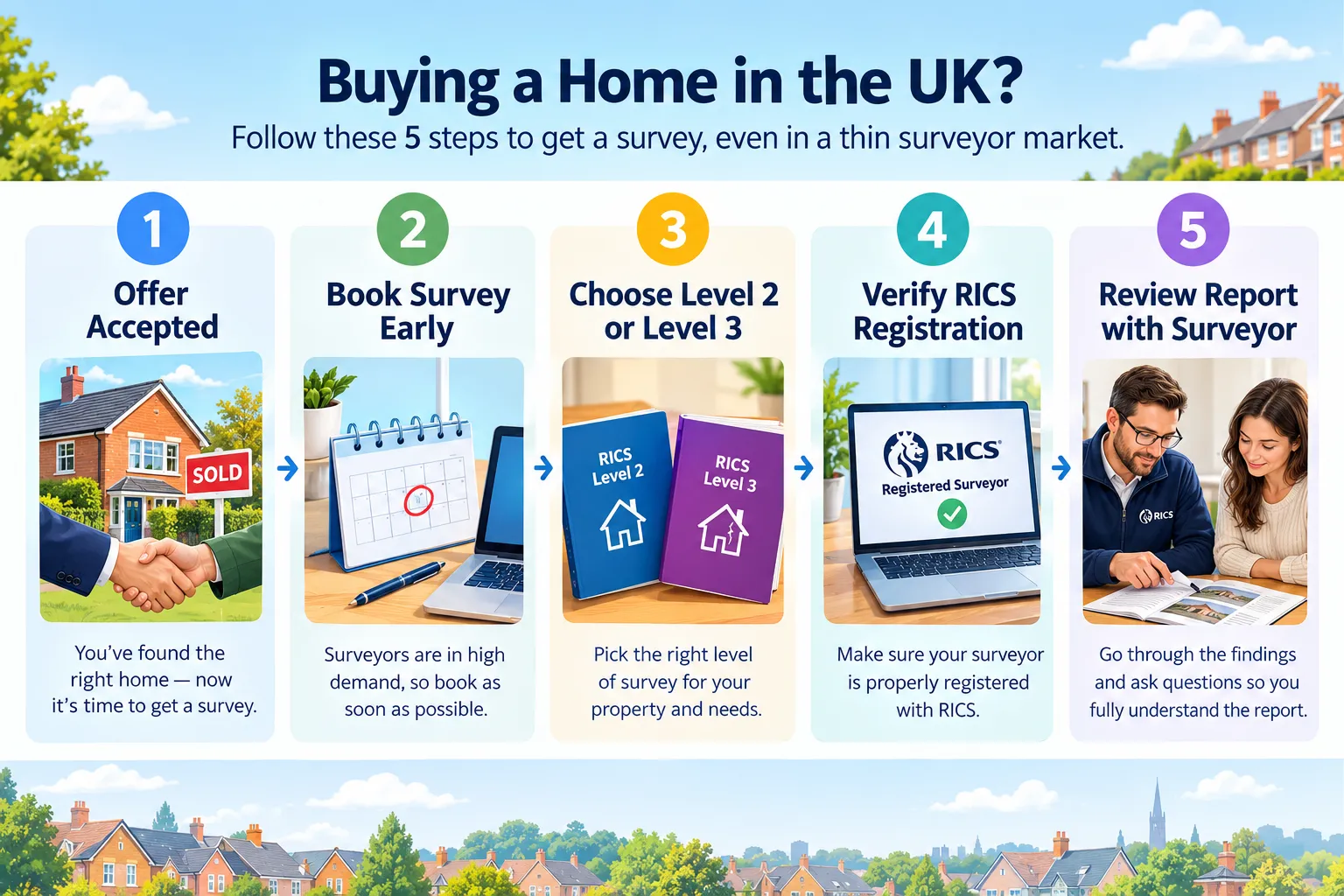
Book the moment your offer is accepted. Do not wait for mortgage paperwork or searches to clear first. With firms turning away work, slots fill quickly, especially for Level 3 Building Surveys on older or unusual properties.
Match the survey level to the property. A Level 2 Home Survey suits conventional properties in reasonable condition. A Level 3 Building Survey is worth the extra cost and wait for older homes, listed buildings, properties with extensions, or anything showing visible defects.
Verify RICS regulation before you pay a deposit. Check the surveyor is RICS-regulated and holds current professional indemnity insurance. This protects you if the report later proves negligent or incomplete, a real risk when experienced surveyors are in short supply and newer staff are covering more ground.
Treat independent reports as more valuable, not less. In a thin market, a thorough, independent survey is one of the few checks fully in the buyer's control. It is worth paying for quality over speed.
Ask about technology-assisted inspections. Many firms now use drones for roof and chimney inspections, moisture mapping for damp detection, and AI-assisted report drafting to speed up delivery without cutting corners. Given that only 15% of surveyors feel fully AI-ready, ask how a firm uses these tools and whether a qualified surveyor still personally inspects the property.
Frequently Asked Questions
What did the RICS Skills Report 2026 actually find? Published 15 October 2026, it found 55% of surveying professionals say skills shortages are reducing their firms' capacity to meet demand, with 50% lacking time to train staff and only 15% feeling ready for AI.
How long should I expect to wait for a survey in late 2026? There is no fixed national figure, but with over half of respondents reporting capacity constraints, buyers should expect longer lead times than in previous years and should book as early as possible after an offer is accepted.
Is a Level 2 or Level 3 survey better right now? It depends on the property, not the shortage. Choose Level 2 for standard, modern homes and Level 3 for older, altered, or higher-risk properties, even if it means a longer wait.
Does the shortage affect survey quality? It can increase pressure on less experienced staff, which is why checking a surveyor's RICS registration and indemnity insurance matters more than ever.
Are drones and AI tools making surveys faster? Many firms are adopting drones and digital reporting tools to speed up inspections, but a qualified human surveyor should still carry out and sign off the assessment.
Conclusion
The RICS Skills Report 2026 is a warning worth taking seriously. More than half of surveying professionals say their firms cannot meet demand, training capacity is thin, and the gap is now reaching experienced professionals, not just new entrants. Combined with a housing market already moving slowly, buyers who wait to book a survey risk delays that ripple through the entire purchase.
The practical response is simple: book a RICS-regulated surveyor as soon as an offer is accepted, choose the right level of survey for the property, confirm professional indemnity cover, and ask how technology is being used to maintain quality under pressure. In a market short on skilled surveyors, a well-chosen, carefully timed survey is one of the strongest safeguards a buyer has. The Survey Merchant can connect you with RICS-regulated surveyors with availability in your area; get in touch to book your Level 2 or Level 3 survey today.
Sources
RICS Skills Report 2026 (15 October 2026); PrimeResi (15 October 2026); Property Industry Eye (20 October 2025); Zoopla House Price Index (1 October 2026); Rightmove House Price Index (21 September 2026).
Related guides
No items found.
Book a RICS surveyor
Survey Merchant provides vetted RICS surveyors across 100+ UK locations at fixed fees: