We use cookies to improve your experience on our site, analyze site traffic, and assist in our marketing efforts. By clicking "Accept all," you agree to the storing of cookies on your device. You can choose to "Reject all" non-essential cookies. For more information, please read our Cookie Policy.
UK House Prices and Mortgage Rates September 2026: A Surveyor's Outlook
September 2026 UK property snapshot: Nationwide +1.6%, Lloyds +0.1%, Rightmove's July fall the largest in a decade, and 2yr fixed mortgages at 5.59%. Surveyor guidance on why an independent Level 2 or Level 3 survey matters when the market softens.
The headline numbers depend heavily on which index you read, and that gap itself is telling a story about UK house prices and mortgage rates in September 2026.
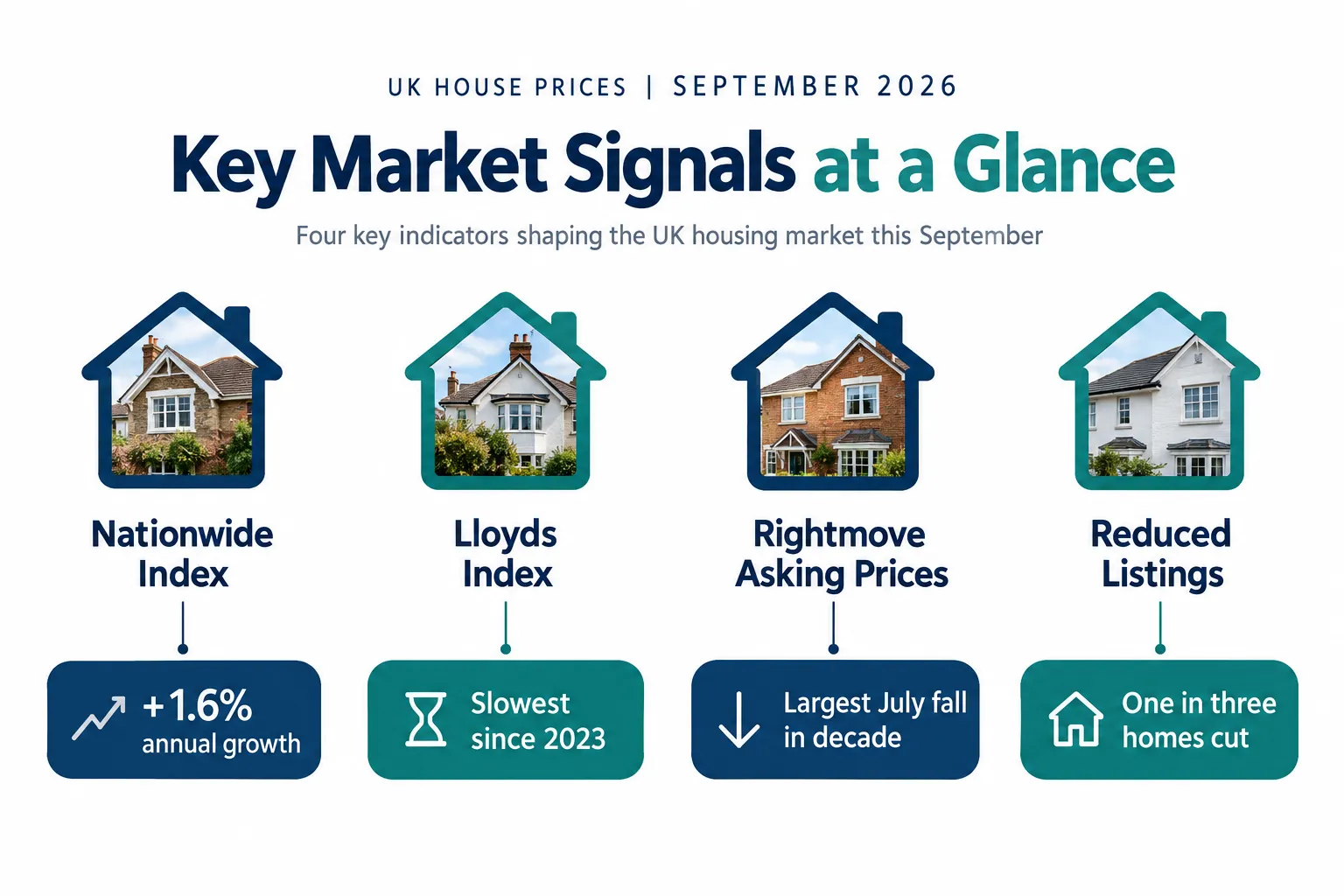
Nationwide's August 2026 report shows annual price growth holding at 1.6%, with the typical UK home now valued at £275,465. Lloyds paints a more subdued picture: its August House Price Index recorded growth of just 0.1% year-on-year, the weakest reading since November 2023, with an average price of £299,253. The gap between the two lenders reflects differences in mortgage mix and regional exposure, but both point the same direction, momentum is fading.
Rightmove's asking-price data, which tracks seller behaviour rather than completed sales, is the most striking of all. Asking prices fell 1.0% in July 2026, the largest July decline in a decade. July is normally a firm month for the market, so a fall of this size signals sellers are pricing defensively rather than testing the water. Around a third of all live listings have now been reduced, by an average of roughly 7%, as vendors chase realistic offers instead of holding out.
Four UK house price data points, September 2026
Surveyor Sentiment: Cautious, Regional, and Watching the Budget
Chartered surveyors reporting into the RICS UK Residential Market Survey describe a market that is, in their own words, subdued rather than in crisis. The July 2026 survey recorded a national house price balance of around -30%, meaning more surveyors still report falling prices than rising ones, though this is a mild improvement on -32% in June. Price weakness remains most pronounced in London and the South, while northern regions and Scotland continue to show more resilience.
Regional divergence is stark. One August analysis put annual growth at around +7.4% in Northern Ireland, +3.6% in Scotland, +2.8% in the North East and +2.1% in the North West, against a broadly flat UK average, while Greater London slipped roughly -1.3% and the South East fell around -2.0%. Surveyors attribute this split directly to affordability pressure biting hardest where prices, and therefore mortgages, are largest.
Encouragingly, surveyors are not pessimistic about the year ahead. The RICS 12-month price expectations balance has moved into slightly positive territory, around +4%, suggesting a modest recovery is expected rather than further declines. Landlord instructions, meanwhile, are reported to be weakening, tightening rental supply and keeping upward pressure on rents.
Mortgage Rates in September 2026: A Sharper Climb Than Headlines Suggest
Borrowing costs are the single biggest reason buyer demand has cooled. Moneyfacts data from 1 September puts the average two-year fixed mortgage rate at 5.59%, a marked jump from 4.83% in late February. That is a rise of more than three-quarters of a percentage point in barely six months, a significant shift in monthly repayment terms for anyone remortgaging or buying with a smaller deposit.
Rightmove's daily mortgage tracker, which reflects live lender pricing rather than lagging averages, shows the average two-year fixed rate at 5.09%, up from 4.95% a month earlier. Earlier in August, several major lenders including Nationwide, Barclays, Coventry Building Society and Virgin Money trimmed fixed rates by up to 0.50 percentage points, but renewed volatility tied to Middle East tensions and mounting uncertainty ahead of the Autumn Budget has since pushed swap rates back upward through late August and into September.
Average standard variable rates remain elevated near 7.13%, even with the Bank of England base rate held at 3.75% after its 30 July meeting. Bank of England data shows mortgage approvals have fallen to their lowest level since January 2024, a clear sign that higher borrowing costs are pushing would-be buyers to the sidelines or delaying decisions until the Budget picture clears.
The Chartered Surveyor's View: Why Valuation Risk Rises When the Market Softens
From a chartered building surveyor's perspective, this is exactly the type of market where corners cannot be cut. When prices are stable and rising, minor valuation errors or overlooked defects tend to sort themselves out over time as equity builds. When prices are flat or falling, as they are across much of London and the South East right now, that safety margin disappears.
A property purchased on an optimistic valuation in a softening market can leave a buyer exposed to negative equity risk almost immediately, particularly if hidden structural issues emerge after completion. This is why demand for independent surveys typically rises whenever RICS data shows a negative price balance, as it does now.
A Level 2 Homebuyer Report suits conventional homes in reasonable condition and covers visual inspection, condition ratings, damp checks, and roof and services overview. A Level 3 Building Survey suits older, altered, listed or unusual properties and offers in-depth structural analysis, defect diagnosis, and repair cost guidance. A mortgage lender's own valuation is not a substitute for either; lender valuations exist to protect the lender's loan security, not the buyer's interests, and they rarely involve a detailed internal inspection.
What Buyers and Sellers Should Do Now
Lock in rate offers early. Mortgage offers are typically valid for three to six months.
Commission a survey before exchange. A Level 2 or Level 3 report can support price renegotiation if defects are found.
Expect negotiation room. A third of listings are already reduced.
Watch regional differences. Northern regions and Scotland show firmer growth; London and the South East carry more downside risk.
Conclusion
The picture emerging this September is one of a market losing momentum rather than collapsing. Nationwide and Lloyds both still show positive, if thin, annual growth. Rightmove's asking-price data and the scale of listing reductions show sellers adjusting their expectations in real time. For anyone transacting this autumn, the sensible path is to proceed with proper due diligence: commission an independent Level 2 or Level 3 survey, negotiate hard where price reductions are already visible, and secure a mortgage offer promptly given how quickly rates have moved this year.