We use cookies to improve your experience on our site, analyze site traffic, and assist in our marketing efforts. By clicking "Accept all," you agree to the storing of cookies on your device. You can choose to "Reject all" non-essential cookies. For more information, please read our Cookie Policy.
Fire Risk Assessment 2026: Who Needs One, Cost and Rules
Plain-English 2026 guide to fire risk assessments in England and Wales: the legal duty under the Fire Safety Order, record-keeping since October 2023, costs by building type, review intervals, penalties and the coming regulation of assessors.
A fire risk assessment is the one piece of fire-safety paperwork that the law in England and Wales says you must have for any non-domestic premises, and for the shared parts of any building split into two or more flats. Since 1 October 2023 it has to be written down in full, whoever you are and however small the building. In 2026 the rules around who may carry one out are changing too, with a government consultation on regulating fire risk assessors closing on 18 June 2026 and a new competence standard, BS 8674:2025, already in print. This guide explains what a fire risk assessment is, who needs one, what it costs, how often it should be reviewed and what happens if you don’t bother.
Key takeaways
Under Article 9 of the Regulatory Reform (Fire Safety) Order 2005 the “responsible person” must make a suitable and sufficient fire risk assessment of every workplace, commercial premises and the common parts of any building containing two or more domestic premises.
Since 1 October 2023 (section 156 of the Building Safety Act 2022) the full assessment and its findings must be recorded, whatever the size of the business or building, together with the name of anyone who helped produce it.
Typical 2026 fees run from about £150 for a small single-let property to £1,500 or more for a high-rise block, with HMOs usually quoted at £250 to £650.
There is no fixed legal review interval. The Order says “regularly”; most assessors recommend an annual review and a fresh inspection every one to three years depending on risk.
Prosecution can mean an unlimited fine in the magistrates’ court, or an unlimited fine and up to two years in prison at the Crown Court.
In blocks of flats the cost of the assessment and any remedial work is normally recovered through the service charge, so leaseholders have a direct interest in what it says.
What is a fire risk assessment?
A fire risk assessment is a structured inspection and written report that identifies fire hazards in a building, works out who is at risk, judges whether existing precautions are adequate and records what needs to change. It is a legal duty under Article 9 of the Regulatory Reform (Fire Safety) Order 2005 for all non-domestic premises in England and Wales, including the communal areas of blocks of flats and houses in multiple occupation.
That’s the short version. In practice the report covers five things, and GOV.UK sets them out in the same order every assessor uses: identify the fire hazards; identify the people at risk; evaluate, remove or reduce those risks; record your findings, prepare an emergency plan and train people; then review and update it. A good report also grades each finding by priority and gives a realistic timescale, because a landlord staring at forty “high” items with no order has nowhere to start.
Communal fire doors, self-closers and escape routes are where most findings sit in a residential fire risk assessment.
Who needs a fire risk assessment?
The duty falls on the “responsible person”. GOV.UK lists who that is: the employer, the owner, the landlord, the occupier, or anyone else with control of the premises, such as a facilities manager or managing agent. For the shared areas of a converted house or purpose-built block it is normally the freeholder, the landlord or the managing agent acting for them. Where several people share control, they have to co-operate, and each one carries the duty.
Buildings that need one include:
Every workplace and commercial premises, from a one-room office to a factory.
Any premises the public can enter, including shops, pubs, surgeries and places of worship.
The common parts of any building containing two or more sets of domestic premises: hallways, stairs, lobbies, plant rooms, bin stores.
Houses in multiple occupation, where the shared kitchen, landing and escape route are “common parts” in law.
Since the Fire Safety Act 2021, the structure, the external walls (including cladding and balconies) and the entrance doors of individual flats where they open onto common parts.
A single private house let to one family does not need a fire risk assessment under the Order, though the landlord still has to fit smoke and carbon monoxide alarms under separate regulations. Our surveyors get asked about this on most weeks. The point at which a landlord crosses the line is usually a loft conversion let as a separate unit, or a three-bed terrace turned into a four-person house share. At that moment the hallway becomes a common part and the Order applies.
What changed on 1 October 2023 and what is changing in 2026
Section 156 of the Building Safety Act 2022 rewrote several articles of the Order with effect from 1 October 2023 (SI 2023/362 in England and SI 2023/914 in Wales). Before that date only employers with five or more staff, or licensed premises, had to keep a written record. Now every responsible person must record the whole assessment, not just the significant findings, and must also record the name of any person they appointed to help. The amended Article 22A requires that information to be shared with other responsible persons in the building and handed on to whoever takes over.
One provision in section 156 has still not been switched on. Subsection (4) would insert a new Article 9A requiring the responsible person to use only a competent assessor. As of October 2026 it had no commencement date, so in strict legal terms anyone may still carry out the assessment. In our view that is a trap. If the report turns out to be deficient and someone is hurt, the responsible person remains liable, and “I used the cheapest person on a comparison site” is not a defence a court has ever warmed to.
The 2026 developments matter more. The Ministry of Housing, Communities and Local Government ran a 12-week consultation from 26 March to 18 June 2026 on regulating the fire risk assessor profession, delivering recommendation 26 of the Grenfell Tower Inquiry Phase 2 report. The proposals cover a defined role for assessors, a competence framework with verification, an apprenticeship route and regulatory powers. The government has said it will legislate for mandatory accreditation, with primary legislation pencilled in for 2027 to 2029. Alongside that, BSI published BS 8674:2025 on 15 August 2025, the first British Standard setting competence levels for fire risk assessors (Foundation, Intermediate and Advanced), and BAFE’s SP205 scheme moved to version 6 for audits from 1 April 2026. The direction of travel is obvious: by the end of the decade only certified people will be allowed to sign these reports.
What does a fire risk assessor actually check?
A competent assessor walks the whole building, not just the ground-floor corridor. On a typical 1960s four-storey block in outer London our panel would expect to look at:
Means of escape: travel distances, protected stairs, final exit doors that open from the inside without needing to be unlocked, and whether residents have wedged a fire door open with a bin.
Fire doors: flat entrance doors, communal doors, intumescent strips, cold smoke seals, self-closers and the gap under the door.
Compartmentation: holes in ceilings where contractors ran new cables, missing fire stopping around pipes, open voids above suspended ceilings.
Detection and alarms: whether the block relies on a “stay put” strategy with no communal alarm, or needs a Grade A system, and whether the strategy still makes sense for the building.
Emergency lighting, signage and fire extinguishers (which, in most purpose-built blocks, are deliberately absent from common parts).
Electrical intake cupboards, meter rooms, bike stores, and anything stored in the escape route.
External walls, balconies and cladding where they fall within scope under the 2021 Act, often with a separate external wall appraisal (PAS 9980) if the building height or construction warrants it.
Residential assessments are usually described by type, following the sector guidance on purpose-built blocks of flats. A Type 1 is non-destructive and covers the common parts only. Type 2 adds limited destructive opening-up of the common parts. Type 3 extends into a sample of flats on a non-destructive basis, and Type 4 is destructive and includes flats. Most blocks need a Type 1; a Type 3 or 4 is justified where there is evidence of poor conversion work or where the stay-put strategy itself is in doubt.
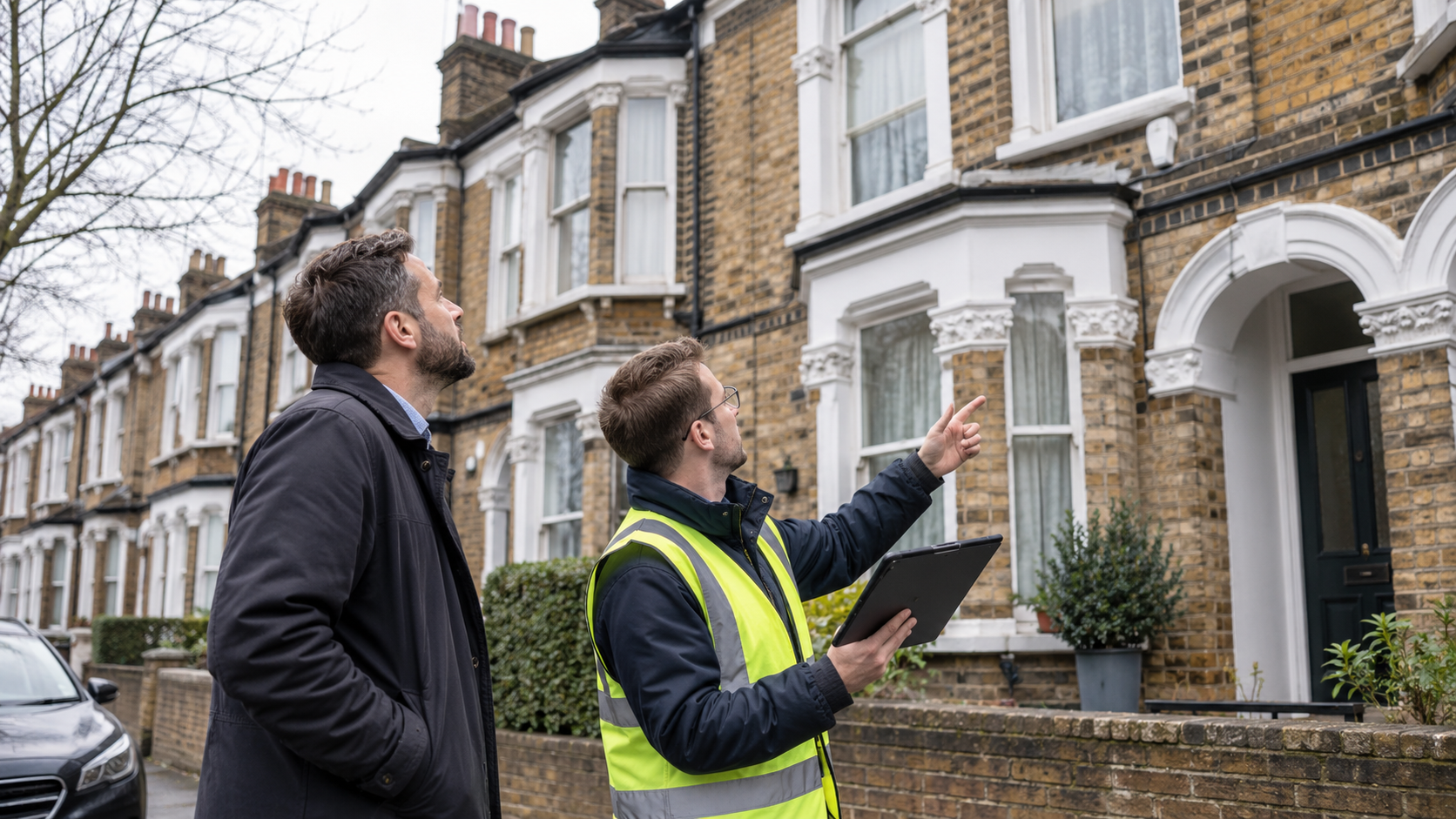
Converted Victorian terraces are where we find the most compartmentation problems, usually from historic work done without Building Regulations sign-off.
How much does a fire risk assessment cost in 2026?
Fees depend on floor area, number of storeys, occupancy and whether any destructive inspection is needed. Published 2026 price guides are reasonably consistent, and the figures below are drawn from the ranges quoted by Checkatrade, the Portsmouth and District Private Landlords Association and several national assessment firms.
Premises
Typical 2026 fee (ex VAT)
Notes
Single-let flat or house with shared access
£150 to £300
Only needed where there are common parts
HMO (3 to 6 bedrooms)
£250 to £650
Licensing authorities usually ask to see it
Small office, shop or café
£150 to £550
Often half a day on site plus report writing
Two or three-storey converted block
£250 to £600
Type 1, common parts only
Warehouse or restaurant
£300 to £900
Cooking and storage raise the risk profile
High-rise block or large multi-building site
£350 to £1,500+
Type 3 or 4, or external wall appraisal, quoted separately
Be wary of “fire risk assessment from £99” adverts. At that price nobody is opening riser cupboards or checking door gaps with a feeler gauge; you’re paying for a template. The report has to be good enough to stand up in front of a fire officer or, in the worst case, a coroner.
Who pays? In a leasehold block the cost of the assessment, and usually of the remedial work it recommends, is recovered through the service charge where the lease allows, as the Leasehold Advisory Service explains. Where any leaseholder’s share of qualifying works would exceed £250 including VAT, the freeholder must follow the Section 20 consultation process first. We cover how those charges are built up in our guide to leasehold service charges.
How often should a fire risk assessment be reviewed?
Article 9(3) of the Order says the assessment must be reviewed “regularly” and in particular where there is reason to suspect it is no longer valid or there has been a significant change. The law never names a number of months, and it’s a question we’re asked constantly. Most of the profession works to an annual desktop review and a fresh site inspection every one to three years, shortening the gap for higher-risk buildings such as care homes, HMOs with vulnerable tenants and tall blocks.
Triggers for an immediate review include a change of use, an extension or loft conversion, new cladding or insulation, a fire or near miss, a change in the number or vulnerability of occupants, and a change of managing agent. Our surveyors also advise a review after any major services work, because electricians and plumbers are the most common cause of breached compartmentation we see.
Fire Safety (England) Regulations 2022: extra duties by building height
If your building is in England and contains two or more sets of domestic premises, the Fire Safety (England) Regulations 2022, in force since 23 January 2023, add duties on top of the assessment itself. They scale with height.
Building
Additional duties under the 2022 Regulations
All multi-occupied residential buildings
Give residents fire safety instructions and information on the importance of fire doors
Over 11 metres
Quarterly checks of all communal fire doors; annual checks of flat entrance doors (best endeavours)
At least 18 metres or 7+ storeys (high-rise)
Share external wall information and floor plans electronically with the fire and rescue service; keep a secure information box; install wayfinding signage; monthly checks of firefighting lifts and equipment; report any lift or equipment out of order for more than 24 hours
High-rise buildings also sit within the Building Safety Regulator regime. If you own or are buying a flat in one, our Building Safety Act 2026 update and EWS1 form guide explain how the fire risk assessment, the external wall appraisal and the safety case fit together.
What happens if you don’t have one?
The local fire and rescue authority enforces the Order. The government’s enforcement guide, updated on 3 July 2026 when MHCLG took over as lead department, sets out the ladder: informal advice, then a non-statutory letter of fire safety matters, then a statutory enforcement notice (allowing at least 28 days to comply), an alterations notice or, where there is a serious risk to life, a prohibition notice that can close the premises on the spot. Appeals go to the magistrates’ court within 21 days.
Prosecution follows where people have been exposed to the risk of death or serious injury, or a statutory notice has been ignored. The penalty is an unlimited fine in the magistrates’ court, or an unlimited fine and/or up to two years’ imprisonment at the Crown Court. Fire authorities publish their prosecutions, and landlords of HMOs and converted houses feature in them far more often than office tenants.
There is a second, quieter cost. Mortgage lenders, insurers and HMO licensing officers now routinely ask for the current fire risk assessment. A missing or out-of-date report can hold up a remortgage, void a buildings insurance claim or delay an HMO licence renewal by months. Our HMO licensing guide covers what councils expect to see.
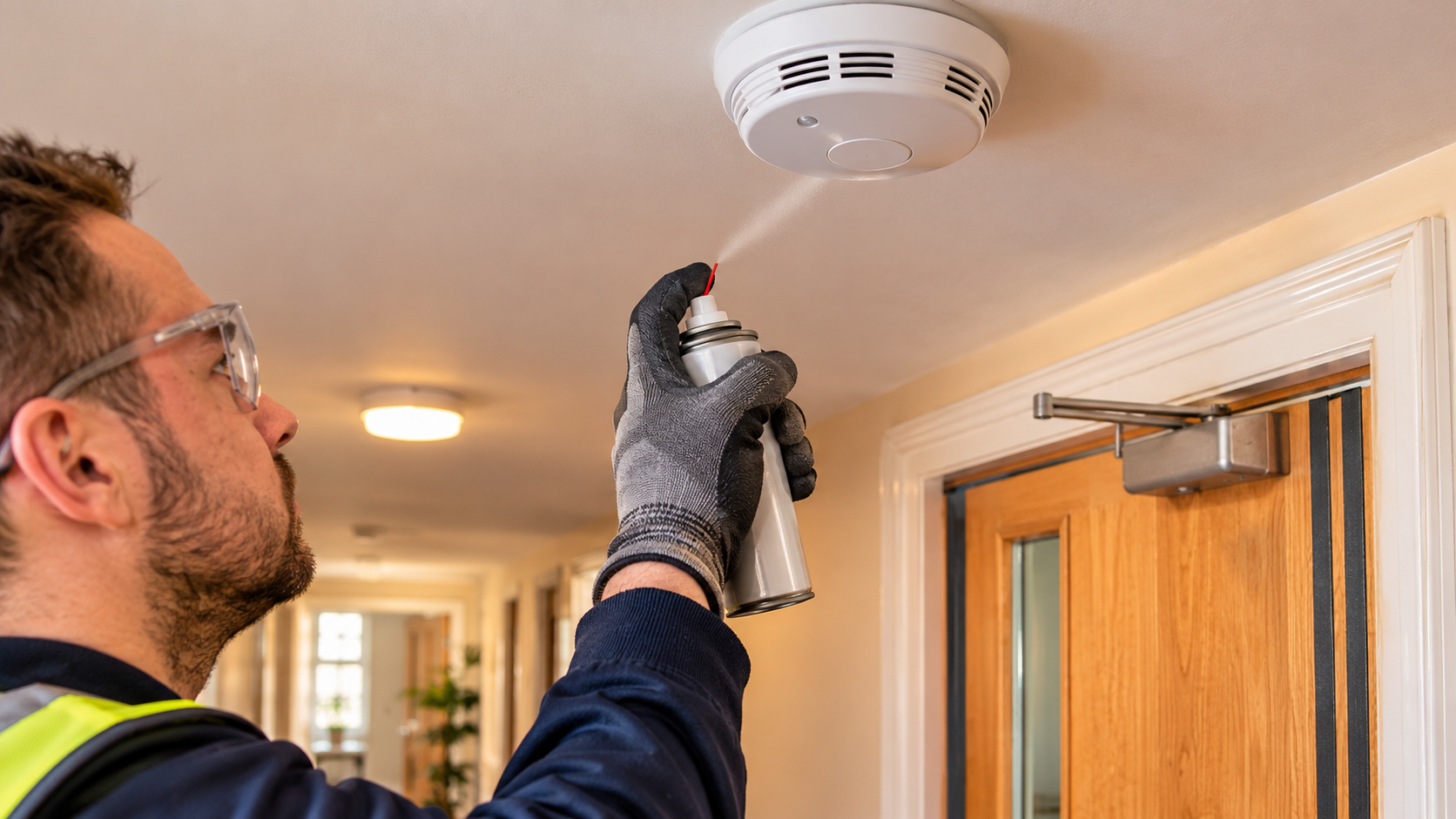
Detection, emergency lighting and door seals are tested on site; a desktop review alone cannot do this.
Who can carry out a fire risk assessment?
Today, legally, the responsible person may do it themselves. GOV.UK says that if you lack the expertise or time you must appoint a competent person, and that the fire service will not do it for you. For a one-room shop with no sleeping risk, a careful owner working through the government’s five-step checklist can produce something adequate. For anything with sleeping accommodation above, complex layouts, or a stay-put strategy, the Home Office’s own guidance recommends a competent professional.
Judging competence takes a little digging. Look for a named individual, not just a company, on one of the third-party registers: BAFE SP205 certificated firms, the Institution of Fire Engineers register, or the IFSM National Fire Risk Assessors Register. Ask which level of BS 8674:2025 they work at and whether they follow PAS 79-1:2020 or BS 9792:2025 as their methodology. The Home Office survey of assessors published in September 2024 found that only 46% of respondents held a certification or register entry and 11% had never held any, which tells you how mixed the market still is. Many building surveyors hold these registrations alongside their surveying accreditation, and a surveyor regulated by RICS, CIOB or RPSA who also does fire risk work is well placed to spot the structural and compartmentation issues a pure fire consultant might miss.
If you are buying a flat, ask the seller or managing agent for the current fire risk assessment before exchange. It is one of the documents we flag in our landlord inspection checklist, and any outstanding high-priority actions should feed straight into the price negotiation.
Why choose Survey Merchant for your fire risk assessment?
Survey Merchant is a UK surveying marketplace rather than a single practice, which means we match your building to an assessor who actually does this type of work, instead of sending whoever is free.
A panel of suitably qualified, accredited surveyors regulated by bodies including RICS, CIOB and RPSA, with fire risk assessors who hold recognised third-party registrations.
Nationwide coverage, from converted terraces in Leeds to purpose-built blocks in south London, with local knowledge of what each fire authority and licensing team expects.
Transparent, competitive fixed fees agreed before anyone visits, with Type 1 to Type 4 assessments and external wall appraisals quoted separately so you pay only for what the building needs.
Fast turnaround, with reports written in plain English, graded by priority and ready to hand to a lender, insurer or licensing officer.
Impartial advice. Our assessors do not sell fire doors, alarms or remedial works, so the recommendations are not padded.
End-to-end support, including Section 20 consultation advice for freeholders and help reviewing a report you have been sent by someone else.
Yes, in England and Wales. Article 9 of the Regulatory Reform (Fire Safety) Order 2005 requires the responsible person to make a suitable and sufficient fire risk assessment of every workplace, every premises the public can enter and the common parts of any building containing two or more flats. Since 1 October 2023 it must also be recorded in full.
How often does a fire risk assessment need to be done?
The Order says it must be reviewed regularly and whenever there is reason to think it is out of date, for example after an extension, a change of use, a fire or new cladding. No fixed interval is written into the law. Most assessors we work with recommend an annual review and a fresh site inspection every one to three years, sooner for care homes, HMOs and tall blocks.
Who can carry out a fire risk assessment?
Legally, the responsible person can still do it themselves, and for a simple single-storey shop that may be adequate. For anything with sleeping accommodation, several floors or a stay-put strategy, government guidance recommends a competent professional. Look for a named assessor on a third-party register such as BAFE SP205, the IFE register or the IFSM register, and ask which BS 8674:2025 level they work to. A legal competence duty (Article 9A) has been passed but not yet brought into force.
How much does a fire risk assessment cost?
Published 2026 figures put a single-let flat or small shop at roughly £150 to £300, an HMO at £250 to £650, a two or three-storey converted block at £250 to £600, and a high-rise or large site at £350 to £1,500 or more. Destructive Type 2 and Type 4 inspections, and external wall appraisals, are quoted separately. In a leasehold block the fee is usually recovered through the service charge.
Do I need a fire risk assessment for a single rented house or flat?
Not under the Fire Safety Order if the property is let to one household and has no shared access. You still need working smoke alarms on every storey and a carbon monoxide alarm where there is a fixed combustion appliance. The moment the property is split into flats or let as an HMO, the hallway and stairs become common parts and a fire risk assessment is required.
What are the penalties for not having a fire risk assessment?
The fire and rescue authority can serve enforcement, alterations or prohibition notices, and a prohibition notice can close premises immediately. Where people are put at risk of death or serious injury, or a notice is ignored, prosecution can lead to an unlimited fine in the magistrates' court, or an unlimited fine and up to two years in prison at the Crown Court. Lenders, insurers and HMO licensing teams will also ask to see the current report.