Leasehold
Jul 16, 2026
Average Subsidence Repair Costs in 2026
From £800 drain fixes to £75,000+ underpinning — how cause, repair type and region determine subsidence bills and why diagnosis matters.

Subsidence repair in the UK can cost anything from about £800 for a drain fix to £75,000+ for major piling or underpinning. In most cases, the bill depends on the cause, the type of repair, the size and location of the property, and the checks needed before work starts.
If I boil the article down, here’s what matters most:
Here’s the short version of the cost range by repair type:
| Repair type | Usual cost range |
|---|---|
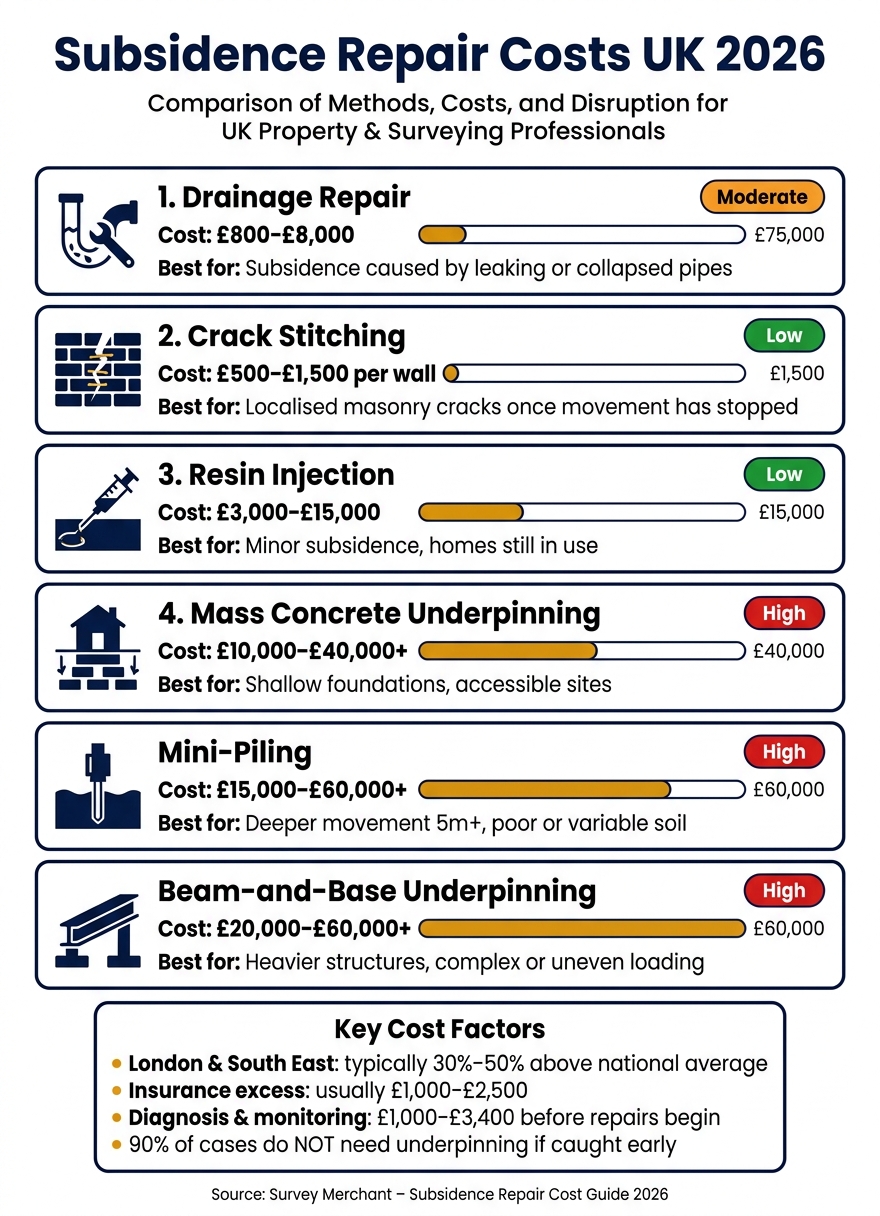
| Drainage repair | £800–£8,000 |
| Crack stitching | £500–£1,500 per wall |
| Resin injection | £3,000–£15,000 |
| Mass concrete underpinning | £10,000–£40,000+ |
| Mini-piling | £15,000–£60,000+ |
| Beam-and-base underpinning | £20,000–£60,000+ |
A few numbers stand out. Subsidence excesses are often £1,000–£2,500. Monitoring can last 6–12 months. And active, unresolved subsidence can cut a home's value by 20%–25%.
The main takeaway? Get the cause checked before you approve repairs. A leaking drain or tree-related soil movement may cost far less to sort out than jumping straight into heavy structural work.
Subsidence Repair Costs UK 2026: Methods, Prices & Disruption
The repair method has the biggest effect on price. A structural engineer or geotechnical specialist will decide on the right fix based on the movement, ground conditions and how the property was built. The order matters: diagnosis first, then the repair method, then the cost. The table below shows the main options, and the notes underneath explain where each one fits.
| Repair Method | Typical Total Cost | Typical Rate | Disruption | Best for |
|---|---|---|---|---|
| Mass concrete underpinning | £10,000–£40,000+[1][4] | £1,200–£2,500 per linear metre[1][4] | High (3–6 weeks)[1][2] | Shallow foundations, accessible sites |
| Mini-piling | £15,000–£60,000+[1][4] | £2,000–£4,000 per linear metre[1][7][10] | High (2–4 weeks)[1][10] | Deeper movement at 5 m+, poor or variable soil, restricted access |
| Beam and base underpinning | £20,000–£60,000+[1] | £2,500–£4,000 per linear metre[1][10] | High (3–8 weeks)[1][10] | Heavier structures, complex or uneven loading |
| Resin injection | £3,000–£15,000[2][4] | About £1,200/m²[8][10] | Low (1–2 days)[1][2][8][10] | Minor subsidence, homes still in use, quick stabilisation |
| Crack stitching | £500–£1,500 per wall[1][9] | About £400 per metre for helical bars[1][10] | Low (1–3 days)[1][10] | Localised masonry cracks once movement has stopped |
| Drainage repair | £800–£8,000[1][7] | £800–£3,000 (relining)[1][7] | Moderate[1][7] | Subsidence caused by leaking or collapsed pipes |
Traditional underpinning extends shallow foundations with new concrete. Mass concrete underpinning is often used for older properties or homes with shallow foundations where the affected area is easy to reach. If the movement is limited to one corner or one wall, the work can stay more contained and the cost may be lower. On a larger detached property, especially if the full perimeter needs work, the bill can climb a lot[4][7].
Mini-piling is usually the better fit when the movement runs deeper, access is tight, or the soil is too weak for mass concrete[1][4][7]. Beam-and-base underpinning tends to suit heavier structures or properties with uneven loading, where the weight needs to be spread more carefully[1][10].
Resin injection works by injecting expanding polymers into the ground to fill voids and compact loose or shrinking soil. It suits minor movement only. One reason people look at it is the low level of disruption: it can often be finished in 1–2 days, and homeowners usually do not need to move out while the work is done[1][2][8][10].
That said, it is not a catch-all fix. A structural engineer still needs to confirm that the ground conditions and the amount of movement make it suitable[2][8].
If the movement is limited to one area, a smaller fix may do the job. In some cases, drainage repairs or crack repairs are enough, rather than moving straight to heavier structural work.
Crack stitching and drainage repairs are often part of a bigger repair plan, not a fix on their own. Crack stitching uses stainless steel helical bars to strengthen masonry, but it should only be done after the movement has stopped[1][9].
It often makes sense to start with the drains. Leaking pipes are a common cause of subsidence, and a CCTV drain survey can show quite fast whether a leak or collapse is the root issue[1][7]. If that turns out to be the problem, drain relining or full replacement may be enough to steady the ground without extra structural work[1][7].
Tree-related cases can need a different approach. Where roots are drying out clay soil, tree felling or removal, or a longer-term management plan, may also be part of the stabilisation work[1][7].
After the repair method itself, the next big cost factors are property size, access and professional fees.
The repair method sets the starting point. But the final price can still move quite a bit.
Once a repair route has been picked, the total cost comes down to three things: the property itself, the ground beneath it, and how much investigation is needed before any work starts.
Bigger homes usually cost more to repair. The same goes for properties with more than one storey, because they need more support and more materials [3][2].
Terraced homes can bring an extra cost too. If the work affects a shared wall, you may need a Party Wall Agreement, which can add £1,500–£2,100 [2].
Ground conditions matter just as much as the building. Shrink-swell clay can lead to broader investigation and deeper repair work [1][5]. Made ground, mining legacy and high water tables also tend to push up both investigation and repair costs [11][4]. Older homes with shallow foundations are often at greater risk as well [11].
Before any physical repair begins, there are often diagnosis and compliance costs to deal with. These early checks can add up, but they help show what is actually going on.
Diagnosis often costs:
| Service | Typical Cost | Purpose |
|---|---|---|
| Structural engineer's report | £500–£2,000 [1][12] | Needed for underpinning design and sign-off |
| CCTV drain survey | £150–£400 [1] | Identify or rule out water-related subsidence |
| Soil investigation / trial pits | £1,000–£3,000 [1] | Determine foundation depth and soil type |
| Crack monitoring (6–12 months) | £500–£1,500 [1] | Confirm whether movement is ongoing |
| Building Control fees | £200–£800 [1] | Compliance and resale records |
| Party Wall Agreement | £1,500–£2,100 [2] | Required if repairs affect a shared wall |
Insurance excess is another part of the picture. Subsidence excesses usually sit between £1,000 and £2,500, which means smaller repairs may not be worth claiming for [1][2][3]. It makes sense to compare the excess against the repair quote before you go ahead with a claim.
Location has a direct effect on price. In London and the South East, labour rates for specialist workers can go beyond £350 per day [1]. In many parts of the Midlands and North, the same kind of labour is often around £200–£250 per day [1].
Access can change costs too. Dense urban areas often mean narrow streets, terraced layouts and less room for machinery, which can add both time and cost [1][4].
| Factor | London & South East | Midlands & North |
|---|---|---|
| Labour rates (per day) | £350+ [1] | £200–£250 [1] |
| Primary soil risk | High-shrinkage clay [1] | Variable; made ground / mining risks [11] |
| Site access | Often restricted (terraces, narrow streets) [1] | Generally better (more detached / semi-detached) [4] |
| Typical underpinning project | £30,000–£60,000+ [1] | £10,000–£30,000 [4] |
London and the South East often come in higher because labour costs more and access is tougher. The Midlands and North are often lower, but mining legacy and made ground can still drive the bill up. That is exactly why early diagnosis matters: spotting the cause sooner can stop costs from snowballing.
Once you’ve narrowed down the likely cause, the lowest-cost fix is usually the one that deals with the source first. Timing matters here. Act early and you can keep subsidence costs down, because many cases are linked to tree roots and most do not need underpinning when they’re caught soon enough [13][1].
Spotting movement early gives you more room to act. Diagonal cracks wider than 3mm - about the thickness of a 10p coin - should be checked, especially if they’re wider at the top than at the bottom [1][5].
Other signs to watch for include:
These can all point to movement and are worth taking seriously [1][5][14].
If the signs are new or getting worse, don’t wait. Move to drain checks and a structural inspection before the damage spreads.
Diagnosis works best as a staged process, not a one-off visit. Start with a structural engineer rather than going straight for a builder’s quote.
A structural engineer can identify the cause, depth and scope of the issue. Without that, repairs can easily be over-specified or under-specified.
A CCTV drain survey is often the first practical check. If it shows that a leaking pipe is causing the movement, a simple repair may stop it and remove the need for underpinning [1][14]. After that, crack monitoring over 6 to 12 months is often used to show whether the movement is active or just seasonal before insurers agree to major works [1][14].
The usual sequence looks like this:
Fixing the root cause before you commission structural repairs can cut total costs by 30% to 50% [14][1].

Survey Merchant can arrange impartial Level 2 HomeBuyer Reports, Level 3 Building Surveys, and Red Book valuations where suspected movement needs formal diagnosis.
Subsidence costs usually break into three stages: diagnosis, repair and reinstatement. Once you know what's causing the movement, the total bill tends to follow that same pattern.
Diagnosis and monitoring can cost £1,000 to £3,400 before any repair work starts [1][7]. On top of that, allow £2,000 to £8,000 for structural engineering and party wall costs [7].
Repair costs can vary a lot depending on what's gone wrong and how far the damage has spread. As a guide:
If you're making an insurance claim, set aside the subsidence excess as its own line in the budget. This is usually £1,000 to £2,500, which is often higher than the excess on a standard home insurance claim [3][7].
One part people often miss is the cost of putting everything back afterwards. Plastering, decorating, and reinstating paving can add £3,000 to £15,000 to the final total [7].
Repair bills are only one side of the story. Subsidence can also hit a home's price, mortgage options and ease of sale.
Active, unresolved subsidence can cut a property's market value by 20% to 25% and will usually make it unmortgageable with mainstream lenders [2][5]. In many cases, that means cash buyers are the main option.
Things look different when the issue has been fixed and properly recorded. Historic subsidence that has been fully remedied, with no sign of it coming back, may have little to no effect on price if the paperwork is in order [2]. In 2026, lenders will generally want:
These documents are often needed before a mortgage is approved on a property that has had subsidence in the past [1][6][7].
Insurance can stay tricky too. After a subsidence claim, future premiums can rise by 20% to 50% for several years. It can also be hard to switch providers, because many insurers won't cover homes with a past subsidence issue [7].
That's why the paperwork matters almost as much as the repair work itself. Keep a full record of the diagnosis, repair and final sign-off, including crack monitoring data, CCTV drain survey results, the engineer's final report, Building Control sign-off and the insurance-backed guarantee [1][5].
Subsidence repair costs in 2026 can range from a few thousand pounds to well over £50,000, depending on the cause, the repair method and the property's location. A leaking drain caught early may be a fairly small job, but left alone, the same problem can turn into a £50,000+ underpinning project [1][7]. Around 90% of subsidence cases do not need full underpinning when the root cause is found and dealt with early [1].
Location also affects pricing. London and the South East are typically 30% to 50% above national averages because labour costs are higher and jobs are often harder to carry out [7]. A Level 3 Building Survey or Red Book valuation through Survey Merchant can give you the evidence you need to make a call, whether you're buying, selling or dealing with a repair claim.
Get a professional diagnosis before any structural work starts.
Not every property with subsidence needs underpinning.
In many cases, the issue can be sorted by dealing with the root cause instead. That might mean repairing leaking drains or getting vegetation under control.
Underpinning is usually only needed when the foundations are no longer adequate, movement is still happening, or other repairs haven’t worked. A structural engineer should assess the property to confirm the cause and decide whether underpinning is needed.
In many cases, buildings insurance pays for subsidence repairs, minus an excess that is often £1,000.
If you think your home may have subsidence, tell your insurer as soon as possible. They will usually appoint a structural engineer to look into the problem and oversee the repairs.
Get in touch with them before you arrange any work yourself. If you don’t, they may refuse to pay the bill.
It depends on the diagnostic process.
Initial structural site visits usually take 30 to 90 minutes, and the report often arrives within 2 to 7 working days. If the case needs more detailed calculations, that can stretch the timescale to 2 weeks.
If movement is suspected but not yet confirmed, the engineer may recommend monitoring with crack gauges for 6 to 12 months. After that, repair times vary quite a bit. Crack repairs or drain repairs often take 1 to 5 days, while underpinning usually takes 3 to 8 weeks.
Survey Merchant provides vetted RICS surveyors across 100+ UK locations at fixed fees:
→ Level 2 Home Survey (HomeBuyer Report)
→ Level 3 Building Survey (full structural survey)
→ RICS Red Book property valuations
→ Party wall surveyors — notices, awards & schedules of condition
→ Expert witness surveyors — CPR Part 35 reports for property disputes