Building Surveying
Aug 2, 2026
Why survey historic buildings: a complete guide
Discover why survey historic buildings is crucial for preservation. Learn the benefits of accurate documentation for planning and investment decisions.

Surveying a historic building is defined as the detailed, measured documentation of its physical fabric, heritage significance, and structural condition. This process is the foundation for every informed decision in conservation, planning, and investment. Without an accurate survey, owners, preservationists, and professionals are working from assumptions. Assumptions in heritage work are expensive. The importance of surveying historic buildings extends from regulatory compliance under bodies such as Historic England to financial risk management for owners and developers. A survey is not a formality. It is the single most reliable tool for understanding what a building is, what it needs, and what the law requires.
Survey data is a mandatory requirement for securing planning approval and listed building consent. Authorities require clear, evidence-based documentation demonstrating a thorough understanding of the existing fabric before approving any intervention. This applies to every regulated listed building planning application without exception. That means no survey equals no consent.
Historic England, the government’s adviser on the historic environment in England, expects applicants to submit measured drawings, condition reports, and photographic records as part of any consent application. Conservation officers at local planning authorities use this evidence to assess whether proposed works are appropriate and reversible. Without it, applications stall or fail.
Conservation area management adds another layer. Buildings within designated conservation areas must meet additional scrutiny, and survey data supports the case that proposed changes respect the character of the area. The planning permission process for heritage assets is more demanding than for standard properties, and accurate survey evidence is what makes applications credible.
Survey data does not just support a planning application. It defines whether one is viable at all. Authorities assessing listed building consent need to see that the applicant understands the building’s existing condition, construction history, and material composition before any work is sanctioned.
Protection orders and scheduled monument designations carry their own documentation requirements. Failing to provide adequate survey evidence risks enforcement action, project delays, and in serious cases, prosecution under the Planning (Listed Buildings and Conservation Areas) Act 1990.
Modern heritage surveying draws on three principal techniques: Static Terrestrial Laser Scanning (TLS), photogrammetry, and handheld LiDAR. Each suits different project scales, budgets, and levels of detail required.
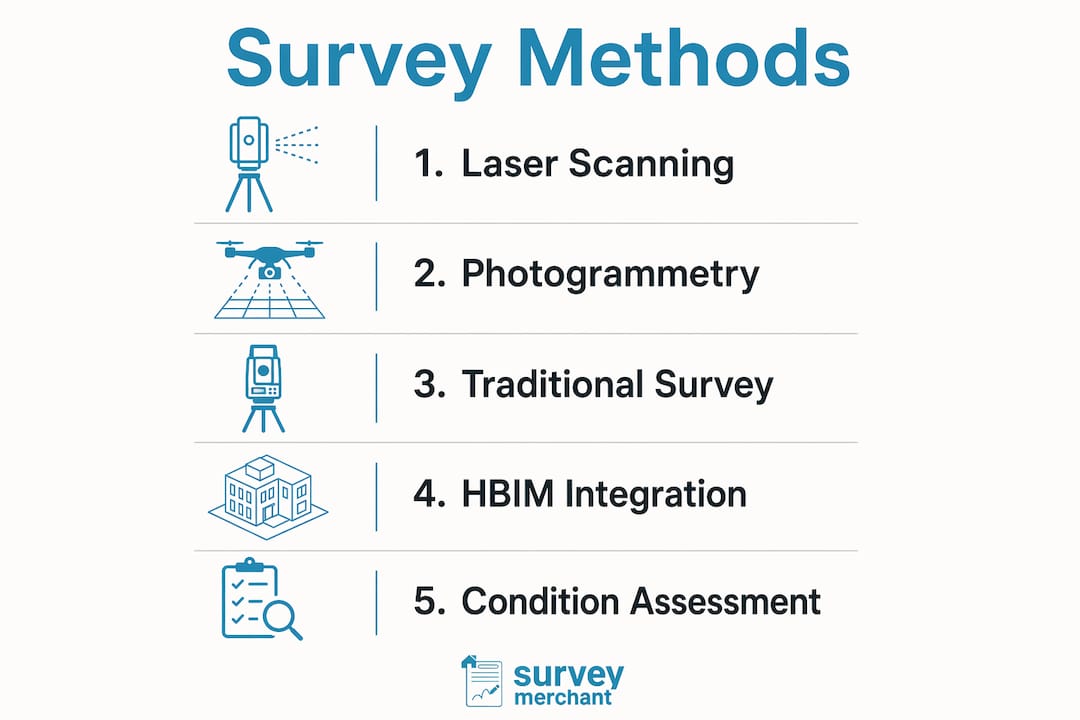
Static TLS is the most precise option for complex heritage work. It captures up to 1,000,000 points per second, producing dense point clouds that record every surface irregularity, moulding, and structural deformation. That level of fidelity is essential when documenting intricate architectural features such as carved stonework, vaulted ceilings, or timber-framed elevations. The resulting data supports the production of accurate measured drawings to millimetre tolerances.
Photogrammetry uses overlapping photographs processed through specialist software to generate three-dimensional models. It is faster to deploy than static TLS and works well for external elevations, decorative details, and inaccessible areas. Handheld LiDAR devices, now available as professional-grade tools, offer a middle ground: faster than static TLS and more accurate than photogrammetry alone. Many heritage surveyors combine all three methods on a single project to balance speed, cost, and accuracy.

The non-destructive nature of modern digital surveying is critical for preserving historic fabric. No drilling, no probing, no physical contact with fragile surfaces. This minimal-intervention approach means surveyors can capture comprehensive data without risking damage to irreplaceable materials.
Pro Tip: Request deliverables in both point cloud and processed drawing formats. Point clouds remain useful for future interventions, while drawings serve immediate planning and design needs.
The outputs from these methods feed into Heritage Building Information Modelling (HBIM) platforms. HBIM integrates geometric data with historical records, material schedules, and condition notes into a single, queryable model. This goes well beyond a static drawing set. It creates a living record of the building that supports decisions across its entire lifecycle.
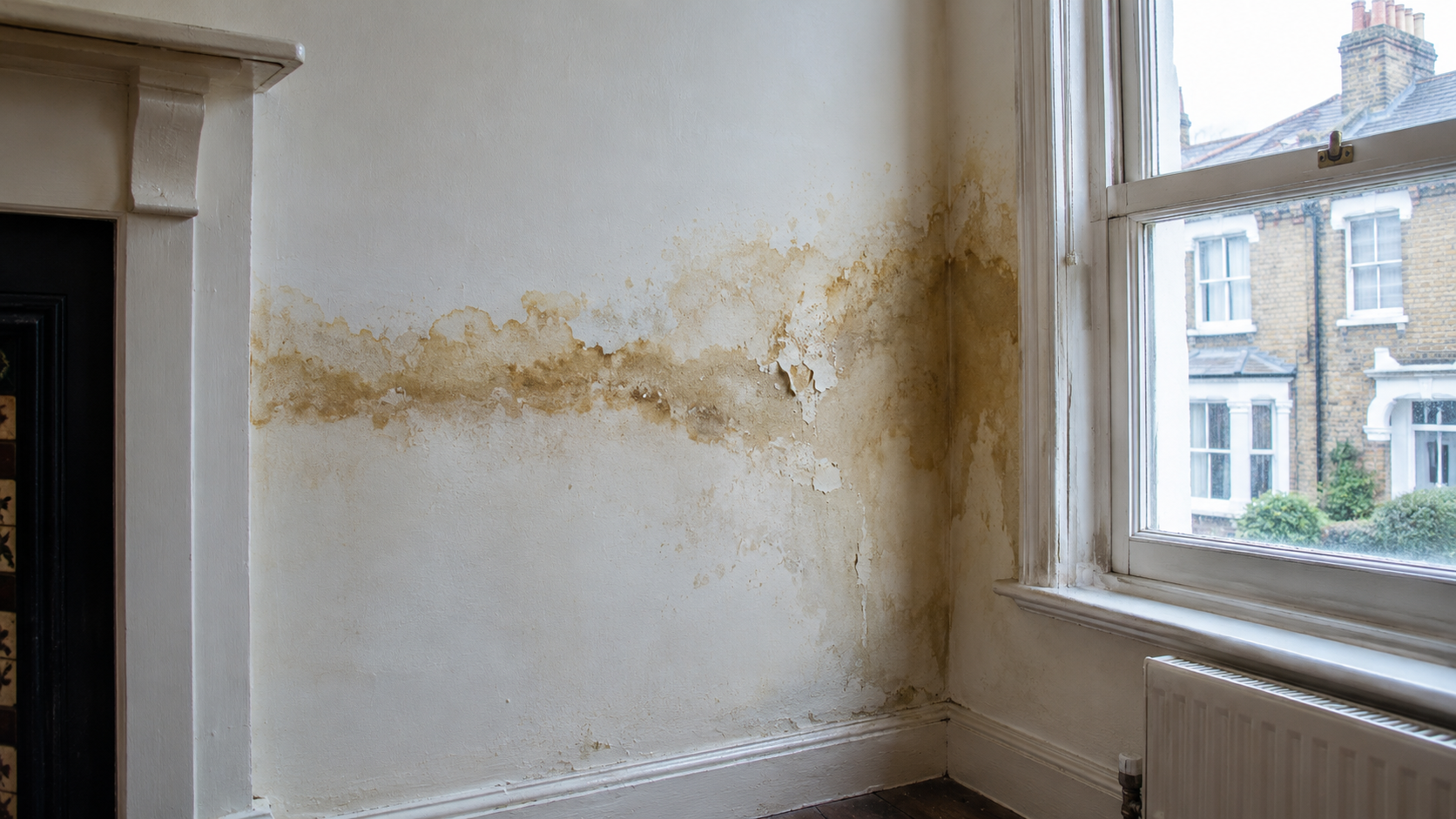
The practical benefits of historic building surveys extend well beyond regulatory compliance. A thorough survey identifies defects that are invisible to the naked eye and impossible to detect without specialist assessment.
Common findings in heritage surveys include:
Each of these defects carries a financial consequence if missed. A survey prevents costly design revisions that can far exceed the original survey fee. Discovering a structural problem after a contractor has begun work is exponentially more expensive than identifying it during the survey stage.
Historic buildings frequently contain significant geometric irregularities. Walls can be 120mm out of plumb. Floor levels can vary by 80mm across a single room. Assuming symmetry in a Georgian or Victorian building leads to fabrication errors, clashing elements, and costly on-site corrections. Accurate survey data eliminates these assumptions before they become problems.
The semantic quality of survey data matters as much as its geometric accuracy. Identifying the specific type of decay, the material affected, and the likely cause allows conservation professionals to specify repairs that are faithful to the original construction. Applying the wrong repair material to a historic building can accelerate deterioration rather than arrest it.
Survey data also functions as a long-term asset record. Owners and estate managers use it to plan phased maintenance programmes, prioritise urgent repairs, and demonstrate due diligence to insurers and lenders. For investors, a detailed condition survey supports accurate valuation and reduces the risk of post-acquisition surprises.
Timing is the most critical variable in commissioning a heritage survey. Commissioning a professional survey before any design team begins work is the single most effective way to manage financial risk. Architects and engineers who begin design work without accurate survey data are building on guesswork. Changes made after design is complete cost far more than changes made before it starts.
A structured approach to commissioning looks like this:
Relying on outdated or incomplete existing documentation is one of the most common and costly mistakes in heritage projects. Drawings produced decades ago may not reflect subsequent alterations. Photographic records from previous surveys may lack the resolution needed for current work. Commissioning a fresh survey removes this uncertainty.
Pro Tip: Ask your surveyor to flag any areas where access was restricted during the survey. Unexplored voids, sealed roof spaces, and inaccessible substructures are where the most significant defects tend to hide.
Selecting a surveyor with specialist heritage knowledge matters beyond technical competence. Conservation projects involve nuanced judgements about material compatibility, historical significance, and regulatory sensitivity. A surveyor familiar with the construction survey methods specific to heritage assets will identify issues that a generalist might miss.
Surveying historic buildings is the foundation of every successful conservation, planning, and investment decision, and no heritage project should proceed without one.
| Point | Details |
|---|---|
| Regulatory necessity | Survey data is required for every listed building consent and planning application without exception. |
| Defect identification | Surveys reveal hidden decay, damp, and structural deformation before they become costly construction problems. |
| Geometric accuracy | Historic buildings contain significant irregularities; accurate surveys prevent fabrication errors and design conflicts. |
| Method selection | TLS, photogrammetry, and handheld LiDAR each suit different project scales and should be chosen by a specialist. |
| Early commissioning | Appointing a heritage surveyor before design work begins is the most cost-effective risk management decision available. |
The most persistent misconception I encounter is that a heritage survey is a box-ticking exercise. Clients see a line item on a fee schedule and ask whether it can be reduced or deferred. The answer, in my experience, is always no.
Heritage surveys prevent delays, cost overruns, and regulatory refusals. Those three outcomes are not abstract risks. They are the most common reasons heritage projects fail to complete on time and on budget. A survey that costs a few thousand pounds can prevent a design revision that costs tens of thousands. That is not a cost. That is a return.
What I find genuinely exciting about the current state of the field is the shift towards semantic HBIM models for long-term asset management. We are moving away from surveys as one-off documents and towards dynamic records that evolve with the building. An owner who commissions a well-structured HBIM model today has a tool that will inform maintenance decisions for decades. That changes the economics of heritage ownership entirely.
The other thing worth saying plainly: the surveyors who work in this field are not interchangeable with general practice surveyors. Heritage work requires a specific understanding of historic construction methods, material behaviour, and conservation philosophy. Appointing the right specialist at the start of a project is as important as the survey technology itself.
— Editorial perspective, Surveymerchant
Surveymerchant connects property owners, investors, and conservation professionals with qualified surveyors who specialise in historic and heritage buildings across the UK.

Whether you need a full condition assessment for a listed building consent application, a measured survey to support a restoration design, or an independent structural opinion on a heritage acquisition, Surveymerchant’s panel includes specialists with the right credentials and experience. Every surveyor on the panel is vetted for qualifications and sector expertise. For commercial and heritage properties, the commercial property survey service provides thorough, compliance-ready assessments. You can also explore the full range of building surveying services to find the right match for your project.
A historic building survey captures measured drawings, photographic records, condition notes, and material assessments of the existing fabric. It documents structural condition, heritage significance, and any defects requiring attention.
Survey data is required for all listed building consent applications. Authorities will not approve interventions without evidence-based documentation demonstrating a clear understanding of the existing structure.
Survey duration depends on building size, complexity, and the methods used. A standard measured survey of a medium-sized listed building typically takes one to three days on site, with processing and report production taking additional time.
Heritage Building Information Modelling (HBIM) integrates geometric survey data with historical records, material schedules, and condition information into a single dynamic model. It supports long-term asset management and informed decision-making across the building’s lifecycle.
The best time is before any design or restoration work begins. Early commissioning prevents costly revisions and gives every consultant accurate baseline data from the start of the project.
Survey Merchant provides vetted RICS surveyors across 100+ UK locations at fixed fees:
→ Level 2 Home Survey (HomeBuyer Report)
→ Level 3 Building Survey (full structural survey)
→ RICS Red Book property valuations
→ Party wall surveyors — notices, awards & schedules of condition
→ Expert witness surveyors — CPR Part 35 reports for property disputes