Building Surveying
Oct 8, 2026
What Is a Conveyancer? a UK Homebuyer's Guide for 2026
Wondering what is a conveyancer and what they do? Our guide explains their role in UK property sales, costs, and how to choose the right one for your move.

A conveyancer is the legal specialist who manages the transfer of property ownership in the UK, and that service is used in more than one million home sales and purchases every year. For most buyers and sellers, that means once your offer is accepted, your conveyancer becomes the person who handles the legal steps between “yes” and getting the keys.
If you're a first-time buyer, this is usually the point where the excitement meets confusion. The estate agent helped you agree the deal. Your mortgage broker may be sorting the finance. But neither of them makes the property legally yours. That's the conveyancer's job.
Think of a conveyancer as the project manager for the legal side of your move. They check the paperwork, investigate the property's legal history, deal with contracts, coordinate with the other side, and make sure ownership is properly transferred. Without that work, a purchase can't complete safely.
A lot of people asking what is a conveyancer are really asking something more practical. Who does what next? Do I need a solicitor instead? How long does this all take? And what should I be watching out for so I don't get caught by delays, missing documents, or legal surprises?
When a seller accepts your offer, the property is not yet yours. You've agreed the price, but the legal transfer still has to happen properly. That's the point where your conveyancer steps in.
In the UK, conveyancing is not some specialist service only a few people ever need. It sits at the centre of more than one million home sales and purchases every year, and the Solicitors Regulation Authority says it is one of the most common legal services people use in their lifetime, which tells you how fundamental it is to the property market (SRA research on conveyancing legal services).
Once the deal is agreed, your next steps are usually quite practical:
What catches buyers out is that several things now run at once. Your lender is looking at affordability and the mortgage offer. Your surveyor checks the building itself. Your conveyancer checks the legal side.
Practical rule: The estate agent helps agree the deal. Your conveyancer helps make sure the deal is legally safe to complete.
A lot of first-time buyers worry when there are no dramatic updates in the first week or two. That usually doesn't mean nothing is happening. It means your conveyancer is opening the file, confirming identity, gathering papers, contacting the seller's lawyer, and starting the legal due diligence.
That early work matters because risks often show up during this stage. A title issue, a missing document, unclear rights of way, or a lease problem can turn into a serious headache later if nobody spots it now.
So if you've just had an offer accepted, the short answer is simple. You now need a legal professional whose entire job is to guide the ownership transfer from agreed offer to completion, while protecting you along the way.
If the phrase still feels abstract, it helps to picture your conveyancer as a legal project manager. They don't just file forms. They coordinate the whole legal workflow so that a property can change hands properly.
A conveyancer handles the transfer of ownership and the connected transaction steps, including drafting and reviewing contracts, running searches, and dealing with the Land Registry. In practice, that means much more than paperwork. It includes title verification and completion logistics too, as outlined in this explanation of what a conveyancer does.
The process usually begins with instructions and documents. Your conveyancer confirms who you are, who your lender is, and what property you're buying or selling. On a purchase, they then review the draft contract papers sent by the seller's side.
Here is the process in a single view:
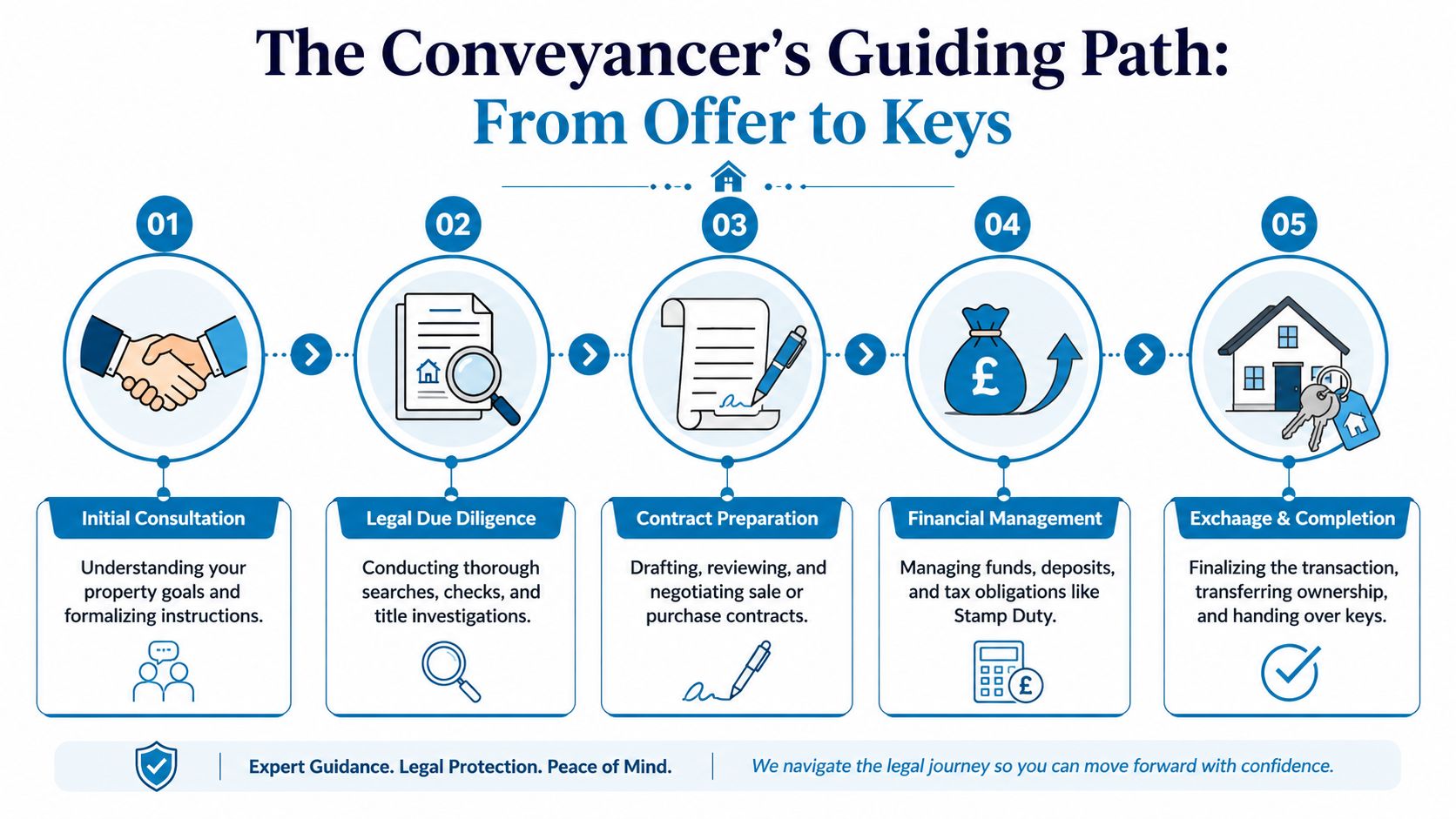
After that, the work gets more investigative.
A short video can help make those moving parts easier to picture:
A good conveyancer is trying to stop you discovering a problem after you already own the property.
For example, imagine you're buying a house that looks perfectly straightforward. During the legal checks, your conveyancer might discover that an extension appears on the plans but the supporting approval paperwork is missing, or that access rights over a shared drive are unclear. Those aren't decorative details. They can affect value, mortgageability, or your ability to sell later.
A conveyancer's value is often invisible when everything goes well. You feel it most when they spot a problem before you're locked in.
They also handle the mechanics of completion itself. That means coordinating with the other side, receiving and sending money through the proper channels, and then making sure the change in ownership is registered correctly.
So when people ask what a conveyancer does, the clearest answer is this. They investigate, explain, coordinate, and complete the legal transfer so that you don't buy a problem instead of a home.
Many buyers often get tangled up because people use “conveyancer” and “solicitor” as if they mean the same thing, but they don't always.
A licensed conveyancer specialises in property law only. A solicitor has broader legal training and may be the better fit where the transaction includes wider legal complications, according to Setfords' explanation of the difference.
That doesn't mean one is automatically better than the other. It means the right choice depends on the type of transaction.
If you're buying a fairly standard freehold house with no unusual complications, a licensed conveyancer is often a sensible option because property transfers are their core focus. If the purchase involves a dispute, family law issues, a complex lease, or a legal problem that spills beyond straightforward conveyancing, a solicitor may be the safer choice.
| Factor | Licensed Conveyancer | Solicitor |
|---|---|---|
| Training focus | Specialist property law training | Broader legal training across multiple areas |
| Main strength | Standard property transactions and process efficiency | Property work plus wider legal advice where needed |
| Best for | Straightforward purchases, sales, and remortgages | Transactions with added legal complexity |
| Scope beyond conveyancing | More limited outside property matters | Can advise on connected legal issues |
| Typical buyer question | “Can they handle my house purchase smoothly?” | “Might I need broader legal advice as well?” |
There's a third category that often gets left out of basic guides. Chartered legal executives can also work in property law and may handle conveyancing matters in practice. That's one reason the word “conveyancer” can be confusing. It often describes the job being done, not just one exact professional title.
Some firms use teams made up of solicitors, licensed conveyancers, and chartered legal executives. From a client's perspective, the useful question isn't only “what are they called?” It's “who will handle my file, and are they experienced with this type of transaction?”
If your purchase is ordinary, specialisation can be a strength. If your purchase has legal wrinkles, broader legal training can be valuable.
Here's a practical way to decide:
The best professional is the one whose skills match the transaction in front of you, not the one with the most familiar title.
Your offer is accepted, the seller says “great,” and it can feel as though the hard part is over. In practice, this is the stage where the legal work starts to gather pace. A conveyancer works a bit like a project manager for the legal side of your move, but the timetable is affected by other people too, including the seller's lawyer, your lender, the local authority, and sometimes a whole chain of buyers and sellers.
That is why conveyancing can feel quiet for a few days, then suddenly urgent.
A typical UK conveyancing transaction often takes around 12 to 16 weeks, although some are faster and some take much longer. The Legal Ombudsman's residential conveyancing report also shows a clear pattern behind client frustration. Delays and poor communication sit near the centre of many complaints, and the draft contract stage alone can vary widely depending on how quickly information is supplied (Legal Ombudsman residential conveyancing report).
The timeline is easier to understand if you picture it as several workstreams running at the same time, not a single queue where one job finishes before the next begins. Your conveyancer may be checking the contract papers while your lender processes the mortgage and your survey is being arranged.

Some buyers find it helpful to understand your home purchase timeline when they can see how the legal, mortgage, and survey stages overlap.
The broad pattern usually looks like this:
The biggest delays are usually practical ones rather than dramatic legal problems. A seller may be slow to answer enquiries. A managing agent may take time to produce a leasehold information pack. A chain may be waiting for one buyer's mortgage offer. For a first-time buyer, the silence can be the hardest part, because the file may still be moving even when there is nothing new to report that day.
Conveyancing costs usually fall into two groups, and it helps to separate them from the start.
That split matters because two quotes that look similar at first glance can be very different once extras are added. One firm may include acting for the lender, ID checks, and electronic transfer fees in the headline price. Another may list them separately. Ask for a written quote that shows what is included, what is excluded, and which costs are only estimates.
The legal fee is not just payment for form-filling. You are paying for someone to spot title problems, chase missing information, explain risks clearly, and keep the transaction on track. If your purchase is straightforward, a specialist licensed conveyancer may offer focused property experience at a competitive price. If the matter involves a lease extension issue, probate, a boundary dispute, or another legal complication, a solicitor's broader training may justify a higher fee. A chartered legal executive in an experienced property team may also be a strong option, especially if they handle this type of transaction every day.
A cheap quote can still be expensive if poor communication causes delays, stress, or missed issues. Good value usually means clear updates, accurate work, and a fee structure you can understand before you commit.
People often confuse these roles, especially on a first purchase. The easiest way to separate them is this: a surveyor checks the building's physical condition, while a conveyancer checks the property's legal position.
Those two jobs are different, but they work best together.
A survey is a bit like a health check for the building. It can reveal damp, movement, roof problems, poor alterations, or signs that further investigation is needed. Your conveyancer then uses that information as part of the wider legal and practical picture.

This is why a survey should never be treated as an isolated extra. It can directly influence what legal questions get asked next. If you want a clear overview of your options, you can Find property surveys with Survey Merchant.
Say your surveyor finds signs that a rear extension may have been altered over time, or notes a boundary feature that doesn't seem to match what you thought was included. Your conveyancer can then raise targeted enquiries.
That might include asking for supporting paperwork, checking whether approvals exist, or clarifying exactly what land is included in the title. If the answer is unsatisfactory, you may decide to renegotiate, ask the seller to remedy the issue, or walk away.
Here's the cleanest way to think about the relationship:
A survey can uncover the reason to ask a legal question. A conveyancer can turn that concern into a formal enquiry that protects you before exchange.
That combined approach is especially useful for older homes, altered properties, and anything that doesn't feel completely straightforward from the viewing alone.
Most buyers don't need the “perfect” conveyancer. They need one who is clear, organised, and suited to their transaction. The easiest way to judge that is by asking better questions before you instruct.
Use these as a practical shortlist:
Pay attention to how they answer, not just what they say. If someone is vague about fees or hard to reach before you've even instructed them, that's worth taking seriously.
Try to line up your survey and your conveyancer early, rather than treating them as separate jobs to think about later. That way, the legal checks and the property checks can progress at the same time, and any concern raised by the survey can feed into the legal enquiries while there is still room to act.
Buying a property can feel complicated because several professionals are involved. But your decision becomes simpler when you reduce it to two immediate tasks. Choose the right legal professional for the transaction, and get the right survey on the property.
If you need a surveyor alongside your conveyancer, Survey Merchant helps match buyers and owners with qualified surveyors across the UK for building surveys, valuations, and other property reports. It's a practical way to get the physical side of the property checked early, so your legal process can move forward with better information.
Survey Merchant provides vetted RICS surveyors across 100+ UK locations at fixed fees:
→ Level 2 Home Survey (HomeBuyer Report)
→ Level 3 Building Survey (full structural survey)
→ RICS Red Book property valuations
→ Party wall surveyors — notices, awards & schedules of condition
→ Expert witness surveyors — CPR Part 35 reports for property disputes