Party Wall
Jul 16, 2026
Independent Party Wall Surveyor: A Complete UK Guide 2026
Need an independent party wall surveyor? This guide explains their role, the process, costs, and how to appoint one under the Party Wall Act. Get expert advice.

You're ready to build. The drawings are moving, the builder wants dates, and then someone says, “You need a party wall surveyor.” That's usually the moment the process starts to feel more legal than practical.
Most homeowners aren't worried about the wall itself. They're worried about delay, neighbour friction, and surprise costs. The biggest confusion usually comes when a neighbour says they want “their own surveyor” and you're left wondering whether that means you have to pay for two professionals instead of one.
The good news is that the Party Wall Act has a clear structure. Once you understand what an independent party wall surveyor does, what triggers the process, and how cost liability works, the whole thing becomes much easier to manage.
If you're planning an extension, loft conversion, basement works, or structural alterations near a shared boundary, the Party Wall Act isn't there to stop your project. It's there to set rules before work starts, so both owners know where they stand.
In practice, the Act matters when your work could affect a shared wall, a boundary line, or your neighbour's foundations. It creates a formal route for giving notice, dealing with objections, and recording what's allowed. That's important because neighbour disputes often don't begin with major damage. They begin with uncertainty. One side thinks the work is minor. The other thinks nobody asked.
The language puts people off. Terms like Party Wall Notice, dispute, and Award sound more dramatic than they often are. A “dispute” under the Act doesn't always mean an argument. It often just means the legal procedure has started because consent wasn't given.
A useful way to think about it is this:
The Act works best when it's treated early as part of project planning, not as a problem to mop up later.
Many homeowners also assume this is just paperwork for difficult neighbours. It isn't. Even where relations are good, a formal process helps protect both sides. If you want a broader starting point before diving into costs and appointments, the Survey Merchant party wall guidance gives a useful overview of common scenarios.
Before you worry about fees or forms, answer two practical questions:
Those two points shape everything else. Get them right, and the process is usually manageable. Leave them too late, and even a straightforward job can become awkward.
An independent party wall surveyor isn't merely “your surveyor” or “your neighbour's surveyor” in the usual sense. Under the Party Wall etc. Act 1996, it's a statutory appointment and the surveyor must act independently of the person who instructed them, as explained in the RICS guidance on party wall legislation and procedure.
That point matters more than is often realised. The person paying the fee often assumes the surveyor is there to push their side. Under the Act, that isn't the job.
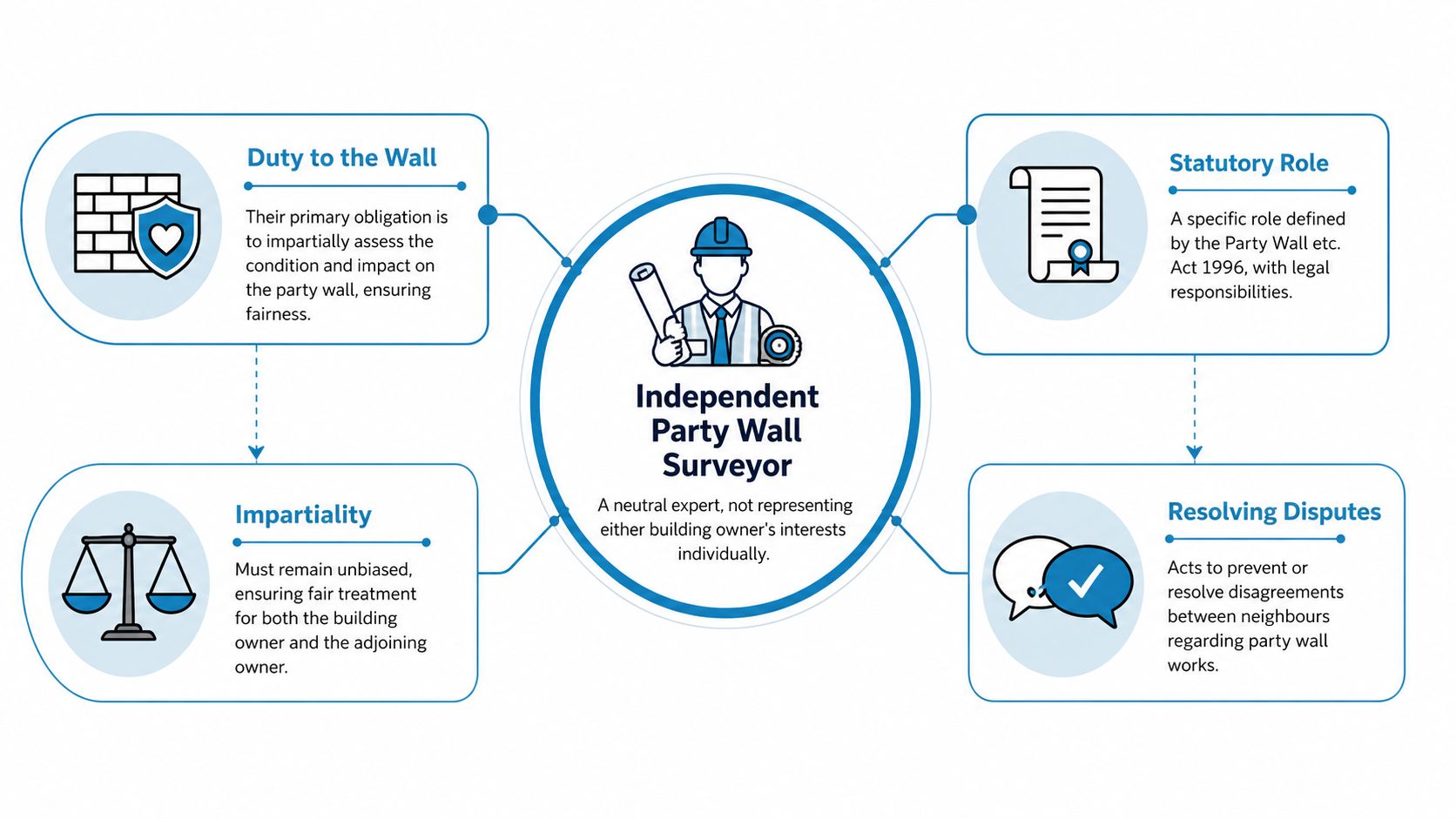
The simplest analogy is a referee in a match. A referee is appointed within a process, applies the rules, and doesn't switch sides because one team pays for the pitch.
A party wall surveyor does the same sort of thing. They assess the proposed works, consider the risk to the adjoining property, and produce the formal document that governs how the job should proceed. Their duty is to the Act and to a fair outcome, not to personal loyalty.
That independence is also personal to the individual surveyor. It's not just about the firm name on the letterhead. The appointment sits with the named surveyor.
The Act covers three main categories of work, as set out in the same RICS guidance:
That middle category catches many homeowners out. You might think you're only doing internal work, but cutting into a wall for beams, raising a party wall, or carrying out other structural alterations can bring the Act into play.
An independent party wall surveyor typically helps deal with the practical and legal mechanics of the job, including:
Practical rule: A party wall surveyor is not there to make your project harder. They're there to make it harder for the project to go wrong.
If you remember only one thing from this section, remember this. Independence doesn't mean distance or indifference. It means professional neutrality.
Once the Act moves into formal dispute resolution, one of the first decisions is whether both owners will use one Agreed Surveyor or appoint two separate surveyors.
Cost liability often becomes cloudy for many homeowners. The word “independent” makes some people assume each side must have their own surveyor. That isn't how the Act works. One surveyor can act impartially for both owners if both agree.
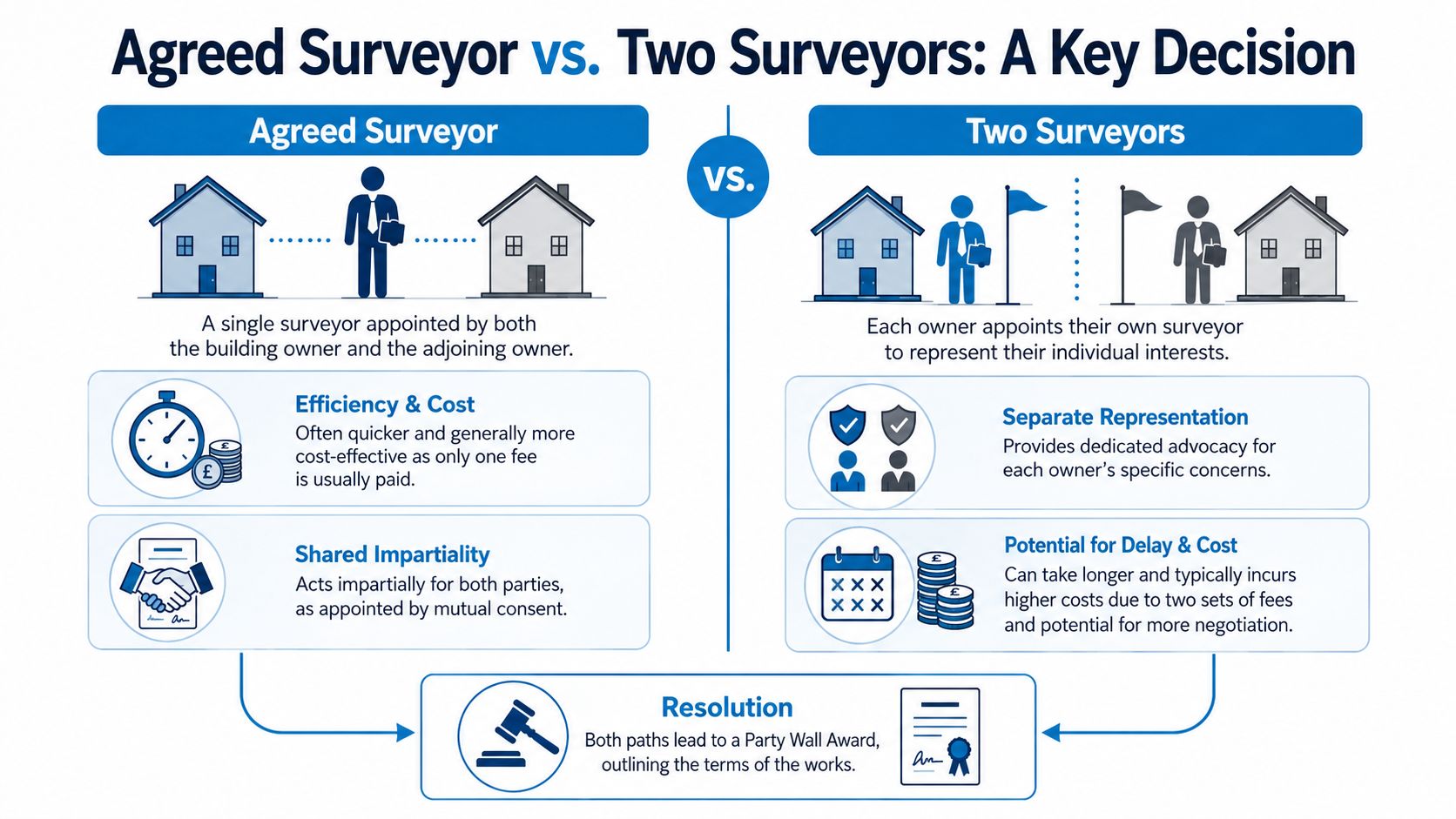
An Agreed Surveyor is a single surveyor appointed by both owners. This route often suits straightforward residential work where the relationship is civil and the risks are understood.
The main practical advantages are usually:
That doesn't make the surveyor less independent. In fact, independence is exactly why the arrangement is legally workable.
With two surveyors, each owner appoints one. The two surveyors then prepare the award together. Some owners prefer this because it feels more protected. In some cases, especially where trust is poor or the works are more contentious, that may be a sensible route.
But two surveyors usually mean more administration, more correspondence, and more cost. It's a bit like turning a simple meeting into a negotiation between two representatives. Sometimes that's necessary. Sometimes it just adds friction.
This is the point that causes the most frustration. Recent judicial clarification means that if a building owner appoints a surveyor, the neighbour cannot demand a second surveyor at the building owner's expense unless the costs are deemed reasonable, as discussed in this HousingUK thread on independent surveyor cost liability.
That distinction matters. A neighbour may choose to hire their own adviser, but that doesn't automatically mean you must fund any extra appointment they want. The question becomes whether those extra costs are reasonable in the circumstances.
If your neighbour wants their own surveyor, don't assume the answer is automatically “I have to pay.” First ask whether this is a statutory appointment under the Act, a private adviser of their choosing, or a cost whose reasonableness may be challenged.
Here's the practical comparison most homeowners need:
| Option | Best suited to | Likely effect on cost | Likely effect on speed |
|---|---|---|---|
| Agreed Surveyor | Straightforward jobs and workable neighbour relations | Lower | Faster |
| Two Surveyors | More sensitive jobs or lower trust between neighbours | Higher | Slower |
If you're budgeting for works, this decision isn't minor. It can materially change the final bill and the pace of the process.
Your builder is ready, the structural drawings are done, and then your neighbour replies, "I want my own surveyor." For many homeowners, that is the moment the process stops feeling like paperwork and starts feeling like risk. The key is to separate two different questions. First, has the notice process been handled properly? Second, if a dispute arises, does the case call for one agreed surveyor or two separate surveyors?
The notice is the starting point because it defines what the Act is dealing with. If it is vague, everything that follows becomes harder. A surveyor can only act on the works described, much like an architect can only price the drawings put in front of a builder.
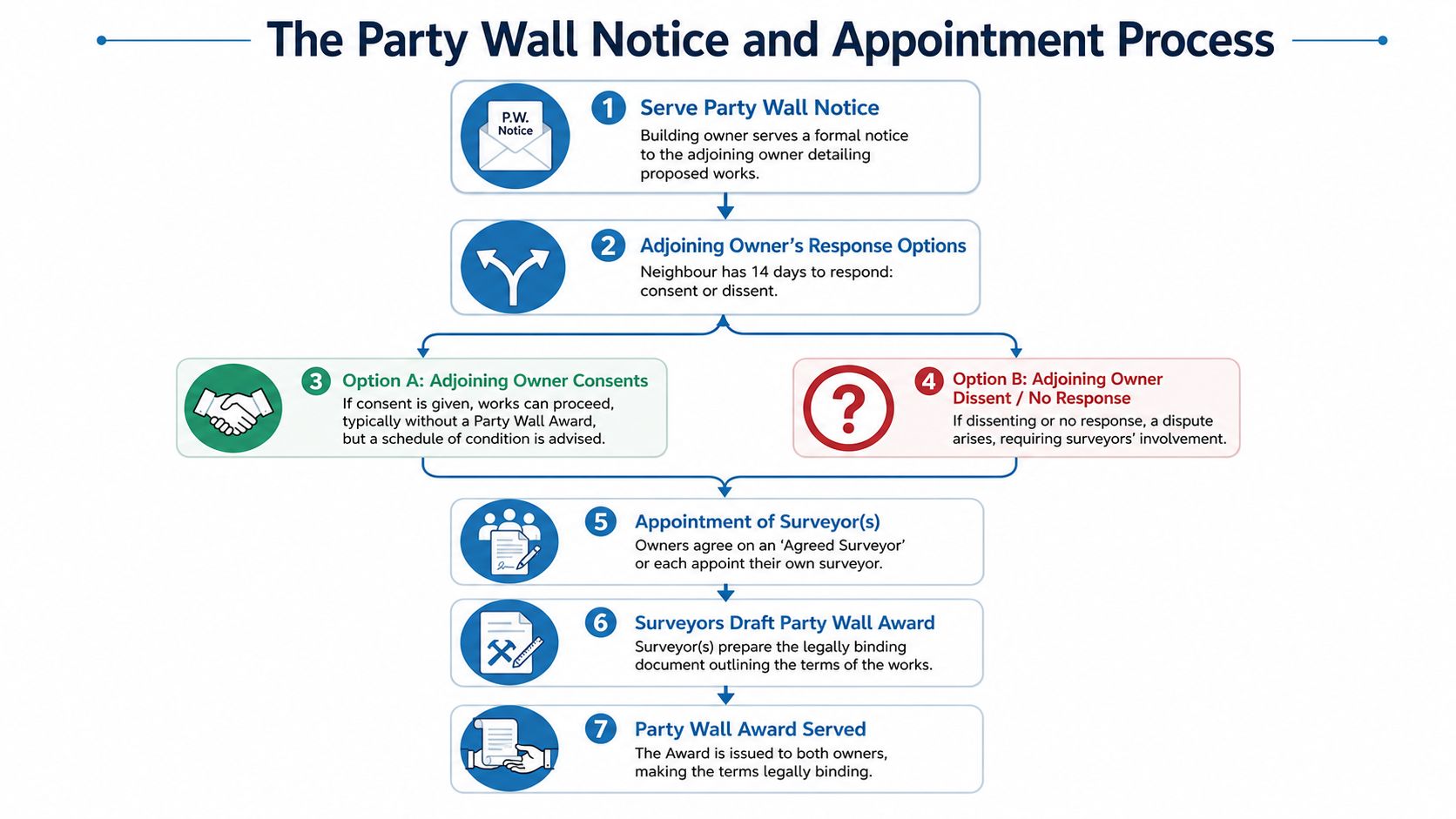
The notice should be in writing and should describe the proposed works clearly enough that your neighbour can understand what they are being asked to consent to. That usually means the nature of the work, the property it affects, and the intended start date.
Poorly drafted notices create avoidable arguments. If a rear extension notice loosely refers to "building works" and the actual job includes excavation near foundations, the neighbour may say they never had a fair chance to consider the full impact. That is how small administrative errors turn into delay.
Timing matters too. Party wall procedure rarely fits neatly around builder availability, planning conditions, and family schedules, so early preparation helps. For practical examples of when notice is required, see this guide to important party wall notice information.
Once the notice is served, the adjoining owner has a set period to reply. Under the Party Wall etc. Act 1996, if they do not consent in writing within 14 days, a dispute is treated as having arisen and the surveyor appointment process follows, as set out in the legislation itself.
That wording can sound more dramatic than it is. In party wall terms, "dispute" does not necessarily mean hostility. It often just means the Act now requires surveyor involvement so the work can be regulated formally.
The usual responses are:
This is the point where many homeowners get confused about liability. If a dispute exists, the owners can appoint one Agreed Surveyor or each appoint their own surveyor. The legal mechanism matters because it affects both administration and the likely fee position.
An Agreed Surveyor works like a single referee accepted by both sides. Two surveyors work more like two professionals who must confer and, if needed, select a third surveyor to resolve a point they cannot agree on. Neither route is automatically right. Straightforward works with sensible communication often suit an Agreed Surveyor. More sensitive projects, or cases where trust is low, may justify separate appointments.
That choice also links back to the grey area on cost. If your neighbour says, "I want my own surveyor," the next question is not solely who they prefer. The primary question is whether that separate statutory appointment, and the resulting fees, are reasonable in the circumstances. That is why the appointment stage should be treated as a decision, not a formality.
After appointment, one of the first practical tasks is often a schedule of condition. This is a written and photographic record of the adjoining property before work starts. It works like a timestamped baseline. If cracking, staining, or movement is alleged later, everyone has something firmer than memory to rely on.
A short explainer can help if you prefer to see the process laid out visually.
A well-prepared schedule of condition often prevents later arguments about whether damage was new, historic, or unrelated to the works.
Once the surveyor, or the two surveyors, have reviewed the notice, the drawings, and the condition of the adjoining property, they issue the Party Wall Award. This is the formal document that sets the rules for the job.
A clear Award usually states what work is authorised, when and how it may be carried out, what protective measures are required, and how any damage should be addressed if it occurs. For homeowners, it helps to read the Award as the site rulebook. It does not just record permission. It sets the operating instructions for getting the work done with the least room for argument.
Your neighbour receives your notice, decides they want their own surveyor, and your first question is usually the blunt one. Who pays for that?
In many cases, the building owner pays the reasonable fees linked to the party wall process, even where the adjoining owner appoints a separate surveyor. That point often causes the most confusion. Homeowners assume that if the neighbour chooses their own surveyor, the neighbour must also pay that bill. The Act does not work that way in many standard cases. The key question is usually whether the fee is reasonable for the job and whether one surveyor could have dealt with it just as properly.
That is why the choice between an agreed surveyor and two separate surveyors matters financially. One surveyor works like a single referee accepted by both sides. Two surveyors create a wider process, more correspondence, and usually more cost, even before any dispute becomes serious. If you want to see how that arrangement is typically recorded, this example of a party wall award two surveyors helps make the paperwork more concrete.
Fees are driven less by a flat national price and more by the amount of professional time the job needs.
A straightforward loft conversion with clear drawings and a cooperative neighbour is usually at the lower end. A basement excavation is often higher because the surveyor has more to review, more risk to assess, and more detail to set out in the award. Projects also become more expensive when plans are incomplete, questions go unanswered, or access for inspections is delayed.
Location matters too. Surveyors in London and the South East often charge more than surveyors in other areas. Some charge fixed fees for routine matters. Others work partly or wholly on an hourly basis.
This is the part many online guides blur.
If both owners appoint the same surveyor, there is one professional preparing the award and one fee structure to manage. If each owner appoints their own surveyor, both surveyors must review the matter, correspond with each other, and agree the terms of the award. That extra layer often increases the total bill. It can still be the right choice where trust is low or the works are more contentious, but homeowners should understand the cost consequence before treating it as the default option.
The adjoining owner is entitled to appoint their own surveyor. That does not automatically make every level of fee recoverable without question. Fees still need to be reasonable in the circumstances.
The broad pattern is simple. One agreed surveyor usually costs less than two separate surveyors.
| Project Type | Cost with One Agreed Surveyor | Cost with Two Surveyors |
|---|---|---|
| Loft conversion | Usually lower than more complex works | Usually higher than a single agreed surveyor |
| Extension | Often mid-range | Usually higher than a single agreed surveyor |
| Basement excavation | Often at the higher end | Often the highest-cost route |
| General Party Wall Award range | Broadly lower overall | Broadly higher overall |
Treat any early quote like a builder's estimate before opening up the structure. It gives a useful starting point, but the final figure depends on what the surveyor has to deal with.
Timelines catch homeowners out more often than fees.
The legal notice periods set the minimum pace, but the practical timetable is often longer. Surveyors need the notice, drawings, replies, access for inspections where needed, and enough information to draft the award properly. If one owner is slow to respond or the design changes halfway through, the process can stretch.
For a simple matter with prompt replies, the process may move along fairly smoothly. Where there are two surveyors, technical concerns, or repeated revisions to the plans, allow more time. The safest approach is to start early and treat the party wall process as part of the project programme, not as admin to squeeze in just before the builder arrives.
A useful rule is this. If your planned start date is already close, you are likely working with less margin than you think.
Your neighbour has dissented, surveyors have been appointed, and a formal document arrives. This is the point where many owners skim to the fees, then put it down. That is a mistake. The Party Wall Award is the working rulebook for the job. It records what work can go ahead, how it should be carried out, what protections apply to the adjoining property, and who is expected to pay the surveyors' costs.
That last point causes more confusion than it should. If you are the building owner, the award often deals with your neighbour's surveyor's reasonable fees as well as your own. This is one reason the choice between an Agreed Surveyor and two separate surveyors has real cost consequences. The award is usually where that liability is set out in black and white.
Read the award the way you would read a building contract or an insurance schedule. You are checking whether the document would still make sense if a disagreement arose halfway through the works.
A sound award will usually cover:
If any of that is vague, ask for clarification before work begins. Ambiguity is expensive.
Owners often treat the schedule of condition as an attachment of secondary importance. In practice, it is one of the parts you are most likely to rely on later.
It works like the check-in photos taken before you hire a car. If a crack appears, a tile loosens, or decoration is marked, the first question is whether it was already there. A written and photographic record gives both sides something firmer than memory. Without it, small disputes can become arguments about recollection rather than evidence.
Check this first: When you receive an award, review the description of works, the schedule of condition, and the section dealing with fees. Those are often the parts with the biggest practical effect on cost, liability, and what happens on site.
You do not usually "sign off" the award in the way people expect, but you should still test it carefully. A homeowner reading it for the first time should be able to answer these questions:
That last question matters more than many online guides suggest. If your neighbour appoints their own surveyor, the award often records that you, as the building owner, must pay that reasonable cost. Where one Agreed Surveyor is used, there is usually one surveyor's fee to deal with. Where two surveyors are appointed, there are usually two sets of professional fees to consider. The award does not create that commercial reality from nowhere, but it is the document that usually confirms it.
If you want to see how that structure looks in practice where separate surveyors are appointed, this sample party wall award two surveyors shows the usual layout and clauses.
Your builder is booked, scaffolding starts on Monday, and your neighbour says, "I think I want my own surveyor." That is the point where many projects become expensive, not because the work is unusual, but because the legal steps were left too late.
The Party Wall Act works a bit like an insurance policy. It needs to be arranged before the risk starts, not after dust is already coming through the wall.
No. If the work requires notice and either consent or an award, that process needs to be in place before the relevant works begin.
A surveyor cannot usually tidy this up after the event with a retrospective award. Once work has started without the required party wall procedure, the problem is timing as much as paperwork. That can leave a building owner exposed to delay, neighbour objections, and arguments about damage that would have been easier to manage if the schedule of condition and access terms had been agreed at the start.
A party wall notice does not stay live indefinitely. If your programme slips too far, you may need to serve a fresh notice rather than relying on an old one.
That catches homeowners out. They serve notice early, then planning, structural design, or contractor availability changes the build date. By the time they are ready to begin, the original notice may no longer fit the project timetable. The practical lesson is simple. Serve notice when the scheme is settled enough to proceed within a realistic window.
Earlier than many homeowners expect.
If you wait until the week before the builder wants access, you compress everything that needs calm handling. Notice periods have to run. Your neighbour needs time to respond. If they appoint their own surveyor, that appointment has to be made properly. Then the surveyor or surveyors need time to inspect, agree the scope of the works, prepare the schedule of condition, and settle the award.
This is also where cost questions become clearer. If one Agreed Surveyor is appointed, there is usually one professional fee stream to deal with. If your neighbour appoints a separate surveyor, there are usually two sets of reasonable surveyor's fees in play, and the building owner is often asked to meet both. That is one of the least understood parts of the process, and one of the main reasons early advice matters. The choice between one surveyor and two is not just administrative. It often changes the bill.
Get project-specific advice before notices are served or builders are booked.
Small changes in design can change the answer. Excavation depth, distance from the neighbour's structure, cutting into a shared wall, or building on the line of junction can each bring the Act into play. A quick assumption based on a builder's view or a neighbour's casual comment is a poor substitute for advice from someone who deals with the Act regularly.
If you need help finding the right person, Survey Merchant connects property owners with surveyors who handle party wall matters through a UK-wide panel service. That can help if you want an early view on whether the Act applies, whether an Agreed Surveyor may be suitable, or what the likely fee position looks like if your neighbour prefers their own surveyor.
If you are unsure, act before work starts. That is usually the cheapest stage to fix anything.
Survey Merchant provides vetted RICS surveyors across 100+ UK locations at fixed fees:
→ Level 2 Home Survey (HomeBuyer Report)
→ Level 3 Building Survey (full structural survey)
→ RICS Red Book property valuations
→ Party wall surveyors — notices, awards & schedules of condition
→ Expert witness surveyors — CPR Part 35 reports for property disputes