Building Surveying
Jul 16, 2026
Making an Offer on a House: The 2026 UK Buyer's Guide
Our UK guide to making an offer on a house. Learn how much to offer, negotiation tactics, and how to use a survey to save money. For buyers in 2026.

You’ve found a house you can see yourself living in. The viewing went well. The photos matched reality for once. The area feels right. Then the estate agent asks the question that catches most first-time buyers off guard: “Would you like to make an offer?”
That’s the point where too many buyers switch from careful research to guesswork.
Making an offer on a house isn’t about picking a number that feels about right. It’s a negotiation. Better buyers treat it like one from the start. They build an offer around evidence, position and timing, not hope. They ensure they don't think of the survey as something you do after the hard part is over. In practice, the survey is often the thing that gives you the strongest hand.
You view a house on Saturday, like it, and the agent asks for best and final offers by Monday. Buyers who go in with a feeling usually overpay. Buyers who go in with evidence usually keep control.

Before you put a number on the table, get clear on one point. The lender’s valuation is not your safety net. As explained in this guide to mortgage valuations, that check exists to protect the bank’s lending position, not to tell you whether the property is a good buy at your agreed price.
That distinction matters more than first-time buyers realise.
A proper survey is not just something to order after your offer is accepted. It is the best tool you have for shaping the offer itself. If the house shows signs of damp, movement, roof spread, outdated electrics, poor drainage, or timber decay, those are not abstract risks. They are costs, delays, and bargaining points. Once those issues are written down by a surveyor, your negotiation stops being opinion against opinion.
Build your position before you bid around three things:
I tell buyers to price the risk, not just the property.
If the house needs work, put rough numbers against it early. Kitchen and bathroom wear is one thing. Structural movement, roof failure, damp remediation, rewiring, or replacing old windows are different. Even a basic refurbishment budget can sharpen your thinking. The All Well Property Services pricing guide is useful for sense-checking renovation costs before you decide whether the asking price survives contact with reality.
The old Home Information Pack system disappeared, but the lesson behind it still holds. The buyer who gathers information first has the stronger hand. Agents respond differently when your offer comes with a clear rationale, known funding position, and a list of issues already identified for follow-up.
That is the groundwork. You are not trying to sound keen. You are showing the seller that your number is disciplined, your risk is measured, and any future renegotiation will be based on evidence rather than panic.
You view a house at £325,000. It looks tidy enough, the photos were flattering, and the agent says there has been “good interest”. Then you notice the rear wall has been patched, two windows have blown units, and the roofline has a dip you can see from the pavement. If you offer off the asking price alone, you are negotiating blind. If you price the defects before you bid, you are setting the first serious anchor in the deal.

Asking price is only a marketing number. Your opening bid should come from evidence you can defend later if the negotiation tightens after survey.
Use sold prices first. Asking prices show hope. Sold prices show where buyers and sellers met.
Pull comparables that are as close as possible on type, size, condition, tenure and position. A renovated Victorian terrace is not a fair benchmark for a tired one with dated electrics and a roof near the end of its life. A flat with a short lease, high service charges, poor light or a compromised layout also needs adjusting. Small differences change value quickly.
Then apply a condition discount with a cold eye. This is the part first-time buyers often miss. They allow a bit for decorating, but fail to price the expensive items that come later and weaken their position once they are emotionally committed.
Use a rough repair schedule before you offer:
If bigger works are likely, sense-check the numbers against the All Well Property Services pricing guide. It is not a substitute for contractor quotes, but it is good enough to stop you paying finished-house money for an unfinished-house problem.
A smart opening offer does two jobs. It reflects market value, and it reserves room for issues a survey may confirm.
That matters because the survey is not just a box to tick after acceptance. It is the tool that turns suspicion into evidence. If you already believe the property has £15,000 to £25,000 of deferred maintenance, your first offer should reflect that risk instead of assuming you can claw it back later. Sometimes you will. Sometimes the seller refuses and you have wasted legal fees, survey costs, and weeks of momentum.
I usually advise buyers to split defects into three buckets. Cosmetic, foreseeable, and uncertain. Cosmetic items, such as old carpets or tired paint, rarely justify much discount. Foreseeable building issues, such as worn windows or an aged boiler, should be costed and reflected in the bid. Uncertain items, such as movement, damp source, hidden timber decay, or non-compliant alterations, are where you leave proper room because the survey may move the numbers hard.
A formal valuation can help you separate noise from substance, especially if you are trying to judge whether the price is merely ambitious or entirely unsupported. If you need the distinction, read what a RICS valuation covers.
The same house can justify different opening bids depending on the seller’s circumstances.
A fresh listing with two weekend viewings booked is one negotiation. A property that has been reduced, relisted, or sat around for weeks is another. Stale stock often means one of three things. The price is too high, earlier buyers found defects, or the seller is difficult on terms. All three improve your position if you stay disciplined.
Ask direct questions. Has anything come up on previous surveys? Has a sale fallen through? Have there been any reductions? How quickly does the seller need to move? Agents may not hand you the full story, but the answers usually reveal where the pressure sits.
Do not go into a negotiation with one figure in your head.
Write down:
Those numbers should reflect the property as it stands today, not the polished version in your imagination six months after completion.
This protects you from the two classic mistakes. Offering too high because you fear losing the property, or offering too low without evidence and getting dismissed as a time-waster. A good opening bid is firm enough to create value, but credible enough that the agent can defend it to the seller.
That is the aim. Set an anchor you can support with comparables, condition, and repair risk. Then if the survey confirms your concerns, you are not inventing a new position halfway through. You are continuing the same evidence-based negotiation from a stronger footing.
A good offer is brief, clear and easy for the agent to present to the seller.
Too many buyers make a rushed phone call, mention a number, then disappear. That creates work for the agent and uncertainty for the seller. A stronger approach is to call first, then confirm in writing the same day.
Your offer should include more than price. It should tell the seller why you are a credible buyer and how clean the transaction is likely to be.
Include these points in your message:
What sellers like hearing: “We’re chain-free, our agreement in principle is in place, our solicitor is ready to receive papers, and we can move on the timeline that best suits the vendor.”
Notice what that does. It reduces uncertainty.
Agents are paid to get a deal through, not just agreed. If your offer looks easier to progress, it can beat a slightly higher bid from a buyer with a messy chain, unclear finances or unrealistic timing.
| Scenario | Subject Line | Sample Wording Snippet |
|---|---|---|
| First-time buyer | Offer for [Property Address] | We would like to offer £[amount] for the property, subject to contract and survey. We are first-time buyers, chain-free, with our mortgage in principle agreed and solicitor instructed. |
| Chain-free buyer seeking speed | Offer submitted for [Property Address] | We are in a position to move quickly and can work to the seller’s preferred timetable. Our offer is £[amount], subject to contract and standard legal checks. |
| Buyer offering below asking due to visible condition | Offer for [Property Address] based on current condition | Having considered the property’s current condition and likely remedial works, we would like to submit an offer of £[amount], subject to contract and survey. |
| Buyer in competition | Best and final offer for [Property Address] | Please submit our offer of £[amount] to the vendor. We are fully proceedable, our funding is arranged in principle, and we can provide solicitor and financial details immediately. |
Keep the tone professional. Don’t overexplain your life story. Don’t try to sound clever. Don’t threaten to walk away unless you mean it.
A strong written offer reads like a buyer who has already done this before, even if you haven’t.
Your offer gets accepted at £385,000. You feel relieved for about a day. Then the survey comes back with roof defects, signs of damp around the bay, and old electrics that may need upgrading sooner than you thought.
That is not a setback. It is the point where guesswork ends and your negotiating position gets stronger.
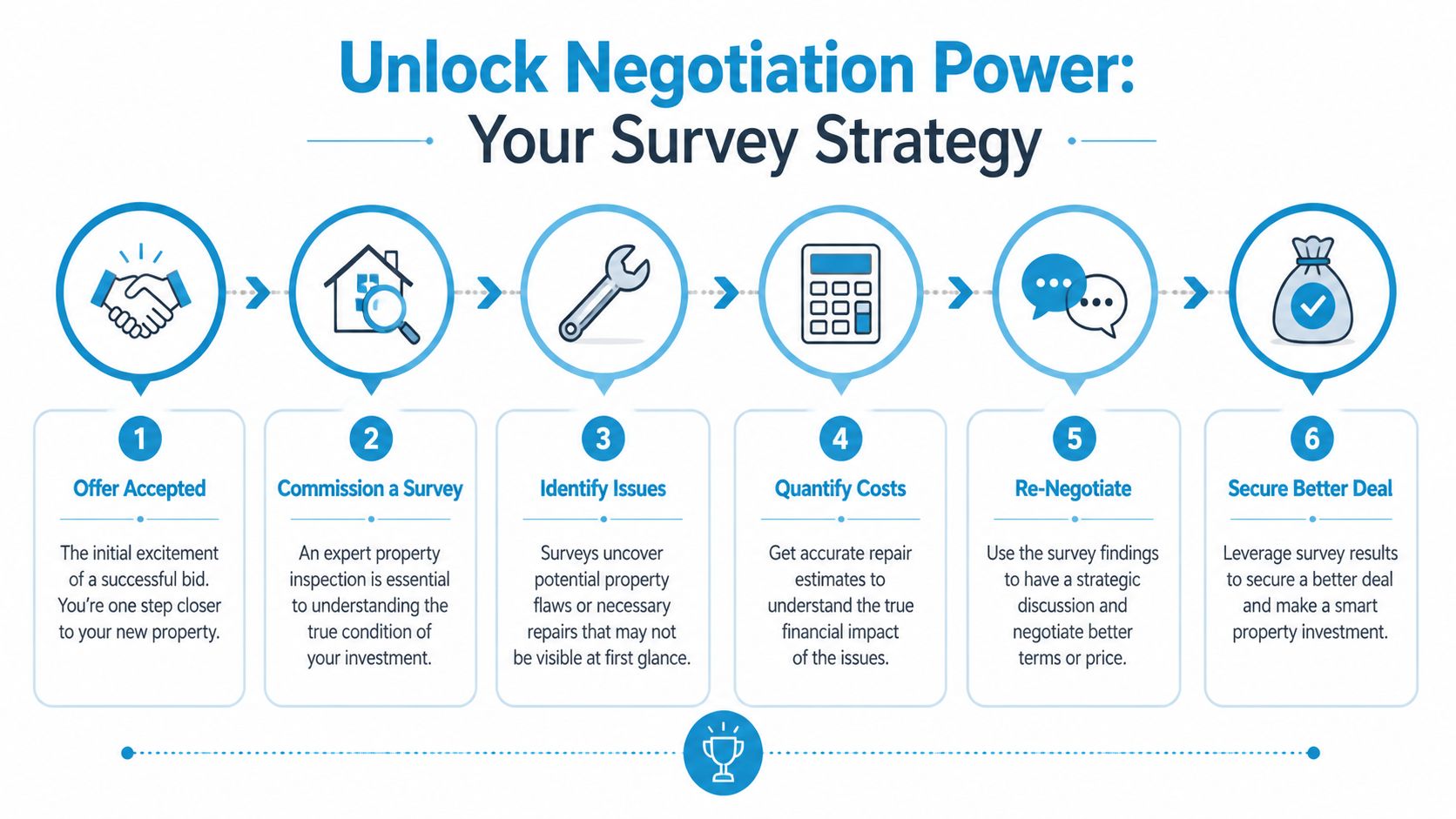
A proper Level 2 or Level 3 survey is not just a condition report. It gives you evidence you can price.
Sellers can brush off a buyer’s nerves. They struggle to brush off documented defects, photos, risk ratings, and a surveyor’s comments on likely repair work. That is why buyers who know how to negotiate the house price after your property survey usually handle this stage better than buyers who treat the survey as a formality.
Common findings that can support a price reduction include:
A survey does not kill a deal. Unpriced repair liability does.
Do not tell the agent the survey was "bad" and ask for money off. That reads like panic, not evidence.
Use a tighter method.
Pick out the defects that matter
Focus on safety issues, lender concerns, items affecting value, and repairs you will need to fund soon after completion.
Separate defects from routine upkeep
Worn decoration, tired kitchens, and old carpets rarely justify a reduction if you saw them at the viewing. Defective roofing, active damp, movement, and unsafe electrics are different.
Put numbers against the main problems
If the survey flags expensive work, get quotations or specialist reports. A seller is far more likely to take a revised offer seriously when the figures are attached.
Adjust the agreed price to reflect actual condition
The argument is simple. The property is worth less in its surveyed condition than it appeared to be on the day you agreed the price.
Send the revised figure in writing
Keep it short, factual, and calm. Attach the relevant survey pages and any estimates.
Here is wording that usually lands well:
Following the survey, several significant defects have been identified, including [issue], [issue] and [issue]. Based on the likely remedial costs and the property’s condition as now evidenced, we would like to revise our offer to £[amount], subject to contract.
That works because it is specific. It also shows the seller you are still proceeding, just at a figure that matches the property in front of you.
The way you present the survey matters almost as much as the findings.
| Approach | What happens |
|---|---|
| Buyer mentions defects without costs or extracts | Seller says every older property needs work |
| Buyer points to one or two serious issues with survey evidence | Seller has a clear problem to answer |
| Buyer asks for a vague round-number discount | Agent assumes it is a tactic |
| Buyer ties defects to repair costs, lender concerns, or short-term cash outlay | The revised price sounds commercially reasonable |
There is a real trade-off here. Push too hard on minor items and you lose credibility. Brush past serious defects because you are afraid of rocking the boat and you inherit the bill later.
The strongest post-survey negotiations are narrow, evidenced, and disciplined. Focus on defects that change value, finance, safety, or immediate repair spend. Leave the cosmetic gripes out of it.
Your offer is accepted on Friday. By Monday, the seller’s solicitor has not sent the contract pack, the agent says the chain is “being sorted”, and your lender is waiting for documents. This is the stage where buyers lose time, bargaining position, and sometimes the house itself.

Once a property is marked Sold Subject to Contract, nothing is binding yet. The accepted price is only the starting point for the legal work, lender checks, and any further decisions triggered by the survey findings. Until exchange, either side can still walk away.
The estate agent will usually issue a Memorandum of Sale setting out the agreed price, the names of the parties, and the solicitors acting. After that, your conveyancer takes over and starts checking whether the property can be bought on the terms you think you agreed.
That legal work usually includes:
Buyers often treat this phase as admin. That is a mistake.
The survey proves its value once more. If your survey flagged structural movement, damp with an unclear cause, roof spread, timber decay, or non-compliant alterations, your solicitor can focus enquiries on those points. That can expose missing building regulation sign-off, disputes, guarantees that do not exist, or repair liabilities the seller has not spelled out. A good survey does more than support a price discussion. It gives your solicitor a sharper list of questions and gives you a cleaner basis for deciding whether to proceed.
Delays usually come from one of four places. A slow chain. Missing documents. Leasehold management packs that take weeks to arrive. Enquiries that start simple and turn into a long exchange because the seller does not have a clear answer.
The practical job here is to keep the file moving without creating friction. Buyers who handle this well tend to do the same few things:
Use short, specific questions. “What is still outstanding before we can exchange?” gets better results than “Any update?”
If a problem appears, deal with the actual risk in front of you. Missing FENSA paperwork for windows is different from a loft conversion with no evidence of approval. An old damp mark is different from active water ingress. A short lease, an absent freeholder, or planned major works can change the value of the property and the cost of owning it. Those are not minor legal details. They are buying decisions.
A calm weekly chase is usually enough. If the matter is urgent, ask for the next action and the deadline attached to it.
The buyers who get through this stage cleanly are rarely the loudest. They are the ones who stay organised, use the survey to direct the legal checks, and make decisions early when the paperwork shows the deal no longer matches the property.
You agree a price on Friday. By Tuesday, the seller has another buyer circling, the managing agent still has not answered basic lease questions, and your “good offer” starts looking expensive. This is the stage where buyers lose money by treating the survey as a box to tick instead of the document that should shape the whole negotiation.
Gazumping happens when a seller accepts your offer, then takes a higher one before exchange. It is legal in England and Wales, and it usually hits buyers who look slow, uncertain, or underprepared.
Speed matters, but blind speed is dangerous. The right move is to get your survey booked early and use it to separate cosmetic issues from defects that affect value, mortgageability, or future resale. A buyer who can say, “My survey is booked for Wednesday, my solicitor is instructed, and my lender has the file,” looks harder to replace than a buyer who only says, “I’m very interested.”
Sealed bids create a different risk. Buyers start competing against each other’s fear rather than the property itself. Set your ceiling from evidence. If the survey, local comparables, or title position suggest future cost, price that in before you submit. A clean offer backed by logic will not always win, but overpaying for a problem property is worse than losing to someone else.
If you can only secure the property by ignoring the evidence, the seller has negotiated well and you have not.
Leasehold purchases go wrong subtly. The flat may present well, the asking price may look fair, and the trouble sits in the lease, the service charge history, or planned works that have not yet landed as a bill.
London has a high share of leasehold homes, especially flats, so buyers need to treat lease terms as a pricing issue from the start, not a legal detail to mop up later. The key questions are simple, but the consequences are not. A short lease can cut value and restrict lending. Ground rent clauses can make a flat harder to finance or sell. Major works can turn an affordable purchase into a cash drain within months.
Check these points before you get too committed:
This is also where the survey earns its keep. A surveyor looking at the building as a whole can spot maintenance patterns that match future service charge pain. Cracked external walls, tired roofs, defective balconies, water ingress in common areas, or neglected windows often point to bigger costs ahead. That gives you grounds to revise the offer, ask sharper legal questions, or walk away before you are trapped by sunk costs.
The expensive mistake is waiting until after acceptance to start asking leasehold questions. By then, you are emotionally committed and negotiating from a weaker position.
You can, but you should tread carefully. Until exchange, an offer isn’t legally binding in England and Wales. Even so, making multiple offers while acting as though each one is a committed purchase can create practical and ethical problems. If you do it, be honest with yourself about which property you’d proceed with if more than one seller accepts.
An exclusivity agreement is a short arrangement where the seller agrees not to negotiate with other buyers for a set period while you progress survey, legal work and finance. It can help where you’re worried about competition, but it needs proper legal drafting and it won’t suit every transaction. It’s most useful when both sides are serious and there is a clear reason to lock the deal down temporarily.
There’s no fixed legal deadline unless you set one in your written offer. In practice, many buyers give a reasonable short window so the negotiation doesn’t drift. If you do set a deadline, keep it credible. An aggressive expiry can irritate a seller unless the circumstances justify urgency.
That creates a gap between what you offered and what the lender is willing to support. You usually have three choices: renegotiate the price, increase your cash contribution, or walk away. This is one reason not to confuse a mortgage valuation with a survey. The lender is checking loan security, not giving you a full risk assessment of the property.
No. Tell them you are proceedable and financially organised. Don’t volunteer your ceiling. If the negotiation moves, you can choose whether to improve. Once an agent knows your upper limit, you’ve handed over an advantage for nothing.
Only if you can justify it. A weak low offer with no evidence gets ignored or annoys the seller. A lower offer based on sold comparables, time on market, visible condition and later survey findings is a different thing entirely. The issue isn’t whether the number is low. The issue is whether it’s defensible.
If you want an evidence-led approach to making an offer on a house, Survey Merchant can help you line up the right surveyor for a Level 2 or Level 3 survey, valuation, leasehold advice or other specialist property input. The advantage isn’t just learning what’s wrong with a property. It’s using impartial professional evidence to negotiate from a position of strength before a costly mistake becomes your responsibility.
Survey Merchant provides vetted RICS surveyors across 100+ UK locations at fixed fees:
→ Level 2 Home Survey (HomeBuyer Report)
→ Level 3 Building Survey (full structural survey)
→ RICS Red Book property valuations
→ Party wall surveyors — notices, awards & schedules of condition
→ Expert witness surveyors — CPR Part 35 reports for property disputes