We use cookies to improve your experience on our site, analyze site traffic, and assist in our marketing efforts. By clicking "Accept all," you agree to the storing of cookies on your device. You can choose to "Reject all" non-essential cookies. For more information, please read our Cookie Policy.
UK House Prices October 2026: Nationwide Growth Halves as Market Cools
Nationwide's September 2026 index shows annual growth slowing from 1.6% to 0.8%, the weakest since December 2025, with southern England in decline. What 5.93% mortgage rates, the 28 October Budget and the 5 November rate call mean for you.
Annual house price growth has been cut in half in a single month. That is not a typo. Nationwide's latest index, released on 1 October 2026, shows the pace of UK house price growth tumbling from 1.6% in August to just 0.8% in September, the weakest reading since December 2025. For anyone weighing up whether to buy or sell this autumn, that single statistic changes the calculation.
This article breaks down what the Nationwide data actually means in practice: what the numbers show, why the market is splitting along regional lines, and what buyers and sellers should do next. It also looks at why a professional survey matters more than ever when negotiating power has shifted.
Key Takeaways
Nationwide recorded annual house price growth of 0.8% in September 2026, down from 1.6% in August, with the average UK home now costing £274,251.
Prices fell 0.2% month on month on a seasonally adjusted basis, and Zoopla reports sales agreed down 9% year on year despite more homes coming to market.
Average mortgage rates have climbed to around 5.2%, with Moneyfacts showing two-year fixes at 5.93% and sub-5% two-year deals almost disappearing.
The Bank of England holds its next rate decision on 5 November 2026, with markets pricing a 92% chance of a rise to 4%; the Budget follows on 28 October 2026.
In a slower, more negotiable market, a RICS Level 2 or Level 3 survey gives buyers hard evidence to renegotiate or walk away, protecting them from costly surprises.
The Numbers Behind the October 2026 Nationwide Index
The headline figure tells its own story. Nationwide's House Price Index, published 1 October 2026, confirmed that annual growth dropped from 1.6% to 0.8% between August and September, the slowest pace since December 2025. On a monthly basis, prices actually fell 0.2% once seasonal adjustments are applied. The average UK property now stands at £274,251.
Robert Gardner, Nationwide's chief economist, pointed to a "jittery economic backdrop", with Middle East-driven energy pressure feeding into household costs and expectations of further Bank Rate rises weighing on sentiment. Yet he also offered a note of balance, observing that "earnings are now rising faster than house prices", a dynamic that is gradually improving affordability even as headline growth slows.
Property type matters here too. Terraced houses are still rising at 1.8% annually, comfortably outpacing the market average, while flats have been virtually flat over the past year. That gap reflects continued demand for family-sized homes with outside space, against softer appetite for city-centre apartments.
Zoopla's own snapshot, also released 1 October 2026, adds colour to the Nationwide data. The number of homes for sale is up 5% year on year, meaning buyers have noticeably more choice than twelve months ago. But sales agreed are down 9%, showing that higher supply has not translated into higher demand. Zoopla's Richard Donnell expects year-end price growth of around 0.5% and roughly 1.1 million completed sales across 2026, a market that is active but clearly losing momentum.
The North-South Divide Widens
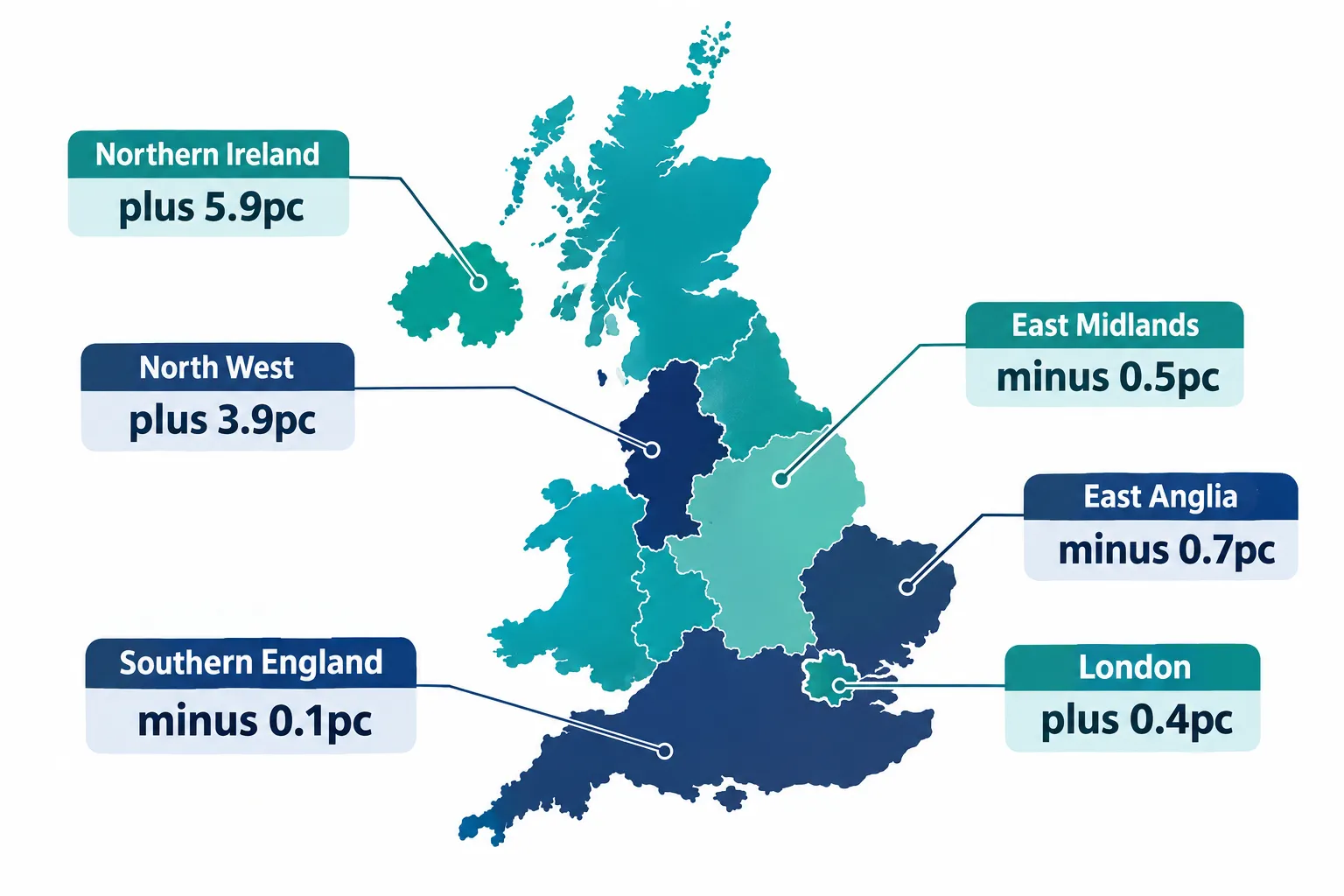
Behind the national average sits a sharply uneven picture. Northern Ireland remains the standout performer, with annual growth of 5.9%, by far the strongest of any UK region. The North West follows at 3.9%, continuing a pattern of northern English markets outperforming the south.
London, by contrast, managed only 0.4% annual growth, while southern England as a whole slipped into negative territory at minus 0.1%. The East Midlands fell 0.5%, and East Anglia recorded the weakest performance in the country at minus 0.7%.
The pattern is consistent: affordability-constrained southern markets, where average prices and mortgage repayments bite hardest relative to local incomes, are seeing outright price falls. Northern and devolved markets, where property remains comparatively cheaper and mortgage affordability stretches further, continue to see solid annual gains. For anyone comparing a move between regions, this divide is now too large to ignore.
What This Means for Buyers
For buyers, the slowdown brings a mixed but broadly favourable set of conditions, provided the borrowing costs are managed carefully.
The upside:
More choice, with Zoopla reporting a 5% year-on-year rise in homes for sale.
Genuine negotiating room, given sales agreed are down 9% and sellers are competing harder for fewer committed buyers.
Softer regional and property-type pricing, particularly in southern England, East Anglia and the flats market, which may open up opportunities that were unaffordable twelve months ago.
The catch:
Mortgage rates have climbed sharply. The average rate across new lending is now around 5.2%, up from 4% at the start of 2026, adding roughly £150 a month to a typical repayment.
Moneyfacts data shows the average two-year fixed rate now at 5.93%, the highest since July 2024, and the average five-year fix at 5.94%, the highest since October 2023.
Choice at the cheaper end has collapsed: sub-5% two-year fixed deals fell from around 630 products in early September to just five by 1 October, after Barclays, Nationwide, HSBC, TSB and Virgin Money all raised rates.
In short, buyers have leverage on price but are paying considerably more to borrow. That combination rewards patience, strong preparation, and a buyer who has done their homework on a property's true condition before making an offer.
What This Means for Sellers
Sellers face a different reality. With sales agreed down 9% year on year and prices slipping month on month, overpricing a property is now a fast route to a stale listing. A property priced against last year's market, rather than this month's, risks sitting unsold while mortgage rates keep buyers cautious.
Practical steps for sellers this autumn:
Price realistically from day one. Use recent local Land Registry and Nationwide regional data rather than last year's asking prices as a benchmark.
Expect a longer sales process. With fewer transactions completing, timelines from listing to exchange are likely to stretch compared with the faster market seen earlier in 2026.
Be prepared for survey-led renegotiation. Buyers with more choice and tighter budgets are more willing to use a survey's findings to ask for a price reduction or repair contribution.
Keep paperwork and certificates ready. Anything that reduces a buyer's uncertainty, such as EPCs, warranty documents and building regulation sign-offs, helps protect the agreed price.
What to Watch Between Now and 5 November
Two dates matter enormously for anyone transacting this autumn.
28 October 2026, the Budget. This is when full details of the new "Your First Home" scheme, announced 29 September 2026, will be published. The scheme is designed to offer first-time buyers of new-build homes in England a 20% equity loan against just a 2.5% deposit, potentially reshaping affordability for entry-level buyers. Anyone close to a new-build purchase should track this closely, since eligibility criteria and funding limits could influence timing decisions.
5 November 2026, the Bank of England rate decision. The Bank Rate currently stands at 3.75%, held on a 6-3 vote on 17 September 2026. Markets are pricing around a 92% probability of a rise to 4% at the November meeting, driven partly by CPI inflation running at 3.1% in August. A rate rise would likely push mortgage pricing higher still, reinforcing the affordability squeeze already visible in Moneyfacts' figures.
Buyers currently weighing up a mortgage offer should consider the cost of waiting against the cost of locking in a rate now, particularly given how quickly sub-5% deals have disappeared from the market.
Why a Professional Survey Pays for Itself in This Market
In a market where buyers have genuine negotiating room, a RICS Level 2 Home Survey or Level 3 Building Survey is one of the most cost-effective tools available. Here is why it matters more now than during the fast-moving markets of recent years.
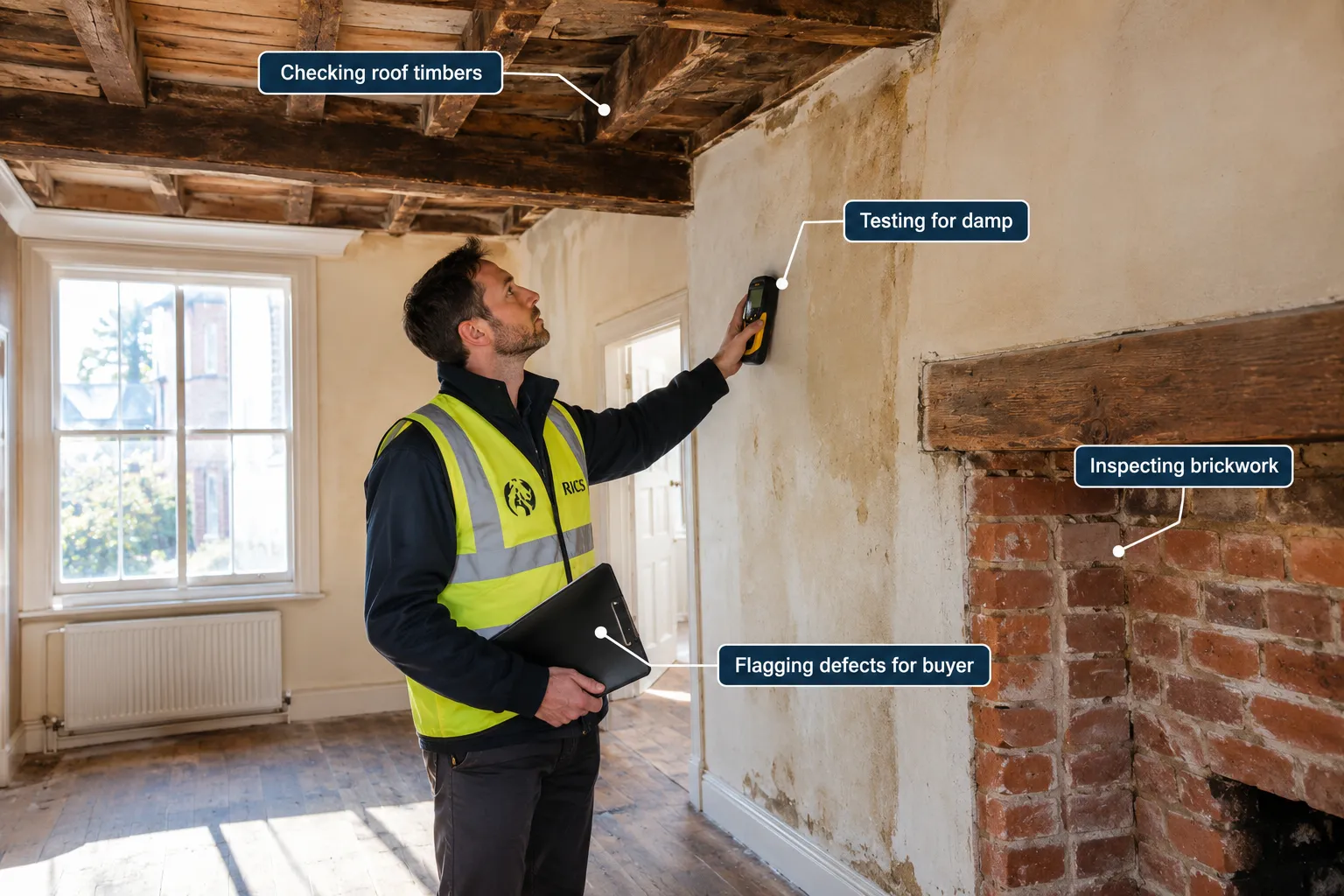
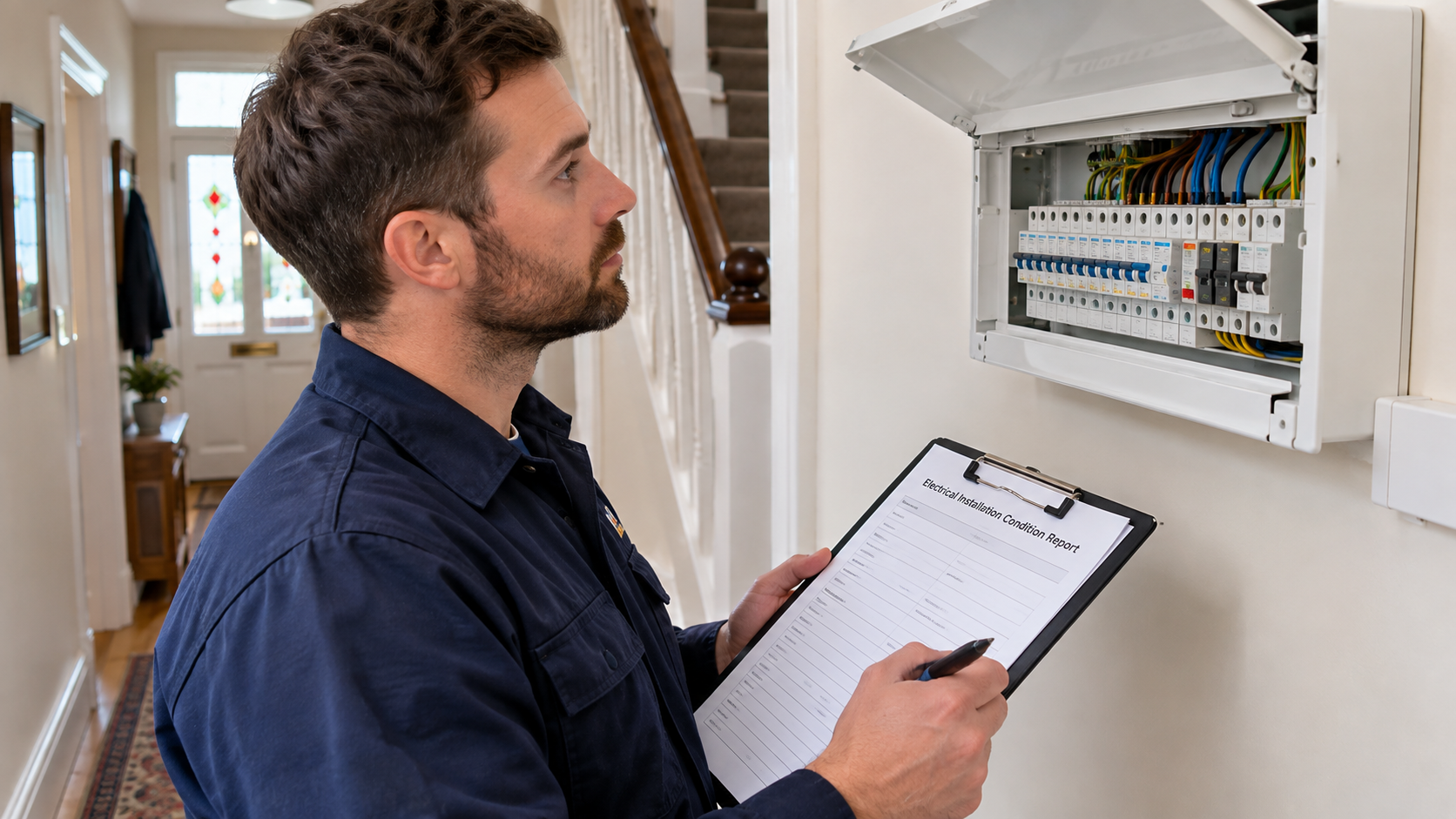
Renegotiation leverage. When a survey identifies issues such as damp, subsidence risk, roof defects or outdated electrics, buyers in today's slower market are in a far stronger position to ask the seller for a price reduction or for repairs to be completed before exchange. With sales agreed down 9% year on year, sellers are more likely to engage with a reasonable renegotiation rather than risk losing the sale entirely.
Avoiding fall-throughs. A detailed survey surfaces problems early, before solicitors, lenders and removal firms are booked. That reduces the risk of a late-stage collapse, which is costly and stressful for everyone involved, and particularly relevant when higher mortgage rates mean buyers have less financial slack to absorb unexpected repair bills after completion.
Budgeting for higher borrowing costs. With average mortgage rates around 5.2% and two-year fixes averaging 5.93%, every pound of unexpected repair cost matters more. A survey gives buyers a realistic picture of future maintenance spend, helping them budget alongside higher monthly repayments.
Which survey suits which home?
Level 2 Home Survey: conventional homes in reasonable condition. A clear overview of condition and valuation, useful for renegotiation.
Level 3 Building Survey: older, listed, extended or unusual properties. Detailed defect analysis and the strongest basis for price or repair negotiation.
How The Survey Merchant Helps
The Survey Merchant makes it straightforward to compare and book a local RICS-qualified surveyor without the usual back-and-forth. Buyers can compare quotes for Level 2 Home Surveys and Level 3 Building Surveys from surveyors covering their specific postcode, check availability, and book directly online. For anyone navigating the current slower, more negotiable market, getting a survey booked promptly means findings are available in good time to inform offers, renegotiations, or decisions ahead of a mortgage offer deadline.
Conclusion
The headline from Nationwide is unambiguous: the October 2026 index marks a genuine shift in momentum, not a minor blip. Growth has slowed from 1.6% to 0.8% annually, prices dipped month on month, and the regional divide between the North and South has become more pronounced. Add in mortgage rates near 5.2%, a fast-shrinking pool of cheap fixed deals, and two major dates, the Budget on 28 October and the Bank of England decision on 5 November, and the case for careful, well-informed decision-making has rarely been stronger.
Buyers with more choice and real negotiating power should use that leverage wisely, starting with a professional survey that turns guesswork into evidence. Sellers should price to today's market, not last year's. Whichever side of the transaction you are on, book a RICS-qualified surveyor through The Survey Merchant to get clear, independent findings before you commit.
Related guides
No items found.
Book a RICS surveyor
Survey Merchant provides vetted RICS surveyors across 100+ UK locations at fixed fees:
Why did UK house price growth halve in September 2026?
Nationwide's chief economist pointed to a jittery economic backdrop, energy pressure linked to Middle East tensions, and expectations of further Bank Rate rises. Combined with mortgage rates rising to around 5.2%, these have cooled buyer demand even as more homes come to market.
Is now a good time to buy a house?
It depends on individual circumstances. Buyers benefit from more choice and stronger negotiating positions, but face mortgage rates significantly higher than at the start of 2026. A survey that shows a property's true condition helps buyers negotiate confidently.
Should sellers lower their asking price?
With sales agreed down 9% year on year, pricing realistically from the outset matters. Overpricing risks a longer time on the market and often a lower final sale price than pricing competitively from day one.
What is the Your First Home scheme?
Announced on 29 September 2026, it offers first-time buyers of new-build homes in England a 20% government equity loan with a 2.5% deposit. Full details are due at the Budget on 28 October 2026.
Will mortgage rates rise again soon?
The Bank of England's next decision is on 5 November 2026. Markets are pricing roughly a 92% chance of a rise from 3.75% to 4%, which could push average mortgage rates higher still.
Do I still need a survey if prices are falling?
Yes. A slowing market is exactly when a survey adds the most value, giving buyers concrete evidence to renegotiate price or repairs rather than discovering issues after completion.