We use cookies to improve your experience on our site, analyze site traffic, and assist in our marketing efforts. By clicking "Accept all," you agree to the storing of cookies on your device. You can choose to "Reject all" non-essential cookies. For more information, please read our Cookie Policy.
UK Asking Price Cuts September 2026: Sellers Slash Prices as Property Market Softens
About a third of UK homes on the market have had asking prices cut by 7%. Ahead of the 17 September BoE decision, an independent surveyor's valuation matters more than ever for buyers negotiating and sellers pricing realistically.
A third. Not a handful of desperate vendors, not a niche corner of the market - roughly one in three homes currently for sale across the UK has already had its asking price cut, by an average of 7%. That is the scale of repricing now under way, and it is happening just weeks before the Bank of England's next interest rate decision.
For anyone selling, buying, or advising on property this autumn, understanding why sellers are cutting so hard - and what it means for valuations - has become essential.
Key takeaways
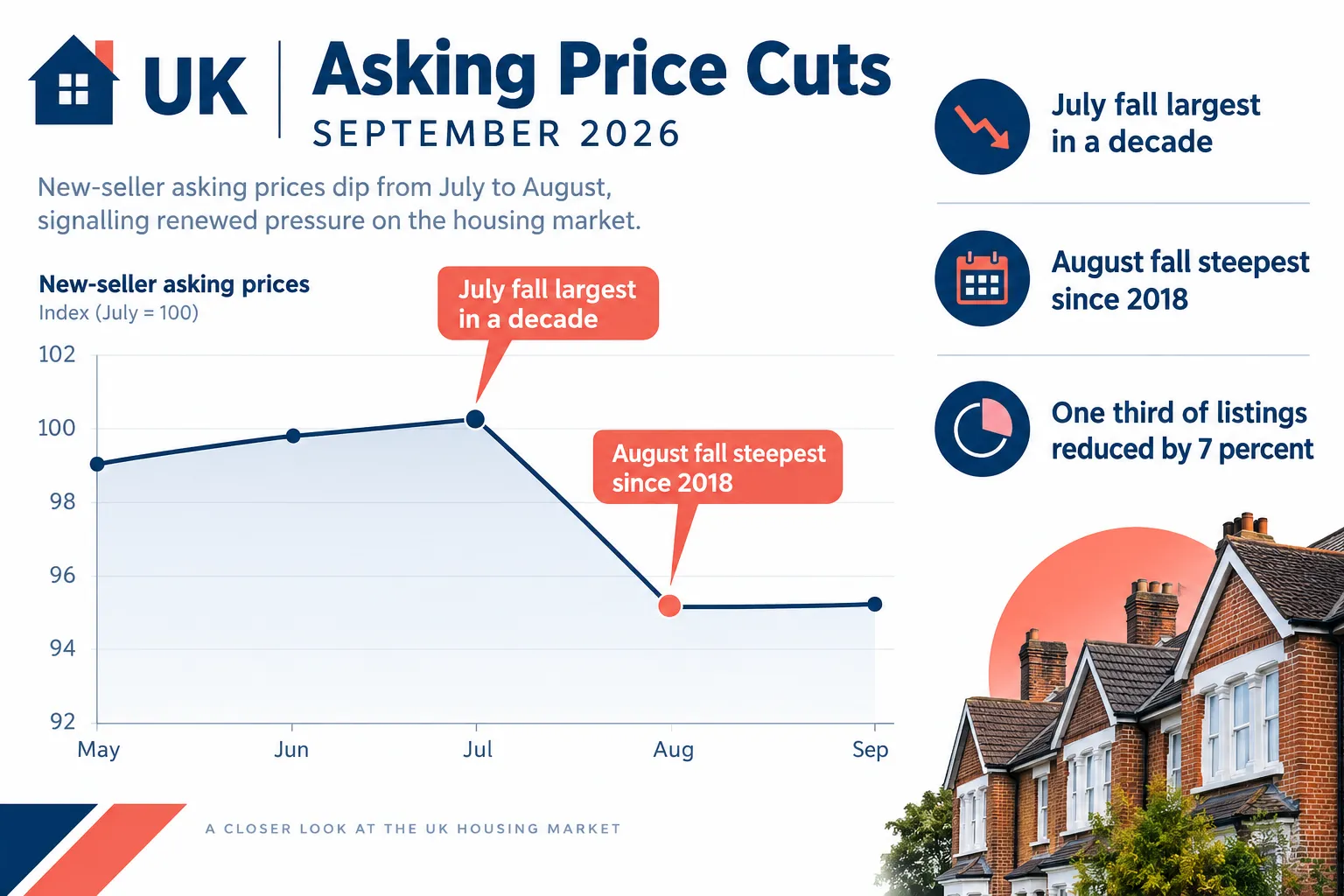
About a third of homes currently listed for sale in the UK have had their asking price reduced, by an average of 7%.
New-seller asking prices fell 1.0% in July 2026 and a further 2.0% in the four weeks to 8 August - the sharpest August fall in eight years.
Mortgage approvals slipped to 56,053 in July, the lowest since January 2024, signalling weaker buyer firepower.
Lloyds has recorded the first annual fall in UK house prices since 2023.
The Bank of England's 17 September 2026 rate decision is the next major catalyst.
Why UK asking-price cuts are defining the September 2026 property market
Sellers who priced ambitiously in spring are now watching listings sit unsold, and many are correcting course fast. Rightmove data show new-seller asking prices fell 1.0% in July 2026 - the sharpest July drop in ten years - before falling a further 2.0% in the following month, taking the typical newly listed home from £372,359 to £364,999, a drop of £7,360. That August fall was far deeper than the usual seasonal dip; the ten-year average August decline is closer to 1.3%, so this year's correction is roughly 50% steeper than normal.
Annually, new asking prices are now around 1.0% below where they were a year ago - the largest annual decline since December 2023. Rightmove has responded by slashing its full-year 2026 forecast from a predicted 2% rise to somewhere between flat and a 2% fall, effectively admitting that price growth is off the table for this year.
The numbers behind sellers slashing prices
The picture is not uniform. London and the South are absorbing the deepest cuts, while parts of the North are holding steadier.
Market segment
Approximate movement
Source
National new-seller asking prices (August, monthly)
Down 2.0%
Rightmove
National new-seller asking prices (annual)
Down about 1.0%
Rightmove
London asking prices (annual)
Down around 3.1%
Rightmove/reporting
Prime London boroughs (monthly)
Down around 4.4% - near £30,000 off
Reporting on Kensington and Chelsea
Existing listings reduced
About a third of stock, average 7% cut
Zoopla-style market monitoring
Northern England
Broadly flat to slightly positive
Regional reporting
A record volume of homes for sale - near a 12-year high for the time of year - is compounding the problem. With so much choice, buyers simply move on from anything that looks overpriced, forcing sellers to correct or sit unsold.
Mortgage approvals and the countdown to 17 September 2026
Behind every asking-price cut sits a borrower doing sums that no longer add up at the old price. Mortgage approvals fell to 56,053 in July 2026 - the lowest figure since January 2024 - a clear sign that fewer buyers are securing finance or that lenders are tightening criteria as affordability strain persists.
Lloyds has now recorded the first annual fall in UK house prices since 2023, putting the average property value at £298,468 in August, down 0.2% month-on-month, with London leading the decline. Nationwide's own tracking has similarly flagged a cooling in annual growth, reinforcing that completed sale prices are beginning to follow asking prices lower.
All eyes are now on the Bank of England's decision on 17 September 2026. A hold or cut could ease mortgage stress and stabilise sentiment; a further pause on cuts risks pushing more sellers into the "reduce or withdraw" camp.
What falling asking prices mean for buyers
Check the reduction history. A property cut once already may still be overpriced relative to comparable sales.
Use approval data as leverage. With fewer mortgages being approved, reasonable offers below asking are increasingly accepted.
Get an independent valuation before offering. Asking prices are aspirational; a surveyor's figure reflects actual market evidence.
Watch London and prime postcodes closely. Annual falls of 3% or more and monthly drops near 4.4% in some boroughs leave real room to negotiate.
Do not assume a written-down price is the floor. A second cut may follow if the home remains unsold.
Pricing realistically: advice for sellers
For sellers, the era of testing the market with an ambitious figure is largely over. With record stock levels and cautious buyers, an overpriced listing simply accumulates days on market and eventually forces a steeper cut than if it had been priced correctly from day one.
Commission a professional valuation survey before listing rather than relying solely on an estate agent's marketing appraisal.
Benchmark against recently sold - not just currently listed - comparables.
Factor in the local trend; London and southern sellers should price more conservatively than firmer northern markets.
Revisit pricing every three to four weeks if enquiries are thin.
The surveyor's role in valuing property during price cuts
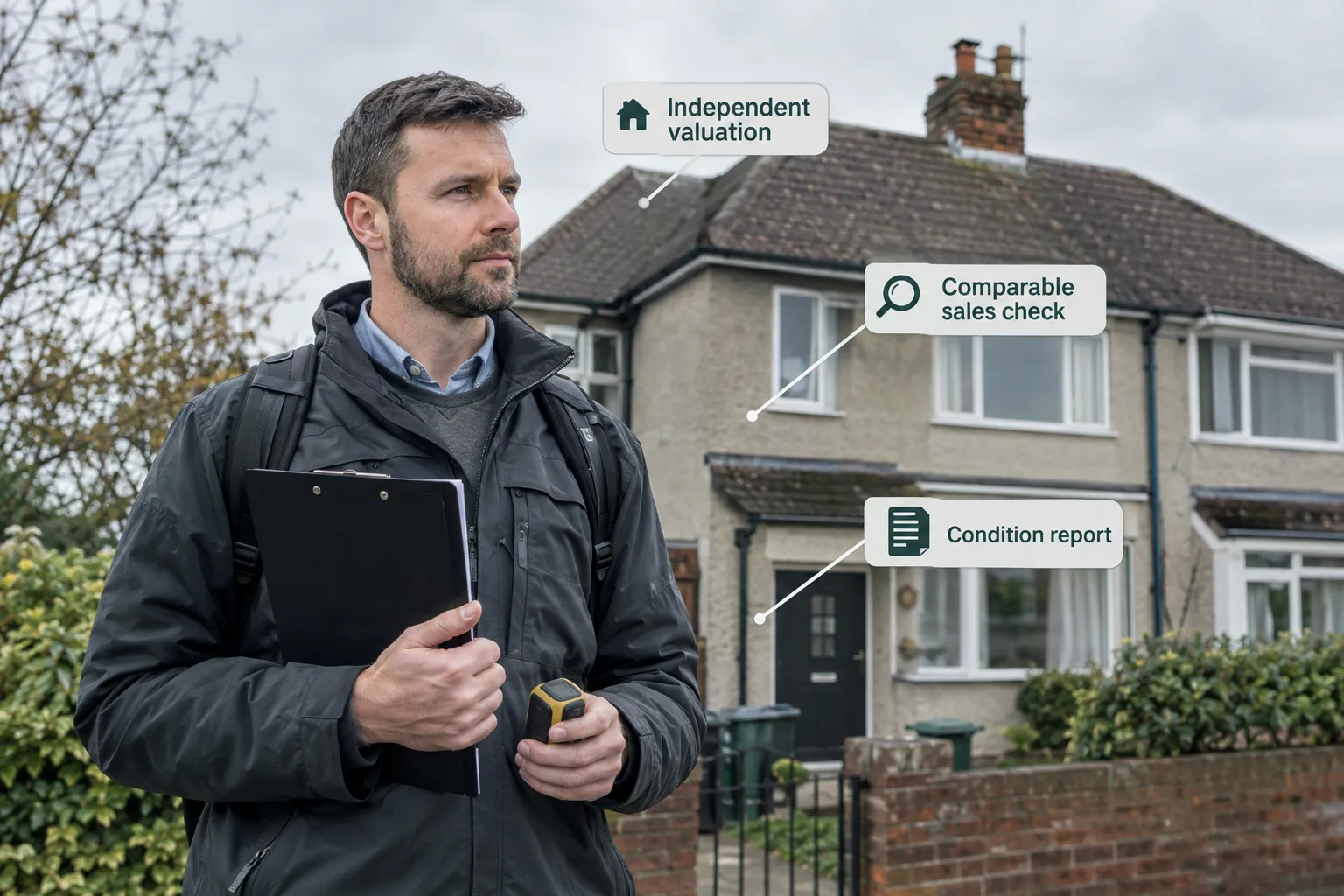
This is precisely the environment in which an independent chartered surveyor earns their fee. Estate agent valuations are, by design, influenced by the desire to win instructions; a surveyor's valuation is grounded in verified comparable evidence, condition assessment, and market data rather than optimism.
In a market where a third of listings are already reduced and completed prices are following asking prices lower, both buyers and sellers benefit from a professional RICS-level valuation or Homebuyer Report. For buyers, it provides evidence to support a negotiation. For sellers, it offers a realistic starting figure that avoids the eventual price damage of an unsuccessful, overpriced listing. For lenders, it protects against overexposure at a time when mortgage approvals are already falling.
Frequently asked questions
Why are so many UK sellers cutting asking prices in September 2026?
A record volume of homes for sale, weaker mortgage approvals and buyer caution ahead of the Bank of England's 17 September decision have combined to make overpriced listings unsellable, forcing widespread reductions.
How much have asking prices actually fallen?
New-seller asking prices fell 1.0% in July and a further 2.0% in the four weeks to 8 August 2026, with about a third of existing listings cut by an average of 7%.
Is London worse affected than the rest of the UK?
Yes. London asking prices are down roughly 3.1% annually, with some prime boroughs seeing monthly falls near 4.4%, while parts of northern England remain comparatively stable.
Does this mean house prices are definitely falling, not just asking prices?
Lloyds has recorded the first annual fall in completed UK house prices since 2023, suggesting sale prices are starting to follow asking prices lower - though the picture varies by lender and region.
Should I get a survey before making an offer on a reduced-price home?
Yes. A price cut does not guarantee the new figure reflects true market value. An independent valuation or Homebuyer Report gives evidence-based confidence before you negotiate or exchange.
Will the Bank of England's 17 September decision change the trend?
It could influence mortgage rates and buyer confidence, but with approvals already at their lowest since January 2024, most analysts expect price growth to stay flat to negative for the rest of 2026 regardless of the outcome.
Conclusion
A third of listings reduced by an average of 7%, the sharpest July and August asking-price falls in years, and the first annual house-price fall from a major lender since 2023 signal a genuine reset in seller expectations rather than a temporary blip. With mortgage approvals sliding and the Bank of England's rate decision looming on 17 September, both buyers and sellers face a market demanding realism over optimism.
Buyers should negotiate from evidence, not hope. Sellers should price to sell, not to test. And anyone transacting in this climate should commission an independent surveyor's valuation before committing - it remains the most reliable way to separate a genuine asking price from wishful thinking in a market still finding its floor.
Related guides
No items found.
Book a RICS surveyor
Survey Merchant provides vetted RICS surveyors across 100+ UK locations at fixed fees: