Leasehold
Jul 16, 2026
Condition Surveys vs Structural Surveys: Key Differences
Clear guide to RICS Level 1 condition reports vs Level 3 structural surveys — what each covers, typical costs and when to ch

Choosing the right property survey saves money and prevents future repair headaches. In the UK, condition surveys (RICS Level 1) and structural surveys (RICS Level 3) are two popular options, each suited to different property types and needs.
Key takeaway: A condition survey is best for newer homes with no visible issues, while a structural survey is recommended for older buildings, properties with structural concerns, or those requiring renovations. Both surveys are independent evaluations and far more thorough than mortgage valuations, which only serve lenders.
Quick Comparison:
| Feature | Condition Survey (Level 1) | Structural Survey (Level 3) |
|---|---|---|
| Property Type | Modern, well-maintained | Older, larger, or unusual |
| Inspection Depth | Visual only | In-depth, includes causes |
| Repair Advice | No | Yes |
| Cost | £300–£900 | £630–£1,500+ |
| Purpose | Identify visible issues | Assess structural integrity |
Selecting the right survey ensures you know what you’re buying and can negotiate effectively based on findings.
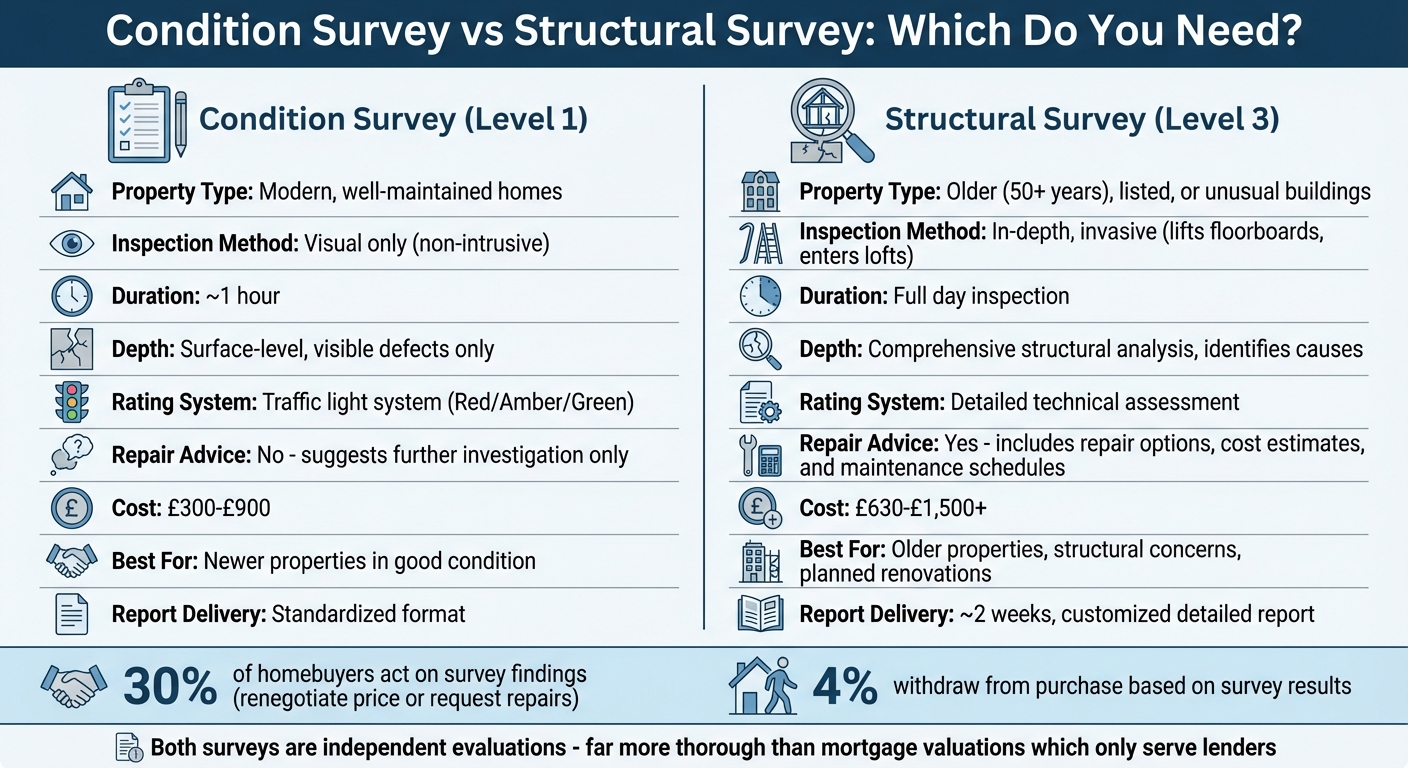
Condition Survey vs Structural Survey Comparison Chart

A condition survey - officially referred to as the RICS Level 1 Condition Report (or the Home Survey Level 1 Report since 1 September 2021) - is a professional evaluation of a property's construction and overall condition [3]. Essentially, it provides a straightforward overview of the state of the building.
The surveyor conducts a visual inspection of accessible areas, typically lasting around an hour [5]. This involves examining construction materials, identifying significant defects, and highlighting areas that may need urgent repairs or further investigation. The process is non-intrusive, meaning furniture isn’t moved, spaces aren’t cleared, and system checks are limited to visible elements. Roofs, for instance, are inspected from ground level. This streamlined method ensures the survey remains focused on its primary goal.
For property buyers, the survey helps confirm whether a purchase is a sound investment and can even provide leverage during price negotiations. As isurv explains:
"Condition surveys are of benefit to everyone involved in ownership, occupation or investment in property. For owners, occupiers and managers, a condition survey provides a database of information, identifying maintenance and repair work, and the timescale for undertaking that work, and thereby permitting budgeting, the assessment of compliance and strategic…" [2]
– isurv
Beyond property transactions, these surveys are useful for long-term maintenance planning. They establish repair schedules, support accurate budgeting, and assist in strategic asset management. Additionally, they can help evaluate regulatory compliance and serve as an official record of the property's condition at a specific moment. This can be particularly helpful before nearby construction projects begin or at the start of a lease agreement.
One notable feature of a condition survey is its "traffic light" rating system, which simplifies the assessment of defect severity. Here's how it works: green indicates no immediate repairs are needed, amber signals defects that require attention (but not urgently), and red highlights serious issues that demand prompt action. As Homebuyer Surveying explains:
"This report does not value the property but simply uses traffic light colours to represent the severity of the defects." [3]
– Homebuyer Surveying
Photographs are also included to document existing defects. This visual evidence can be particularly valuable in situations like:
"...if the building that's the subject of the report is damaged by the adjoining building operations, there is evidence available to show which defects were caused by the building work and which already existed." [4]
– Herbots Solicitors
If certain areas couldn’t be fully examined during the initial inspection, the report might recommend further investigation. However, it’s important to note that a Level 1 Condition Report does not include a market valuation, reinstatement costs for insurance purposes, or detailed repair advice. Its primary focus is solely on recording the current condition of the property.
A RICS Level 3 Building Survey is one of the most detailed inspections available for residential properties [1]. Unlike the simpler Level 1 Condition Report, this survey goes beyond surface-level observations to assess the structural integrity of key load-bearing elements like foundations, external walls, roof structures, and beams [1][6].
What sets this survey apart is its analytical depth. Instead of just spotting defects, it digs into the causes of those issues [1][3]. This makes it especially useful for older properties (over 50 years), listed buildings, unconventional constructions, or homes that are being considered for significant renovations [1]. Its focus on understanding problems helps differentiate it from other types of surveys.
A Specific Structural Survey, however, is narrower in scope. Typically conducted by a Structural Engineer, it targets a single issue - like a major crack or signs of subsidence - rather than evaluating the entire property [6]. As Allcott Associates explains:
"A Structural Survey focuses on the structural integrity of the property only; the general condition of the building, such as cosmetic issues, boundaries and issues in the grounds, will not be considered." [6]
– Allcott Associates
The primary goal of a structural survey is to ensure the building's stability. To achieve this, surveyors examine critical elements like foundations, walls (both internal and external), beams, and roof structures [6][1]. They also assess how materials are performing and investigate the root causes of visible defects [6][3].
But it doesn’t stop there. The survey takes into account external factors that might affect the building's stability. For example, the soil type and the proximity of large trees - both of which can impact the foundations - are carefully reviewed [1]. Additionally, any modifications to supporting walls or structural changes from renovations are scrutinised to ensure they haven’t compromised the property’s integrity [1].
The Royal Institution of Chartered Surveyors (RICS) highlights the importance of this analysis:
"A surveyor conducting a Building Survey aims to help you make a reasoned and informed decision when purchasing a property, or when planning for repairs, maintenance or upgrading the property." [1]
– Royal Institution of Chartered Surveyors (RICS)
Recent research from 2024 shows that 30% of homebuyers acted on survey findings - whether by renegotiating the purchase price or requesting repairs - while 4% decided to withdraw from the purchase entirely [1]. This demonstrates how a structural survey can be a powerful tool during property negotiations.
A Level 3 survey typically involves a full day of onsite inspection, with the final report delivered within about two weeks [1]. Surveyors are required to examine all accessible areas, which includes entering lofts, lifting manhole covers, and using specialised tools to test for damp in walls [1].
In addition to visual inspections, invasive methods are often employed. This could involve lifting floorboards or inspecting the internal side of the roof to uncover hidden issues [1][7]. This thorough approach is a clear contrast to the non-intrusive methods used in a Level 1 Condition Report.
The final report provides an in-depth analysis of serious problems, such as subsidence, timber damage (from woodworm or dry rot), and structural concerns in walls or the roof [1]. It doesn’t just diagnose issues - it also explores their likely causes, suggests repair options, and estimates both the urgency and cost of these repairs [1][3]. As Ruth Jackson-Kirby, a property journalist at the HomeOwners Alliance, explains:
"A Level 3 Survey will look at every element of a property and identify any problems, the likely cause, how urgently they need to be repaired and how much the repair could cost." [1]
– Ruth Jackson-Kirby, Property Journalist, HomeOwners Alliance
While RICS Chartered Surveyors typically handle Building Surveys, Structural Engineers are often called in for more focused Structural Surveys. Their expertise in material performance allows for a deeper investigation into specific defects [6]. Costs for a Level 3 Building Survey range from £630 to over £1,500, depending on the size, value, and location of the property [1].
Condition Surveys and Structural Surveys serve different purposes, with variations in their depth and focus. A Condition Survey (Level 1) offers a quick overview of visible defects using a standardised "traffic light" rating system. In contrast, a Structural Survey (Level 3) digs deeper, identifying the root causes of issues and assessing how the building is likely to perform over time [3][8].
| Feature | Condition Survey (Level 1) | Structural Survey (Level 3) |
|---|---|---|
| Primary Goal | Highlight urgent defects and hazards | Detailed structural analysis and long-term planning |
| Property Type | Modern, conventional homes | Any age, size, or unconventional construction |
| Methodology | Visual inspection with traffic light ratings | Comprehensive examination of materials and structural performance |
| Material Performance | Notes construction and current condition | Explains how materials will behave over time |
| Repair Advice | Suggests further investigation only | Provides repair options and maintenance schedules |
| Report Format | Standardised RICS "traffic light" system | Customised, detailed technical report |
This table outlines the critical differences in methods and goals. While a Condition Survey focuses on immediate, visible issues, a Structural Survey takes a more investigative approach, offering repair advice and long-term insights [3]. For older or traditional buildings, RICS advises surveyors to adopt a "whole building" perspective, addressing sources of problems like excessive moisture rather than merely noting their presence [8].
The choice between these surveys depends on your property's age, condition, and construction type.
A Condition Survey (Level 1) is ideal for newer or modern properties that appear to be in good condition. It provides a basic overview to confirm there are no serious defects or hazards.
A Structural Survey (Level 3) is better suited for older homes (pre-1950), larger properties, or those with unconventional construction, such as timber frames or thatched roofs. This type of survey is especially useful if the property shows visible structural issues or if you’re planning major renovations or extensions. The detailed findings, including repair estimates, can also help you negotiate a lower purchase price [3].
Merging the strengths of condition and structural surveys into a Level 3 survey creates a more thorough property assessment. Instead of arranging two separate inspections, this method provides a complete evaluation in one visit, covering everything from surface-level issues to deeper structural concerns.
This approach is particularly useful for older properties (over 50 years old), listed buildings, or those with unconventional construction methods. Unlike basic condition reports, which often recommend additional checks, a Level 3 survey tackles all potential issues in one go. The surveyor examines all accessible areas during a single, full-day visit and delivers a detailed report within two weeks[1].
The financial advantages are clear: nearly 30% of homebuyers who commissioned a survey took action based on the findings, such as negotiating a lower purchase price or requesting repairs[1]. Only 4% chose to withdraw entirely from the purchase[1]. The report also includes repair cost estimates and maintenance schedules, enabling buyers to secure accurate contractor quotes before committing to the purchase. These insights highlight the practical value of a Level 3 survey.
"A surveyor aims to help you make a reasoned, informed decision when purchasing or planning repairs, maintenance, or upgrades." – Royal Institution of Chartered Surveyors (RICS)[1]
For properties with visible signs of neglect, planned major renovations, or non-standard materials like timber frames or thatched roofs, a Level 3 survey can eliminate the need for further investigations. The report combines a 'traffic light' summary of urgent issues with a detailed structural analysis, making it an ideal choice for comprehensive property assessments.
Selecting the right survey is an essential step in protecting your most important investment - your home. The choice depends on factors like the property's age, construction type, and your future plans. Each survey type offers distinct advantages, whether it's the straightforward traffic light system of a condition survey or the detailed insights of a structural survey.
For example, condition surveys cost between £300 and £900, providing a visual inspection without repair advice[1]. On the other hand, structural surveys (RICS Level 3) are ideal for older properties (over 50 years), listed buildings, or homes in need of major renovations. These surveys deliver a thorough analysis and repair recommendations, with prices ranging from approximately £630 to £1,500+[1].
Interestingly, most homeowners act on the findings from surveys, underlining their importance in safeguarding your investment[1].
"Your home is often your biggest investment, so you need to know as much as you can about the property before you buy it, live in it and perhaps sell it." – RICS[9]
Understanding these survey types is vital for making informed decisions when purchasing a property. A mortgage valuation only serves the lender and cannot replace an independent survey. Whether you choose a basic condition report or a more detailed structural survey, selecting the right option ensures you know exactly what you’re buying. For properties with visible issues or planned renovations, a Level 3 survey provides the detailed information and technical evidence needed to negotiate effectively. This thoughtful choice not only protects your investment but also helps avoid unexpected costs.
Survey Merchant connects buyers with qualified RICS surveyors across the UK, offering Level 2 HomeBuyer Reports and Level 3 Building Surveys tailored to your property’s needs.
Deciding between a condition survey and a structural survey comes down to the type of property you're dealing with and the level of detail you need.
A condition survey (also called a Level 1 survey or Condition Report) offers a straightforward overview of the property's general state. It flags up urgent issues and noticeable defects but doesn't dive too deep. This makes it a good choice for newer or well-kept properties where you're not expecting any major surprises.
On the other hand, a structural survey (known as a Level 3 Building Survey) goes into much greater detail. It thoroughly assesses the property's structure and fabric, making it the better option for older homes, unique builds, or properties that show signs of damage. This type of survey can uncover hidden problems, highlight structural issues, and even estimate repair costs.
To make the right choice, think about the property's age, its current condition, and any concerns you may have. Your budget and the survey's purpose - whether you're looking for reassurance or planning repairs - will also play a role. If you're not sure which survey is best, a professional surveyor can help steer you in the right direction based on your requirements.
A structural survey can be a game-changer during property negotiations. By offering a detailed assessment of a building's structural condition, it highlights any defects, risks, or weaknesses that might affect the property's value or safety. If serious issues are uncovered, buyers can use this as leverage to negotiate a lower purchase price or request that the necessary repairs are completed before finalising the sale.
For older or more intricate properties, a structural survey provides peace of mind by confirming the building’s stability and safety. Sellers, on the other hand, might adjust their asking price or agree to carry out repairs based on the survey's findings. Essentially, it adds a layer of transparency, enabling both buyers and sellers to make well-informed decisions and work towards a fair outcome in the negotiation process.
A condition survey generally provides a broad overview of a property's state, but it may fall short when dealing with older or uniquely designed buildings that could have hidden structural problems or more intricate defects. For such properties, a Building Survey (Level 3) is often the better choice. This type of survey delivers a far more thorough evaluation of the building's structure, materials, and any potential risks.
Older properties or those with unusual architectural designs can often conceal issues like subsidence, damp, or outdated construction techniques - problems that a standard condition survey might miss. Choosing a more detailed survey ensures you’re well-informed about the property's actual condition and any future repair costs you might face.
Survey Merchant provides vetted RICS surveyors across 100+ UK locations at fixed fees:
→ Level 2 Home Survey (HomeBuyer Report)
→ Level 3 Building Survey (full structural survey)
→ RICS Red Book property valuations
→ Party wall surveyors — notices, awards & schedules of condition
→ Expert witness surveyors — CPR Part 35 reports for property disputes