We use cookies to improve your experience on our site, analyze site traffic, and assist in our marketing efforts. By clicking "Accept all," you agree to the storing of cookies on your device. You can choose to "Reject all" non-essential cookies. For more information, please read our Cookie Policy.
Remediation of Unsafe Cladding Bill Introduced 14 October 2026: Medium-Rise Register, £500,000 Penalties and What Flat Buyers Should Ask Their Surveyor
The Remediation of Unsafe Cladding Bill, introduced 14 October 2026, brings a medium-rise register, £500,000 penalties and a 2029 target. What buyers of flats in 11m+ buildings should ask their RICS surveyor.
More than eight years after the Grenfell Tower fire, thousands of leaseholders are still locked out of selling their flats because nobody can confirm the cladding is safe. On 14 October 2026, Parliament introduced legislation designed to end that limbo for good. The Remediation of Unsafe Cladding Bill 2026, formally the Building Safety (Remediation of Unsafe Cladding etc.) Bill, brings new legal duties, a national building register, and fines of up to £500,000 for those who drag their feet.
For anyone buying, selling or managing a flat in a building over 11 metres, this is not background noise. It changes what questions a surveyor must ask, what a freeholder must disclose, and how quickly unresolved cladding problems must be fixed.
Key Takeaways
The Remediation of Unsafe Cladding Bill 2026 creates a legal duty for freeholders and responsible parties to identify and fix cladding safety issues promptly.
Failing to comply with a Remediation Order can now trigger First-tier Tribunal penalties of up to £500,000.
A new register of all medium-rise residential buildings in England carries civil penalties up to £40,000, or prosecution, for non-registration.
Government targets full remediation, or a clear completion date, for every unsafe-cladding building over 11 metres by the end of 2029.
Flat buyers should ask about EWS1/FRAEW status, Remediation Order history and service charge exposure before instructing a RICS survey.
What the Remediation of Unsafe Cladding Bill 2026 Actually Does
The Bill tackles a problem that has stalled the sales market for years: buildings where nobody is legally forced to act quickly. It introduces a statutory duty on those responsible for building safety, typically freeholders, to identify and remediate safety defects without unreasonable delay.
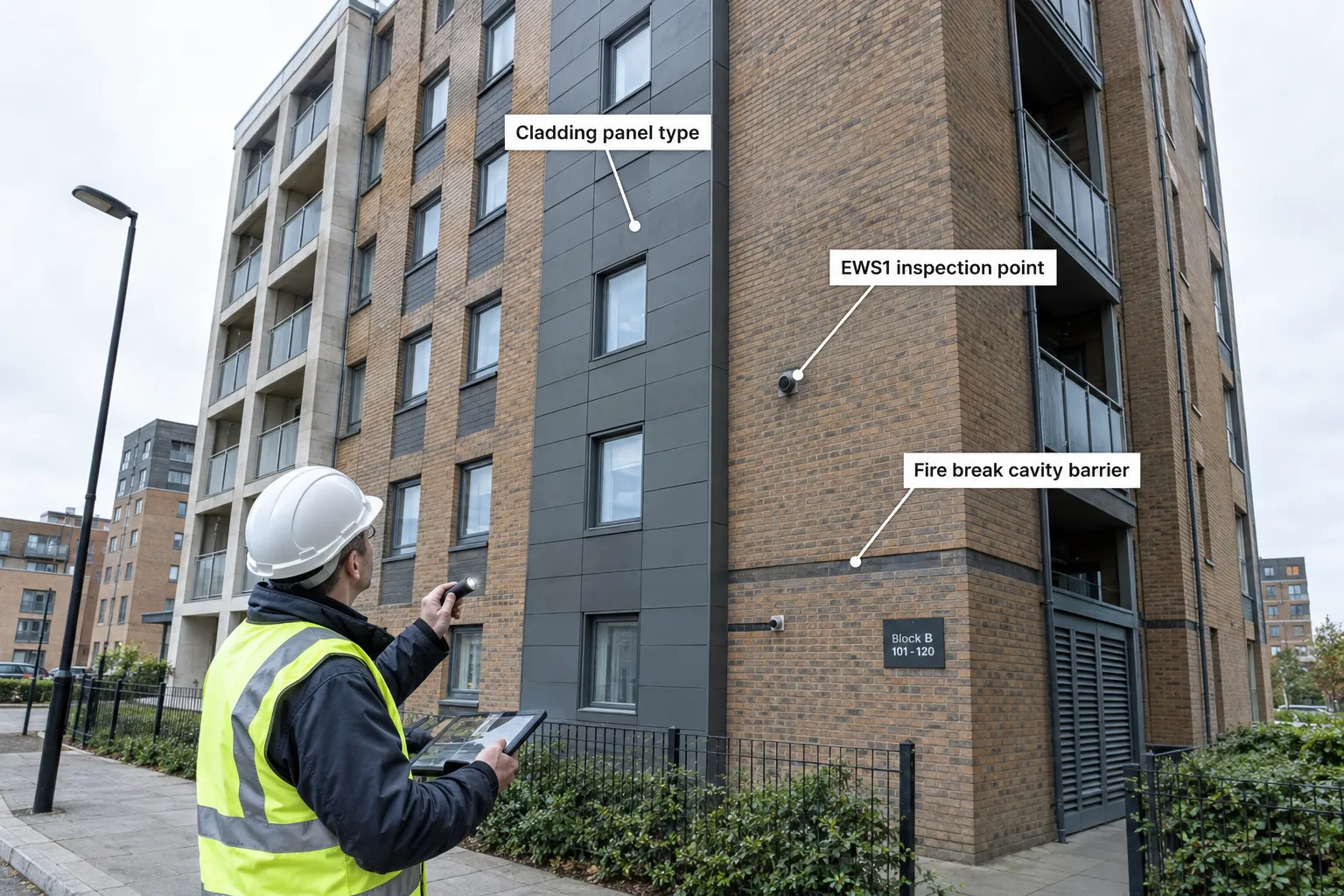
Medium-rise blocks over 11 metres fall within the scope of the new register and enforcement powers.
It also strengthens enforcement. Where a Remediation Order is ignored, the First-tier Tribunal can now impose financial penalties of up to £500,000. Previously, enforcement relied heavily on slow court processes with limited financial consequences for delay.
Three further measures matter for the housing market:
Third-party intervention: Homes England or local authorities can step in and carry out remediation themselves where a responsible party repeatedly fails to act.
Leaseholder takeover rights: leaseholders get a clearer legal route to take over building management when there is no effective owner in place.
Cost recovery from manufacturers: developers and others who have already paid for remediation gain a simpler legal route to recover costs from cladding manufacturers whose products contributed to the problem.
As Rae Ahmed, senior associate at Norton Rose Fulbright, puts it, the Bill is "aimed at ensuring unsafe buildings are identified and remediated promptly," adding that "those with potential remediation exposure should be reviewing their position now."
The Medium-Rise Register and Registration Penalties
A central feature of the Remediation of Unsafe Cladding Bill 2026 is a new register covering every medium-rise residential building in England. The goal is simple: regulators and buyers should be able to find out, in one place, whether a building's safety status is known and documented.
Non-compliance is not a minor administrative slip. The penalty structure is tiered:
Failure
Consequence
Failing to register a medium-rise building
Civil penalty up to £7,000
Repeated or serious non-registration
Higher civil penalty up to £40,000
Persistent refusal to register
Prosecution
Ignoring a Remediation Order
First-tier Tribunal penalty up to £500,000
"It's unacceptable that so many people have been left living in homes with dangerous cladding." — Baroness Blake, building safety minister.
The government's stated ambition is that every building over 11 metres with unsafe cladding is either fully remediated or has a clear completion date by the end of 2029. Officials point to the Remediation Acceleration Plan as evidence of momentum, saying it has already helped 470 more buildings complete cladding works, with around 12,000 residents expected to benefit from faster remediation as a result of the wider programme.
Timeline: From King's Speech to Introduction
The Bill did not appear from nowhere. It follows a clear policy path:
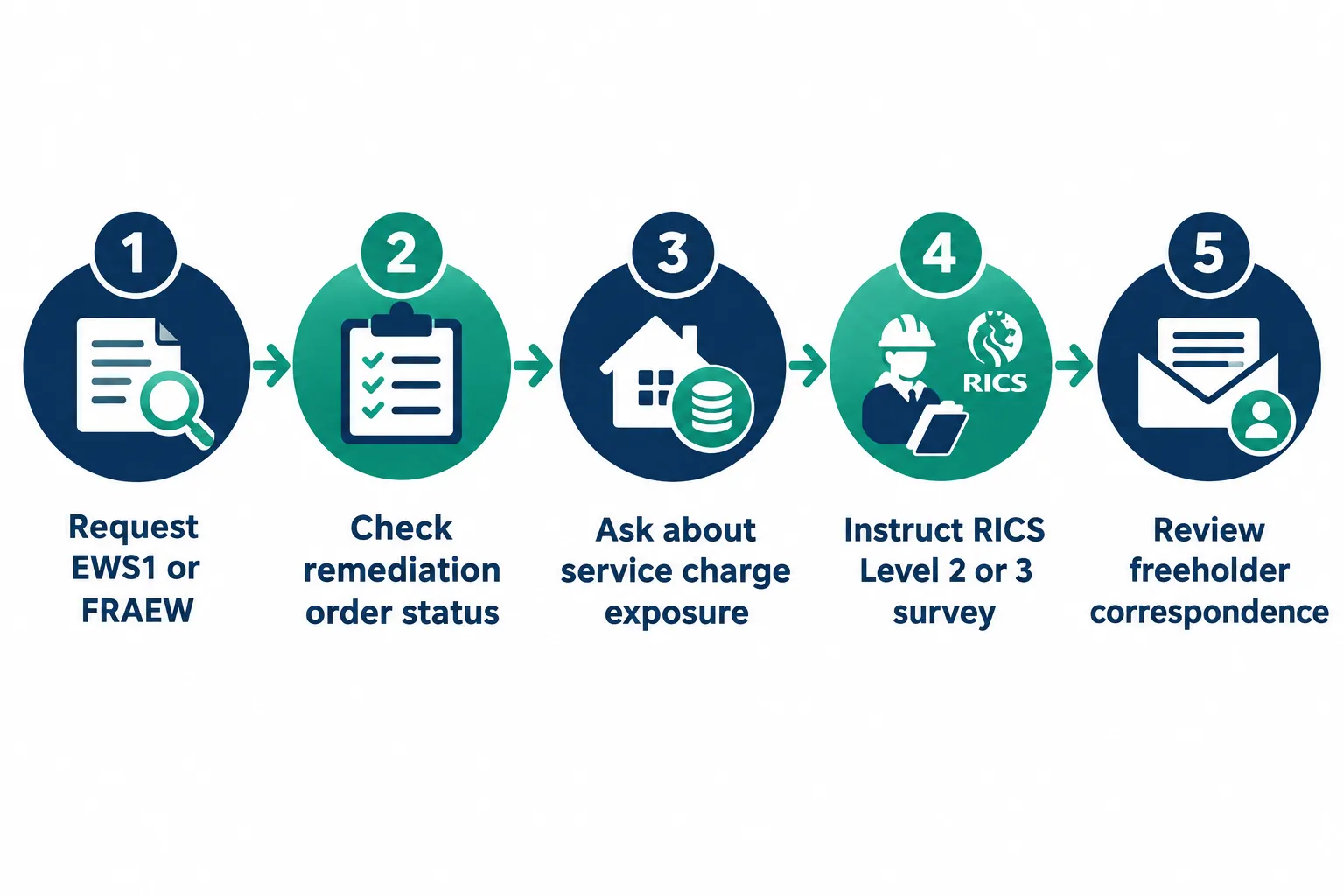
Five questions every buyer of a flat in an 11m+ building should have answered before exchange.
13 May 2026 — The King's Speech named cladding remediation, social housing and leasehold reform as legislative priorities.
Through mid-2026 — The Remediation Acceleration Plan continued pushing completion rates on existing unsafe buildings.
14 October 2026 — The Remediation of Unsafe Cladding Bill 2026 was formally introduced to Parliament, setting out the register, enforcement powers and penalty structure.
This sequencing matters for anyone with a transaction in progress. Buildings currently mid-remediation, or awaiting an EWS1 assessment, may see their status reclassified once the register and enforcement powers take effect.
What Flat Buyers Should Ask Their Surveyor Now
For anyone purchasing a flat in a building of 11 metres or more, the Remediation of Unsafe Cladding Bill 2026 adds a new layer of due diligence. A standard mortgage valuation will not catch these issues; buyers need targeted questions and, in most cases, a specialist instruction.
Key Questions for an 11m+ Building
Has an EWS1 form or a Fire Risk Appraisal of External Walls (FRAEW) been completed, and when?
Is the building currently subject to a Remediation Order, or has one been issued and closed?
Will the building need to appear on the new medium-rise register, and has the freeholder registered it?
Who is paying for remediation, and what proportion of costs could be passed to leaseholders through service charges?
Has the freeholder repeatedly failed to act, raising the possibility of third-party intervention by Homes England or the local authority?
Where a RICS Level 2/3 Survey Fits In
A RICS Level 2 Home Survey can flag visible defects and recommend further investigation, but cladding risk usually requires a Level 3 Building Survey or a specialist building surveyor experienced in fire safety assessments. These professionals can interpret EWS1/FRAEW documentation, question gaps in paperwork, and advise on realistic remediation timelines rather than relying on assurances alone.
What Freeholders and RMCs Should Do Now
Freeholders and Resident Management Companies carry the sharpest exposure under the new regime. Practical steps include:
Commissioning or updating fire risk assessments before a Remediation Order becomes necessary.
Preparing to register affected buildings promptly once the register opens, to avoid the £7,000 to £40,000 penalty tiers.
Keeping clear records of remediation funding sources, since cost-recovery claims against manufacturers rely on documented evidence.
Communicating proactively with leaseholders, given their strengthened right to take over management where oversight is absent.
Frequently Asked Questions
What is the Remediation of Unsafe Cladding Bill 2026? It is legislation introduced to Parliament on 14 October 2026 that creates legal duties to fix unsafe cladding promptly, establishes a medium-rise building register, and strengthens enforcement with penalties of up to £500,000.
Who can be fined up to £500,000 under the Bill? Parties who fail to comply with a First-tier Tribunal Remediation Order can face financial penalties up to this amount.
What happens if a building is not registered? Civil penalties start at up to £7,000, rising to £40,000 for repeated failures, with prosecution possible for persistent non-compliance.
Should flat buyers still get a survey if a building is on the register? Yes. Registration confirms a building's status is tracked, not that cladding issues are resolved. A RICS survey or specialist building surveyor is still essential.
What is the government's remediation deadline? The target is for every building over 11 metres with unsafe cladding to be remediated, or have a clear completion date, by the end of 2029.
Conclusion
The Remediation of Unsafe Cladding Bill 2026 marks a shift from encouragement to enforcement. Freeholders now face real financial consequences for delay, buildings face mandatory registration, and leaseholders gain stronger routes to act when nobody else will. For flat buyers, the practical takeaway is simple: ask for EWS1/FRAEW evidence, check Remediation Order history, and instruct a qualified RICS surveyor before exchanging contracts. Freeholders and RMCs should start reviewing documentation and registration readiness immediately, since the penalty clock is already running.
Sources: Mortgage Strategy (16 October 2026); Norton Rose Fulbright commentary; UK Parliament, Remediation of Unsafe Cladding Bill introduced 14 October 2026.
Related guides
No items found.
Book a RICS surveyor
Survey Merchant provides vetted RICS surveyors across 100+ UK locations at fixed fees:
What is the Remediation of Unsafe Cladding Bill 2026?
Legislation introduced to Parliament on 14 October 2026 creating legal duties to fix unsafe cladding promptly, a medium-rise building register, and Tribunal penalties of up to £500,000.
Who can be fined up to £500,000 under the Bill?
Parties who fail to comply with a First-tier Tribunal Remediation Order can face financial penalties up to this amount.
What happens if a building is not registered?
Civil penalties start at up to £7,000, rising to £40,000 for repeated failures, with prosecution possible for persistent non-compliance.
Should flat buyers still get a survey if a building is on the register?
Yes. Registration confirms a building's status is tracked, not that cladding issues are resolved. A RICS survey or specialist building surveyor is still essential.
What is the government's remediation deadline?
Every building over 11 metres with unsafe cladding should be remediated, or have a clear completion date, by the end of 2029.