We use cookies to improve your experience on our site, analyze site traffic, and assist in our marketing efforts. By clicking "Accept all," you agree to the storing of cookies on your device. You can choose to "Reject all" non-essential cookies. For more information, please read our Cookie Policy.
Your First Home Scheme Explained: 2.5% Deposits, 20% Equity Loans and Why New-Build Buyers Still Need a Survey (October 2026)
Announced 26 September 2026, Your First Home offers first-time buyers in England a 2.5% deposit and 20% equity loan on new builds. Full rules come at the 28 October Budget. What it means and why a survey still matters.
Seven and a half thousand pounds. That is roughly what a 2.5% deposit looks like on a £300,000 new-build flat, less than most people spend on a used car. It sounds like the answer first-time buyers have been waiting for. But a deposit that small also means almost no financial cushion if something goes wrong with the property, which is exactly why the Your First Home scheme new build survey question matters more than the headline numbers suggest.
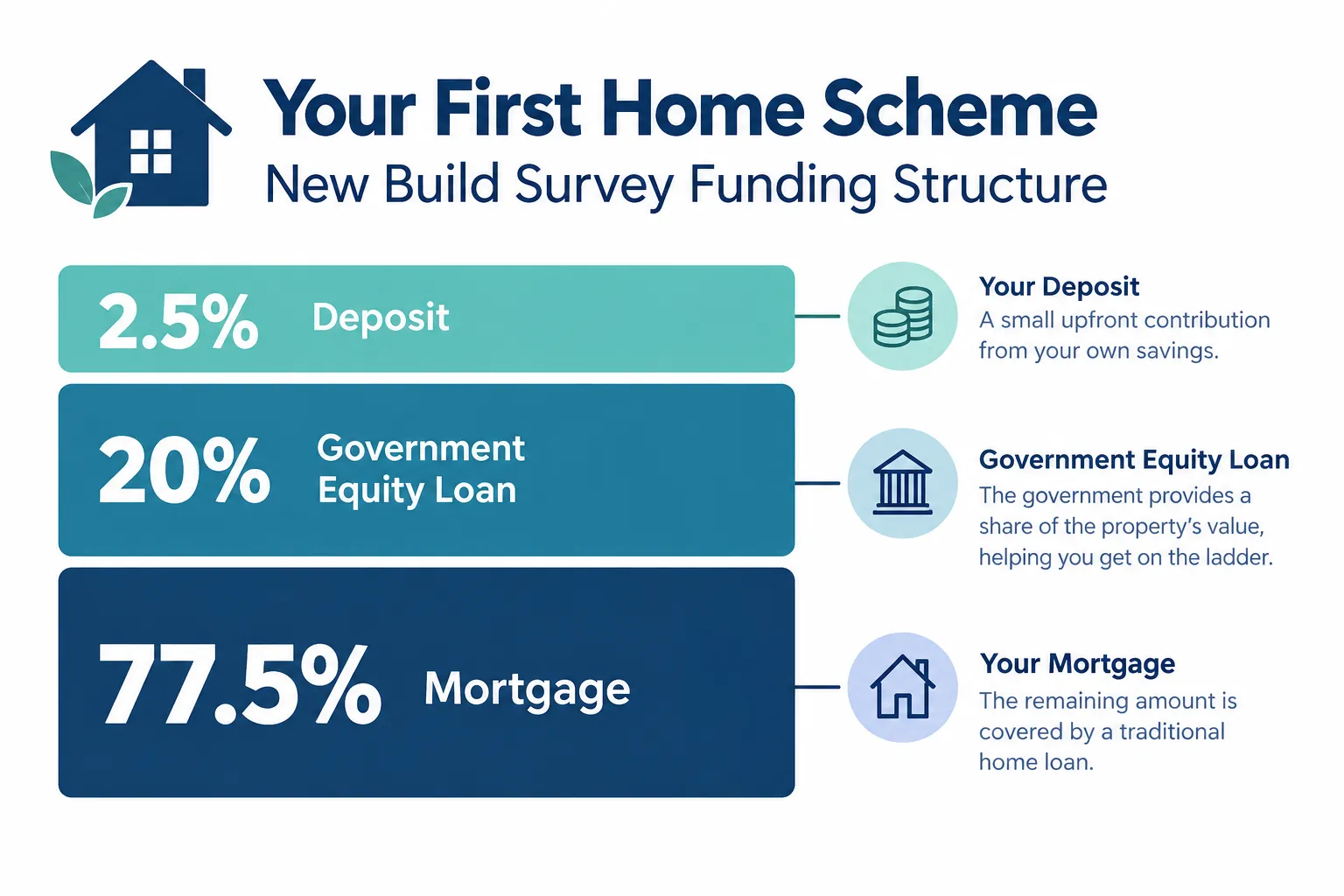
On 26 September 2026, the government unveiled "Your First Home," a new homeownership scheme fronted by Prime Minister Andy Burnham as a route into property for buyers without family money behind them. The proposal pairs a 2.5% deposit with a 20% government-backed equity loan, echoing the old Help to Buy model, leaving a mortgage to cover the remaining 77.5%. Full rules are not yet confirmed, they are expected at the Autumn Budget on 28 October 2026, but enough detail has emerged to start planning, and to flag the risks that come with buying on the thinnest deposit margin seen in a mainstream scheme in years.
Key Takeaways
Your First Home offers first-time buyers in England a 2.5% deposit, a 20% government equity loan, and a 77.5% mortgage on participating new-build homes.
Household income caps of roughly £90,000 (£110,000 in London) are expected, alongside local price caps that have not yet been detailed.
Full scheme rules arrive at the 28 October 2026 Budget; pre-registration is expected by the end of 2026, so nothing is open yet.
A 2.5% deposit leaves almost no buffer against negative equity, new-build price premiums, or costly snagging defects.
An independent RICS-level Your First Home scheme new build survey, alongside a snagging inspection, is essential protection when the deposit margin is this tight.
How the Your First Home Scheme Actually Works
The structure is straightforward on paper. A buyer puts down 2.5% of the purchase price. The government provides an equity loan worth 20% of the property's value, expected to be interest-free for an initial period, though how long that period lasts has not been confirmed. A mortgage lender covers the remaining 77.5%. The scheme is restricted to first-time buyers in England purchasing a new-build home from a participating developer.
Income caps are expected to sit around £90,000 a year for households outside London and £110,000 inside it. Local price caps will also apply, though the detail on where those caps will be set has not been published. Participating housebuilders are required to contribute to the scheme, but how much they must put in has not been announced either.
It is worth comparing this to the scheme it replaces in spirit:
Feature
Help to Buy (previous scheme)
Your First Home (proposed)
Minimum deposit
5%
2.5%
Equity loan
Up to 20% (40% in London)
20% nationwide
Buyer mortgage
75-80%
77.5%
Property type
New-build only
New-build only
Status
Closed
Awaiting full rules, October 2026
As HomeOwners Alliance CEO Paula Higgins put it, "Any support that helps first-time buyers overcome the huge barriers to homeownership is welcome." But she also flagged the obvious trade-off: a very small deposit brings real negative-equity risk, particularly for buyers of new-build and leasehold flats, where values can dip sharply in the first few years of ownership.
Why a Your First Home Scheme New Build Survey Is Non-Negotiable
A 2.5% deposit buyer has almost no room for error. If a property needs £10,000 of remedial work after completion, or if its resale value turns out to be inflated by the very scheme used to buy it, the buyer's entire deposit could be wiped out instantly. This is where an independent survey stops being optional and becomes the single most important safeguard a buyer controls.
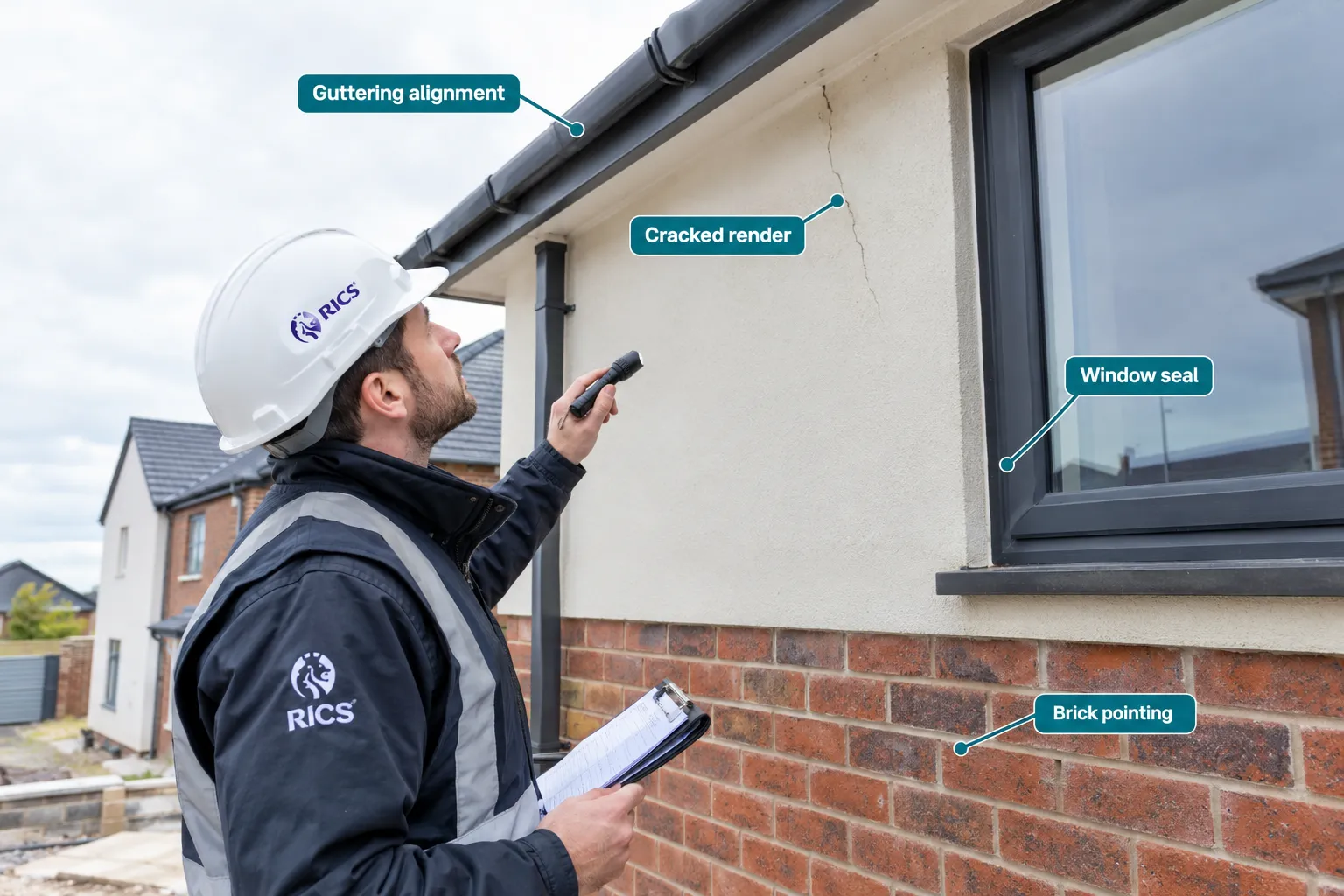
New-build homes are not immune from defects simply because they are new. Snagging issues, from poorly fitted windows to incomplete insulation, are common in the first year of a build. A dedicated new-build snagging survey, carried out separately from the developer's own checks, identifies these problems while the builder is still contractually obligated to fix them, often at no cost to the buyer.
There is also a pricing concern specific to equity-loan schemes. An independent evaluation of Help to Buy found that buyers using the scheme paid about 1% more than buyers of comparable new-build homes without it. Developers know buyers have guaranteed government-backed funding, and prices can reflect that. A RICS valuation check, carried out alongside a survey, gives a buyer an independent read on whether the asking price actually matches the home's true market value, not just what the scheme allows them to borrow.
What a New-Build Snagging Survey Checks
A snagging survey typically covers:
Structural finish, brickwork, render, roofing, and pointing
Windows and doors, seals, alignment, and draughts
Internal fittings, plasterwork, flooring, kitchen and bathroom installation
Services, heating, electrics, and plumbing connections
External areas, drainage, guttering, and landscaping completion
Buyers should also factor in leasehold and estate charges, which are common on new-build developments and can add hundreds of pounds a year to ownership costs, costs that do not show up in the headline purchase price but directly affect affordability on a mortgage already stretched to 77.5% loan-to-value.
The Market Backdrop: Rates, Prices and a Waiting Game
Timing adds another layer of risk. Moneyfacts data from 5 October 2026 shows the average five-year fixed mortgage rate has climbed to 6%, with sub-5% deals almost gone from the market. Zoopla's 1 October 2026 report found house price growth slowing while the number of homes for sale has risen by 5%, and mortgage rates are at a three-year high. For a buyer relying on a 77.5% mortgage, even small rate movements translate into meaningfully higher monthly payments.
Housebuilder Bellway has already warned that some buyers may delay purchases until Your First Home officially launches, which could soften demand for new-builds in the short term, useful leverage for buyers negotiating price, but also a reason developers may hold firm on list prices while they wait to see how much demand the scheme generates.
HomeOwners Alliance frames the scheme accurately: it is a demand-side measure, helping people borrow to buy, not a fix for the underlying shortage of affordable homes. That distinction matters because demand-side support without a matching increase in supply has historically pushed new-build prices up rather than down.
Your First Home Scheme New Build Survey Checklist Before the Budget
With the scheme unconfirmed until the 28 October Budget, buyers have a window to prepare rather than rush. A practical checklist:
Check eligibility early, confirm first-time buyer status and estimate household income against the expected £90,000/£110,000 caps.
Watch for pre-registration, expected by the end of 2026; register as soon as it opens rather than waiting.
Research local price caps, ask participating developers directly, since national detail is still thin.
Budget for fees beyond the deposit, legal costs, mortgage arrangement fees, and survey costs still apply.
Book an independent Your First Home scheme new build survey, do not rely solely on the developer's snagging list.
Get an independent valuation, compare the asking price against similar local new-builds before exchanging contracts.
Understand resale conditions, ask what happens to the equity loan if the home is sold or remortgaged before full details are published.
A 2.5% deposit buys a foot on the ladder, not protection from a bad surveyor's report, an inflated price, or a defect the developer missed.
FAQ
When does the Your First Home scheme open? It is not yet open. Full rules are expected at the Autumn Budget on 28 October 2026, with pre-registration expected by the end of 2026.
Who is eligible for Your First Home? First-time buyers in England purchasing a new-build home from a participating developer, subject to expected household income caps of around £90,000 (£110,000 in London) and local price caps.
Is the 20% equity loan interest-free? It is expected to be interest-free initially, but the length of that interest-free period has not been confirmed.
Do I still need a survey on a new-build home? Yes. New-build homes can have construction defects, and an independent survey plus a snagging inspection protects buyers whose deposit margin leaves little room for unexpected repair costs.
How is this different from Help to Buy? The deposit is lower (2.5% versus 5%), and the equity loan is smaller than London's old 40% Help to Buy loan, though it matches the 20% offered outside London previously.
Should I wait for the scheme or buy now? That depends on individual circumstances, but buyers close to exchanging should get independent advice, since delaying to wait for unconfirmed rules carries its own risks in a market with rising mortgage rates.
Conclusion
Your First Home could genuinely open the door to homeownership for buyers who have been locked out by deposit requirements alone. But a 2.5% deposit is an unforgiving amount of protection against anything that goes wrong, a construction defect, an inflated price, or a market dip. Until the Budget on 28 October 2026 confirms the detail, buyers should use the time to prepare: check eligibility, watch for pre-registration, and commit to an independent Your First Home scheme new build survey and valuation before signing anything. The scheme can lower the entry price of homeownership. Only a proper survey can confirm what that home is actually worth.
It is not yet open. Full rules are expected at the Autumn Budget on 28 October 2026, with pre-registration expected by the end of 2026.
Who is eligible for Your First Home?
First-time buyers in England buying a new-build home from a participating developer, subject to expected household income caps of around £90,000 (£110,000 in London) and local price caps.
Is the 20% equity loan interest-free?
It is expected to be interest-free initially, but the length of that interest-free period has not been confirmed.
Do I still need a survey on a new-build home?
Yes. New-build homes can have construction defects, and an independent survey plus a snagging inspection protects buyers whose thin deposit leaves little room for unexpected repair costs.