We use cookies to improve your experience on our site, analyze site traffic, and assist in our marketing efforts. By clicking "Accept all," you agree to the storing of cookies on your device. You can choose to "Reject all" non-essential cookies. For more information, please read our Cookie Policy.
Mortgage Rates Touch 6% Ahead of the 5 November Rate Decision: What It Means for Surveys, Valuations and Buyers (October 2026)
Fixed rates reached 6% in October 2026 (Tembo) and 34% of homes are price-cut (Rightmove). How a RICS survey differs from a lender valuation and how to time it before the 5 November rate decision.
Average two-year and five-year fixed mortgage rates have reached or briefly crossed 6% in October 2026, the highest level for five-year fixes in almost three years, according to Tembo Market Watch. This matters for anyone mid-purchase because higher borrowing costs are pushing sellers to cut asking prices, which raises the chance a lender's valuation comes in below the agreed sale price. Buyers who understand the gap between a mortgage valuation and a RICS survey, and who time their survey carefully around the 5 November Bank of England decision, are better placed to renegotiate or walk away with confidence.
Key Takeaways
Average five-year fixed mortgage rates briefly passed 6% in October 2026, the first time in nearly three years, per Tembo Market Watch (15 October 2026).
Average two-year fixes rose from 5.68% to 5.97% in a single month.
Bank Rate has held at 3.75% since December 2025, but markets expect a possible move on Thursday 5 November 2026.
Rightmove's October 2026 House Price Index shows 34% of listed homes have had a price reduction, close to the September 2023 peak of 36%.
A lender's mortgage valuation is not the same as a RICS Level 2 HomeBuyer or Level 3 Building Survey, and confusing the two can cost buyers money.
Down-valuation risk is rising as asking prices fall, making an independent survey more useful for renegotiation leverage.
Buyers mid-purchase should book their RICS survey early enough to review findings before any rate-lock expiry.
Survey Merchant lets buyers compare quotes from RICS surveyors to match survey type and timing to their purchase.
What does it mean when mortgage rates hit 6%
A mortgage rate of 6% means the cost of borrowing to buy a home has returned to levels last seen before the rate-cutting cycle that followed 2023. According to Tembo Market Watch, the average five-year fix stood at 5.99% on 15 October 2026 after briefly touching 6% earlier in the month, while the average two-year fix reached 5.97%, up sharply from 5.68% a month earlier.
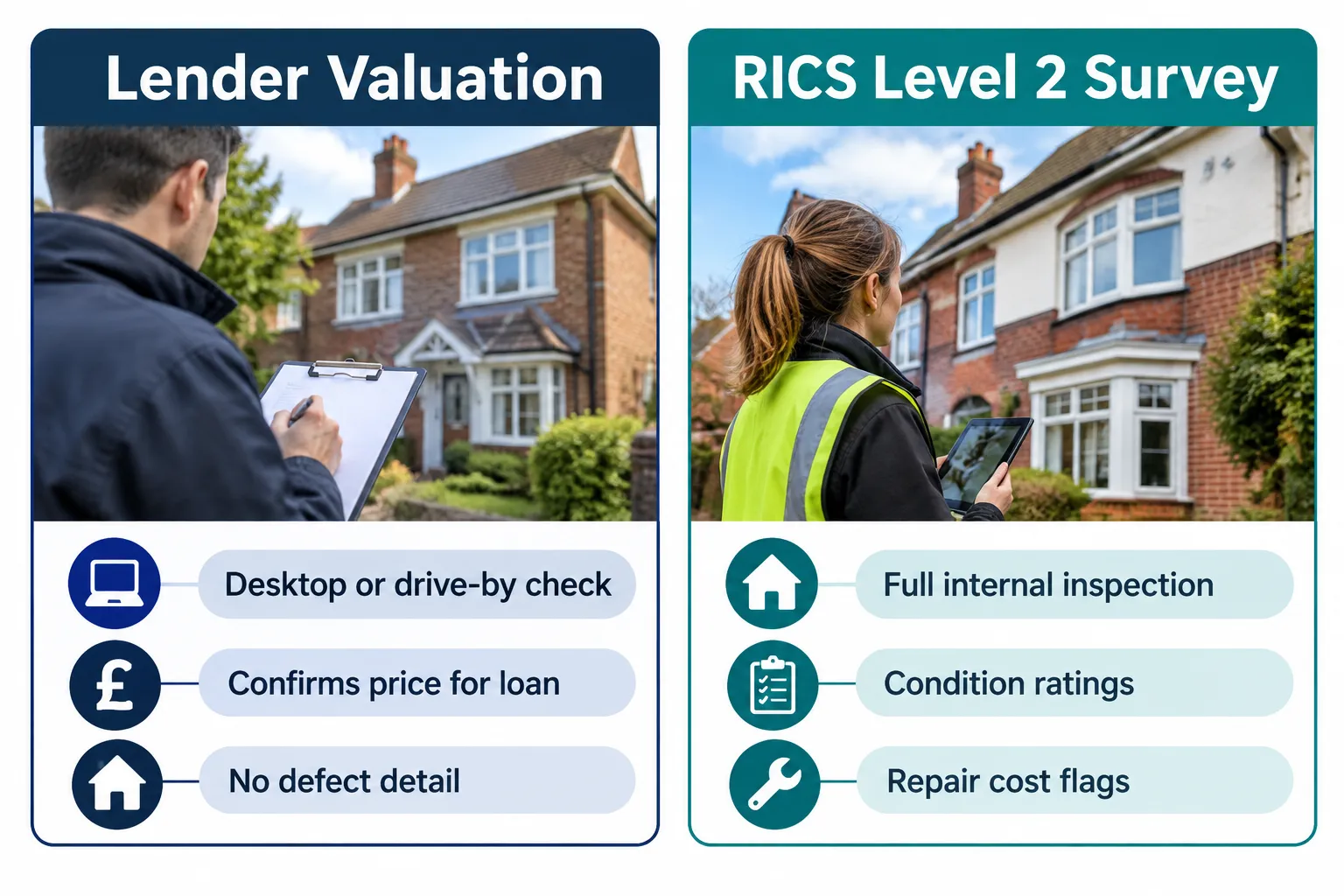
A lender's valuation and a RICS survey answer different questions.
This is not a one-off spike. It reflects a broader shift in the cost of funding for lenders, driven by rising swap rates and inflation expectations. For a buyer, it means:
Monthly repayments on a new mortgage are meaningfully higher than earlier in 2026.
Lenders apply stricter affordability checks at higher rates, which can reduce how much someone can borrow.
Sellers face pressure to adjust prices to keep deals affordable for buyers.
How much will my monthly payment be at a 6% mortgage rate
Monthly payments rise directly with the interest rate, and Rightmove's October 2026 data gives a concrete benchmark. Rightmove's own average two-year fix reached 5.55% in October, up from 5.29% the previous month and 4.25% back in February 2026, a change Rightmove says adds roughly £250 a month to repayments on a typical new mortgage.
That £250 figure is based on Rightmove's typical mortgage assumptions, not a fixed outcome for every buyer. The actual change depends on:
The size of the mortgage relative to deposit
Whether the buyer is moving from a tracker, a fix, or buying for the first time
The specific lender and product chosen
Choose a fixed rate now if your current offer is time-limited and further rises seem likely. Consider waiting a short period if your mortgage offer has flexibility and you expect the 5 November decision to ease pressure.
Should I buy a house now or wait for rates to drop
There is no single right answer, and it depends on how exposed a buyer already is to a purchase chain. Buyers already under offer with a survey booked generally gain more by proceeding carefully than by waiting on a rate call that is not guaranteed to go their way.
Factors to weigh:
Rightmove reports agreed sales down 8% and enquiries down 9% year-on-year, alongside new listings up 3%, a market with more choice but more caution.
Reduced-price homes are taking 119 days to find a buyer compared with 39 days for homes that have not been reduced, so delay can mean a longer wait in a softening market, not a guaranteed better rate.
The Autumn Budget on 28 October 2026 and the Bank of England decision on 5 November 2026 both land before most purchases complete, so some rate movement is unavoidable either way.
Edge case: if a buyer's current rate offer expires before 5 November, locking in now avoids the risk of rates rising further before completion.
Why are mortgage rates going up to 6%
Mortgage rates are rising because of a combination of geopolitical and inflation pressures feeding into lender funding costs. The Middle East conflict has lifted oil and energy prices, pushing up swap rates that lenders use to price fixed-rate mortgages. The IMF forecasts UK inflation averaging 3.3% in 2026 and 2.8% in 2027, a backdrop that discourages the Bank of England from cutting rates quickly.
Bank Rate has sat at 3.75% since December 2025. Markets are now pricing in a possible rise at the 5 November 2026 decision rather than a cut, which is pushing fixed-rate pricing higher in anticipation.
Is 6% a good mortgage rate compared to last year
Six percent is notably higher than rates available earlier in 2026, but it is not unprecedented in longer historical terms. Rightmove's figures show its average two-year fix moved from 4.25% in February 2026 to 5.55% in October 2026, a rise of 1.3 percentage points in eight months.
For context on relative value:
Rate type
October 2026
One month earlier
Comment
Average 2-year fix (Tembo)
5.97%
5.68%
Sharp monthly rise
Average 5-year fix (Tembo)
5.99%
Below 6%
Briefly crossed 6% in October
Average 2-year tracker (Tembo, end-Sept)
4.45%
—
Over 1 point below average fix
NatWest 2-year fix (from 15 Oct)
5.04%
—
Selected cuts available
NatWest 5-year fix (from 15 Oct)
4.98%
—
Selected cuts available
Common mistake: assuming every lender moved in lockstep. HSBC and NatWest cut selected fixed rates from 15 October 2026 even as the market average rose, so shopping around still matters.
How do higher mortgage rates affect home valuations
Higher mortgage rates affect valuations by cooling demand, which pushes sellers to reduce asking prices and increases the chance a lender's valuation lands below the agreed purchase price. Rightmove reports 34% of listed homes have had at least one price reduction in October 2026, close to the 36% peak recorded in September 2023, with reductions averaging almost 7%, or about £21,000.
This is where the distinction between a lender's mortgage valuation and a RICS survey becomes critical:
A mortgage valuation is a brief check instructed by the lender, often desktop-based or a short drive-by inspection, solely to confirm the property is worth enough to support the loan. It gives no detail on condition.
A RICS Level 2 HomeBuyer Survey involves a full internal and external inspection, flags visible defects, and gives a condition rating for each part of the property.
A RICS Level 3 Building Survey goes further still, suited to older, extended, or unusual properties, with detailed technical findings and repair cost indications.
Choose a Level 2 HomeBuyer Survey if the property is a conventional house or flat in reasonable condition. Choose a Level 3 Building Survey if the property is older, listed, has had major alterations, or shows visible signs of movement or damp.
Does a 6% mortgage rate mean my home survey will change
A survey itself does not change because of the interest rate, but how a buyer uses the survey results changes significantly when affordability is tighter. With Tembo reporting average fixes near 6%, every pound of unexpected repair cost identified by a RICS surveyor carries more weight in a buyer's decision to renegotiate.
Practical ways to use survey findings now:
Request a copy of the full RICS report, not just a summary, before the mortgage offer deadline.
Flag any defects with cost estimates to the seller's agent in writing, referencing the survey section.
Ask the lender's valuer to reconsider the valuation if the RICS survey identifies issues the desktop valuation missed.
Keep renegotiation requests proportionate. Citing £21,000 as the current average market reduction, per Rightmove, gives useful context for what sellers are already accepting elsewhere.
What does the November rate decision mean for mortgage rates
The Bank of England's 5 November 2026 decision matters because it will confirm whether Bank Rate rises from 3.75% or holds, directly shaping where fixed and tracker rates move next. Markets currently expect a possible rise, according to Tembo Market Watch, after Bank Rate has been unchanged since December 2025.
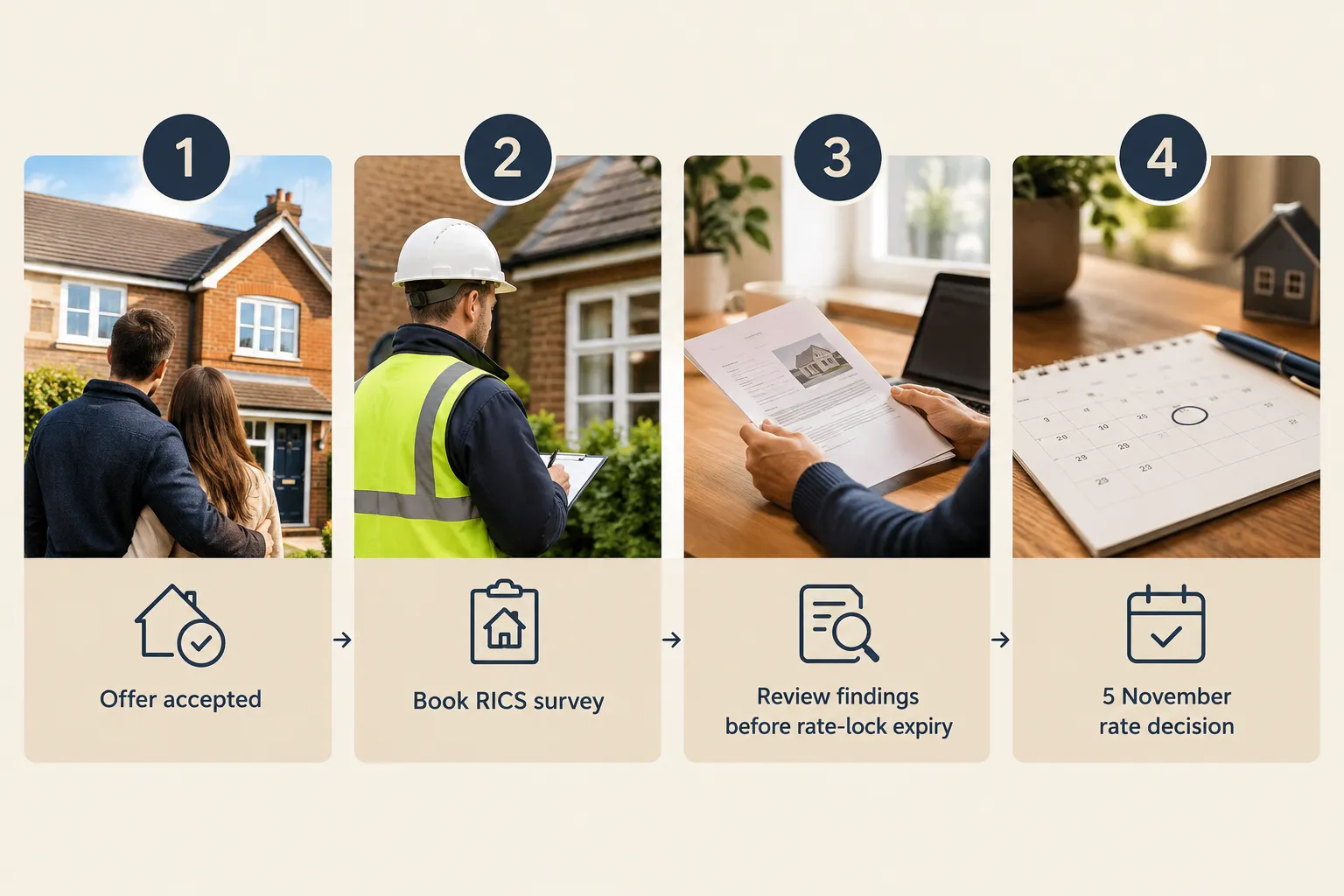
Timing a survey around a rate lock: offer accepted, book the survey, review findings, then the 5 November decision.
If the Bank raises rates on 5 November:
Variable and tracker mortgage costs rise quickly, since the average 2-year tracker already sat at 4.45% at end-September versus 5.94% for the average fix.
Lenders may reprice fixed deals upward again shortly after.
If the Bank holds:
Existing fixed-rate offers, including the NatWest cuts from 15 October, become more attractive relative to new pricing.
Buyers with flexibility may benefit from waiting a short period to see if more lenders follow HSBC and NatWest in trimming rates.
Can I lock in a rate now or should I wait
Locking in now protects against further rises but forfeits any benefit if rates ease after 5 November. Most UK mortgage offers can be switched to a cheaper deal before completion if the lender allows a rate-switch window, so securing a rate now is rarely an irreversible decision.
Decision rule: lock in now if the current offer is due to expire before the Budget on 28 October or the Bank of England decision on 5 November. Wait a short window if the offer has flexibility and the lender permits a later rate switch without penalty.
What are the alternatives if a 6% mortgage is too expensive
Several alternatives exist for buyers priced out by average fixed rates near 6%. Tembo's data shows the average 2-year tracker at 4.45% at end-September, more than a point below the average 2-year fix of 5.94% at that time, which some buyers use as a lower-cost bridge while hoping fixes fall later.
Other options:
Review selected lender cuts, such as NatWest's 5.04% two-year and 4.98% five-year fixes from 15 October 2026.
Increase deposit size if possible, since lower loan-to-value bands often unlock cheaper rates.
Use the price-reduction trend, averaging nearly 7% per Rightmove, to negotiate a lower purchase price rather than only chasing a lower rate.
How does 6% impact first-time buyers
First-time buyers feel higher rates most acutely because they typically borrow a larger share of the purchase price and have less room to absorb a £250-a-month increase, the figure Rightmove attaches to recent rate rises on a typical new mortgage. Reduced lending headroom at 6% can mean qualifying for a smaller loan than expected just months earlier.
A RICS survey becomes especially valuable here: identifying repair costs before completion gives first-time buyers a concrete basis to renegotiate price, which can partly offset the higher monthly cost created by today's rates.
Will mortgage rates go back below 6% soon
It is uncertain, and will depend heavily on the outcome of the 5 November 2026 Bank of England decision and the Autumn Budget on 28 October 2026. The IMF's inflation forecast of 3.3% for 2026 easing to 2.8% in 2027 suggests gradual improvement is plausible over time, but no lender or forecaster in current reporting guarantees a near-term fall below 6%.
Buyers should plan around the rate available today rather than delay a purchase on the assumption of a near-certain future drop.
What mistakes should I avoid when rates are at 6%
The most common mistake is treating the lender's mortgage valuation as a substitute for an independent condition survey. A mortgage valuation only protects the lender's interest in the loan; it does not protect the buyer from inheriting costly repairs.
Other mistakes to avoid:
Booking a survey too late to review findings before the mortgage offer or rate-lock expires.
Assuming a price reduction advertised by the seller already reflects the property's true condition.
Ignoring the gap between tracker and fixed rates when the gap is unusually wide, as it is now according to Tembo Market Watch.
Failing to compare more than one RICS surveyor's quote before instructing a survey.
What this means for you
Buyers currently mid-purchase in this market face two pressures at once: borrowing costs near 6% and sellers cutting prices to keep deals moving. The sensible response is to treat the RICS survey as a negotiating tool, not just a box-ticking exercise, and to time it so the findings are in hand well before any rate-lock or mortgage offer deadline.
Steps to take this week:
Confirm the expiry date of the current mortgage offer or rate lock.
Book a RICS Level 2 or Level 3 survey immediately if not already instructed.
Review findings against the seller's asking price, using local reduction trends as context.
Watch the Autumn Budget on 28 October and the Bank of England decision on 5 November before making a final rate decision.
Buyers can compare quotes from RICS-regulated surveyors through Survey Merchant to match survey level, timing, and cost to their specific purchase.
FAQ
Does a mortgage valuation check the condition of the property?
No. A lender's mortgage valuation confirms the property is worth enough to support the loan and does not assess condition in detail, unlike a RICS Level 2 or Level 3 survey.
What happens if my mortgage valuation comes in below the agreed price?
This is a down-valuation. Buyers typically need to renegotiate the price, increase their deposit, or challenge the valuation with supporting evidence such as a RICS survey report.
Should I get a survey before or after my mortgage offer?
A RICS survey can be booked as soon as an offer is accepted, ideally before the mortgage valuation is finalised, so findings can support any renegotiation discussion in good time.
Will the 5 November Bank of England decision definitely raise rates?
No. Markets expect a possible rise, according to Tembo Market Watch, but the outcome is not confirmed until the decision is announced.
Is a tracker mortgage cheaper than a fix right now?
Based on Tembo Market Watch data, the average 2-year tracker at end-September was 4.45%, compared with 5.94% for the average 2-year fix, though trackers carry the risk of future rate rises.
How much have asking prices fallen in October 2026?
Rightmove's October 2026 House Price Index shows average reductions of almost 7%, around £21,000, with 34% of listed homes reduced.
Conclusion
Average mortgage rates brushing against 6% in October 2026, combined with a near-record share of price-reduced listings reported by Rightmove, create real financial pressure but also real opportunity for buyers who move carefully. The key is not to confuse a quick lender valuation with a proper RICS survey, and to use genuine condition findings as leverage when prices are already softening. Buyers mid-purchase should confirm their rate-lock deadline now, get a RICS surveyor booked without delay, and watch both the 28 October Budget and the 5 November Bank of England decision before finalising their mortgage choice. Compare quotes from RICS surveyors through Survey Merchant to find the right survey type and timescale for a purchase moving through this market.
Related guides
No items found.
Book a RICS surveyor
Survey Merchant provides vetted RICS surveyors across 100+ UK locations at fixed fees: