Nearly 4,000 overdue fire safety actions. More than 1,400 of them high risk. One in six homes failing the Decent Homes Standard. These are not findings from a routine inspection, they are the headline numbers behind the lowest grade a social landlord can receive from England's housing regulator.
On 28 October 2026, the Regulator of Social Housing handed the London Borough of Haringey a C4 consumer grade, citing "very serious failings" and demanding fundamental change. The Haringey judgement is now the clearest live example of why asset data, not good intentions, determines regulatory outcomes. For every housing association, council landlord, and block manager watching, the lesson is blunt: you cannot manage what you have not accurately surveyed.
Key Takeaways
- Haringey received a C4 grade, the regulator's lowest, over fire safety backlogs, non-decent homes, and poor communication with the regulator.
- Almost 4,000 fire risk assessment remedial actions were overdue at inspection, over 1,400 of them high risk.
- Around 16% of Haringey's roughly 15,300 social homes are non-decent; full compliance is targeted for March 2028.
- The regulator found Haringey had a good understanding of most homes' condition from physical surveys, but failed to act on the data.
- Stock condition surveys, fire risk assessment tracking, and transparent reporting are now the clearest dividing lines between a C1 and a C4 grade.
What the Regulator Actually Found
The judgement identified serious failings against the Safety and Quality, Neighbourhood and Community, and Transparency, Influence and Accountability standards. Most damaging was a finding of very serious failings in how Haringey communicated with the regulator, specifically, not disclosing the full scale of its growing fire remedial action backlog.
Other findings included:
- Only around half of non-emergency repairs completed on time in 2025/26
- A substantial backlog of overdue repairs and overdue damp and mould cases
- Roughly 9% of adaptations completed within required timescales
- High complaint volumes, maladministration findings, and escalation rates
The regulator has not used formal enforcement powers yet but says it will keep this under review while maintaining intensive engagement. Haringey apologised to tenants on 30 October, accepted the findings, and has commissioned an independent review.
Why the Haringey Judgement Matters Beyond Haringey
Here is the detail that should concern every landlord: the regulator noted Haringey had a good understanding of most homes' condition from physical surveys. The data existed. The failure was in converting survey findings into completed, verified, and reported remedial action.
This is the structural lesson of the Haringey judgement. Good survey coverage is necessary but not sufficient. Regulators are now grading landlords on the full chain: survey, prioritise, fund, complete, verify, and report honestly. A break anywhere in that chain, even with excellent raw data, produces the same outcome as having no data at all.
Fire Risk Assessment Follow-Through: The New Fault Line
Fire risk assessments (FRAs) are now arguably the single most scrutinised dataset in social housing regulation. It is not enough to commission an FRA, landlords must demonstrate that remedial actions are tracked, risk-rated, resourced, and closed within a reasonable timeframe.
Haringey's nearly 4,000 overdue actions, with over a third rated high risk, illustrate what happens when FRA outputs become a static report rather than a live management tool. Housing providers should treat every FRA action as an asset management task with:
- A named owner and completion deadline
- A risk tier (low/medium/high) with escalation triggers for high-risk delays
- A visible status dashboard accessible to board members and the regulator
- Independent verification that remedial works were actually completed, not just scheduled
What a Modern Stock Condition Survey Programme Looks Like
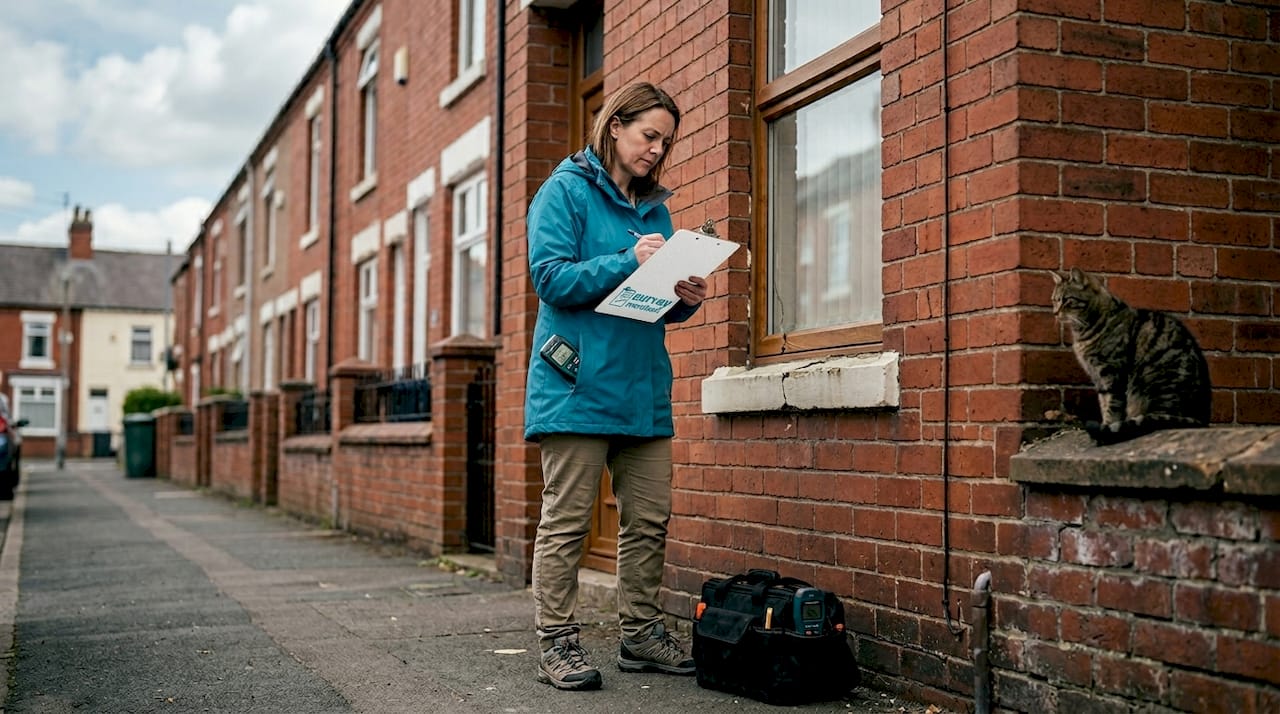
Landlords rebuilding credibility after findings like Haringey's, or trying to avoid a similar outcome, need a stock condition survey approach built for both compliance and assurance.
Sampling vs. 100% Surveys
| Approach | Best For | Limitation |
|---|
| Statistical sampling (10-20% of stock) | Large, homogeneous portfolios | Can miss outlier properties with severe defects |
| 100% physical surveys | High-risk or ageing stock, post-regulatory scrutiny | Higher cost and longer programme duration |
| Rolling 5-year cycle | Steady-state maintenance planning | Data can go stale between visits |
| Targeted re-survey (fire, damp, DHS failures) | Fast regulatory response | Not a substitute for full condition picture |
Given the Decent Homes Standard failures and Awaab's Law obligations on damp and mould, many landlords are now moving toward hybrid models: full surveys for blocks with known fire, damp, or structural risk, combined with statistically robust sampling elsewhere.
Core Data Every Survey Should Capture
- HHSRS (Housing Health and Safety Rating System) category 1 and 2 hazards
- Decent Homes Standard compliance status
- EPC rating and retrofit/decarbonisation readiness
- Fire safety features and FRA cross-reference
- Damp, mould, and condensation risk scoring
- Structural condition and remaining component lifespans
Asset Management Systems
Survey data is only as useful as the system that holds it. Modern asset management platforms should link survey findings directly to repairs scheduling, FRA tracking, and board-level reporting dashboards, removing the gap that let Haringey's fire backlog grow without full regulatory disclosure.
Lessons for Housing Associations, Councils, and Block Managers
Three practical takeaways apply regardless of landlord type:
- Treat communication with the regulator as a compliance duty, not a reputational choice. Haringey's most severe finding was about disclosure, not the underlying defects themselves.
- Audit the gap between survey and action. Commission an independent check on how many identified defects from the last stock condition survey cycle remain unresolved, and why.
- Benchmark against Decent Homes and Awaab's Law timelines now. With Haringey targeting full compliance by March 2028, other landlords with ageing stock should assume similar scrutiny timelines are coming.
What Leaseholders and Buyers in Ex-Local-Authority Blocks Should Ask
Leaseholders in blocks affected by councils under regulatory pressure face direct financial exposure, particularly around fire remedial works recharged through service charges. Before buying or budgeting, ask:
- Is there an up-to-date fire risk assessment for the block, and what is the status of remedial actions?
- Has the freeholder disclosed any overdue high-risk fire actions affecting this building?
- What stock condition survey data exists for this block, and when was it last updated?
- Are any Decent Homes Standard or damp/mould remedial works planned, and how will costs be apportioned?
- Has the landlord received any regulatory judgement, and does it affect major works programming?
A qualified building surveyor can review FRA documentation, major works notices, and service charge accounts to flag undisclosed liabilities before a purchase completes.
FAQ
What does a C4 grade from the Regulator of Social Housing mean?
C4 is the lowest consumer grade, indicating serious or very serious failings in meeting regulatory standards, with fundamental change required.
Does a C4 grade trigger automatic enforcement?
Not necessarily. The regulator may choose intensive engagement rather than formal enforcement, as in Haringey's case, while keeping enforcement options under review.
How does this affect Haringey tenants immediately?
Tenants should see increased oversight of repairs, fire safety works, and complaint handling, alongside the council's independent review and apology.
Why do stock condition surveys matter so much in this judgement?
The regulator found Haringey understood its stock condition well but failed to act on and disclose that data, showing survey data alone cannot prevent regulatory failure without strong follow-through.
Should other councils expect similar scrutiny?
Yes. The regulator's consumer standards framework applies universally, and fire safety backlogs or Decent Homes failures elsewhere are likely to draw comparable attention.
What should leaseholders in affected blocks do now?
Request current FRA documentation and stock condition data from the landlord, and seek independent surveyor advice before agreeing to major works service charge demands.
Conclusion
The Haringey C4 judgement is a warning that good data without disciplined execution and honest reporting still fails regulatory scrutiny. Landlords should audit their FRA backlog status, stress-test stock condition survey coverage, and confirm reporting lines to the regulator are complete and current. Leaseholders and buyers in ex-local-authority blocks should demand transparency on fire remedial works before committing financially. Acting now, rather than after a regulatory judgement, is the only reliable way to avoid becoming the next case study.