Building Surveying
Jul 16, 2026
Woodworm Survey 2026: Protect Your Property
Protect your UK property. Our 2026 woodworm survey guide covers costs, active signs, and how to get a professional report. Don't wait!

You're midway through a purchase. The survey has flagged small holes in a loft beam, a skirting board, or the underside of a floor. The estate agent says it's probably old. The seller says it was treated years ago. Your lender wants clarity before moving ahead.
That's the point where a woodworm survey becomes useful. Not because every flight hole means major structural trouble, but because timber defects are easy to misunderstand from a quick look. Old beetle damage can sit harmlessly for years. Active infestation, damp timber, poor ventilation, and decay can also sit out of sight until repair costs escalate.
This isn't a niche issue. Around 20% of UK homes are estimated to have some level of woodworm infestation, or roughly 1 in 5 homes, which is why buyers and lenders regularly ask for proper timber inspection before a purchase proceeds, according to AMS Surveys on wood-boring insects in UK homes. The practical point is simple. Woodworm is common enough that it should be assessed calmly, not guessed at.
A good survey does more than confirm whether insects have been present. It asks the more important question. Why has the timber become vulnerable in the first place? In many cases, the answer sits with damp, leakage, poor subfloor airflow, or long-term condensation. If you've dealt with other timber pests before, the logic is similar to a Crown Point homeowner's termite inspection. The visible damage matters, but the surrounding building conditions matter just as much.
Most buyers first notice the issue through a survey note, a mortgage retention, or a last-minute comment from a contractor lifting a hatch. The timber may look serviceable from the room below, yet the concern sits in the roof void, beneath suspended floors, or behind stored belongings where nobody has looked properly for years.
That uncertainty is usually what drives the instruction. You don't need a specialist report because holes exist. You need one because nobody should make a decision on structure, treatment, or price reduction from surface marks alone. A competent timber inspection helps separate harmless historic evidence from conditions that still need attention.
A proper woodworm survey is also helpful when the paperwork matters. Lenders, insurers, and buyers often want something more substantial than verbal reassurance. They may need a written opinion on whether the issue is active, whether load-bearing timber is affected, and whether repair or treatment is justified.
Practical rule: If timber signs appear in joists, floor structures, roof timbers, or other structural areas, don't rely on a seller's memory of past treatment. Ask for current inspection evidence.
The survey should answer four practical questions:
Homebuyers often focus first on the insect. Surveyors usually focus first on the timber environment. That's the right order. If the building stays damp, treatment on its own may not solve much for long.
Woodworm isn't a worm. It's the commonly used name for the larval stage of several wood-boring beetles. The damage happens while the larvae feed inside timber. The round exit holes people notice later are usually the final visible sign, not the start of the problem.
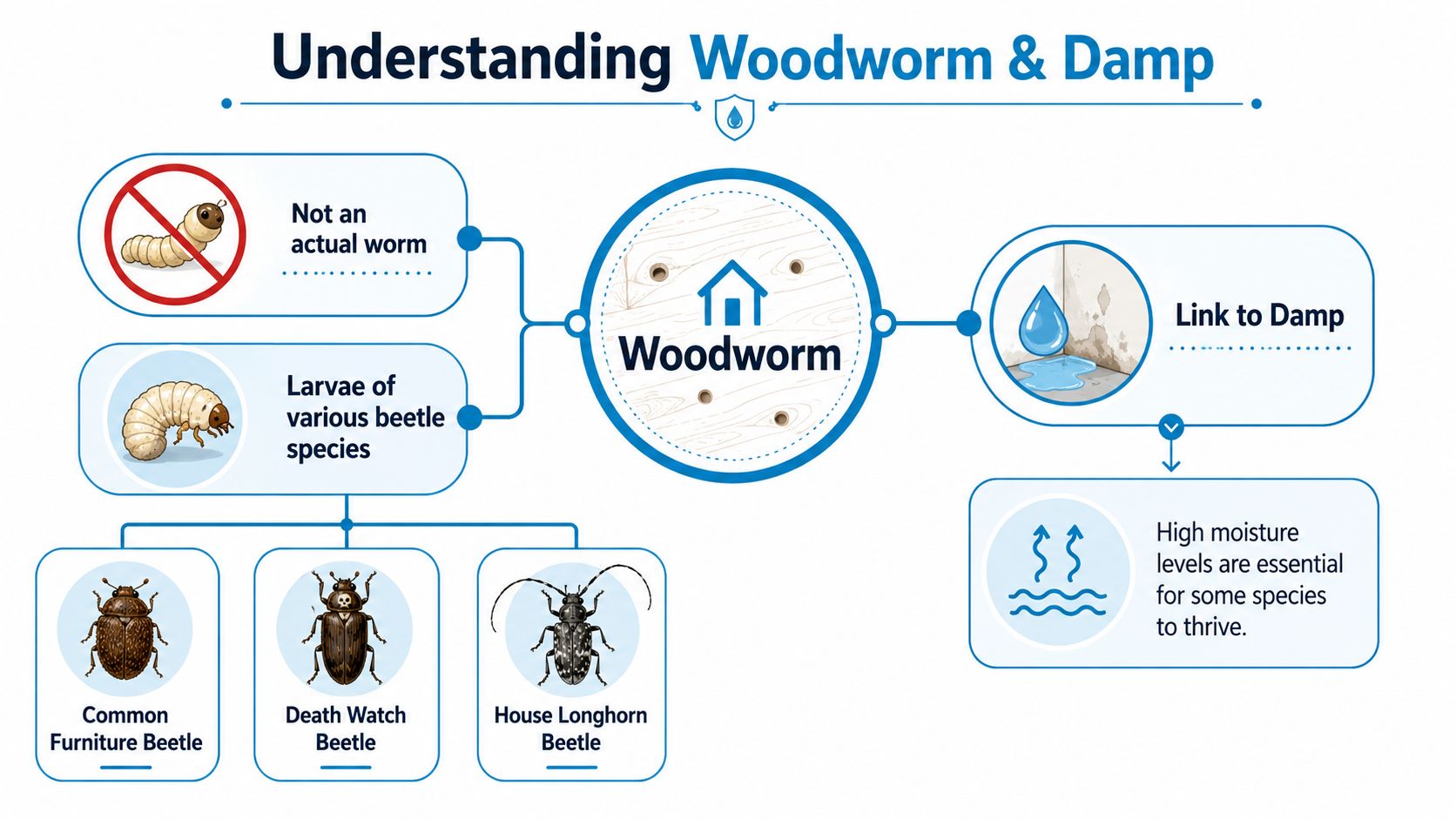
Think of it as hidden internal feeding followed by a visible exit. By the time adult beetles emerge and leave holes, activity may be current, fading, or long gone. That's why a few small holes in a beam don't tell the full story.
Different beetle species prefer different timber conditions. From a buyer's point of view, exact species identification matters because it influences risk, likely extent, and the sort of treatment or repair that may be appropriate. From a surveyor's point of view, it also helps explain whether the surrounding building conditions are inviting repeat attack.
What matters most in houses is not the label attached to the beetle. It's whether the timber is dry, sound, and stable, or damp and attractive to further infestation.
Many consumer guides stop too early. A timber report shouldn't be read only as a pest report. It should be read as a moisture pathway investigation. Surveyors regularly find that visible wood-boring damage is secondary evidence of another defect such as poor subfloor ventilation, a roof leak, plumbing escape, or persistent condensation. That broader point is well captured in this explanation of woodworm as a sign of hidden damp and wider building pathology.
If a suspended timber floor has restricted air bricks, or if a roof void has long-term moisture entry, the building has created the conditions in which timber problems can persist. Killing insects without dealing with that background moisture is often poor value.
For homeowners dealing with timber floors rather than structural roof timbers, useful parallels appear in this advice for water damaged hardwood in Richmond. The context is different, but the principle is the same. Timber condition follows moisture exposure.
A good next read on this wider diagnostic approach is Survey Merchant's guide to navigating damp and timber issues.
Treat woodworm as a building health clue, not just a pest control problem.
When I inspect timber defects, the most revealing findings often aren't the holes at all. It's the stale subfloor air, the blocked vents, the roof underlay staining, or the cold corners where moisture keeps returning. Those are the details that decide whether the problem is historic or likely to come back.
The question every buyer asks is fair enough. Is this live, or is it old? The trouble is that visible holes alone rarely answer it.
RICS guidance stresses that surveyors shouldn't recommend treatment on exit holes alone. Moisture, decay, and species all need assessment first, because beetle holes do not automatically prove active infestation. That matters directly to buyers deciding whether to renegotiate, monitor, or press for immediate repair, as discussed in this RICS-related guidance on timber defect assessment and misdiagnosis.
A surveyor looks for a pattern rather than one isolated clue. Fresh bore dust, sometimes called frass, matters. So does the appearance of the timber surface around holes, the location of damage, and whether the timber still has high moisture content.
Common features that can point towards recent or ongoing activity include:
None of those signs should be judged in isolation. Dust can fall from old holes after disturbance. Newly uncovered timber can look deceptively fresh even when infestation is not.
Historic infestation is common in older housing stock. In many cases the beetles have gone, the timber has dried, and the remaining issue is whether strength has been materially reduced.
Indicators often associated with old activity include:
| Feature | Often more consistent with historic damage |
|---|---|
| Hole appearance | Darkened, worn, painted over, or softened at the edges |
| Surrounding dust | No fresh accumulation after cleaning and monitoring |
| Timber condition | Dry, firm, and not worsening |
| Building context | Damp source appears resolved and ventilation is adequate |
That still doesn't make old damage irrelevant. Old attack in a non-structural trim board is one thing. Old attack in a badly notched joist or decayed wall plate is another.
People understandably look for one quick answer. Fresh holes mean active. No beetles means inactive. Unfortunately, the real picture is rarely that neat.
A useful comparison is the way people assess moisture marks on plaster or ceilings. The same patch can be active, recurring, or just historic staining. That's why material context matters. The logic is similar in this article on identifying new or old water damage. Timber needs the same kind of careful reading.
Old woodworm can still leave a repair issue. Active woodworm can sometimes leave less damage than people fear. The survey has to decide which problem you actually have.
As a rule, buyers should be wary of two opposite mistakes. One is panic-buying treatment for every old hole in sight. The other is dismissing obvious timber deterioration because the holes “look old”. Both can be expensive.
A proper woodworm survey is methodical. The aim isn't to count holes room by room. The aim is to inspect all accessible structural timber, understand the moisture conditions, and map where risk is concentrated.
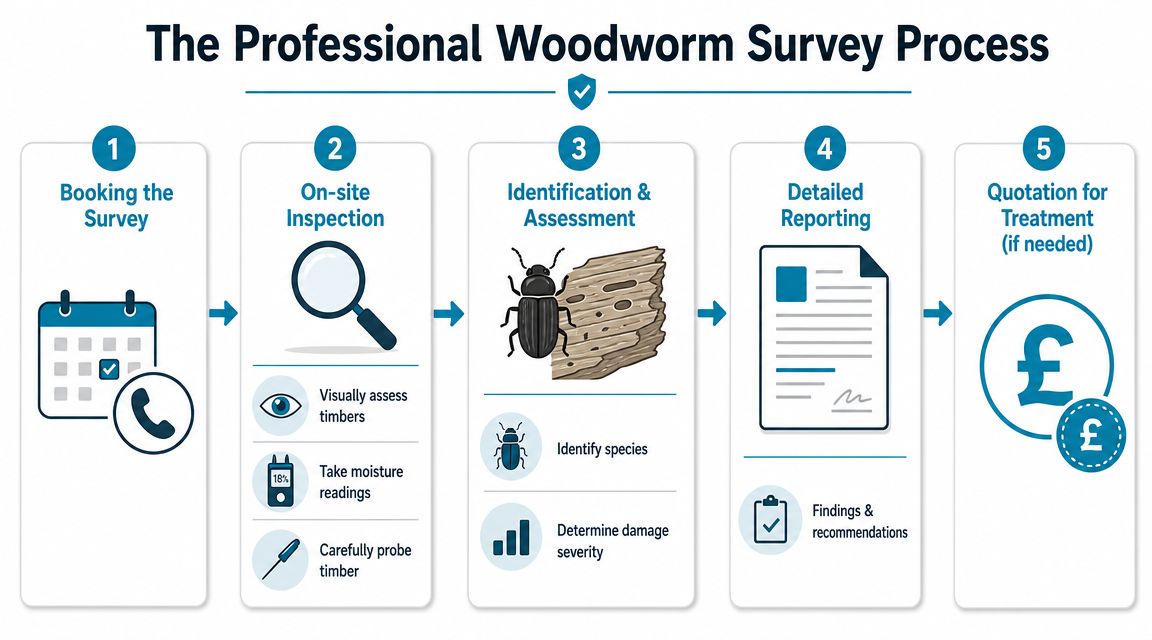
A useful overview of the broader inspection context sits in these complete building survey details, because timber concerns often form part of a wider pattern of maintenance and defect diagnosis.
A strong inspection normally starts with the building as a whole. The surveyor looks at roof coverings, rainwater goods, external ground levels, air bricks, and any obvious moisture sources before moving into the timber spaces themselves. That sequence matters because timber defects rarely make sense in isolation.
Inside the property, attention usually goes to the places where timber stays hidden and poorly ventilated:
A valuable survey focuses on risk mapping and moisture diagnosis, not just visual identification. Surveyors inspect accessible structural timber and use moisture metres and borescopes to judge whether conditions support active infestation or only historic damage, as described by Sussex Damp Experts on certified woodworm surveys and hidden risk.
A trained surveyor uses simple tools well. Flashlights matter. So do ladders, access hatches, and enough time to inspect properly. The specialist tools then add depth.
Common tools include:
The most useful surveys combine observation with judgement. A moisture reading without context can mislead. A borescope image without structural understanding can do the same. Good reporting comes from correlating all of it.
This walkthrough gives a visual sense of how specialists approach timber inspection on site:
When the report lands, it should be clear enough for a buyer, solicitor, lender, or contractor to use. It shouldn't read like a vague alarm bell.
Look for the following:
If a report recommends chemical treatment but says little about moisture sources, ventilation, or timber condition, it may be answering the wrong question.
The best reports reduce uncertainty. Even when further intrusive inspection is needed, they explain why and where, so you can budget and negotiate from a firmer position.
For most buyers, the first practical question is cost. The second is how quickly the report can be turned around before exchange, mortgage review, or contractor pricing.
The clearest published pricing in the verified material comes from a specialist preservation firm. It states that a PCA-accredited report for a standard property typically falls between £80 and £250, while larger, heritage, or difficult-access sites rise to £285 to £525, as set out in this guide to woodworm survey costs in the UK.
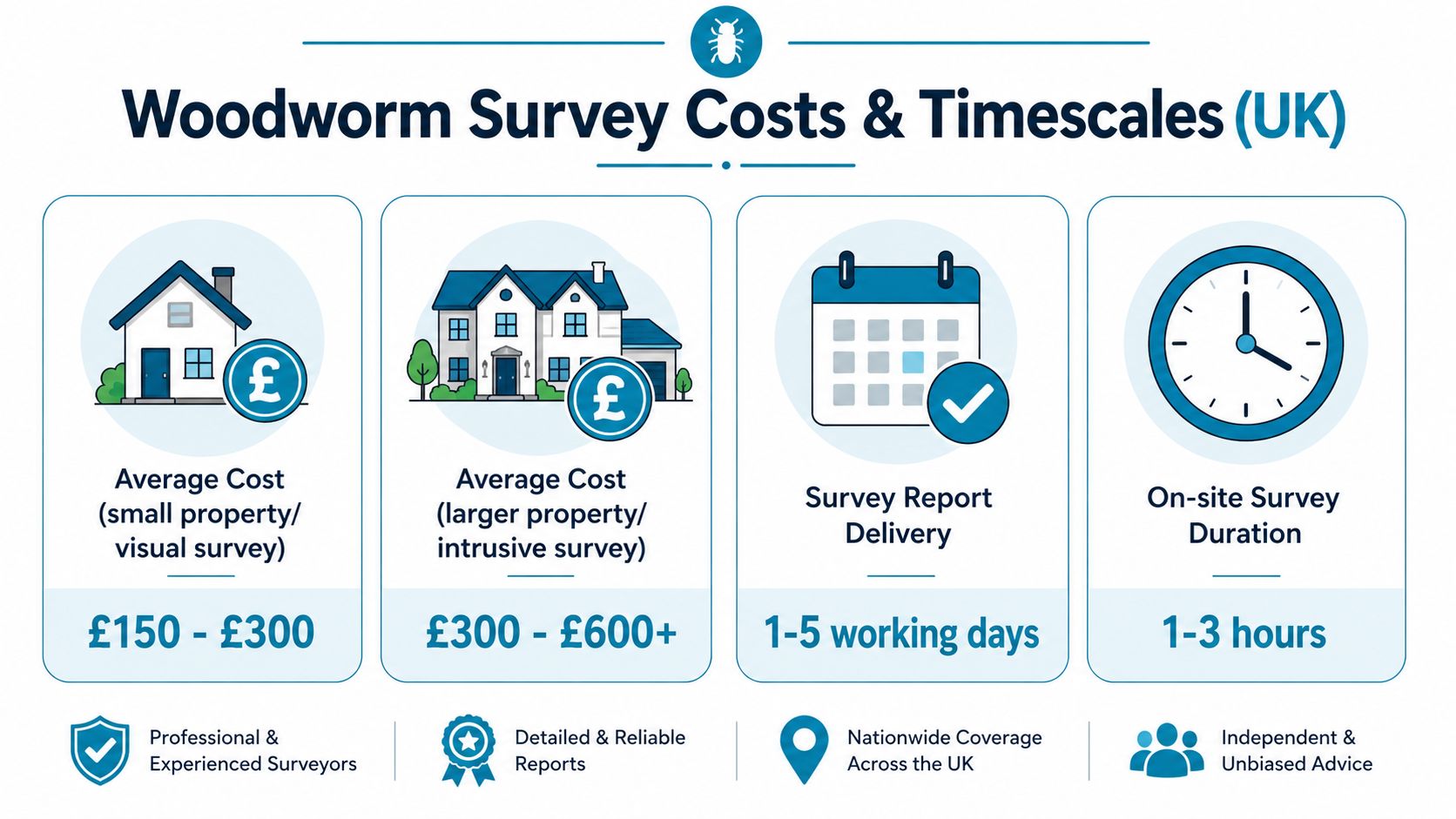
Those figures vary for sensible reasons. A compact house with straightforward loft access and a simple visual concern is one proposition. A listed building with multiple roof spaces, restricted floor void access, and lender-grade reporting requirements is another.
In practice, fee differences often come down to:
This is one area where the cheapest quote can be a false economy. If the report is too light on diagnosis, you may still end up paying again for clarification.
Timescales vary by surveyor workload, access arrangements, and the property itself. Some inspections are completed quickly on site. Others take longer because safe access has to be managed carefully or because further opening up is recommended.
Rather than fixating on speed alone, ask two practical questions when booking:
| Question | Why it matters |
|---|---|
| When can the inspection take place | Important for mortgage and legal deadlines |
| When will the written report be issued | Important for negotiation and contractor follow-up |
If you are buying, align the survey timing with the rest of the transaction. A timber report is most useful when there is still time to obtain repair pricing, ask follow-up questions, or renegotiate if the findings justify it.
Once the survey identifies the problem, the next step is choosing the right response. That response should follow the insect lifecycle, the timber condition, and the moisture environment. It should not default automatically to “spray everything”.
Guidance on treatment notes that a report should distinguish between curative treatment for active infestation and preventive treatment for future risk. It also notes that physical methods such as hot-air remediation are non-persistent unless followed by preventive protection, while biocidal products such as permethrin-based formulations are commonly specified where ongoing protection is needed, according to European guidance on choosing the right woodworm treatment.
Curative treatment deals with a current infestation. Preventive treatment aims to reduce the chance of recurrence once active conditions have been dealt with. Those are related, but not identical.
Common outcomes after a survey include:
The critical judgment is whether treatment is supporting a repair strategy, or substituting for one. Chemicals can't restore lost strength to badly deteriorated wood.
Many remedial schemes fail under these circumstances. If dampness remains, the timber can stay vulnerable even after treatment. The better approach is integrated.
A sound remediation plan usually asks:
Good remediation doesn't stop at killing insects. It restores dry, durable timber conditions.
In older houses, I often see two extremes. Some owners have paid for broad spray treatment where the primary need was ventilation and isolated repair. Others have improved airflow but ignored timber already weakened beyond sensible tolerance. The report should steer between those mistakes.
If the work is significant, ask for the survey findings to be tied clearly to the scope of repair. That makes contractor pricing easier to compare and helps avoid over-treatment.
Choosing the surveyor matters as much as the inspection itself. You want someone qualified to diagnose timber defects impartially, not someone starting from a treatment sale and working backwards.
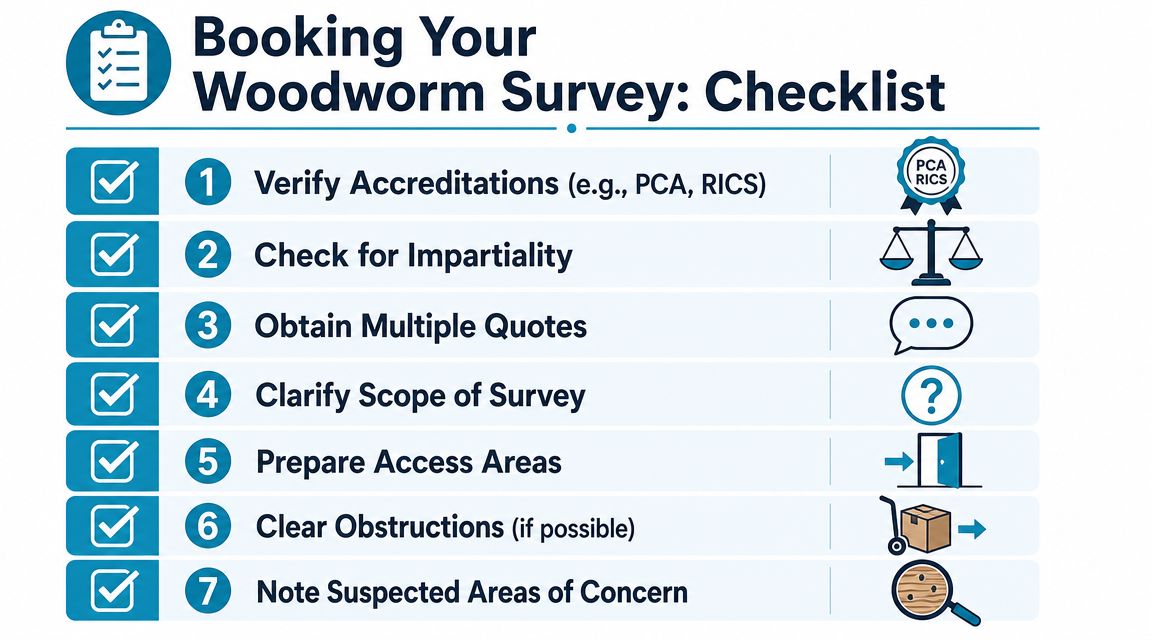
A useful starting point is this guide to finding property surveyors, especially if you need somebody local who understands defect reporting rather than just product-led treatment.
Ask direct questions. The answers usually tell you a lot.
You don't need to strip the house bare, but access helps. A blocked hatch, packed eaves storage, or sealed subfloor opening can limit what any surveyor can confirm.
A short pre-survey checklist helps:
If you're buying, send the original survey extract when booking. That lets the inspector target the right areas and understand what the lender or conveyancer is worried about.
If you need an impartial timber inspection, Survey Merchant can help you find a vetted surveyor from its UK panel of qualified professionals. That's useful when you need clear defect diagnosis, practical next steps, and a report that helps you make a confident decision before repairs, renegotiation, or exchange.
Survey Merchant provides vetted RICS surveyors across 100+ UK locations at fixed fees:
→ Level 2 Home Survey (HomeBuyer Report)
→ Level 3 Building Survey (full structural survey)
→ RICS Red Book property valuations
→ Party wall surveyors — notices, awards & schedules of condition
→ Expert witness surveyors — CPR Part 35 reports for property disputes