Building Surveying
Sep 29, 2026
Understand What Is Dilapidation Report: 2026 UK Guide
Discover what is dilapidation report in our 2026 UK guide. Get clear answers on dilapidations for tenants, landlords, and construction projects.

You may be here for one of two reasons. Your commercial lease is ending and the landlord has mentioned dilapidations, or a developer next door has asked to inspect your home before works start. Both situations use similar language. They are not the same thing.
This is a frequent point of confusion. Individuals may search for what is a dilapidation report, read half an article about lease claims, then realise too late that their problem is about construction damage. Or the reverse. The result is avoidable confusion, poor decisions, and sometimes expensive arguments.
A surveyor would separate these issues immediately. One report is about lease obligations at the end of a commercial tenancy. The other is about recording a property's condition before nearby works begin. Once you know which one applies, the rest becomes much easier to follow.
In everyday conversation, people often use dilapidation report as if it means one thing. In practice, it usually means one of two distinct processes. That distinction matters from the first phone call.
RICS treats dilapidations in England and Wales as breaches of lease covenants about a property's condition at the end of a tenancy. Separately, people also use the term for a pre-construction condition record of neighbouring property. The confusion is real. A 2025 survey cited by RICS found 72% of UK homebuyers confused these terms when assessing potential construction damage, as noted in the RICS consumer guide on dilapidations in England and Wales.
Here's how to picture it:
| Situation | What the report is for | Who usually needs it |
|---|---|---|
| Commercial lease ending | To record alleged breaches of lease obligations and the cost of putting them right | Landlords, tenants, managing agents |
| Construction next door | To create a before-works record of your property's condition | Homeowners, developers, contractors |
If you're a tenant leaving an office, shop, or warehouse, the relevant document is usually a Schedule of Dilapidations. It focuses on what the lease required you to maintain, repair, decorate, reinstate, or comply with.
If you're a homeowner worried about excavation, demolition, or heavy construction nearby, the relevant document is usually a condition report, even though people may still call it a dilapidation report.
Practical rule: Before you discuss fees, liability, or next steps, ask one question. “Is this about a lease ending, or about nearby construction?”
The two reports look similar on the surface because both involve an inspection, photographs, and careful recording of condition. But the purpose is different.
A lease-end schedule is an enforcement and negotiation document. It helps determine whether the tenant has met the lease covenants and what remedy may be due.
A construction condition report is a protective evidence document. It creates a neutral baseline so that later cracking, movement, or damage can be assessed fairly.
That difference changes everything. It affects what gets inspected, who commissions the report, what law or contract applies, and what you should do when you receive one.
A tenant is preparing to hand back an office, warehouse, or shop. The space looks serviceable at first glance. Then the landlord's surveyor serves a Schedule of Dilapidations, and suddenly ordinary wear, missing paperwork, old alterations, damaged finishes, and failed repairs all become line items with a cost attached.
That is the commercial lease version of a dilapidation report.
A Schedule of Dilapidations is a formal claim document used in the landlord and tenant context. It sets out what the lease required, where the landlord says the tenant has fallen short, and what it may cost to remedy those breaches or settle the claim. The key point is simple. This is not a general condition survey. It is a lease-based assessment.
That distinction matters because people often focus on the visible defects and miss the actual test. The question is not just, "What is wrong with the property?" The question is, "What did the lease require the tenant to do about it?"
A surveyor preparing a schedule works a bit like an auditor checking a contract against the building in front of them. The inspection matters, but the lease controls the exercise.
The surveyor will usually compare the premises against obligations such as:
Services can also be in scope. That may include heating, cooling, lighting, electrics, sanitaryware, fire safety items, or other mechanical and electrical elements, depending on the lease and the extent of the demise.
Crest Surveyors gives a useful summary of the areas typically reviewed in a commercial dilapidations survey, including building fabric, services, furnishings, and decor, in their overview of what is included in a dilapidation survey.
A good schedule is specific. It identifies the item, the relevant covenant, the breach alleged, and the remedy proposed.
For example, instead of saying "poor condition throughout," a proper schedule is more likely to say that carpet tiles are badly stained and split in defined areas, internal walls require making good and redecoration under the decorating covenant, or a mezzanine installed by the tenant must be removed under the reinstatement provisions.
That level of detail matters to both sides. A landlord needs a claim that can be justified. A tenant needs enough detail to test whether the item is recoverable.
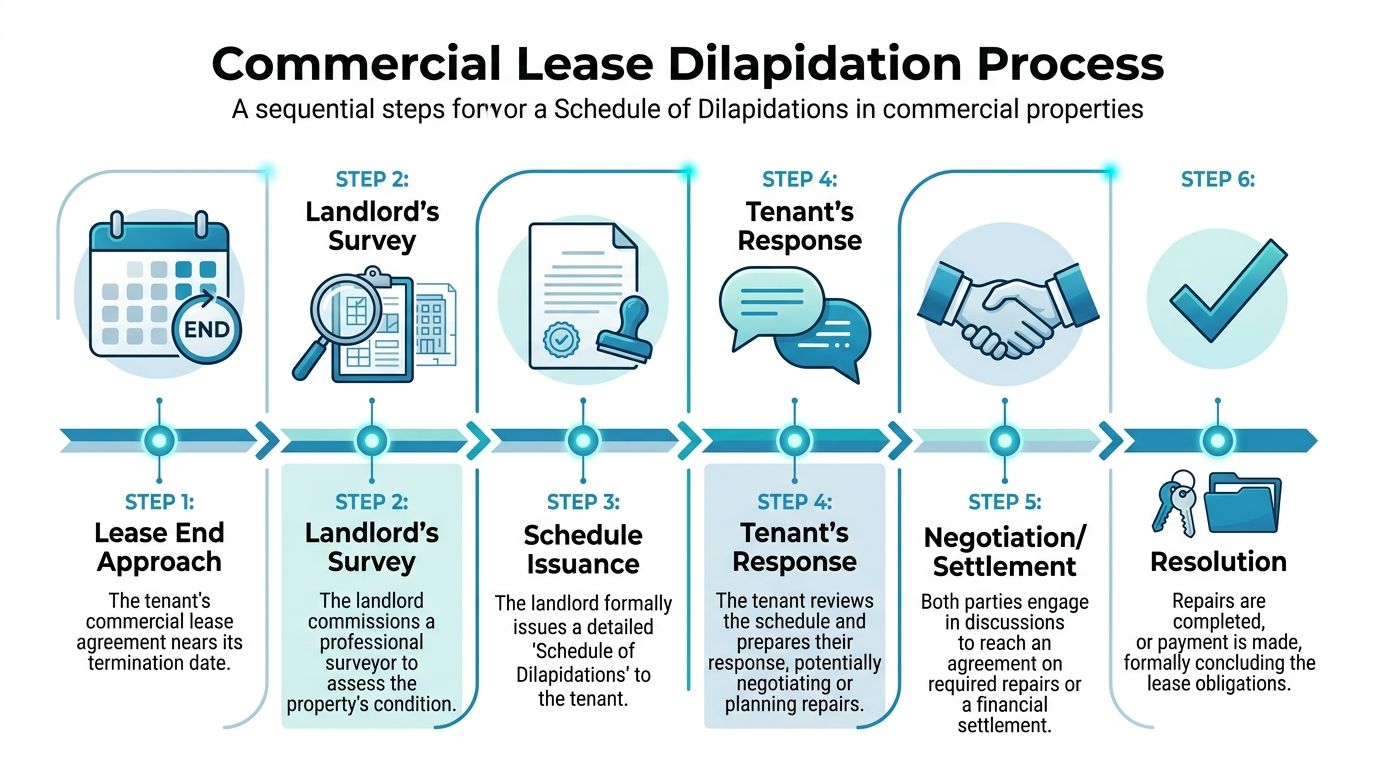
The sequence is often predictable.
The lease end approaches or has just occurred
The landlord reviews the lease, licences for alterations, rent review documents, and any side agreements. Those papers often decide whether an item belongs in the claim.
The property is inspected
The surveyor walks the premises carefully, usually room by room and element by element, taking notes and photographs.
The Schedule of Dilapidations is served
This is the formal statement of alleged breaches. Timing and wording both matter.
The tenant checks the claim against the lease and the facts
A tenant's surveyor will ask practical questions. Is this item actual disrepair, or just age? Was the alteration permitted to remain? Is the landlord claiming for work they would replace anyway?
The parties negotiate
Some items fall away quickly. Others turn on fine points in the lease, the building's condition at the start of the term, or the landlord's actual loss.
The matter ends by works, payment, or legal action
Many claims settle through discussion between surveyors. Some proceed with solicitor input where the wording or value is disputed.
Landlords usually see the schedule as a tool to protect value, lettability, and the standard of the asset they are getting back.
Tenants see it as a claim that must be proved item by item.
Both views are reasonable. A schedule works a bit like an itemised repair bill after you return a hired machine. The owner is entitled to recover losses that flow from the contract. They are not entitled to treat the process as an upgrade programme at the tenant's expense.
That is why lease wording, evidence, and timing matter so much. A cracked basin may be recoverable. A full washroom refurbishment may not be, unless the lease and the landlord's loss justify it.
Three issues cause confusion again and again.
First, wear and tear is not automatically a defence. Some leases require the tenant to keep premises in repair, which can mean putting something into repair, not just maintaining it in the condition it reached naturally.
Second, alterations are a separate trap. A tenant may have had consent to install partitioning, racking, air conditioning, or specialist fit-out, but the licence may still require removal at lease end. If your premises include storage systems, a current PSL racking safety inspection can also help clarify condition and responsibility for warehouse installations before handover discussions escalate.
Third, cost is not the whole story. In many cases, the core argument is about the landlord's actual loss, not the contractor's estimate in isolation.
A schedule should read like a reasoned claim under a lease, not a shopping list of every defect someone can spot on site.
If you are reviewing a claim from the occupier's side, this UK tenant's dilapidations guide gives a useful tenant-focused explanation of the common points to check before responding.
The second use of the term has nothing to do with lease end claims. It belongs to the world of development, excavation, demolition, utilities, and neighbour protection.
Here, a dilapidation report is better understood as a condition report. It records the exact state of neighbouring property before works begin, so everyone has a reliable point of comparison later.

The contrast is straightforward.
| Point of comparison | Lease-end schedule | Construction condition report |
|---|---|---|
| Trigger | Commercial tenancy nearing or reaching expiry | Nearby works with potential to affect adjoining property |
| Main purpose | Assess breaches of lease covenants | Create a baseline record before works |
| Main parties | Landlord and tenant | Homeowner, developer, contractor, sometimes council |
| Focus | Contractual compliance | Evidence and risk management |
Inspect My Home explains that a construction-focused dilapidation report documents neighbouring properties before work begins, is often mandated by councils for Development Approval, uses a risk-based audit, and is typically delivered within 24 to 48 hours to promote transparency and protect parties from false claims, as described in their article on what is a dilapidation report and what's included.
The inspector usually records both internal and external condition. That includes cracking, finishes, doors and windows, paving, fences, driveways, roofs, retaining features, and nearby external elements that could be affected by movement or vibration.
The principle is simple. If an issue appears after the works start, everyone can go back to the record and ask, “Was it there already?”
That same logic turns up in other safety and compliance inspections. In warehouses, for example, structured condition recording helps separate pre-existing defects from damage caused during operations. If your property forms part of an industrial or logistics site, a specialist check such as a PSL racking safety inspection shows the same practical mindset. Record the condition clearly, then manage risk before it becomes a dispute.
If nearby works concern you, the worst time to start gathering evidence is after cracking appears.
A good dilapidation report should let a third party understand the property without ever visiting it. That is the test.
For a lease-end schedule, that means clear evidence of each alleged breach, where it is, and why it matters under the lease. For a pre-construction condition report, it means a reliable before-work record that can be checked later if someone alleges new damage. Same label, different job. If you blur those two uses together, the report quickly becomes less useful.
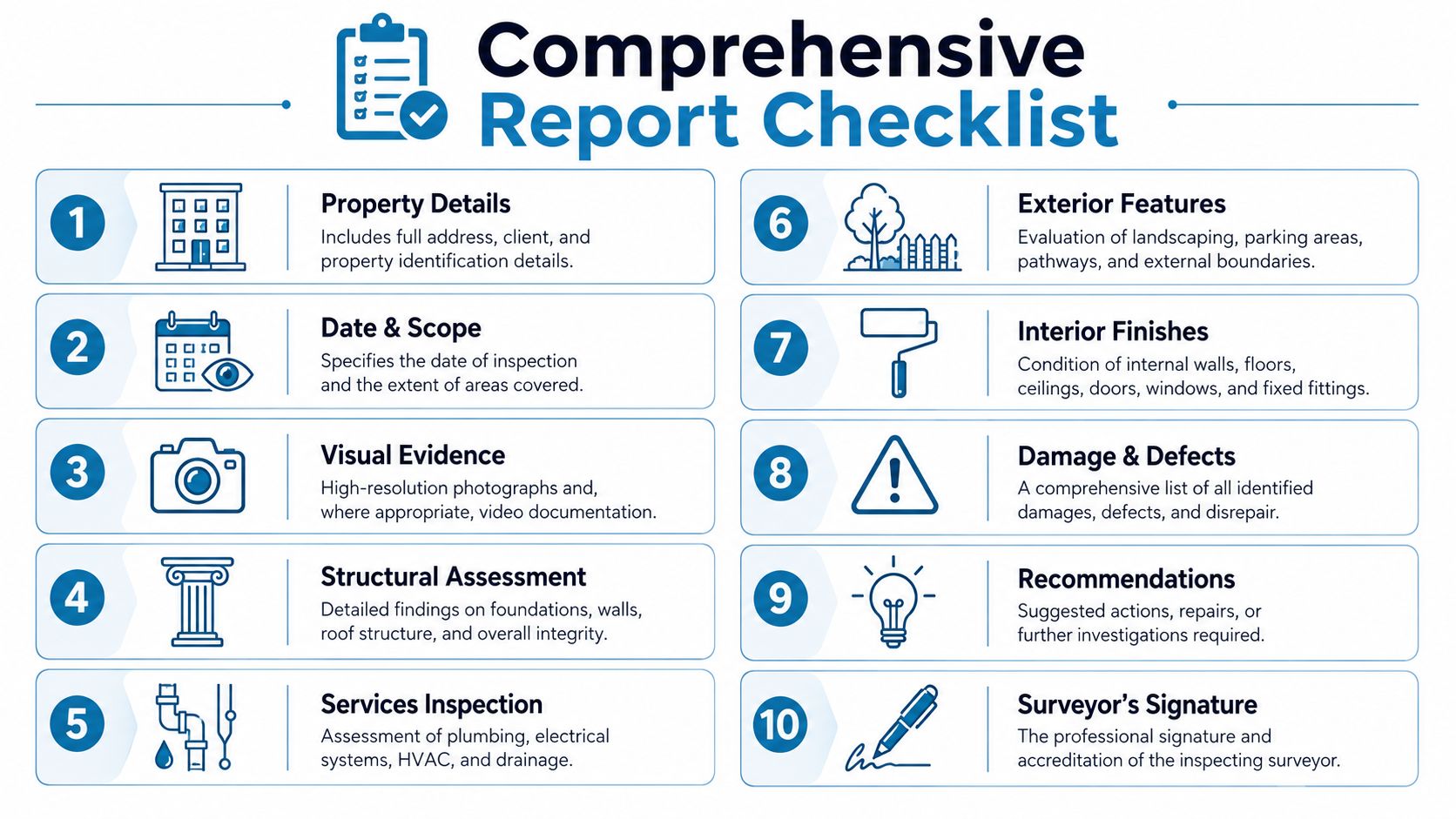
A well-prepared report usually includes:
Property identification
The full address, the client name, and a clear description of exactly which premises, units, floors, or neighbouring areas were inspected.
Inspection date and scope
The report should record when the inspection took place and what was included or excluded. That sounds basic, but scope is often where arguments start.
Photographic record
Photos should be sharp, dated if possible, and easy to match to the written notes. A useful image shows both the defect and its location, rather than a close-up that could be anywhere.
Precise defect descriptions
“Crack to plaster, approximately 2mm wide, above rear bedroom window” is useful. “Wall damaged” is not. The wording should help a landlord, tenant, contractor, insurer, or court follow the point without guesswork.
Condition of building elements
Walls, ceilings, floors, roofs, windows, doors, joinery, finishes, and any visible structural features should be recorded if they fall within the instruction.
Services, where relevant
Heating, lighting, plumbing, ventilation, electrical items, or other installations may be noted, but only within the surveyor's remit. A dilapidation report is not automatically a full services test.
External areas
Paving, fences, yards, parking areas, retaining walls, gates, gardens, and boundaries should appear where they form part of the property or the potential area of impact.
Detail matters, but structure matters just as much. A useful report reads like a map. You can move room by room, elevation by elevation, and understand what was seen, where it was seen, and what significance it may have.
The best reports also separate fact from opinion. The fact might be a stained ceiling with peeling paint. The opinion, if the surveyor is qualified to offer it, might be that the pattern is consistent with moisture ingress. Keeping those two apart makes the document far more persuasive.
For lease matters, it also helps if the observations tie back to the repairing obligations in the lease. For construction matters, the report should focus on condition evidence rather than lease liability. If you want more lease-specific context, this guidance for UK landlords and tenants explains how those obligations are usually argued in practice.
Question to ask before instructing a surveyor: “Will the report identify each issue by exact location, include clear photos, and explain the purpose of the record, whether that is lease liability or pre-works condition evidence?”
Be cautious if you see any of the following:
Photos with no context
If no one can tell which room or elevation the image relates to, the photo has limited value.
Vague descriptions
Phrases such as “general wear” or “minor damage throughout” do not help anyone assess responsibility or cost.
Unclear inspection boundaries
If the report does not say what was inspected, it also fails to say what was missed.
Missing author details
The surveyor's name, firm, and credentials should be clear.
Conclusions with no reasoning
A report should show how the surveyor got to the point, not just announce it.
This checklist is often what people are really asking for when they ask, “What is a dilapidation report?” They usually want to know whether the document in front of them will stand up in a negotiation, support a claim, or protect them from one.
A dilapidation report only becomes expensive when someone tries to turn defects into a payment claim. That is the point where many readers get tripped up, because the phrase "dilapidation report" is used for two different jobs.
For a commercial lease, the legal question is who is responsible, what the lease requires, and what loss can be recovered. For a pre-construction condition report, the legal question is different. It is mainly about evidence. If cracking or movement is alleged later, the report helps show what was already there before work started. Same label. Different legal purpose.
For lease-end claims, one of the main controls is Section 18 of the Landlord and Tenant Act 1927. A simple way to read it is this. A schedule of dilapidations is not an open chequebook. The landlord's claim can be capped by the actual reduction in the property's value caused by the breaches. So if a schedule prices works at one figure, but the landlord's real loss is lower, the lower figure may be the one that matters.
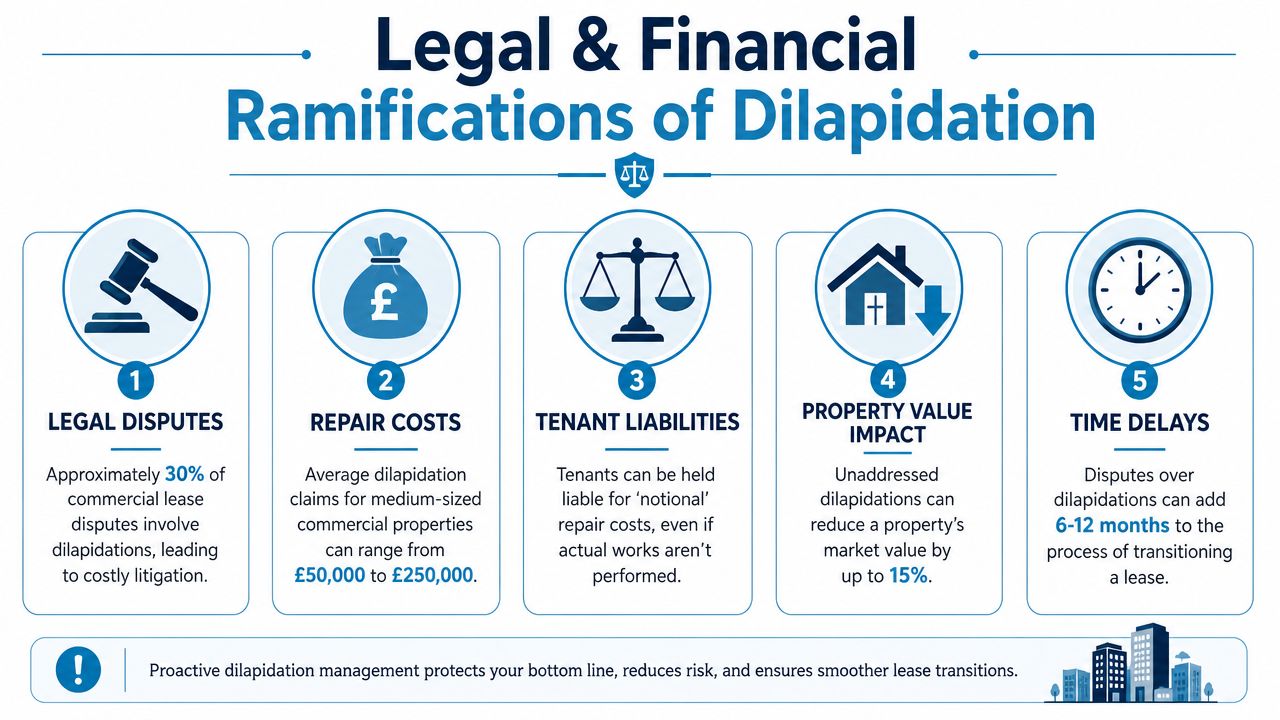
That point changes how both sides should behave. A landlord needs more than a list of defects. They may also need evidence of loss. A tenant should not assume every item in a schedule is automatically payable.
Three legal and money issues often affect the outcome:
A schedule is the opening position, not the final bill
Surveyors often prepare a schedule by reference to disrepair and lease obligations. Settlement can still move significantly once valuation, supersession, and lease wording are examined.
VAT on settlements needs to be handled correctly
The tax treatment of dilapidations payments changed in recent years, so the parties should check current accounting treatment before agreeing figures or drafting settlement terms.
Time limits still apply
Dilapidations claims cannot sit on a shelf indefinitely. Delay can weaken a party's position and, in some cases, prevent recovery altogether.
The practical lesson is simple. Lease dilapidations are part building survey, part contract interpretation, and part valuation exercise. It works like a three-legged stool. If one leg is missing, the claim becomes unstable.
The stakes are different for homeowners and neighbours dealing with pre-works condition reports. There, the report is less about claiming for lease breaches and more about preventing a later argument from turning into a blame game. If a basement excavation starts next door and hairline cracks later appear in an adjoining wall, a well-prepared condition report can show whether those cracks are new, worse, or unchanged. That can save a great deal of time, expert cost, and friction.
For a visual explanation of how practitioners discuss these issues, this short video is useful:
A common mistake is to treat every dilapidation report as if it serves the same decision. It does not. If you are a tenant, the question is often, "What am I liable for under the lease, and what is this claim worth?" If you are a landlord, it is, "What can I prove, and what loss have I really suffered?" If you are a homeowner near building works, it is, "Do I have a reliable before picture if a dispute starts later?"
If you want a fuller lease-side explanation from both perspectives, this guidance for UK landlords and tenants is a useful companion read.
The report records the condition. Liability depends on the lease, the law, the evidence, and the loss that can actually be shown.
The first practical question is usually cost. The second is timing.
For smaller to medium commercial properties under 5,000 sq ft, Ashall Surveyors states that the average cost of a dilapidation survey ranges from £500 to £1,500 plus VAT. For larger properties over 25,000 sq ft, the typical range is £3,000 to £10,000+, according to their guidance on understanding dilapidation survey pricing and process. Those figures are useful for budgeting, but the fee still depends on size, complexity, service installations, and the amount of lease analysis needed.
When commissioning a report, ask direct questions:
What exactly is the instruction?
Lease-end schedule, tenant response, or pre-construction condition report.
Who will inspect the property?
You want a qualified, insured professional with relevant experience in this type of work.
What documents do they need?
For lease matters, that usually includes the lease, licences for alterations, and any repair history.
What will the report include?
Ask about scope, photographs, turnaround, and whether costings are included.
If you want a route to finding an appropriate surveyor for this type of instruction, dilapidations services by Survey Merchant sets out the sort of work involved and the type of professional match clients usually need.
For lease-end matters, don't wait until the keys are almost back in the landlord's hands. Early review gives both sides options.
For construction condition reports, the instruction needs to happen before works begin. After that, the value of the evidence drops because you no longer have a clean baseline.
Sometimes yes, sometimes no. It depends on the lease, timing, and whether the landlord agrees. If you're a tenant, don't assume you can carry out late works unilaterally and wipe out the claim. The lease wording and the landlord's position matter.
Most disputes don't need a trial, but they do need evidence. Each side's surveyor usually narrows the issues first. If agreement still isn't reached, solicitors may become more directly involved.
Potentially, but redevelopment can affect the measure of loss. If the landlord wouldn't have carried out certain repairs because the building was going to be stripped out or demolished, that can become highly relevant to valuation and recoverable damages.
No. A building survey is broader and usually used for purchase, ownership, or defect diagnosis. A dilapidation report is tied to a specific legal or evidential purpose, either lease obligations or pre-construction condition recording.
Yes. Buyers often focus on price and location, then discover too late that lease repair obligations or neighbouring development risk need closer review. If you're considering the wider investment picture, these UK property acquisition strategies can help you think more commercially about risk before you commit.
Ask what event has triggered the issue. If it's lease expiry, you're probably dealing with a Schedule of Dilapidations. If it's construction nearby, you're probably dealing with a condition report.
If you need help finding the right surveyor for a lease-end dilapidations matter or a condition-related instruction, Survey Merchant connects clients with qualified surveying professionals across the UK based on the job type, property, and location.
Survey Merchant provides vetted RICS surveyors across 100+ UK locations at fixed fees:
→ Level 2 Home Survey (HomeBuyer Report)
→ Level 3 Building Survey (full structural survey)
→ RICS Red Book property valuations
→ Party wall surveyors — notices, awards & schedules of condition
→ Expert witness surveyors — CPR Part 35 reports for property disputes