Building Surveying
Jul 16, 2026
What Is BIM in Construction? UK Guide
What is BIM in construction? Our UK guide explains Building Information Modelling, ISO 19650, and how surveyors create models for project success.

You're probably here because someone has mentioned BIM on a project and it's sounded both important and slightly vague.
Perhaps you're planning a refurbishment, extension, fit-out, or estate upgrade. The architect says a BIM model would help. The contractor asks for existing building information. Then somebody else says the old drawings can't be trusted. That's the point where many clients realise they aren't really asking about software. They're asking how to avoid expensive surprises once work starts.
A common example is simple enough. A team arrives on site and discovers that the ceiling void doesn't contain what the drawings suggested. Pipework sits lower than expected, steel crosses the route for ductwork, and suddenly a straightforward installation becomes a redesign exercise. Time is lost, decisions are rushed, and costs start moving in the wrong direction. BIM grew because the industry wanted a better way to test, coordinate, and understand a building before those problems reached site.
Construction used to rely heavily on separate drawing packs, separate disciplines, and separate assumptions. That worked up to a point, but it also left plenty of room for mismatch. One consultant drew structure, another drew services, and the contractor often discovered the awkward bits only when materials and labour were already committed.
That's why BIM matters. It changes the job from “draw it and hope it fits” to “test it digitally before it reaches site”. Instead of treating design information as a pile of disconnected sheets, BIM treats the project as a shared digital rehearsal of the building.
A client doesn't need to become a software specialist to understand the value in that. The practical idea is familiar. You'd rather spot a problem on screen than after steel is erected, ceilings are closed, or tenants are due back in.
Practical rule: BIM is less about drawing a building beautifully and more about checking whether the information is reliable enough to build, price, sequence, and manage it properly.
In plain terms, what is BIM in construction? It's a way of creating and managing building information so the people designing, measuring, building, and operating an asset work from coordinated digital data rather than fragmented documents.
For new-build work, that often starts with design teams creating a model from scratch. For refurbishment, retrofit, and existing buildings, the first challenge is different. You need to know what is there. That's where surveyors become central, because a digital model is only useful if it reflects physical reality.
Many people hear “BIM” and think “3D model”. That's understandable, but it's incomplete. A 3D shape on its own can look impressive and still tell you very little about what the thing is, what it's made from, when it's installed, or how it should be maintained.
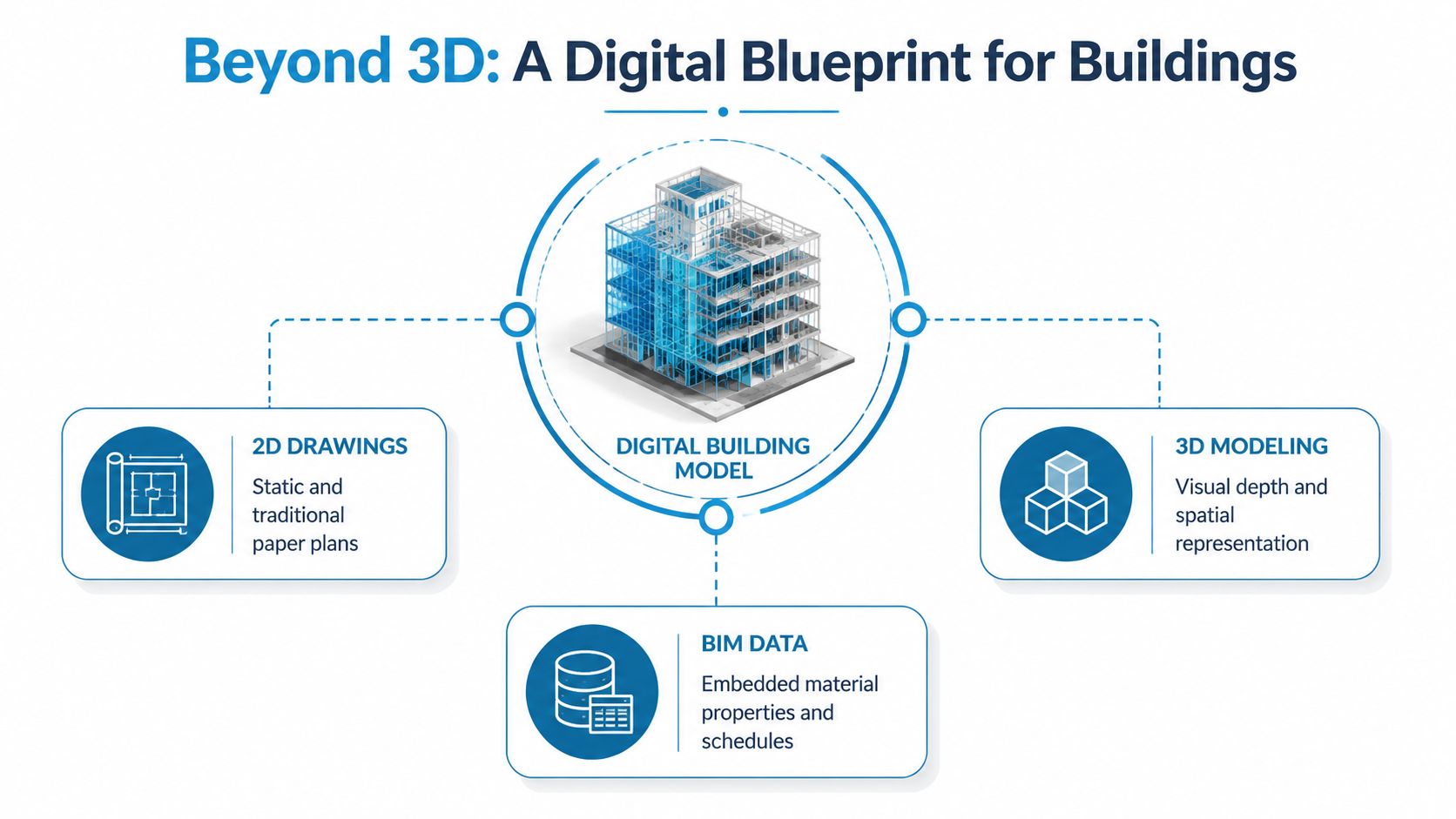
The easiest analogy is this. Traditional drawings are like a paper road atlas. You can see routes and boundaries, but the information is static. A BIM model is closer to a digital map with layers of usable information attached to it.
That difference matters because construction decisions depend on more than geometry. According to the FHWA explanation of BIM as a shared electronic dataset, the BIM approach coordinates geometry, spatial relationships, material quantities, and schedules so teams can plan, design, build, and maintain assets using shared information. In that approach, a wall, beam, or MEP element is not just a shape. It can also contain specification, cost, and maintenance attributes.
So if you click on a door in a true BIM model, you're not just looking at a rectangle in a wall. You may be looking at fire performance, size, type, manufacturer intent, and related information that other team members can also use. That's why the “I” in BIM matters so much more than most first-time clients expect.
A useful way to think about BIM is to separate form from meaning.
| Element in model | What you can see | What the data may tell you |
|---|---|---|
| Wall | Position, height, thickness | Material, finish, specification |
| Beam | Size and location | Structural type, coordination reference |
| MEP component | Route in ceiling or riser | Maintenance and procurement information |
| Room or space | Boundaries and area | Use, schedule link, asset information |
That's why professionals often say BIM is a process as much as a model. The model is the container. The true value sits in how teams create, check, update, and share the information inside it.
A visually polished model can still be poor BIM if the information is incomplete, inconsistent, or unreliable.
For clients, that distinction is important. If you're commissioning work on an office fit-out, school refurbishment, housing block retrofit, or commercial redevelopment, you don't just want a digital object. You want dependable information that supports decisions. That's what turns a 3D representation into a working construction tool.
The benefits of BIM become clearer when you link them to ordinary project headaches. Delays usually come from uncertainty, clashes, poor sequencing, or missing information. BIM addresses those problems directly when the model is properly built and properly coordinated.
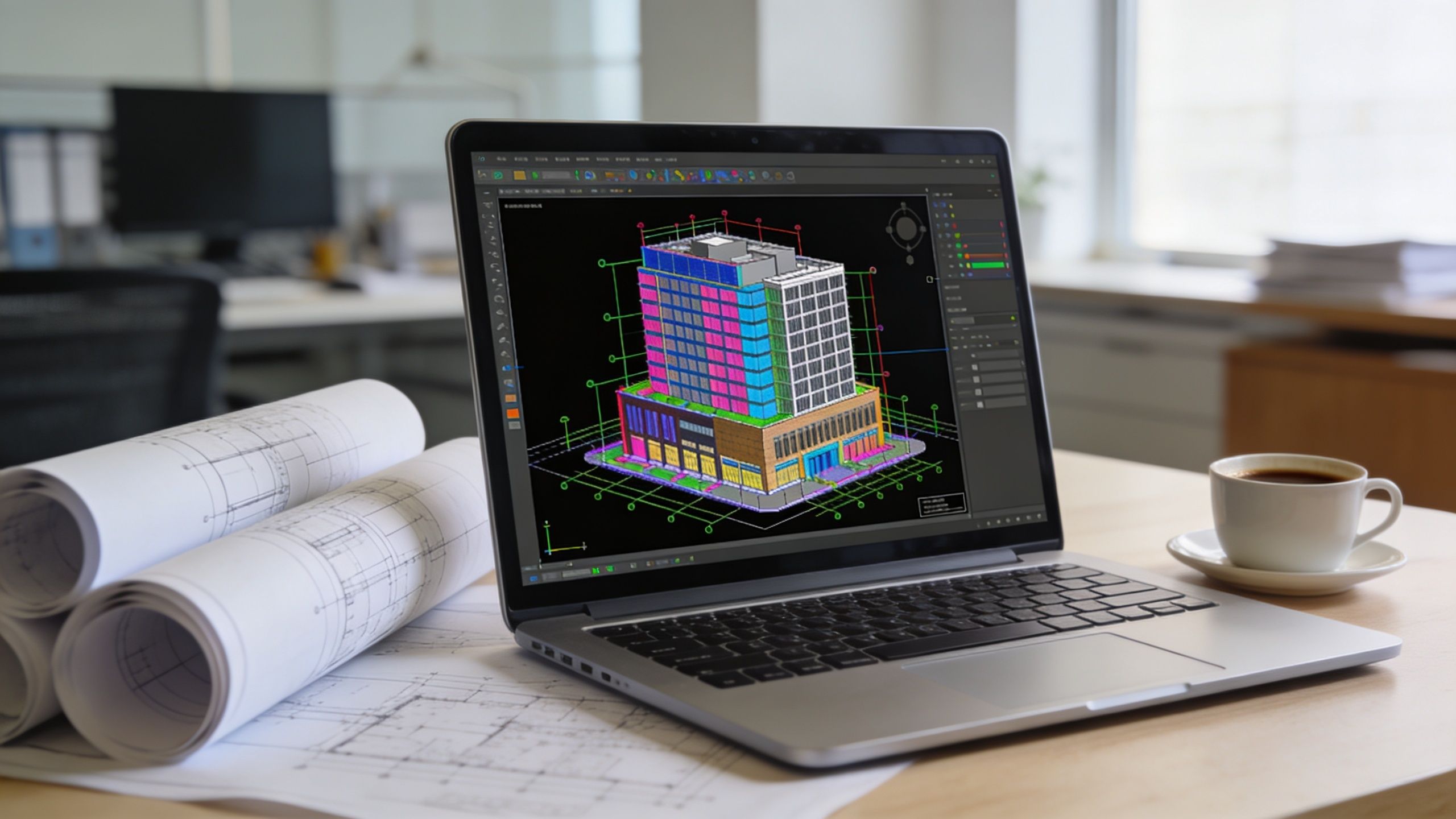
One of the strongest practical uses is clash detection. BIM software can check whether building systems physically interfere with one another before installation begins. That matters most in congested areas such as plantrooms, corridors, risers, and ceiling voids, where several trades are competing for the same space.
The Procore overview of BIM in construction notes that automated clash detection helps identify design conflicts before they become costly on-site delays. The same source says BIM-based take-offs can be up to 35x faster than manual methods when the model is sufficiently data-rich and accurate.
That speed isn't just a nice-to-have. It can improve procurement planning, support earlier cost checks, and reduce the amount of repetitive manual measuring that often introduces error.
BIM also helps teams understand sequence, not just shape. When time is linked to the model, project teams can test installation order, logistics, access constraints, and staging. On tight urban sites, that can be the difference between a workable programme and daily disruption.
A few common gains look like this:
For property owners already using digital capture methods, BIM often complements other data-led surveying tools. For example, aerial capture can support wider site understanding in some circumstances, as explained in this guide to drone survey benefits for UK property owners.
The catch is simple. None of these benefits appear by magic. If the input information is poor, the model can become a tidy-looking container for bad assumptions.
In the UK, BIM didn't grow only because software improved. It became mainstream because public policy and industry standards pushed the market toward a more disciplined way of handling project information.
The major milestone was the government's BIM Level 2 mandate, which took effect in April 2016 for centrally procured public projects, as summarised in PlanRadar's account of BIM adoption. That mattered because it moved BIM from a specialist digital approach to a normal expectation in parts of the market. Coordinated 3D models and standardised data exchange stopped being optional extras on those public-sector workflows.
The same source also reflects how widely BIM has spread in industry reporting, noting 70% of architects, 67% of engineers and 74% of contractors in the USA were using BIM in a 2023 survey, while UK and European contractor reporting places the UK among the stronger adopters in Europe.
For clients, the important point isn't the jargon of “Level 2”. It's what the mandate changed in practice. It made teams think more carefully about who creates information, how it is shared, and what standard it must meet.
Without standards, BIM can become a digital free-for-all. One team names files one way, another team uses different classifications, and no one is certain which version of the model should be trusted. Standards exist to prevent that.
In UK practice, that structured approach now sits closely alongside ISO 19650, which governs how information is managed across the life of a built asset. Clients don't need to memorise the clauses. They do need to appreciate the principle: a good BIM project isn't just well modelled, it's well managed.
If everyone is using different assumptions about naming, ownership, and responsibility, a model won't solve confusion. It will simply package confusion more neatly.
That's also why people asking “is BIM mandatory?” often get muddled answers. For some public-sector work, BIM requirements are formal. For many smaller private jobs, the issue is less about obligation and more about whether the process is proportionate and useful.
This is the part many BIM explainers gloss over. A model for an existing building doesn't start with software. It starts with evidence.
If you're refurbishing an occupied office, converting an older building, or planning retrofit works, the design team needs a trustworthy record of the property as it stands today. Old PDF drawings may help, but they often don't reflect later alterations, uneven construction, hidden structure, or service diversions. That gap between paperwork and reality is where surveyors earn their keep.
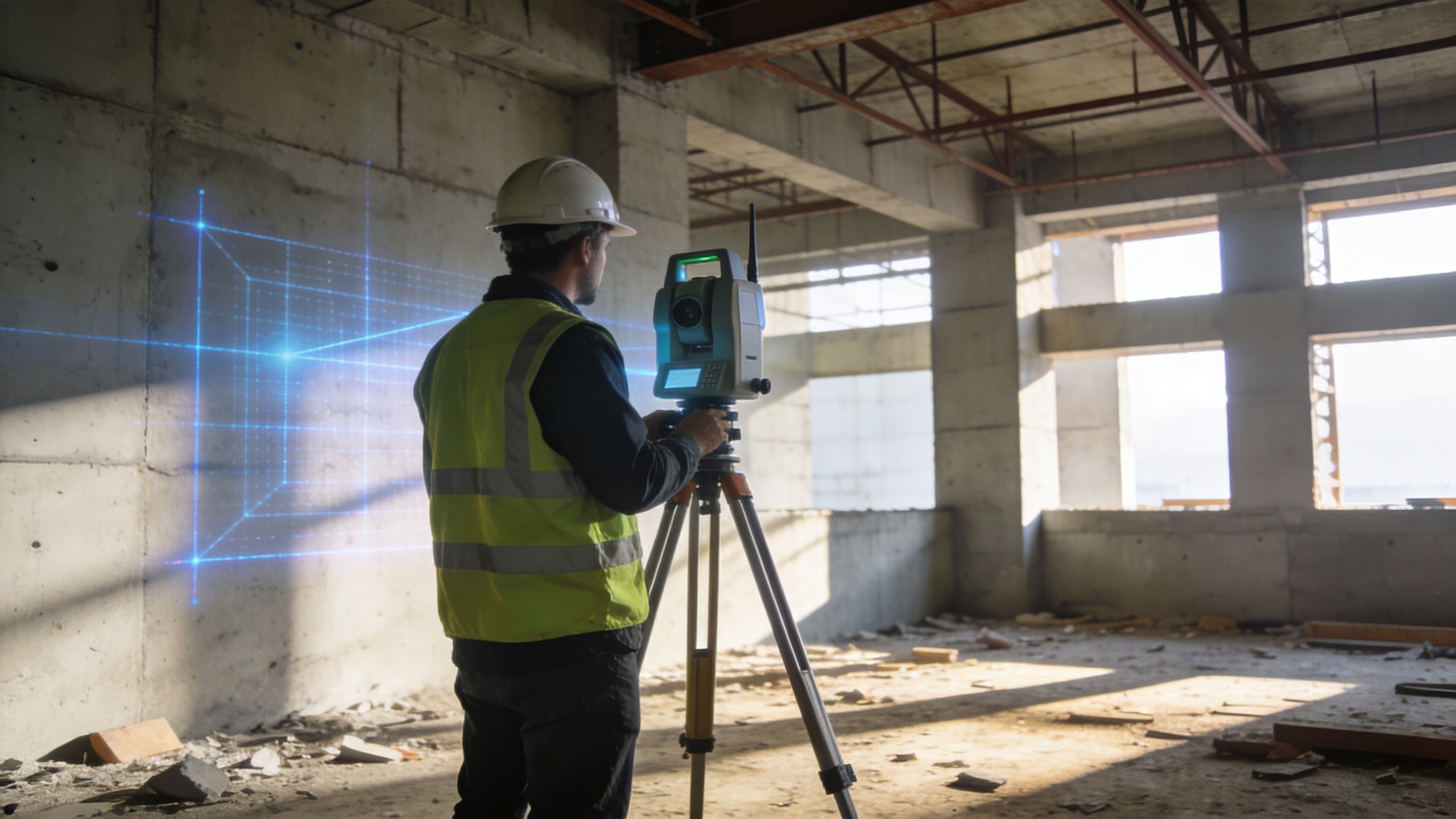
A common workflow is often called Scan-to-BIM. In simple terms, a surveyor captures the building accurately first, then modellers use that measured information to create the digital model.
The usual stages are:
Site capture
Surveyors attend site with the right equipment for the job. That may include laser scanning and other measured survey methods to record geometry, levels, and spatial relationships.
Point cloud creation
The scan data forms a dense digital record of the building. People often call this a point cloud. Think of it as a highly detailed spatial reference, not yet a finished BIM model.
Interpretation and modelling
Specialists trace and model walls, floors, columns, beams, ceilings, openings, and sometimes MEP elements from that survey data in software such as Revit.
Checking and issue resolution
The model is reviewed against the survey evidence so obvious errors, omissions, or assumptions can be flagged.
Delivery against brief
The client receives outputs suited to the project. That might mean floor plans, sections, reflected ceiling plans, or an as-built model at an agreed level of detail.
If you're unfamiliar with measured capture, this guide on what a measured building survey includes is a useful companion.
The University of the Built Environment discussion of BIM and model reliability highlights a problem that clients often miss. A BIM model for existing buildings can be undermined if the underlying as-built data is inaccurate. That's why professional measured surveys matter, particularly in retrofit and asset management, and why standards such as ISO 19650 matter when responsibility for model content is being assigned.
This is especially important in older buildings. Walls aren't always straight. Floors may deflect. Plant may have been replaced without updated records. Tenants may have made undocumented changes. A neat digital model can hide all of that if nobody asks where the source data came from.
A BIM model should be treated like any other professional deliverable. Ask what it is based on, what has been measured, what has been assumed, and what has been left out.
For a surveyor, the role is not merely technical. It is evidential. Surveyors bring the physical building into the digital process with enough rigour that architects, engineers, and contractors can make decisions with confidence.
Clients often think the first question is, “Do I need BIM?” Usually it isn't. The better question is, “What decisions do I need the information to support?”
If the project is a large commercial refurbishment with complex structure and services, BIM may be a practical investment. If it's a modest domestic extension, the modelling and coordination effort may be disproportionate. The FARO article on BIM and its impact on construction makes that point clearly. On smaller private jobs, the cost of model authoring and coordination may not be justified, even though the benefits on larger and more complex projects are easier to see.
A client brief for BIM-related survey work should cover purpose before format.
Ask yourself:
That leads naturally to two important briefing concepts.
One is level of detail. In everyday terms, this means how much geometry and information the model must contain to be useful. A client doesn't need to pay for construction-grade detail if the immediate need is only broad layout planning.
The other is the Employer's Information Requirements, often shortened to EIR. Think of it as the written brief for information. It tells the team what data the client needs, in what format, and for what purpose.
A short checklist can prevent a lot of confusion later.
| Question | Why it matters |
|---|---|
| What is the model for? | Prevents paying for data you won't use |
| What areas will be surveyed? | Stops assumptions about excluded spaces |
| What level of detail is needed? | Aligns cost with actual purpose |
| Is survey data or old drawing data being used? | Shows how much confidence you can place in the model |
| Who is responsible for model accuracy? | Clarifies risk and avoids blurred accountability |
For clients seeking the right surveyor input at project stage, broader advice on RICS construction surveyor services and land surveying support can help frame the conversation.
The strongest appointments are usually the simplest. State the building, the purpose, the outputs you need, and the level of reliance you expect others to place on the result.
Clients often struggle less with the idea of BIM than with the procurement of the right survey input. They know they need accurate existing information, but they aren't always sure whether they need a measured survey, laser scanning, topographical work, or an as-built model.
That is where a platform model can help. Survey Merchant connects clients with a nationwide panel of qualified surveyors and can match an instruction to the type of expertise required, whether the job involves measured building data, existing-condition capture, or wider construction surveying support.
The practical value is straightforward:
If you remember one thing from this article, make it this: what is BIM in construction is not just a question about software. It's a question about trusted information.
A model can only help if it starts from sound measurement, sensible assumptions, and clear responsibility for what is included. That is especially true for existing buildings, where the biggest project risks often come from hidden conditions and outdated records rather than dramatic design ideas.
Good BIM begins with good evidence. For many projects, the surveyor provides that starting point.
If you need reliable building data before design or refurbishment work begins, Survey Merchant can help you find a qualified surveyor for measured surveys, existing building capture, and BIM-related project requirements across the UK.
Survey Merchant provides vetted RICS surveyors across 100+ UK locations at fixed fees:
→ Level 2 Home Survey (HomeBuyer Report)
→ Level 3 Building Survey (full structural survey)
→ RICS Red Book property valuations
→ Party wall surveyors — notices, awards & schedules of condition
→ Expert witness surveyors — CPR Part 35 reports for property disputes