Building Surveying
Aug 2, 2026
How to prepare for a building survey: essential steps
Learn how to prepare for building survey to ensure you get an accurate property condition report. Protect your investment today!

Imagine exchanging contracts on your new home, only to discover weeks later that the roof needs replacing at a cost of £15,000 or that there is active subsidence the seller never disclosed. This is not a hypothetical horror story; it happens to buyers across the UK every year, and the common thread is almost always the same: inadequate preparation before a building survey. A well-prepared survey gives you the clearest possible picture of a property’s condition, arming you with the evidence to negotiate, walk away, or plan confidently. This guide walks you through every step, from understanding what a survey actually covers to acting on the results.
| Point | Details |
|---|---|
| Utilities must work | Ensure water, heating, and electricity are operational and safe before your surveyor arrives. |
| Survey vs valuation | Do not mistake a mortgage valuation for a full condition survey, as only a survey reveals critical risks and repairs. |
| Choose the right level | Pick a Level 3 survey for older or unusual properties and Level 2 for standard, well-kept homes. |
| Review urgent issues | Ask your surveyor to highlight the most urgent faults and follow up with repairs or further investigations. |
| Preparation affects outcomes | Proper property preparation reduces surprises and speeds up the sales process. |
A building survey is a detailed, professional inspection of a property’s condition carried out by a qualified surveyor, typically one registered with the Royal Institution of Chartered Surveyors (RICS). It examines everything from the structural frame, roof, walls, and foundations through to internal fixtures, drainage, damp, and insulation. The surveyor then produces a written report grading defects by condition and risk, giving you a factual basis for your purchasing decision.
Many buyers confuse this with a mortgage valuation. A mortgage valuation is carried out for the lender, not for you, and its sole purpose is to confirm the property is worth the loan amount. It does not assess condition in any meaningful depth. As correctly noted, a common misconception is treating a mortgage valuation as equivalent to a survey; buyers should rely on the commissioned survey for condition evidence and risk assessment. Relying on your lender’s valuation to assess structural integrity is like asking a used car dealer whether the engine is sound.
| Feature | Building survey | Mortgage valuation |
|---|---|---|
| Commissioned by | You, the buyer | Your mortgage lender |
| Purpose | Assess property condition | Confirm loan security |
| Depth of inspection | Full structural and defect review | Brief visual check |
| Useful for negotiation | Yes | No |
| Covers defects and risks | Yes | Rarely |
Here is what a thorough building survey will typically assess:
Understanding these building survey levels explained before you commission one will help you avoid costly mismatches between the survey type and the property’s complexity.
“The survey report is not just a list of problems. It is a risk-graded document designed to help you make an informed decision about one of the most significant financial commitments of your life.”
Before booking, review the questions to ask your surveyor to ensure you understand what you are commissioning and what you will receive. Many buyers skip this step and later feel confused by their report’s findings.
Once you understand the survey scope, preparation becomes straightforward. Good preparation is not about making a property look pristine; it is about removing every barrier that might prevent the surveyor from doing their job thoroughly. Any area the surveyor cannot access will appear in the report as “not inspected,” which creates ambiguity that can actually complicate your transaction more than a known defect would.

You should also consider how the buyer checklist before making an offer aligns with your survey preparation, since many of the pre-offer checks directly complement what surveyors will inspect on the day.
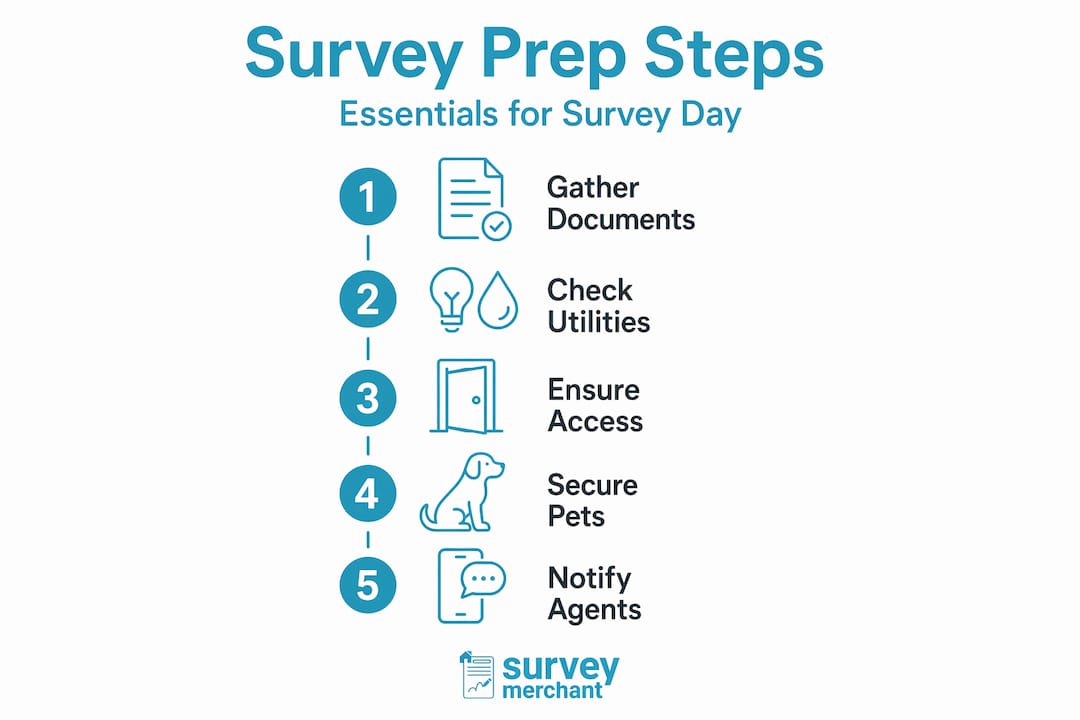
Follow these steps to prepare effectively:
The importance of this preparation is well-established. Utilities and access must be available and safe on survey day, including water, heating, and electricity, and any minor safety or access issues should be addressed well in advance.
| Preparation task | Why it matters | When to complete |
|---|---|---|
| Utilities live and accessible | Allows full mechanical and services inspection | At least 24 hours before |
| Keys and access codes provided | Prevents locked rooms being skipped | Morning of survey |
| Loft and cellar cleared | Enables roof structure and drainage inspection | Day before |
| Furniture moved from walls | Allows damp meter readings and crack assessment | Day before |
| Alarm system disabled | Prevents inspection being cut short | Day of survey |
Pro Tip: Ask your estate agent to do a walk-through the evening before the survey to check that all internal doors open freely, all storage areas are accessible, and the boiler has been on that morning. This single step eliminates the most common cause of “not inspected” notations in survey reports.
For detailed checklists tailored to specific circumstances, see the full guide on preparing your home for survey and, if you are buying in the capital, a dedicated resource on London property survey preparation covers regional nuances including period conversions and basement flats.
Understanding the full survey workflow step-by-step will also help you anticipate timing, manage estate agents, and know exactly when to expect your report.
Choosing the wrong survey level is one of the costliest mistakes a buyer can make. A Level 2 survey (sometimes called a HomeBuyer Report) provides a structured assessment with condition ratings and is suitable for most conventional, well-maintained properties built after around 1900. A Level 3 survey (the full Building Survey) is a more exhaustive inspection that includes a detailed description of construction, materials, and defects, with specific advice on repairs.
| Survey type | Best suited for | Depth of inspection | Typical cost range |
|---|---|---|---|
| Level 2 (HomeBuyer Report) | Conventional homes, post-1900, good condition | Standard condition rating | £400 to £900 |
| Level 3 (Building Survey) | Older, altered, large, or unusual properties | Full structural and material analysis | £600 to £1,500+ |
The decision is not merely about age. Non-standard features such as older construction, significant alterations, complex layouts, or planned major works are all indicators that a Level 3 survey is more appropriate than Level 2. Buying a 1930s semi with a single-storey rear extension, a converted loft, and plans for a kitchen renovation? That property has three separate risk factors that a Level 2 report may simply not explore in sufficient depth.
Consider commissioning a Level 3 survey if any of these apply:
Pro Tip: If you are unsure which level to commission, describe the property to the surveyor before booking. A reputable RICS surveyor will tell you honestly which level is appropriate for the specific property and will not simply upsell you to a more expensive option.
For a thorough breakdown of the decision-making process, the guide on choosing Level 2 or Level 3 survey covers this in detail, and the full Level 2 vs 3 comparison provides a side-by-side review of everything included. If you are leaning towards a full Building Survey, the article on what a Level 3 survey covers explains exactly what the surveyor will inspect and document.
Your survey report has arrived. It may run to 50 pages or more for a Level 3, and the volume of information can feel overwhelming at first. The key is to work methodically through the condition ratings rather than scanning for problems.
RICS-aligned reports typically use a traffic light system. Condition Rating 1 (green) indicates no repair is needed. Condition Rating 2 (amber) means defects that need attention but are not urgent. Condition Rating 3 (red) indicates serious defects requiring prompt action or further investigation. Risk ratings follow a similar structure, helping you distinguish between cosmetic issues and structural concerns.
| Condition rating | Meaning | Recommended action |
|---|---|---|
| Rating 1 (green) | No significant defects | Monitor during ownership |
| Rating 2 (amber) | Defects need attention | Budget for repair, not urgent |
| Rating 3 (red) | Serious defect or risk | Seek specialist report or negotiate |
Follow these steps once you receive your report:
Asking the right questions after receiving your report is critical. You should clarify the top urgent issues with your surveyor, particularly anything related to structural integrity, damp, roof repairs, or electrical and plumbing safety, and use the report’s condition and risk ratings to decide on next steps such as obtaining quotes or commissioning further investigations.
Over 60% of buyers who negotiate based on survey findings succeed in reducing the agreed purchase price or having repairs completed before completion. The survey is not just a safety check; it is a financial tool.
Pro Tip: Keep a copy of your survey report indefinitely. When you eventually sell the property, having a documented record of defects that were remedied adds credibility and can accelerate your own sale process.
The survey report questions resource provides a ready-made list of follow-up questions to ask your surveyor after receiving the report, organised by defect type.
Here is something most guides will not tell you. The survey itself is rarely the problem. The problem is how buyers engage with the process on either side of it.
Surveyors see buyers spend weeks researching neighbourhoods, school catchment areas, and commute times, and then spend less than ten minutes choosing their surveyor. The surveyor you select shapes the depth and accuracy of everything that follows. A rushed online booking with the cheapest option on a comparison site is not the same as selecting a RICS-registered professional who specialises in the property type you are buying. These survey levels explained represent a meaningful difference in what you will know about your investment.
Another thing buyers consistently miss: the survey is a negotiation asset, not just a risk report. Many buyers read a survey, feel anxious about a list of defects, and then do nothing with it because they fear the deal will fall through if they push back. This hesitation is understandable, but it leaves significant money on the table. Vendors expect buyers to negotiate on survey findings. It is part of the process.
Communication matters more than most buyers realise. A brief conversation with your surveyor before the appointment, letting them know about any specific concerns you have noticed or any alterations the vendor has mentioned, will actively improve the quality of the report you receive. Surveyors are professionals, but they benefit from context. You are the one who has walked around that property multiple times. Share what you noticed.
Finally, do not treat preparation as a box-ticking exercise. The goal is not simply to have every door open on survey day. The goal is to make sure the surveyor leaves that property having seen everything that is materially relevant to your buying decision.
Preparation gives you confidence, but having the right surveyor behind you makes the real difference.

At Survey Merchant, we connect UK buyers and property owners with qualified, RICS-registered surveyors who specialise in residential and commercial properties of all types. Whether you need building surveying services for a period home, RICS valuations as part of your purchase process, or expert support for commercial property surveys, our panel of trusted professionals is matched to your specific property and location. Every surveyor in our network is vetted for quality and impartiality, so you receive a thorough, reliable report you can act on with confidence. Start your survey today and move forward informed.
You are not usually required to attend, but being contactable on the day allows you to answer access questions and helps the surveyor flag concerns in real time.
Yes. Gathering planning permissions, building regulations certificates, and any guarantees for previous works helps your surveyor evaluate alterations and assess risk accurately.
You should act promptly on any items flagged as Condition Rating 3, particularly structural faults or safety hazards, since delays can increase repair costs and create complications with your lender or conveyancer. The top urgent issues to prioritise include structural defects, damp penetration, roof failures, and electrical or plumbing safety concerns.
Use the findings to negotiate a price reduction or request that the vendor completes specific repairs before exchange. As your surveyor will confirm, the condition and risk ratings in your report are designed precisely to support these decisions and guide further investigations where needed.
A Level 3 survey provides a far more detailed structural and material analysis and is the right choice for older, altered, or complex properties. A Level 2 survey is appropriate for conventional, reasonably well-kept homes where no major works are planned. Level 2 is often suitable for standard properties, while Level 3 is best for larger, unusual, or significantly altered homes.
Survey Merchant provides vetted RICS surveyors across 100+ UK locations at fixed fees:
→ Level 2 Home Survey (HomeBuyer Report)
→ Level 3 Building Survey (full structural survey)
→ RICS Red Book property valuations
→ Party wall surveyors — notices, awards & schedules of condition
→ Expert witness surveyors — CPR Part 35 reports for property disputes