Party Wall
Jul 16, 2026
What is a party wall surveyor: a homeowner's guide
Discover what a party wall surveyor is and how they safeguard your property. Learn when you need one and their crucial role in building projects.

A party wall surveyor is an impartial professional appointed under the Party Wall etc. Act 1996 to manage building works that affect shared walls, floors, or boundaries between properties. The role exists specifically to protect both the building owner carrying out works and the adjoining owner whose property may be affected. Without a surveyor in place, disputes over damage, timing, or method of construction have no formal resolution mechanism. This guide explains what party wall surveyors do, when you need one, what they cost, and how to work with one effectively.
A party wall surveyor carries out a defined set of legal and technical duties at each stage of a building project. The role is not advisory in the way a solicitor advises a client. The surveyor acts as a neutral arbiter, managing the process on behalf of both parties simultaneously.
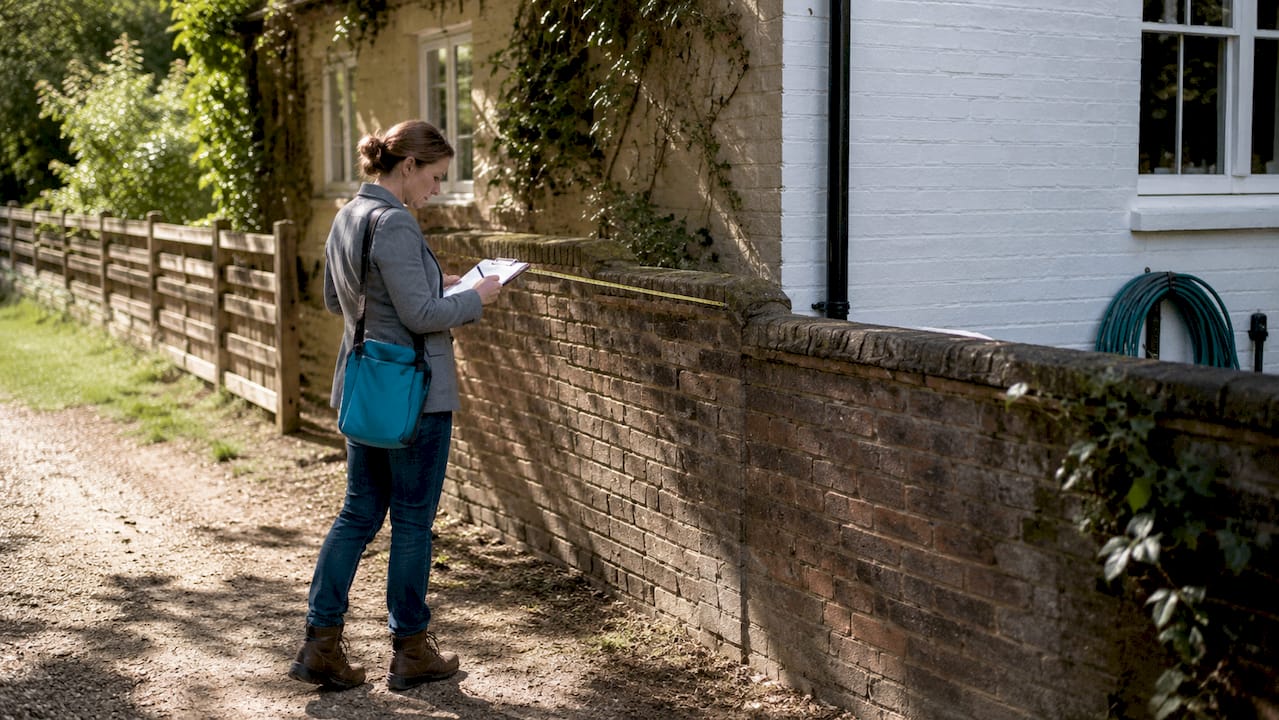
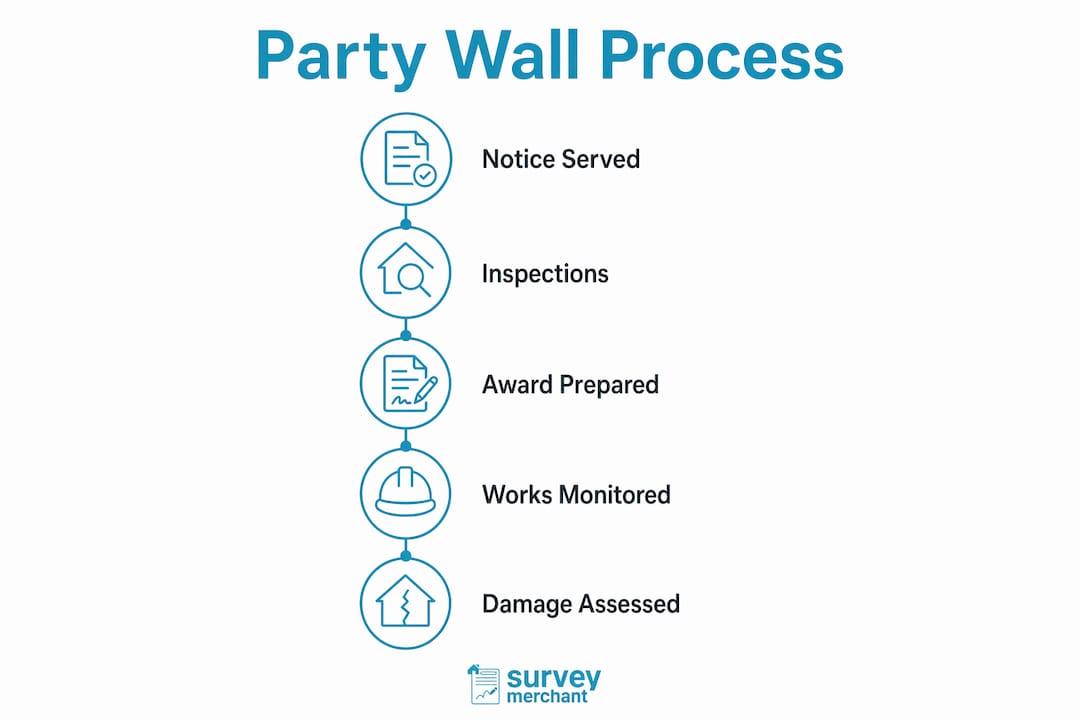
Before any work begins, the surveyor inspects both properties and records their current condition. This produces what is known as a Schedule of Condition. The Schedule of Condition forms the baseline reference against which any post-construction damage claims are assessed. Without it, a neighbour could claim that a crack existed before your works began, and you would have no documentary evidence to dispute it.

The surveyor drafts and serves notices that comply with the Act’s strict timing and content rules. Once a dispute is triggered, the surveyor prepares the Party Wall Award. Surveyors produce the Party Wall Award as a legally binding document defining the scope, timing, and safeguards for work carried out on the party wall. The Award protects both the building owner and the adjoining owner and governs exactly how works must be conducted.
The surveyor’s role does not end when the Award is signed. They monitor compliance during construction and assess any damage claims that arise afterwards. This ongoing involvement gives both parties a formal point of contact if something goes wrong.
Key duties at a glance:
Pro Tip: Ask your surveyor to photograph every room adjacent to the works, not just the shared wall. Courts and insurers give far more weight to photographic condition records than written descriptions alone.
A party wall surveyor becomes legally necessary the moment your neighbour dissents or fails to respond to a party wall notice. Property owners must appoint surveyors if the neighbour dissents or fails to respond within 14 days, triggering a formal dispute under the Act. That 14-day window starts from the date the notice is served, not from when the neighbour reads it.
Once a dispute is triggered, you have three structural options for appointing surveyors:
The building owner pays all surveyor fees as a general rule, including the adjoining owner’s surveyor costs. This reflects the fact that the building owner is the one carrying out works that affect their neighbour. You can find a detailed breakdown of typical charges through Surveymerchant’s party wall surveyor cost guide.
| Scenario | Typical cost range |
|---|---|
| Single agreed surveyor, straightforward project | Lower end of the range |
| Two surveyors, standard residential works | Mid-range |
| Complex excavations or shared party walls | Higher end, often over £1,000 |
Professional fees vary widely depending on complexity, number of surveyors appointed, and the nature of the works. Projects involving complex excavations or multiple shared walls consistently sit at the higher end.
Pro Tip: If your neighbour is cooperative, propose an agreed surveyor from the outset. You will typically pay less overall, and the process moves faster because there is only one professional to coordinate.
A party wall surveyor acts in a quasi-judicial capacity under Section 10 of the Party Wall etc. Act 1996. This is the most misunderstood aspect of the role. Many property owners assume the surveyor they appoint represents their interests. The surveyor does not. They are required by statute to act fairly to both parties.
“A party wall surveyor acts in a quasi-judicial capacity, impartial and fair to both parties rather than an advocate for one side. Surveyors inspect adjoining properties, draft notices and awards, and monitor compliance, maintaining neutrality as required by Section 10 of the Act. An Award produced by a biased surveyor risks being overturned in court, causing costly delays to the project.”
This impartiality protects the Award’s legal enforceability. If a surveyor acts as an advocate for the party who appointed them, the opposing party can challenge the Award in court. That challenge can halt construction entirely while the matter is resolved. The financial and time costs of that outcome far exceed the cost of simply engaging a genuinely impartial professional from the start.
Professional bodies play a direct role in maintaining these standards. Party wall surveyors should ideally be members of specialist bodies such as the Faculty of Party Wall Surveyors (FPWS) or the Royal Institution of Chartered Surveyors (RICS). Membership signals knowledge of statutory procedures and carries professional indemnity insurance requirements. For London projects in particular, where property values and construction complexity are high, RICS membership is a strong baseline requirement. Surveymerchant’s guide on RICS party wall surveyors explains what that accreditation means in practice.
One further point: the role carries no mandatory formal qualification by law. Property owners should prioritise vetting a surveyor’s track record in building pathology rather than relying solely on job title. Ask for examples of Awards they have produced and references from previous projects.
Getting the process right from the start saves money, time, and neighbourly goodwill. The most common cause of failed party wall projects is failure to serve a valid notice before works begin, which disables the Act’s protections entirely. That single error can expose you to common law claims and injunctions that stop your project in its tracks.
Follow these practices to protect yourself:
Pro Tip: Write a brief, friendly letter to your neighbour before serving any formal notice. Explaining your plans informally first dramatically increases the chance they will consent in writing, bypassing the surveyor appointment process altogether.
A party wall surveyor is a statutory impartial professional whose Award is the only legally enforceable mechanism for managing construction disputes between neighbouring property owners under the Party Wall etc. Act 1996.
| Point | Details |
|---|---|
| Statutory impartiality | Surveyors act for both parties under Section 10 of the Act, not as advocates for either side. |
| 14-day response rule | If your neighbour does not respond to a notice within 14 days, a formal dispute arises and surveyors must be appointed. |
| Party Wall Award | The Award is a legally binding document governing the scope, timing, and safeguards for all works. |
| Building owner pays fees | The building owner typically covers all surveyor fees, including the adjoining owner’s costs. |
| Serve notices first | Failing to serve a valid notice before works begin removes all statutory protections under the Act. |
The assumption I see most often is that appointing a party wall surveyor means you have someone in your corner. You do not. The surveyor’s job is to produce a fair Award that holds up legally, and that requires them to consider your neighbour’s position just as seriously as yours. Property owners who push their surveyor to be aggressive on their behalf often end up with a compromised Award that the other side challenges in court.
The second mistake is treating the notice as a formality. A notice served incorrectly, whether to the wrong address, with the wrong description of works, or outside the statutory timeframe, is invalid. An invalid notice means no statutory protection. I have seen projects delayed by months because a builder started work assuming the notice was fine, only for the neighbour’s solicitor to point out a procedural error.
My practical advice: appoint an accredited surveyor with a demonstrable background in building pathology, not just party wall procedure. The best party wall award surveyors understand construction well enough to write Awards that actually prevent damage, rather than simply documenting it after the fact. For London projects, where terraced and semi-detached properties share walls that are often in poor condition, that technical knowledge is the difference between a smooth project and a costly dispute.
Maintain a civil relationship with your neighbour throughout. The Act gives surveyors authority to resolve disputes, but it cannot repair a broken relationship. A neighbour who feels respected is far less likely to instruct their own surveyor to challenge every decision.
— Surveymerchant Editorial Team
Surveymerchant connects property owners with accredited party wall surveyors registered with RICS and the Faculty of Party Wall Surveyors across the UK.

Whether you need a party wall notice surveyor to serve compliant notices, a party wall award surveyor to produce a binding Award, or a full building survey to document your property’s condition before works begin, Surveymerchant matches you with the right professional quickly. For commercial projects, the commercial property survey service covers party wall matters alongside structural and compliance assessments. Appointments are arranged promptly to keep your project on schedule and your statutory obligations met.
A party wall surveyor is an impartial professional appointed under the Party Wall etc. Act 1996 to manage building works affecting shared walls or boundaries. They inspect properties, serve notices, and produce the legally binding Party Wall Award.
A party wall notice is a formal written document served on an adjoining owner to inform them of planned works that affect a shared wall or boundary. The adjoining owner has 14 days to consent or dissent in writing.
The building owner pays all surveyor fees as a general rule, including the costs of any surveyor appointed by the adjoining owner. Costs vary by project complexity and the number of surveyors involved.
Yes. Both parties can agree to appoint a single surveyor jointly, which reduces costs and speeds up the process. Either party may still appoint their own surveyor separately if they prefer.
Starting work without a valid Party Wall Award in place removes all statutory protections under the Act. Your neighbour can apply to court for an injunction to halt the works immediately, and you become liable under common law for any damage caused.
Survey Merchant provides vetted RICS surveyors across 100+ UK locations at fixed fees:
→ Level 2 Home Survey (HomeBuyer Report)
→ Level 3 Building Survey (full structural survey)
→ RICS Red Book property valuations
→ Party wall surveyors — notices, awards & schedules of condition
→ Expert witness surveyors — CPR Part 35 reports for property disputes