We use cookies to improve your experience on our site, analyze site traffic, and assist in our marketing efforts. By clicking "Accept all," you agree to the storing of cookies on your device. You can choose to "Reject all" non-essential cookies. For more information, please read our Cookie Policy.
UK House Prices, Mortgage Rates and the September 2026 Bank of England Decision
UK house prices near £275,465 with 1.6% annual growth; two-year fixed rates around 5.59% ahead of the Bank of England's 17 September 2026 decision. What buyers, sellers and surveyor clients should do now.
A three-bedroom semi that would have sold in nine days last spring is now sitting on the market for eleven weeks, and its asking price has already been cut twice. That single story sums up where the property market stands heading into autumn. The combination of UK house prices, mortgage rates, and the September 2026 Bank of England decision has created one of the most finely balanced housing moments in years, and nobody involved in buying, selling, or valuing property can afford to ignore it.
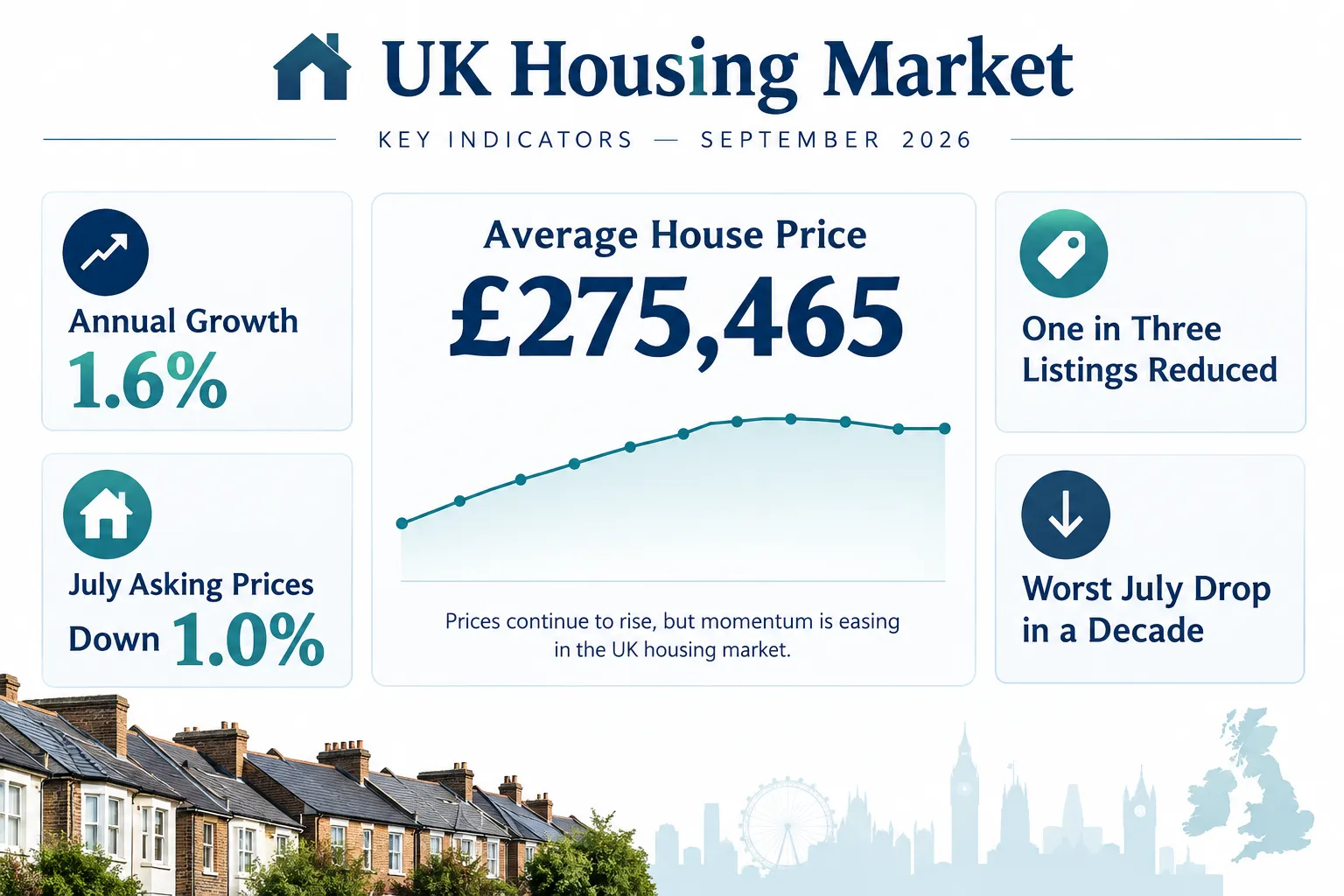
The average UK house price sat at roughly £275,465 in August 2026, according to combined ONS and Halifax figures, with annual growth slowing to just 1.6%. That is a market losing momentum, not collapsing, but the details underneath the headline number tell a more nuanced story that anyone watching UK house prices, mortgage rates, and the September 2026 Bank of England decision needs to understand.
Key Takeaways
Average UK house price stands near £275,465 (August 2026), with annual growth down to about 1.6%.
Roughly one in three property listings has been reduced, with average price cuts around 7%.
Newly listed asking prices fell 1.0% in July 2026, the worst July performance in a decade.
Average two-year fixed mortgage rates have climbed to around 5.59%, with headline deals nearer 5.06%.
The Bank of England's Monetary Policy Committee meets on 17 September 2026, with markets split on the next move.
UK House Prices in September 2026: Where the Market Stands
The property market entering September 2026 looks softer than the spring selling season suggested it would. The average UK house price of £275,465 represents modest year-on-year growth of about 1.6%, a sharp slowdown from the stronger increases recorded earlier in the cycle. This is not a market in freefall, but it is clearly cooling.
Where UK house prices stand in September 2026.
Look past the national average and the picture gets more textured. Around one in three properties currently listed for sale has had its asking price reduced, with typical cuts averaging about 7%. That is a meaningful signal of seller realism, or in some cases, seller desperation, after months of limited buyer interest.
Perhaps the most striking data point is the trend in newly listed properties. Asking prices on fresh listings fell 1.0% in July 2026, the weakest July performance in ten years. Historically, July is a reasonably steady month for pricing, so a decline of this size points to sellers adjusting expectations before they even test the market, rather than waiting to be forced into cuts later.
Major indices tell slightly different versions of the same story. Nationwide recorded a modest monthly rise, its first since April, hinting at some stabilisation. Zoopla put the average price closer to £272,000 with a small annual increase. Lloyds, by contrast, reported its first annual house price fall since 2023. Rightmove's asking-price data showed a larger-than-usual seasonal drop and an annual decline. Taken together, these indices confirm a market that is flat to slightly negative overall, with regional and price-band variation doing a lot of the work behind the scenes.
Mortgage Rates Climbing Ahead of the Bank of England Decision
If house prices are cooling gently, mortgage pricing is moving in the opposite direction, and that mismatch is central to understanding UK house prices, mortgage rates, and the September 2026 Bank of England decision as a combined story.
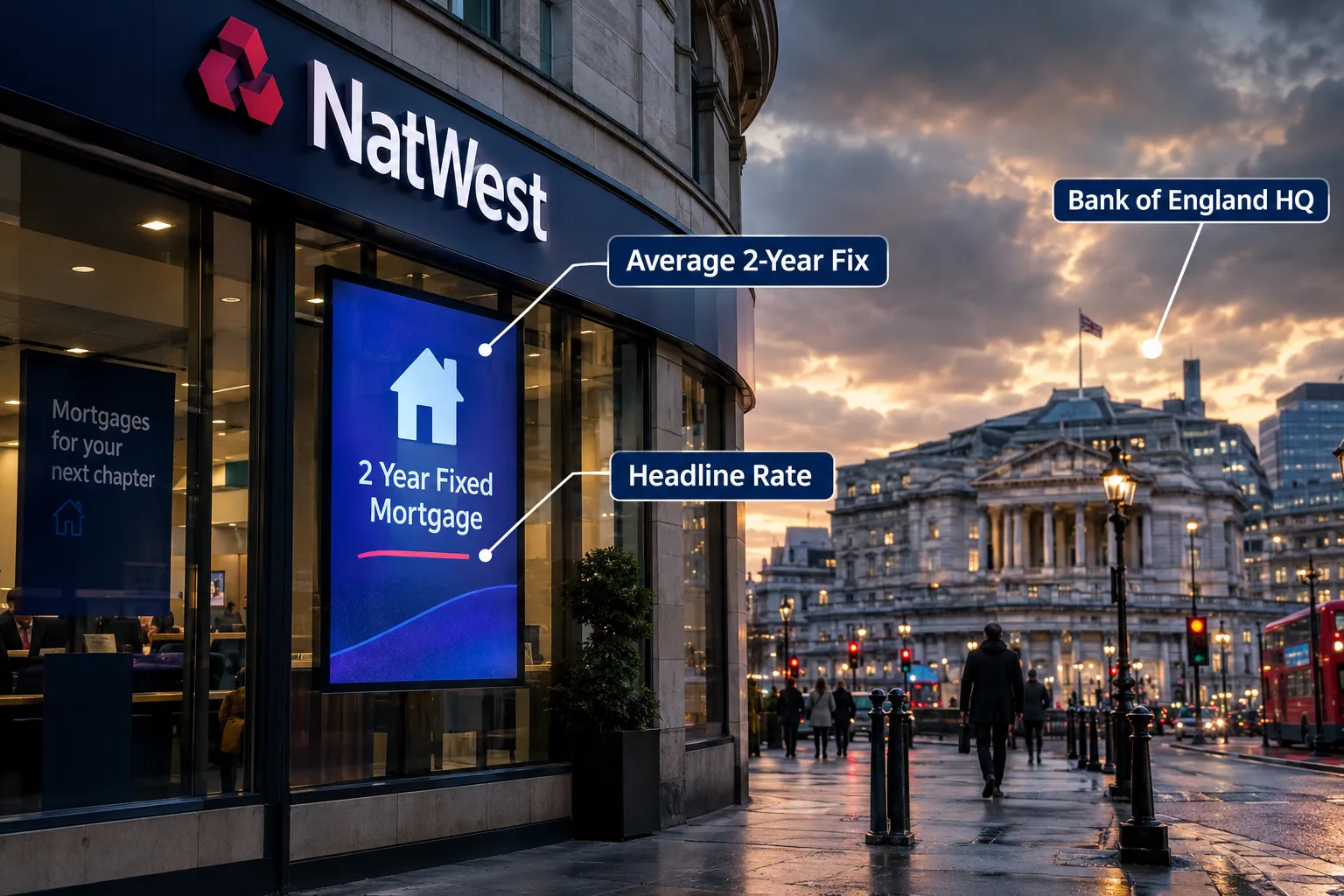
The average two-year fixed mortgage rate has risen to approximately 5.59%, while the most competitive headline deals sit closer to 5.06% for borrowers with strong deposits and clean credit profiles. The gap between these two figures matters: it shows that pricing has become more stratified, rewarding buyers with larger deposits while pushing higher loan-to-value borrowers toward noticeably steeper rates.
Behind this increase sits wholesale funding pressure. Lenders price fixed-rate mortgages largely off swap rates and gilt yields, not directly off the Bank Rate itself. When funding costs in those markets rise, lenders quickly reprice their fixed products upward, even before the Bank of England moves. That is largely what has happened over recent weeks, with several major lenders quietly nudging fixed rates higher ahead of the September decision.
For a typical first-time buyer, this pricing shift is not trivial. A rate move from 5.06% to 5.59% on a £250,000 mortgage can add well over £70 a month to repayments, depending on term and structure. Multiply that across the market and it is easy to see why demand has softened, even as prices themselves have not fallen sharply.
The Bank of England's September 2026 Decision: What to Expect
All eyes now turn to 17 September 2026, when the Monetary Policy Committee delivers its next Bank Rate decision. This meeting carries extra weight because it arrives at a moment when inflation remains sticky enough to worry hawkish committee members, yet growth signals are soft enough to concern those pushing for support.
Recent voting patterns on the MPC have shown a split committee rather than a unanimous one, reflecting genuine disagreement about how much further tightening, if any, is needed. Market pricing going into September suggests traders see a roughly even chance of the Bank holding rates steady versus opting for a small cut later in the year, with most analysts expecting no dramatic single move at this particular meeting.
"Mortgage lenders are pricing in caution, not panic. The bigger risk to borrowers right now is wholesale funding costs, not necessarily what the Bank announces on the day."
Property professionals should treat 17 September as a moment for market sentiment rather than an instant fix for high mortgage rates. Even if the Bank Rate itself is held or trimmed slightly, fixed mortgage pricing may not move meaningfully in the short term, because it is already reflecting funding market expectations set weeks in advance.
What the September 2026 Decision Means for Buyers
Buyers navigating UK house prices, mortgage rates, and the September 2026 Bank of England decision face a genuinely mixed environment. On one hand, softer price growth and widespread asking-price reductions create room to negotiate. On the other, borrowing costs remain elevated compared with the ultra-low-rate years many buyers still remember.
Practical steps for buyers ahead of the 17 September MPC meeting.
Practical steps worth considering:
Get a mortgage in principle early, since rates can shift between application and offer.
Compare two-year and five-year fixes carefully; the 5.06% headline deals often require larger deposits or fees.
Use reduced-listing data as a negotiating tool, particularly on properties already cut once.
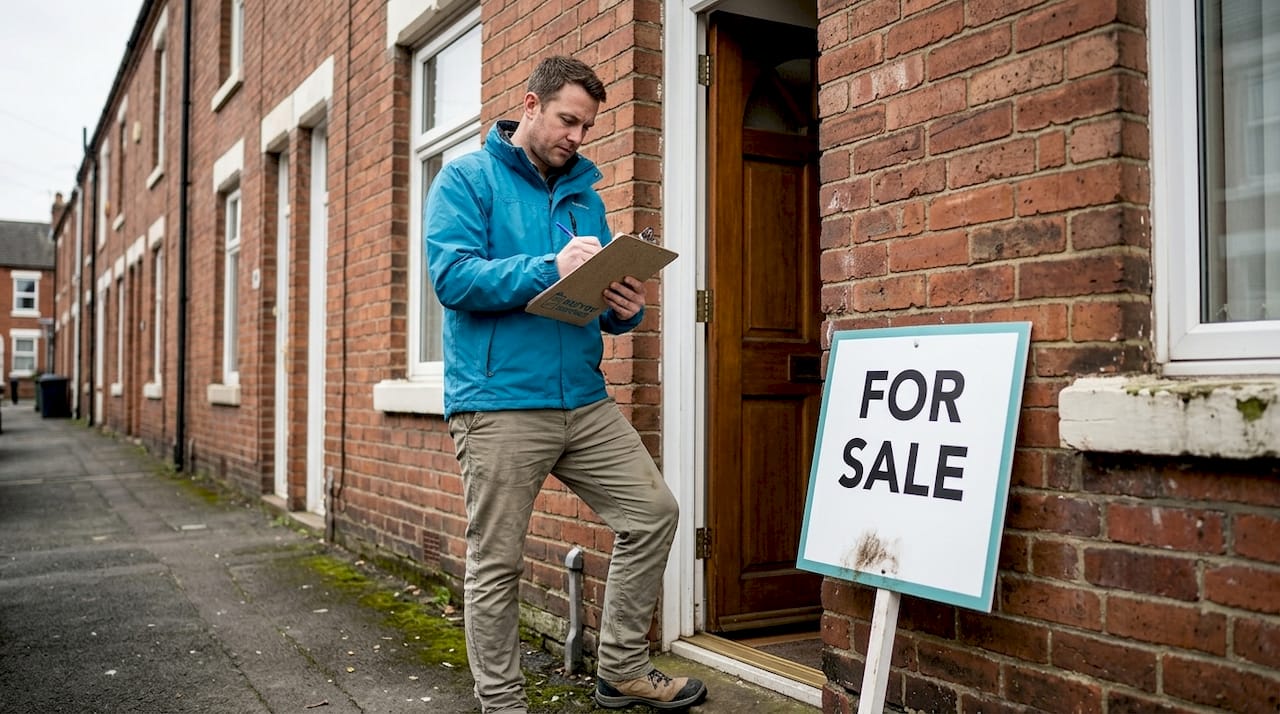
Budget for a commissioned survey before exchange, given how many price reductions reflect underlying condition issues uncovered late in the process.
What the September 2026 Decision Means for Sellers
Sellers face a market that punishes overpricing quickly. With one in three listings already reduced and July's newly listed prices down 1.0%, buyers have grown used to negotiating from the first viewing onward.
Seller Priority
Why It Matters Now
Realistic initial pricing
Avoids the credibility damage of a public reduction
Pre-sale condition survey
Reduces late-stage renegotiation risk
Flexibility on completion timing
Helps mortgage-dependent buyers manage rate locks
Clear, accurate listing details
Cuts down time on market in a slower demand environment
Implications for Surveyor Clients and Property Professionals
For surveying firms and their clients, this environment increases the value of independent, accurate property assessment. When roughly a third of listings are being repriced, buyers and sellers both need objective evidence, not guesswork, to justify a figure. A professional survey helps buyers negotiate confidently on reduced listings and helps sellers defend a price that reflects genuine condition rather than market anxiety alone.
Mortgage lenders, too, are applying closer scrutiny to valuations given the wholesale funding pressures pushing up their own costs. Surveyors should expect continued demand for detailed condition reports, particularly on older stock where hidden defects can widen the gap between asking price and realistic market value.
Frequently Asked Questions
What is the average UK house price in September 2026? Around £275,465 based on combined ONS and Halifax data from August 2026, with annual growth slowing to roughly 1.6%.
Why are so many property listings being reduced? Approximately one in three current listings has had its price cut, averaging about 7%, as sellers respond to softer demand and higher mortgage costs.
What is the average mortgage rate right now? The average two-year fixed mortgage rate sits near 5.59%, while the most competitive headline deals are closer to 5.06%, depending on deposit size and lender.
When is the next Bank of England interest rate decision? The Monetary Policy Committee meets on 17 September 2026 to announce its next Bank Rate decision.
Will the Bank of England decision immediately lower mortgage rates? Not necessarily. Fixed mortgage pricing is driven largely by wholesale funding costs and swap rates, which often move ahead of, and independently from, the Bank's official decision.
Is now a good time to buy a house? It depends on individual circumstances, but softer price growth and widespread reductions give buyers more negotiating power than in recent years, even with higher borrowing costs.
Conclusion
September 2026 marks a genuine turning point for anyone tracking UK house prices, mortgage rates, and the September 2026 Bank of England decision. Prices have cooled to modest annual growth, sellers are cutting asking prices at a scale not seen in a decade of Julys, and mortgage costs have crept upward on the back of wholesale funding pressure rather than the Bank Rate alone. The 17 September MPC meeting will shape sentiment, but it is unlikely to instantly resolve the pricing tension buyers and sellers currently face.
The sensible next step for buyers is to lock in mortgage advice early and use market softness to negotiate firmly. Sellers should price realistically from day one rather than risk a public reduction. Property professionals and their clients should lean on independent surveys to cut through market uncertainty with hard evidence. Whatever the Bank of England decides on 17 September, informed decisions built on accurate data will matter more than ever in the months ahead.