Building Surveying
Aug 9, 2026
RICS Survey Quote Explained: Costs & What to Expect 2026
Get a clear RICS survey quote. Our guide breaks down Level 2 & 3 costs, factors affecting price, and how to compare quotes to avoid hidden fees in 2026.

TL;DR: A typical rics survey quote in the UK often falls somewhere between £400 and over £1,500, depending on whether you need a Level 2 or Level 3 survey, where the property is, and how complex it is. That quote usually covers the surveyor’s inspection, the written report, and the cost of carrying professional indemnity insurance.
Your offer has been accepted. The mortgage is moving. The estate agent sounds upbeat. Then the next question lands: do you just rely on the lender’s valuation, or do you pay for a proper survey?
This is the point where many first-time buyers get stuck. The quotes can look inconsistent, the wording can feel opaque, and one surveyor may be hundreds of pounds more than another for what seems like the same job.
A good survey quote becomes much easier to judge once you know what drives the price. The big difference usually isn’t random. It comes from the survey level, the location, the property itself, and how much work the surveyor must do behind the scenes to produce a report that’s worth relying on.
You’re probably in a familiar position. The lender has issued the mortgage offer, your solicitor has started searches, and everyone is acting as if the deal is already real. It feels tempting to keep costs down and skip straight to exchange.
That’s where many buyers confuse a mortgage valuation with a property survey. A valuation is mainly for the lender. It helps the lender decide whether the property is suitable security for the loan. It does not give you a full picture of the building’s condition.

A survey is the point where you stop buying a listing and start understanding the building. That matters most when the photos were flattering, the viewing was rushed, or the property has any hint of age, alteration, damp, movement, or deferred maintenance.
If you want a simple overview of the buying sequence after finance is agreed, this guide on what happens after your mortgage offer is made is useful because it puts the survey stage in the wider purchase timeline.
The survey quote can feel like just another bill. In practice, it’s a due diligence cost. You’re paying a professional to look for warning signs before you become responsible for them.
According to the RICS Consumer Survey 2024 summary quoted here, 23% of UK homebuyers who commissioned an RICS Home Survey successfully negotiated a lower purchase price after receiving the report.
Practical rule: If a survey helps you renegotiate, budget for repairs, or decide to walk away, it has done its job.
The other benefit is clarity. A proper report can separate cosmetic issues from serious ones. Cracked plaster might be harmless movement. It might also point to something that needs closer investigation. A surveyor helps you tell the difference.
If you’re still unsure who arranges the inspection in a UK purchase, this article on who organises a survey when buying a house clears up the practical side.
Many buyers open a quote, see one total figure, and compare that number alone. That’s understandable, but it misses what you’re paying for.
A survey quote is really a priced professional service. If you’ve ever wondered what a line item is, the idea is simple. It’s each separate component that makes up the total. Understanding those components helps you compare like with like.
Most rics survey quote documents include some version of these elements:
A cheap-looking quote can stop looking cheap once VAT is added. Another can appear comparable until you notice it excludes a valuation or limits the scope.
For a Level 3 Building Survey, the price rises because the work is more involved. The surveyor is expected to give a more detailed condition assessment and defect diagnosis.
The verified RICS-related guidance provided for this article states that quotes for Level 3 Building Surveys factor in the surveyor’s day rate, often £350 to £500, plus compliance with RICS Home Survey Standards and the work involved in detailed diagnosis and remedial cost consideration, which helps minimise the risk of professional indemnity claims, as reflected in this RICS standards document.
The quote isn’t just paying for someone to walk around a house. It’s paying for professional judgement, written accountability, and a report you can act on.
Three details cause the most confusion:
| Quote detail | Why it matters |
|---|---|
| Scope of inspection | It tells you how detailed the survey will be |
| Report type | A shorter report and a Level 3 report are not interchangeable |
| VAT wording | It affects the real final price |
If one quote is much lower than the rest, don’t assume you’ve found a bargain. Ask what has been left out, whether the report is a true RICS format, and whether the surveyor is pricing for the actual property rather than giving a generic starting figure.
If you’ve collected a few quotes already, you may have noticed something frustrating. Two firms can quote very different amounts for properties that sound broadly similar.
That usually happens because “house survey” is too broad a label. The actual cost depends on the survey level, the region, and the level of complexity in the building.
The most reliable price guidance in the verified data gives clear regional differences for Level 2 and broad working ranges for Level 3.
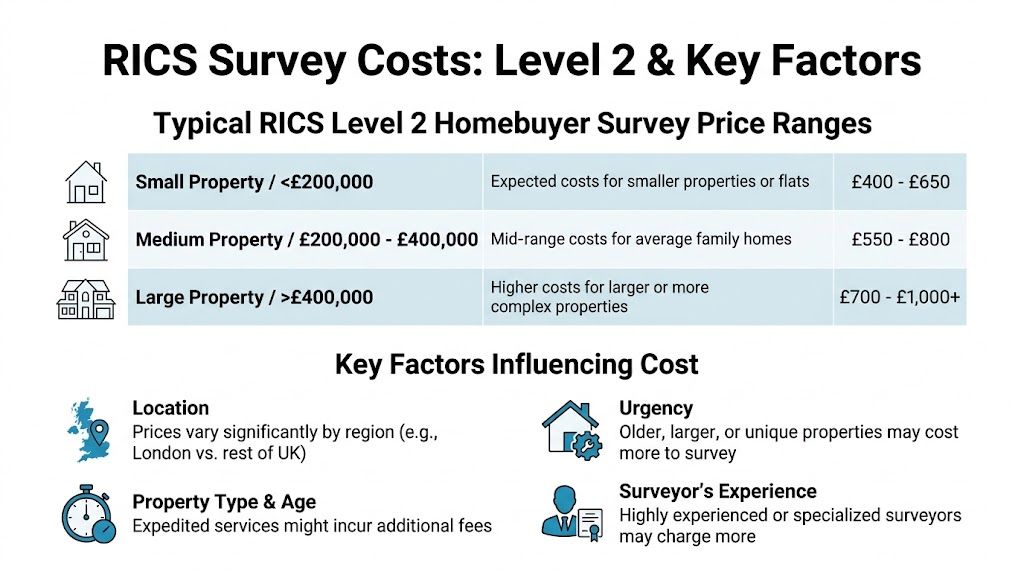
| Survey Level | Ideal For | Average UK Price Range | Typical London Price Range |
|---|---|---|---|
| Level 2 survey | Conventional homes in reasonable condition | £300 to £600 | £400 to £800 |
| Level 3 Building Survey | Older, altered, larger, or more complex homes | £800 to £1,500 for many standard residential properties | £2,000+ can apply in London |
The location gap is one of the biggest reasons quotes vary. Verified guidance says a Level 2 survey quote can range from £300 to £600 in many regional UK hubs, while London can be £400 to £800 because of higher operating costs and demand, as set out in RICS guidance on choosing the right survey.
For a deeper look at the wider cost picture, this explainer on the average survey cost in 2024 is a helpful comparison point.
A surveyor doesn’t price from postcode alone. They also look at what they’re likely to encounter.
Some properties attract a higher quote because they take longer to inspect and write up properly:
If your property is a modern flat in a regional city, a Level 2 quote will often sit at the lower end of the normal range. If it’s a large Victorian house in London with alterations and a cellar, the quote should be higher. That doesn’t mean someone is overcharging. It usually means the workload is larger.
Worth checking: A higher quote can be fair if the surveyor has correctly identified that the building needs a more detailed inspection than a standard home would.
The most useful question isn’t “what’s the cheapest survey?” It’s “what level of survey does this building justify, and is the quote consistent with that level of work?”
A survey quote is only as good as the information you give. If you submit a vague enquiry, you’ll often get a vague price back. That’s when buyers run into surprise supplements, revised fees, or awkward calls after booking.

When you request a quote, send enough detail for the surveyor to price the work properly the first time.
Include these basics:
If you want a practical way to sort and review multiple quotes side by side, this home survey comparison tool gives you a straightforward framework.
Once the quotes arrive, compare them on quality as well as price.
Look at:
A useful sanity check is to ask one plain question: “What are you assuming about this property when you quote?” A careful surveyor should be able to answer that clearly.
Here’s a short video that helps many buyers understand the survey decision in more practical terms:
Some warning signs are easy to spot once you know them:
| Red flag | Why it matters |
|---|---|
| Very low price with little detail | It may be a generic quote rather than a properly scoped one |
| No mention of VAT | The final bill may be higher than it appears |
| Unclear survey type | You may not be buying the level of inspection you think you are |
| No explanation of turnaround | Delays can affect your purchase timeline |
Ask for the quote in writing, ask what’s included, and ask what could change the fee. Clear answers usually signal a well-run practice.
Once you accept the quote, the process becomes more practical and less mysterious. The surveyor or their office will usually contact the estate agent or seller to arrange access. You may be asked to confirm a few property details again so the instruction matches the quote.
The inspection itself varies by survey level and property complexity. A straightforward Level 2 generally takes less time on site than a Level 3, because a Level 3 involves a more detailed review and fuller commentary in the report.
The surveyor will inspect what is reasonably accessible on the day. That usually includes the main building elements such as roofs from ground level or accessible vantage points, walls, ceilings, floors, windows, visible services, and any obvious outbuildings or boundaries relevant to the instruction.
Common steps after booking include:
If it’s a RICS home survey, the report typically presents issues in a clear format that’s easier to scan than buyers expect. You’re not reading a legal textbook. You’re reading a professional summary of the building’s condition, the defects found, and what they may mean for you.
You can usually expect to see:
A good report should help you make decisions. It shouldn’t leave you guessing what matters and what doesn’t.
If something important appears, you can usually call the surveyor to talk it through. That discussion is often where buyers gain the confidence to renegotiate, proceed, or rethink the purchase.
To get a fair RICS survey quote efficiently, focus on matching the right surveyor to your specific property.
That sounds simple, but it explains why one buyer gets a sensible quote in an afternoon while another spends days collecting prices that are impossible to compare. A survey quote is a bit like getting a repair estimate for a car. A small hatchback and a vintage Land Rover may both need inspection, but the skill, time, and risk involved are different. Property works the same way.
A new-build flat in Manchester, a timber-framed cottage in Kent, and a large converted house in Bristol can all need very different surveyors. The survey level may differ. The time on site may differ. The surveyor may need deeper experience of older construction, leasehold issues, or signs of movement and damp.
That is one reason quotes vary so much across the UK.
Regional pricing is part of it, but it is not the full story. The bigger driver is often fit. If your enquiry lands with a surveyor who regularly inspects properties like yours, the quote is more likely to reflect the actual job. If it goes to someone who treats every instruction as roughly the same, the price may be too high, too low, or missing part of the scope.
Survey Merchant is a UK platform that connects buyers, owners, and professionals with a nationwide panel of qualified surveyors for residential and commercial instructions, including Level 2 surveys, Level 3 Building Surveys, and valuations.
For a first-time buyer, the main benefit is practical. You enter the property details once, rather than repeating the same information to several firms and hoping each one has understood the instruction in the same way. That can lead to cleaner quotes and fewer surprises later.
It tends to help most in three situations:
The true value is not just speed. It is better matching. And better matching is often how buyers avoid the two common mistakes. Paying over the odds for a routine job, or choosing a cheap quote that does not properly fit the property.
By the time you reach the quote stage, the confusing part is often not the price itself. It is understanding what the price is for, and why one firm may charge noticeably more than another for what looks like the same job. A useful way to read the questions below is to treat them like a final sense-check before you book. The aim is not just to find a lower fee. It is to make sure the quote fits the property, the instruction, and the risk you are taking on as a buyer.
A mortgage valuation is mainly for the lender. It helps the bank decide whether the property is suitable security for the loan.
A survey is for you. It looks at condition, defects, maintenance issues, and signs of larger problems that could affect your costs after purchase. If you are buying your first home, it helps to picture the valuation as a lender’s box-ticking exercise and the survey as your own detailed check before you commit.
Location affects fees in a very practical way. Surveyors in London and the South East often have higher operating costs, longer travel times between appointments, and stronger demand for appointments at short notice.
The property stock matters too. A modern flat in one part of the country may be straightforward to inspect and price. A period conversion in London, with shared parts, alterations, and access constraints, can take more time and judgement. That is why broad national averages only tell part of the story. Regional pricing changes, but so does the type of work being priced.
Choose the survey that matches the building, not the one with the lowest headline fee.
A Level 2 survey usually suits a more conventional home in reasonable condition. A Level 3 Building Survey is often better for older houses, heavily altered properties, larger homes, unusual construction, or anything that already raises questions. Paying less for the wrong survey can be a false saving, rather like buying the cheapest insurance policy and only later finding the cover is too narrow.
It is a different instruction with a different purpose. A RICS Red Book valuation is a formal opinion of value, often needed for matters such as probate, tax, Help to Buy, or legal proceedings, and it follows defined professional standards set out in this RICS NRM 3 document.
A survey quote covers inspection and reporting on condition. A valuation quote covers the valuer’s assessment of market value for the stated purpose. Some firms offer both, but they are not interchangeable, and the fee structure may differ for that reason.
Yes, if the survey finds defects that were not obvious when you made the offer.
The report gives you evidence. You can use it to ask for a price reduction, request that works are carried out before exchange, or reconsider whether the property still makes sense at the agreed figure. The seller may say no, of course, but you are no longer negotiating on guesswork.
Cheap quotes usually fall into a few predictable categories. The scope may be narrower than it first appears. VAT may be missing from the headline figure. The surveyor may not yet have looked properly at the age, size, construction, or layout of the property.
That last point catches many buyers out. Two quotes can mention the same survey level, but one may be based on a careful reading of the property details and the other on a rough assumption. If the price looks unusually low, ask a simple question: what exactly is included, and has the surveyor priced this specific property or just a generic version of it?
If you still feel uncertain after comparing quotes, Survey Merchant can be a practical starting point for finding a surveyor whose pricing and scope match the property more closely. That tends to reduce the risk of choosing a quote that looks cheap at first and costly later.
Survey Merchant provides vetted RICS surveyors across 100+ UK locations at fixed fees:
→ Level 2 Home Survey (HomeBuyer Report)
→ Level 3 Building Survey (full structural survey)
→ RICS Red Book property valuations
→ Party wall surveyors — notices, awards & schedules of condition
→ Expert witness surveyors — CPR Part 35 reports for property disputes