Leasehold
Jul 16, 2026
Party Wall Costs: Building Owner vs Adjoining Owner
Building owners usually pay most Party Wall surveyor fees, award costs and repairs; neighbours pay only for shared repairs or upgrade extras.

In most Party Wall cases, you as the building owner pay nearly all the costs. That usually includes notices, surveyor fees, the award, and the cost of fixing any damage.
If I strip it right down, the article says this:
This also means loft conversions, rear extensions, and basement works often leave the building owner paying both sides’ surveyor fees, while the adjoining owner is mainly protected by the Act.
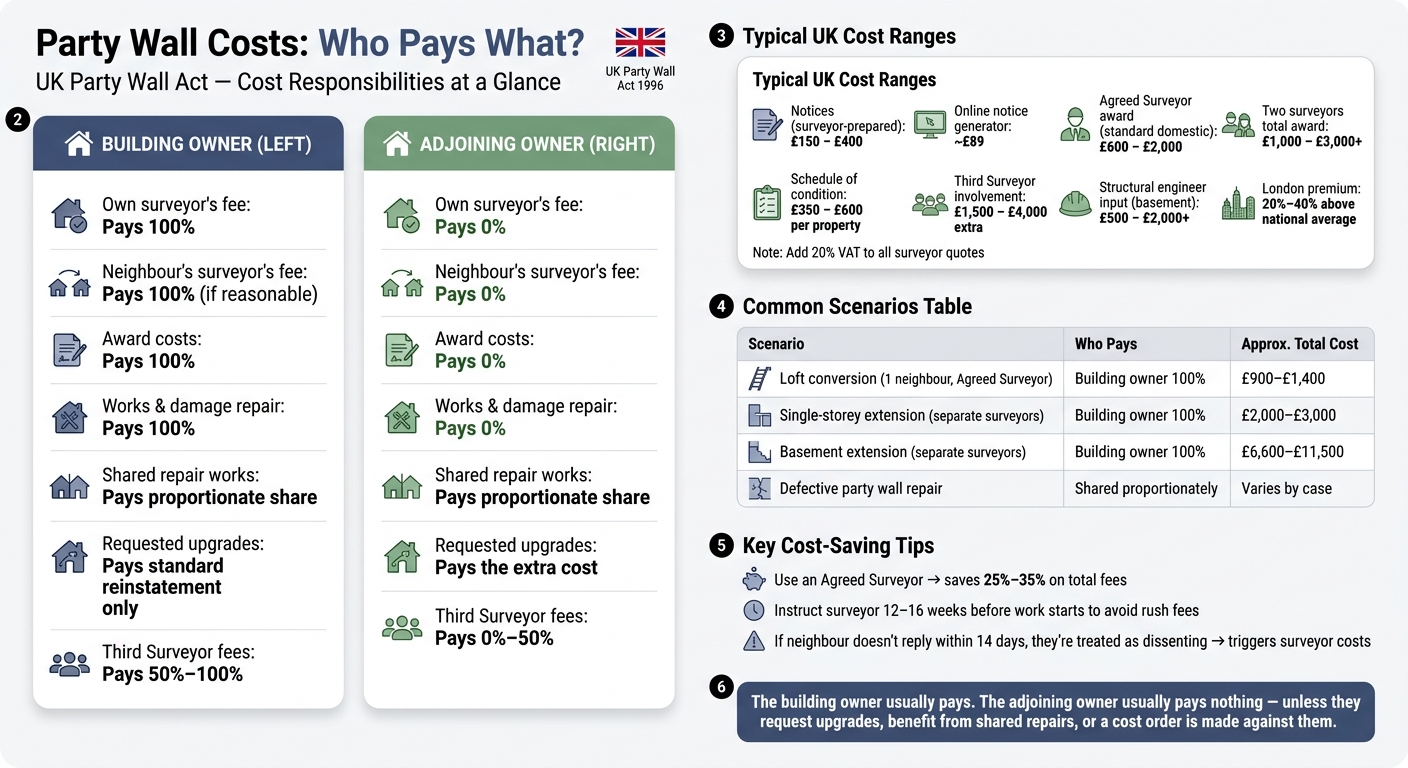
Party Wall Costs: Who Pays What in the UK?
| Point | Building Owner | Adjoining Owner |
|---|---|---|
| Surveyor fees | Usually pays own fee and neighbour’s fee | Usually pays nothing |
| Award costs | Usually pays | Usually pays nothing |
| Damage from works | Pays to repair or compensate | Usually pays nothing |
| Shared repair work | Pays a share | Pays a share |
| Extra upgrades | Pays standard reinstatement only | Pays the extra cost |
| Third Surveyor fees | May pay some or all | May pay some or none |
Put simply: if the work is for your project, the bill is usually yours.
The building owner usually pays the reasonable Party Wall costs. Section 10 makes that clear. In day-to-day cases, that means the building owner will usually cover the surveyors' fees and the award [1].
Why? Because the work mainly benefits the building owner, not the adjoining owner [1][6]. That’s the starting point in most cases. It only shifts in certain repair or damage situations.
Cost-sharing is the exception, not the default.
Under Section 11(6), if work is needed because of a defect or poor repair in a shared structure, the costs are apportioned based on each owner’s use of that structure and their share of the responsibility [8]. So it is not an automatic 50:50 split. The exact share depends on the facts of the case.
An adjoining owner may also have to pay more if they want extras, such as higher-spec finishes or sound insulation that goes beyond normal reinstatement [1].
If the works cause damage to the adjoining property, the building owner must either put that damage right or pay the cost of repairs [8]. A schedule of condition helps here. It records the state of the property before work starts, which can make it much easier to show whether later damage was caused by the works [2].
For higher-risk work, such as basements or deep underpinning, the adjoining owner can ask for security for expenses before the work begins [1][8]. In plain English, that is money or another form of protection held in case the work is left unfinished or damage is not paid for.
These rules set out the basic split in principle; the next section looks at what each owner usually pays in practice.
In practice, the split usually looks like this:
| Cost Category | Building Owner | Adjoining Owner |
|---|---|---|
| Own surveyor's fee | Pays 100% | Pays 0% |
| Adjoining owner's surveyor's fee | Pays 100% if reasonable [1][4] | Pays 0% |
| Agreed surveyor's fee | Usually pays the fee; may be split 50/50 if agreed [1] | Usually pays nothing; may be split 50/50 if agreed [1] |
| Third surveyor's fee | May pay 50%–100% if the award orders them to pay costs [1][6] | May pay 0%–50% if the award orders them to pay costs [6] |
| Works and damage | Pays 100% | Pays 0% |
| Shared repair works | Pays a proportionate share, often 50/50, if both properties benefit [2][5] | Pays a proportionate share, often 50/50, if both properties benefit [2][5] |
| Upgrades beyond standard reinstatement | Pays for standard reinstatement only [1] | Pays the extra cost of any upgrade [1][9] |
As the building owner, you will usually carry most of the cost. That normally means paying for:
That's the default position. The main carve-out is shared repairs, where costs can be split if both properties gain from the work.
For the adjoining owner, the big point is simple: in most standard cases, you pay nothing. For usual notifiable works like loft conversions, rear extensions, and basement excavations, the building owner will usually cover the surveying and work-related costs [1][2].
You can appoint your own surveyor, and the building owner normally pays that fee too, as long as it's reasonable [4][9].
You may still have to pay in a few cases. This tends to happen when:
Put plainly, the building owner usually pays for the project. The adjoining owner only starts paying where there is a shared gain, an extra request, or a cost order against them.
Once the Act applies, most building owners need to budget for notices, surveyor fees and, in many cases, an award. The final bill depends on how complex the job is and how many adjoining owners are involved, but there are some solid guide figures.
London costs are often 20% to 40% above national averages because demand is higher, builds are often more involved, and professional indemnity cover costs more [7]. The figures below reflect London pricing, so national costs may come in lower on the same type of job.
The basic rule is simple: in most cases, the building owner pays. That said, some repair cases are split based on who benefits or who is responsible.
| Scenario | Who Pays | Approximate Total Cost |
|---|---|---|
| Loft conversion (1 adjoining owner, Agreed Surveyor) | Building owner pays 100% | £900 – £1,400 [7] |
| Single-storey extension (1 adjoining owner, separate surveyors) | Building owner pays 100% | £2,000 – £3,000 [7] |
| Defective party wall repair | Shared in proportion to responsibility or benefit | Costs apportioned according to use/benefit [3] |
| Basement extension (standard, separate surveyors) | Building owner pays 100% | £6,600 – £11,500 [7] |
The adjoining owner does not usually pay anything unless they ask for extras beyond normal reinstatement or they cause avoidable costs [10][12].
One of the biggest cost drivers is the number of adjoining owners. In a terrace or semi-detached property, each extra adjoining owner may mean another notice and, in some cases, another surveyor. That can push the total up fast [10][13].
The choice between one surveyor and two also makes a big difference. If a neighbour dissents and appoints their own surveyor instead of using one Agreed Surveyor, the building owner will usually pay both sets of fees. Using an Agreed Surveyor can cut the total by 25% to 35% [7]. If those two surveyors then fail to agree and bring in a Third Surveyor, that can add another £1,500 to £4,000 [7].
The type of work matters as well. Basement excavation tends to cost more because it is more involved and may need structural calculations, monitoring, and input from a structural engineer. That extra input often costs £500 to £2,000+ [12]. A detailed schedule of condition, disputes over access, or notices served late can all add more to the bill.
Timing matters too. Instructing a surveyor 12 to 16 weeks before work starts can help you avoid rush fees and delays [7]. There is also a common trap here: if a neighbour does not reply to a notice within 14 days, they are treated as having dissented. That usually leads to surveyor appointments, which means higher costs [11][7].
After the fee ranges and examples above, the main rule is pretty simple: the Act usually makes the building owner liable for the reasonable costs of the dispute.
There are only a few cases where that changes. Those sit in narrow situations: repairs to a shared structure, upgrades asked for by the adjoining owner, and Third Surveyor cost orders.
| Cost Item | Building Owner | Adjoining Owner |
|---|---|---|
| Repair of shared structure in disrepair | Proportionate share | Proportionate share |
| Requested upgrades or betterment | Pays standard reinstatement | Pays the difference |
| Third Surveyor fees | Usually 50% | Usually 50% |
If you're a building owner, plan for the whole process from the start. That means notices, surveyor fees, the Award, and a Schedule of Condition.
If you're an adjoining owner, the Act usually stops you from being left out of pocket for works that only help your neighbour. You're generally entitled to advice at no cost where the works benefit only your neighbour [1][2]. You only pay towards costs if you ask for upgrades or a costs order is made against you.
Yes. Under the Party Wall etc. Act 1996, the building owner only has to pay reasonable costs.
If a fee looks too high, start by asking the surveyor for a clear breakdown of their time and charges. That usually means looking at how many hours were billed, what work was done, and the rate applied.
If that doesn’t sort it, you can challenge the fee in a County Court appeal. It helps to back up your case with expert evidence, such as fee comparisons or a review of the surveyor’s time sheets.
If your neighbour ignores a party wall notice for 14 days, the law treats that silence as a dispute. At that point, the formal steps under the Party Wall etc. Act 1996 kick in.
You can appoint a surveyor to act for you. If your neighbour still doesn’t reply, you can appoint a surveyor on their behalf too. In most cases, the building owner pays the reasonable surveyor costs.
If you’re planning work that falls under the Party Wall etc. Act 1996, build these costs into your budget from the start.
In most cases, the building owner pays the reasonable costs linked to the process. That usually includes:
This can add up, so it’s best to factor it in early rather than treat it as an extra later on.
Survey Merchant provides vetted RICS surveyors across 100+ UK locations at fixed fees:
→ Level 2 Home Survey (HomeBuyer Report)
→ Level 3 Building Survey (full structural survey)
→ RICS Red Book property valuations
→ Party wall surveyors — notices, awards & schedules of condition
→ Expert witness surveyors — CPR Part 35 reports for property disputes