We use cookies to improve your experience on our site, analyze site traffic, and assist in our marketing efforts. By clicking "Accept all," you agree to the storing of cookies on your device. You can choose to "Reject all" non-essential cookies. For more information, please read our Cookie Policy.
Property Transactions Slip to 94,800 as the Autumn Bounce Fails to Arrive: What HMRC's Latest Data Means for Buyers Commissioning a Survey (November 2026)
HMRC: 94,800 UK sales in September 2026, down 4% on the year, with Zoopla warning mortgage rates have cut buying power by 15%. What a slower, more selective market means for survey timing, Level 2 vs Level 3 and negotiation.
Ninety-four thousand, eight hundred. That is how many homes changed hands across the UK in September 2026, according to HMRC, and it confirms something estate agents have been saying since August: the usual autumn pick-up never showed up.
This November 2026 update looks at what the HMRC property transactions figures for September 2026 actually mean, and why fewer, slower, more cautious sales make a RICS survey more valuable than ever for buyers and sellers alike.
Key Takeaways
HMRC property transactions for September 2026 fell to 94,800 (seasonally adjusted), down 1% on the month and 4% on the year.
Higher mortgage rates cut buyer borrowing power by 15% over summer and autumn, according to Zoopla's Richard Donnell.
Zoopla forecasts 100,000 fewer transactions in 2026 than in 2025.
Nationwide reported house prices fell 0.3% in October, with annual growth slowing to 0.5%.
Fewer, pickier buyers mean survey findings now carry more weight in price negotiations.
HMRC Property Transactions September 2026: The Headline Numbers
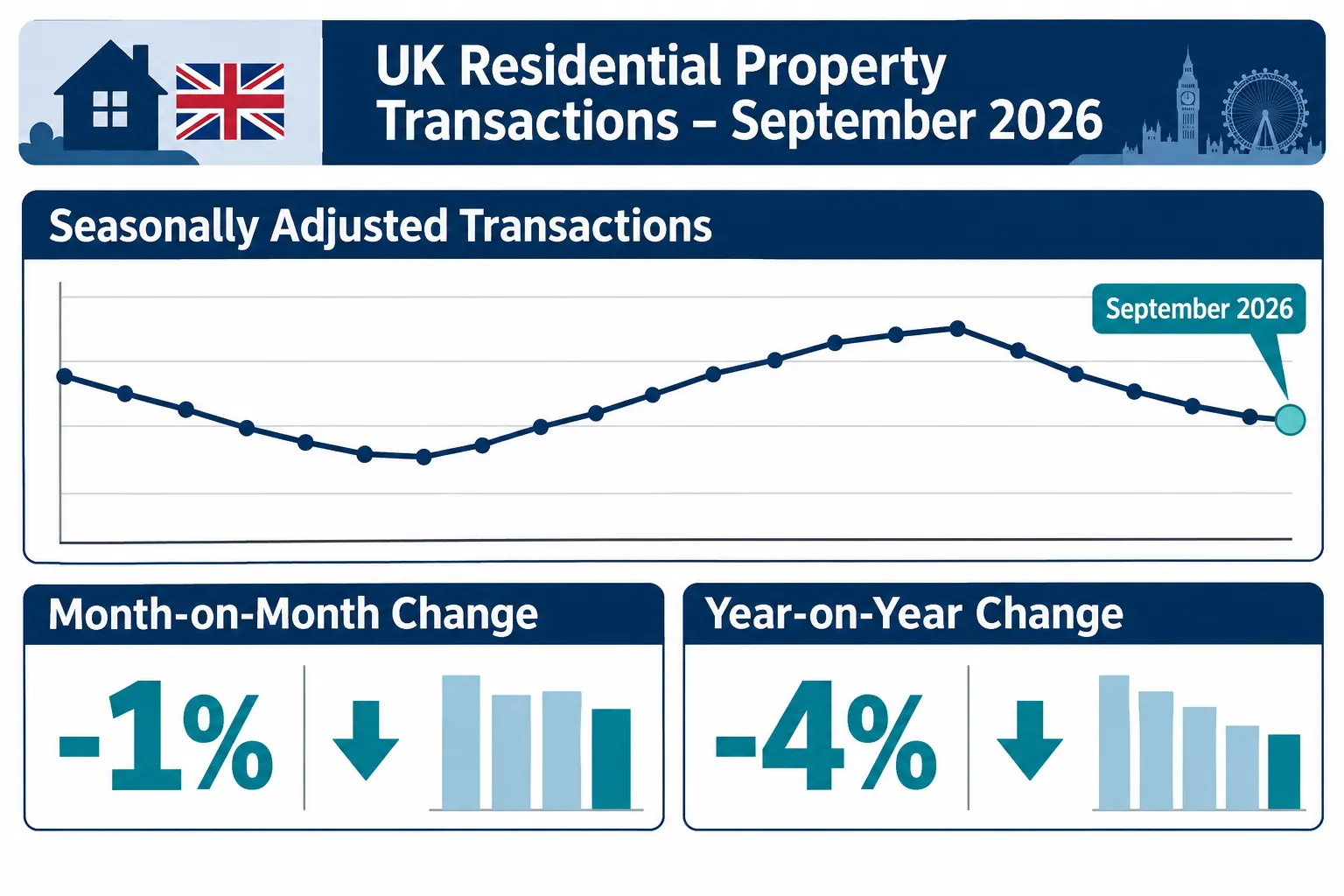
The HMRC property transactions release for September 2026, reported by Property Industry Eye on 2 November 2026, showed seasonally adjusted UK residential transactions at 94,800. That is down 1% on August and 4% lower than September 2025.
HMRC seasonally adjusted transactions: September 2026
Non-seasonally adjusted figures told a slightly different story: transactions rose 1% month-on-month but still fell 5% year-on-year. In other words, the usual autumn pick-up happened on paper, but not by enough to offset the weaker backdrop compared with last year.
Measure
September 2026
Change
Seasonally adjusted transactions
94,800
-1% m/m, -4% y/y
Non-seasonally adjusted transactions
n/a
+1% m/m, -5% y/y
Nationwide average house price (October 2026)
£273,566
-0.3% monthly, +0.5% annual
Why the Autumn Bounce Failed to Arrive
Every autumn the housing market usually perks up after the summer lull. Not this year.
Richard Donnell, executive director at Zoopla, points to higher mortgage rates over summer and autumn, which cut mortgage borrowers' buying power by 15%. Sales agreed in the previous four weeks were already 7% below the same point last year. Zoopla now expects 100,000 fewer transactions across 2026 than in 2025.
Nick Leeming, chairman of Jackson-Stops, confirms the pattern on the ground: the usual autumn recovery did not materialise, with sales running 4% below the same period in 2025. His message to sellers is clear. Buyers are still active, but they are pickier on price, and sellers should price using recent local sold evidence rather than wishful thinking.
Affordability, the Budget, and Borrowing Costs
Ian Harris, president of NAEA Propertymark, says affordability remains the major obstacle for buyers. The 28 October Budget gave some policy clarity, but uncertainty over borrowing costs persists ahead of the Bank of England's 5 November decision. Bank Rate currently sits at 3.75%, and most economists expect a rise to 4%.
Jason Tebb, president of OnTheMarket, adds that swap-rate volatility has already pushed up mortgage pricing, meaning lenders have been repricing deals even before any Bank of England announcement.
Nationwide's 30 October data reinforces the slowdown story: prices fell 0.3% in October to an average of £273,566, with annual growth easing to just 0.5%, the weakest reading since January 2024.
What Fewer, Slower Transactions Mean for Survey Timing
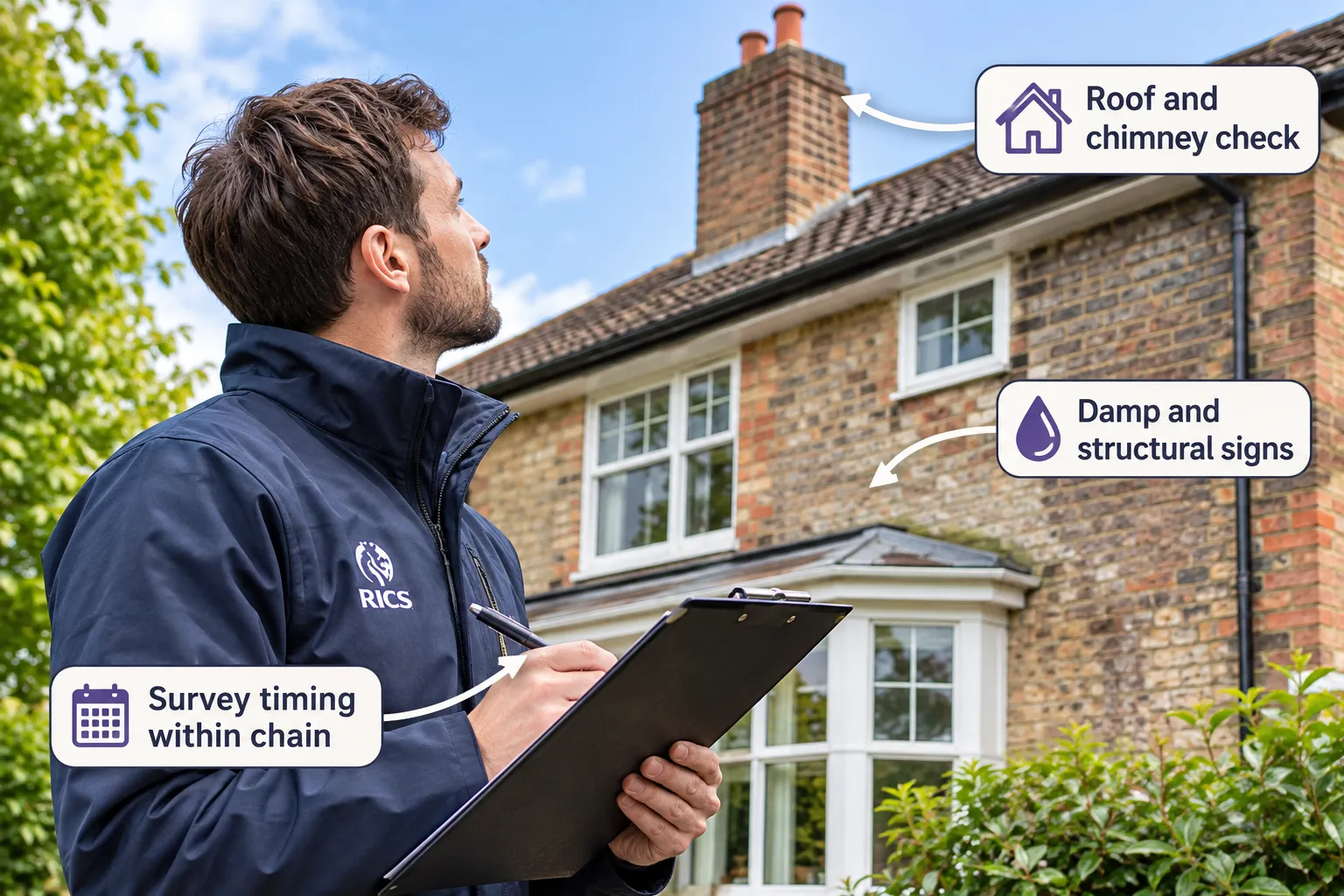
A market with longer selling times and tighter chains changes how buyers should plan their survey. Zoopla puts the average time to agree a sale at 44 days across the UK and 56 days in London, so there is often room to book a survey early and still negotiate before exchange. Chains with several linked sales can compress that window quickly if one party delays.
Survey findings carry more negotiating weight in a selective market
Practical implications:
Book early. Do not wait until solicitors chase you. A delayed survey can hold up the whole chain.
Use findings as leverage. In a market where buyers are pickier on price, a survey report backed by evidence gives real negotiating weight.
Expect scrutiny on valuations. With Nationwide showing price growth near flat, lenders and buyers alike will look harder at whether an asking price reflects genuine local sold evidence.
Level 2 vs Level 3 Surveys in a Selective Market
When buyers are being pickier on price, the type of survey chosen matters more than ever.
RICS Level 2 Survey (HomeBuyer Report): suited to conventional properties built from common materials, in reasonable condition. Flags defects affecting value without exhaustive detail.
RICS Level 3 Survey (Building Survey): recommended for older, altered, non-standard, or visibly deteriorating properties. Gives in-depth analysis of structure, materials and defects, useful where buyers plan renovation or expect negotiation.
Factor
Level 2
Level 3
Property age
Younger, standard construction
Older, altered, unusual
Condition
Reasonable
Visible wear or unknown history
Negotiating detail
Moderate
Extensive
Given HMRC data showing a cooler, more cautious market, buyers have more room, and arguably more reason, to request the survey level that matches the property's actual risk profile, rather than defaulting to the cheapest option.
How Sellers Can Pre-empt Survey Findings
Sellers facing a market where sales sit 4% below last year's levels can reduce the risk of a survey derailing a sale by acting first.
Address obvious defects such as damp, guttering and roof issues before marketing.
Price using recent local sold evidence, as Leeming advises, not aspirational comparables.
Consider a pre-sale survey to flag issues before a buyer's surveyor does.
Keep documentation (boiler service records, damp treatment guarantees) ready for buyers' solicitors.
Conclusion
The HMRC property transactions figures for September 2026 confirm what agents across the country have been reporting: the market has cooled, buyers have less borrowing power, and the expected autumn bounce simply did not happen. With the Bank Rate decision looming on 5 November and swap-rate volatility pushing up mortgage pricing, caution is likely to persist into winter.
For buyers, this is a moment to use the slower pace to their advantage: book a RICS-regulated survey early, choose the right level for the property's age and condition, and use the findings to negotiate from an informed position. For sellers, pricing realistically against sold evidence and pre-empting obvious defects will matter more than ever. Readers should take independent financial or legal advice before making property decisions. The Survey Merchant connects buyers UK-wide with RICS surveyors for Level 2 and Level 3 surveys and valuations.
FAQ
What were the HMRC property transactions for September 2026?
Seasonally adjusted transactions were 94,800, down 1% on August and 4% lower than September 2025.
Why didn't the autumn market recover as usual?
Higher mortgage rates cut buyer borrowing power by around 15%, according to Zoopla, and swap-rate volatility pushed up mortgage pricing, according to OnTheMarket.
Should I get a Level 2 or Level 3 survey?
Level 2 suits standard, reasonably modern properties; Level 3 suits older, altered or visibly deteriorating homes, or where renovation is planned.
How does a slower market affect survey timing?
With sales taking 44 to 56 days to agree and longer chains, there is often more time to book a survey early, but delays can still ripple through linked sales.
Will mortgage rates fall soon?
The Bank of England's 5 November decision was pending at publication, with most economists expecting a rise to 4% from 3.75%. Readers should seek independent mortgage advice.
Related guides
No items found.
Book a RICS surveyor
Survey Merchant provides vetted RICS surveyors across 100+ UK locations at fixed fees: