Project Management
Sep 4, 2026
Improve renovation success with project management for surveyors
Unlock renovation success with expert project management for surveyors. Learn how to avoid costly mistakes and ensure profitable outcomes.

Budget overruns, missed deadlines, and surprise compliance failures are not just frustrating for UK property developers; they are genuinely costly. Structural refurbishments in South East England can reach £1,600 to £2,200 per m², and without a structured approach, even experienced builders can watch margins disappear before a project is half complete. Structured project management, applied through the lens of a qualified surveyor, changes that equation entirely. This article walks you through the preparation, execution, and compliance steps that separate profitable refurbishments from expensive lessons.
| Point | Details |
|---|---|
| Project management reduces overruns | Clear management and budgeting help prevent unexpected renovation costs. |
| Early stakeholder engagement | Involving stakeholders from the start minimises disruption and improves planning. |
| Phased works increase efficiency | Phasing renovations can shorten timelines and keep critical operations running. |
| Regulation compliance is critical | Meeting CDM and Building Safety Act requirements ensures legal, safe renovations. |
| Surveyors lead successful projects | Effective project management by surveyors delivers quality and compliance for property developers. |
Most developers understand that refurbishments carry risk. Fewer appreciate just how quickly unmanaged risk compounds. A delayed scaffold hire leads to a rescheduled roof inspection. That rescheduled inspection means a late building regulations sign-off. That late sign-off triggers a penalty clause with the buyer. What began as a minor scheduling issue becomes a five-figure problem within weeks.
Surveyors sit at the intersection of technical knowledge and regulatory authority, which makes them uniquely positioned to prevent exactly this kind of cascade. When a surveyor takes on a project management role, they bring more than eyes on the brickwork. They bring a structured framework for tracking budget, timeline, contractor performance, and compliance simultaneously.
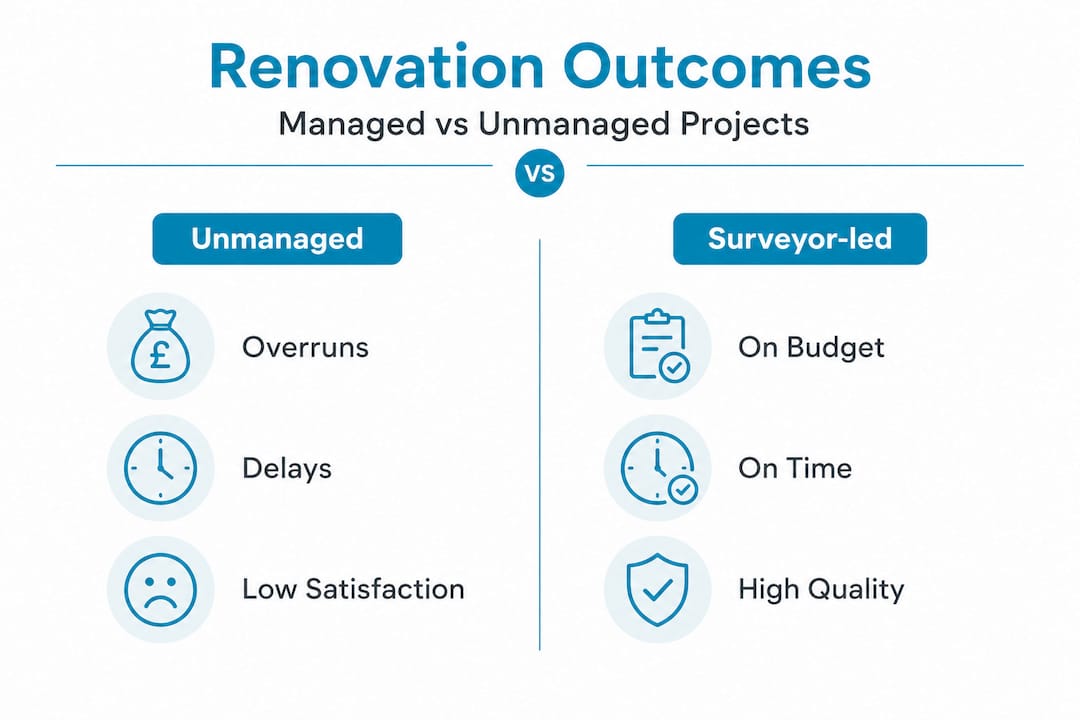
The difference between managed and unmanaged projects is stark. Consider two comparable Victorian terrace conversions in South East England. In the unmanaged scenario, the developer hires contractors independently, coordinates via group chat, and assumes the architect will handle compliance. By week six, there are two active disputes, a missed structural survey, and a stop notice from the local authority. In the managed scenario, a surveyor leads the project from inception, applies surveying best practices throughout, and delivers a coordinated programme where every trade knows their sequence and every sign-off is anticipated.
Here is a comparison of typical project outcomes with and without structured surveyor-led project management:
| Factor | Without structured PM | With surveyor-led PM |
|---|---|---|
| Budget adherence | Frequent overruns (10-25%) | Overruns reduced to 5-10% contingency |
| Timeline delivery | Delays of 2-8 weeks common | Phased schedules met consistently |
| Compliance sign-offs | Reactive and often late | Planned and pre-booked |
| Contractor disputes | Common and costly | Rare with clear scope documents |
| Client communication | Ad hoc and inconsistent | Structured and documented |
The financial benchmarks matter here. Refurbishment costs for mid-range structural projects sit between £1,600 and £2,200 per m² in South East England, with contingency budgets typically running at 5 to 10 percent. Without project management discipline, that contingency evaporates fast. With it, it stays intact as genuine financial protection.
Key risks that structured project management directly addresses:
Effective land surveying for construction projects also reinforces this point. The surveyor’s role is not simply to inspect and report; it is to anticipate risk and create the conditions for successful delivery.
Strong preparation is where the best project managers earn their fees long before a single tool is lifted. For surveyors managing refurbishments, preparation means three things: defining what the project actually is, understanding who is affected by it, and mapping exactly what compliance will demand.

Scope definition comes first. Vague scope documents are the single greatest cause of variation orders and budget disputes. Every room, surface, structural element, and service run should be inventoried and described clearly before pricing begins. That means a thorough pre-contract survey, not a walkthrough with a notepad.
Stakeholder engagement is equally critical and often underestimated. In a RICS APC case study examining operational building refurbishments, early engagement with end users directly shaped the phasing strategy, reducing a projected 12-week programme to 8 weeks through carefully sequenced zone-by-zone working and twilight shifts. That result was only possible because the project manager spoke to the building’s occupants before the design was finalised. Skipping that step would have locked in a programme that simply could not work around the building’s operational needs.
Surveyors should also map compliance requirements at the preparation stage. This includes identifying whether the project requires a principal designer appointment under CDM Regulations, whether any party wall matters need addressing, and what building regulations approvals are required before and during works.
Here is a preparation data table to support structured project planning:
| Preparation element | Action required | Responsible party |
|---|---|---|
| Scope of works | Detailed written specification | Surveyor/PM |
| Budget and contingency | Itemised cost plan with 5-10% contingency | QS or surveyor |
| Stakeholder mapping | Identify owners, occupants, neighbours | PM lead |
| Compliance checklist | CDM, building regs, party wall | Surveyor |
| Programme draft | Phased timeline with key milestones | PM with contractors |
| Contractor procurement | Tender, assess, and appoint | PM lead |
A numbered preparation checklist for surveyors taking on a PM role:
Pro Tip: Involve your structural engineer and M&E consultant at the scope definition stage, not after design. Their early input catches conflicts between structural requirements and service routes before they become expensive on-site surprises.
Engaging stakeholders early is not just courteous; it is strategically essential for project outcomes. The time invested in understanding how a building is used, who depends on it, and what constraints apply will pay back many times over. Using a property survey workflow guide at this stage gives your team a reliable structure to follow across every project, reducing the risk of missing critical steps.
Preparation builds the runway. Execution is the flight. This is where the quality of your project management framework becomes visible, and where the decisions made in weeks one and two determine whether you land smoothly or run out of tarmac.
Experienced surveyors managing renovation projects follow a consistent execution sequence:
The question of phased versus full shutdown working is one of the most consequential decisions in renovation execution. Full shutdown is simpler to manage but often commercially untenable, particularly in occupied commercial buildings or multi-unit residential developments. Phased working, as evidenced by the RICS APC case study, can deliver a 12 to 8-week programme reduction by using zone rotation and off-peak shift patterns. But it demands sharper coordination, clearer contractor briefing, and more active daily management from the surveyor leading the project.
“The most effective renovation programmes we have seen are not the most aggressive. They are the most clearly sequenced. When every contractor knows what comes before and after them, delays become the exception rather than the rule.”
Communication is the engine of successful execution. Contractors need daily clarity on what is expected of them. Clients need weekly confidence that the programme is on track. Neighbours and occupants need advance notice of any noisy or disruptive activities. The impact of survey results on project decisions also reinforces why interim surveys during works are valuable; they capture condition changes before they escalate and create a defensible record for the final account.
Pro Tip: Use a simple traffic light reporting system in your weekly updates. Green means on track, amber means a risk that needs monitoring, red means an issue requiring an immediate decision. This format forces clarity and stops problems from being buried in lengthy written reports.
Compliance is not a box-ticking exercise in UK refurbishments. It is a legal obligation with personal liability attached. Surveyors taking on project management roles must understand this clearly and build compliance management into the fabric of every project they lead.
The Construction (Design and Management) Regulations 2015, commonly known as CDM, place duties on clients, designers, principal designers, and principal contractors. For many refurbishment projects, the surveyor will hold or advise on the principal designer role, which carries specific responsibilities for pre-construction health and safety planning. The Building Safety Act 2022 has added further layers of accountability, particularly for higher-risk buildings, including detailed requirements around design and construction documentation.
Key compliance duties for surveyors managing refurbishment projects:
“CDM compliance is not a project management afterthought. It is the framework within which every other decision on site must be made.”
Understanding and managing health and safety compliance as an active, ongoing responsibility rather than a series of one-off submissions is what separates competent project managers from excellent ones. Regulatory obligations do not pause when a project gets busy. They intensify.
Pro Tip: Create a compliance calendar at the project outset that maps every required submission, inspection, and notification against the programme. Share it with the whole project team so that compliance deadlines are visible to everyone, not just the surveyor.
For developers and builders working with heritage assets or listed structures, additional consents under the Planning (Listed Buildings and Conservation Areas) Act 1990 may apply. Engaging your building surveying services team early in these cases is essential. The regulatory layer for listed buildings is complex, and mistakes carry serious consequences including enforcement action and criminal liability.
There is a persistent myth in UK construction that the best project manager is the one with the tightest programme and the most detailed Gantt chart. In practice, the most successful project managers tend to be the ones who invest the most time in understanding what the project means to the people it affects, before a single line is drawn.
Rigid project strategies fail precisely because they treat buildings as static objects and occupants as inconveniences. A programme built without genuine input from the people who use a building will always encounter resistance, delays, and scope changes that could have been avoided. The importance of early engagement with end users, building managers, and even neighbouring property owners is consistently undervalued.
Phased approaches, when well-executed, almost always outperform full shutdowns on both cost and client satisfaction. They are harder to manage. They require more from the surveyor and the contractors. But they produce outcomes that rigid programmes never can. When a building can keep operating while it is being improved, the client’s business case remains intact, and that matters enormously to any developer managing a commercial asset.
The lesson from veteran surveyors is straightforward: start with the people, then build the programme around them. The technical execution will follow. The compliance will be manageable. The risk register will have fewer red entries. Projects succeed when the surveyor understands that their job is not just to manage a construction process. It is to protect the interests of everyone connected to that building throughout the process.
Bringing structured project management to your renovation or refurbishment starts with having the right surveying expertise at the table from day one.

Survey Merchant connects property developers and builders across the UK with qualified, impartial surveyors who specialise in exactly this kind of work. Whether you need full building surveys to underpin your pre-contract planning, commercial property surveys for complex mixed-use refurbishments, or specialist party wall surveyors to manage adjoining owner obligations, Survey Merchant’s panel gives you access to the right professional for every stage. Start your next project with the confidence that comes from expert, coordinated surveying support throughout.
Surveyors apply structured project management to build accurate, itemised budgets with defined contingency reserves, typically 5 to 10 percent, reducing the likelihood of unexpected costs consuming project margins. Refurbishment costs in South East England can reach £2,200 per m², making this discipline essential.
Engaging stakeholders before the programme is finalised allows the project team to design phasing and working hours around real operational needs. Early stakeholder engagement has demonstrably reduced project durations and prevented costly disruption in occupied buildings.
Surveyors must adhere to CDM Regulations 2015, meet duties under the Building Safety Act 2022, and fulfil principal designer responsibilities where applicable, alongside standard building regulations requirements.
Phased works allow refurbishments to proceed in operational buildings without halting all activity, often reducing programme duration significantly while maintaining the building’s income-generating function throughout.
Surveyors must proactively manage CDM compliance by maintaining live health and safety plans, coordinating with the principal contractor, and verifying that all safety protocols are implemented and updated as site conditions change.
Survey Merchant provides vetted RICS surveyors across 100+ UK locations at fixed fees:
→ Level 2 Home Survey (HomeBuyer Report)
→ Level 3 Building Survey (full structural survey)
→ RICS Red Book property valuations
→ Party wall surveyors — notices, awards & schedules of condition
→ Expert witness surveyors — CPR Part 35 reports for property disputes