Building Surveying
Jul 16, 2026
Why property surveys matter before you buy: Avoid costly risks
Discover why survey before buying property is crucial. Avoid costly repairs and make informed decisions with our comprehensive guide.

Nearly half of buyers face major repairs costing £10,000 or more within their first year of ownership, yet the vast majority still rely on a basic mortgage valuation and assume it covers them. It does not. There is a persistent and genuinely dangerous misunderstanding running through the UK property market: that the report your lender organises tells you anything meaningful about the home you are about to buy. This guide explains exactly what a survey is, how it differs from a mortgage valuation, what happens when buyers skip one, and how the profession and government are evolving to give buyers stronger protection than ever before.
| Point | Details |
|---|---|
| Surveys are not valuations | Only a property survey checks the home’s condition for your benefit, unlike a mortgage valuation done for lenders. |
| Skipping surveys is costly | Nearly half of survey skippers face surprise repairs costing over £10,000 in the first year. |
| Professional standards matter | RICS standards and new technologies are making UK property surveys more thorough and reliable. |
| Policy changes ahead | Upcoming reforms in 2026 may require sellers to provide surveys upfront, so buyers should keep updated. |
| Surveys give you leverage | Using survey insights during purchase negotiations can save thousands or help secure repairs before you buy. |
This confusion is arguably the single most expensive mistake UK buyers make. A mortgage valuation and a property survey sound similar, and both involve a professional visiting the property. But they serve entirely different purposes and protect entirely different people.
A mortgage valuation is commissioned by your lender. Its only job is to confirm that the property is worth enough to secure the loan. The surveyor working on a valuation is not working for you. They are not required to inspect the roof closely, comment on the drainage system, or flag structural movement. Mortgage valuations are for lenders, not buyers, and they do not assess condition or defects. Research suggests that as many as 72% of consumers misunderstand this fundamental point, believing that the lender’s valuation gives them some meaningful protection. It does not.
A property survey, on the other hand, is commissioned by and for the buyer. Its purpose is to give you a clear, professional assessment of the condition of the property you are purchasing. That assessment can range from a high-level overview to a granular, element-by-element inspection, depending on the type of survey you choose.
| Survey type | Level | Best suited for |
|---|---|---|
| Condition report | Level 1 | New builds or recently renovated homes |
| HomeBuyer report | Level 2 | Conventional homes in reasonable condition |
| Full building survey | Level 3 | Older, larger, or non-standard properties |
Each level offers a progressively deeper inspection. A Condition Report is the lightest touch, flagging obvious issues using a traffic-light rating system. A HomeBuyer Report goes further, covering the condition of the main elements of the property and often including a market valuation. A Full Building Survey is the most thorough, providing detailed commentary on every accessible element, including the structure, drainage, and any significant defects. Understanding the RICS valuation differences between these products is an important early step.
“A mortgage valuation is not a survey. It is a figure on a page. The survey is the document that could save you tens of thousands of pounds.”
If you are buying an older terraced house, a Victorian conversion, or any property with a complex structure, a Level 2 report at minimum is advisable. Many professionals recommend a full Level 3 inspection for anything built before the 1950s. You can read more about how the industry defines these products through the RICS Home Survey Standard, which was introduced to bring greater consistency across reporting.
The bottom line: your lender’s valuation is a commercial document that protects their investment. A survey is a professional inspection that protects yours.
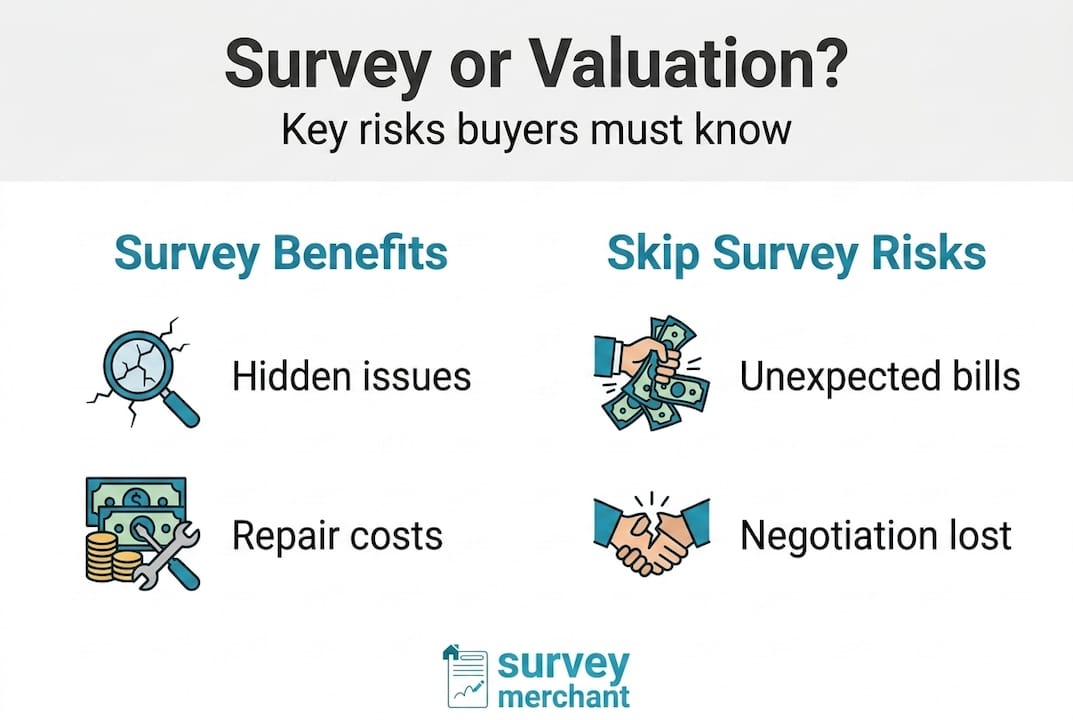
Once you understand that a mortgage valuation offers you no real protection, the consequences of skipping a survey become much clearer. The data is striking.

Nearly half of buyers who proceed without a proper survey face significant repair costs in their first year, with the average bill sitting around £10,000. One in five property sales falls through because major issues are uncovered too late in the process, causing delays, wasted legal fees, and genuine distress. Despite this, survey uptake in the UK remains stubbornly below 15%, which means the overwhelming majority of buyers are taking on risk that a relatively modest upfront cost could have identified.
These are not edge cases. The most common issues found in UK property surveys include damp, roof defects, and outdated electrical systems, all of which are easily missed during a standard viewing.
Key statistic: Fewer than 1 in 7 buyers currently commission any form of survey, yet almost half of those buyers encounter costly repairs within 12 months of completion.
Beyond the financial impact, there is a significant emotional toll. Discovering that your new home has a failing roof or rising damp three months after moving in is stressful, disruptive, and demoralising. Many buyers report feeling betrayed or misled, even in cases where the seller was not aware of the defect. When you factor in UK renovation delays caused by difficulty finding reliable tradespeople, the practical disruption can stretch from months into years.
Pro Tip: If a seller is resistant to you commissioning a survey or tries to rush completion before you can book one, treat that as a red flag. A seller with nothing to hide will welcome the process.
There is also the issue of unmortgageable or uninsurable properties. Some defects, particularly those involving non-standard construction or serious structural movement, can make a property impossible to finance or insure. A survey identifies this risk before you are legally committed, giving you the option to walk away or renegotiate without losing your deposit.
Knowing that surveys matter is one thing. Trusting that the survey you commission is genuinely thorough is another. This is where professional standards and emerging technology become essential parts of the conversation.
The Royal Institution of Chartered Surveyors (RICS) sets the benchmark for survey quality in the UK. Under the RICS Home Survey Standard, chartered surveyors are required to work only within their area of competence. This means a surveyor who lacks expertise in a specific area, such as historic drainage systems or timber-framed construction, must acknowledge that limitation and recommend a specialist. This is a meaningful safeguard for buyers.
RICS standards emphasise competence limits, tech integration, and a retrofit focus, reflecting a genuine evolution in how surveys are conducted. One of the most significant practical developments is the use of drones for external inspections. Roofs, chimney stacks, and high parapets that were previously assessed only from ground level can now be inspected in close detail, improving accuracy considerably and reducing the risk of costly defects going unnoticed.
Thermal imaging is another tool increasingly used by qualified surveyors to identify areas of heat loss, moisture, and hidden insulation gaps. This matters especially for older properties where energy efficiency and retrofit potential are significant purchase considerations.
“Technology does not replace professional judgement, but it gives qualified surveyors a much sharper set of tools to work with.”
Retrofit assessments are also becoming a more prominent feature of building surveys. With the UK’s push towards net zero and the growing importance of EPC ratings in property value, understanding a building’s energy performance is increasingly part of what buyers need to know before committing. Understanding the benefits of an RICS surveyor goes well beyond just finding defects. It includes understanding what it will cost to bring a property up to modern energy standards, which can be a very significant figure for older homes.
Choosing a qualified, RICS-registered professional through a platform that verifies credentials ensures you are getting the full benefit of these developments. The chartered surveyor’s role has grown considerably in scope and sophistication, and buyers who engage with it properly are meaningfully better positioned.
The surveying profession is not the only thing changing. Government policy is also moving in a direction that could fundamentally alter how surveys work in the UK property market.
Potential mandatory upfront surveys are being considered as part of wider reforms to the home-buying process. Under the current system, buyers commission surveys after an offer is accepted, which means significant time and legal costs can be spent before a fundamental defect is discovered. The proposed shift would see sellers commission and provide survey reports upfront, before marketing the property.
Key point: Even if seller-commissioned upfront surveys become mandatory, buyers retain the right to commission their own independent survey. Independent assessment remains the gold standard for buyer protection.
The new RICS survey rules are already aligning with this direction of travel, emphasising transparency and consumer clarity as core principles. If you are buying in 2026 or planning to do so, it is worth asking sellers directly whether they have an existing condition report and, if so, requesting a copy before making an offer.
These reforms represent a genuine improvement for the market, but they do not remove the need for buyer vigilance. A seller’s survey is produced for the seller. Your survey is produced for you.
Here is something most property guides will not tell you: the survey is not just a safety check. It is a negotiation tool, and most buyers never use it as one.
The conventional approach is to treat the survey as a formality, a box to tick before exchange. If the report comes back clean, great. If it flags issues, many buyers panic and either pull out or accept the property as-is and absorb the costs. Both responses leave money on the table.
The smarter approach is to treat the survey findings as leverage. A report that identifies £8,000 worth of roof repairs gives you a direct basis for renegotiating the purchase price. A flagged damp issue gives you grounds to request a retention or a pre-completion repair. Property surveyor advice consistently reinforces this point: buyers who engage actively with their survey report, ask their surveyor questions about priority defects, and use findings in their negotiation strategy routinely save thousands more than the cost of the survey itself.
The real risk in skipping a survey is not just the repair bill you might face. It is the negotiating power you forfeit. You are not just buying a property. You are entering a transaction, and information is your most valuable asset in that transaction. A thorough survey gives you that information. Using it well is what separates an expensive purchase from a genuinely good one.
If this article has made one thing clear, it is that a professional survey is not an optional extra but a practical necessity for any UK property buyer. The cost of a survey is small relative to the financial and emotional risk of proceeding without one.

Survey Merchant connects buyers across the UK with qualified, RICS-registered surveyors who provide thorough, impartial assessments for every type of property. Whether you need a HomeBuyer report or a detailed inspection via full building surveys, the platform makes it straightforward to find the right professional for your specific purchase. Explore the full range of building surveying services available, or use the platform to get matched with a surveyor who understands your property type and location. Take the guesswork out of one of the biggest financial decisions of your life.
Surveys are not currently mandatory for buyers, but 2026 government reforms may shift this by requiring sellers to commission upfront condition reports before marketing a property.
Buyers who skip a survey face average first-year repair costs of approximately £10,000, with nearly half of unsurveyed purchases resulting in significant unplanned expenditure.
A mortgage valuation protects the lender’s financial position, not yours. Mortgage valuations do not assess the condition or defects of the property, and 72% of buyers mistakenly believe otherwise.
Modern surveys may use drone technology and thermal imaging to inspect hard-to-reach areas, producing reports that are more thorough and accurate than traditional ground-level assessments.
Currently, buyers typically commission surveys themselves, but proposed reforms may shift this responsibility to sellers, making upfront condition reports a standard part of the selling process.
Survey Merchant provides vetted RICS surveyors across 100+ UK locations at fixed fees:
→ Level 2 Home Survey (HomeBuyer Report)
→ Level 3 Building Survey (full structural survey)
→ RICS Red Book property valuations
→ Party wall surveyors — notices, awards & schedules of condition
→ Expert witness surveyors — CPR Part 35 reports for property disputes