Party Wall
Sep 29, 2026
Party Wall Surveyor: A Homeowner's Guide to the 1996 Act
Planning an extension? Our guide to the party wall surveyor process covers the Act, notices, costs, and how to find a qualified expert for your building works.

The envelope lands on the doormat and the tone is instantly formal. Your neighbour plans an extension. Or you’re the one planning a loft conversion and your architect has just said, “You may need a party wall surveyor.”
That’s usually the point when a straightforward building project starts to feel legal, technical and slightly personal. You’re not just thinking about builders and budgets now. You’re thinking about the wall you share, the foundations next door, whether your neighbour will object, and what happens if relations become strained.
A party wall surveyor sits in that gap between construction and neighbour relations. The role isn’t to block work. It’s to make sure the statutory process is followed properly, risks are recorded, and any dispute under the Act is resolved through a structured procedure rather than an argument over the fence.
A typical scenario goes like this. A homeowner wants a rear extension. Their designer mentions notices. The adjoining owner receives a letter, worries about cracks and scaffolding, and assumes they now need to hire a solicitor. In most cases, they don’t. They need to understand the party wall process and whether a surveyor is required.
The Party Wall etc. Act 1996 exists to deal with specific building works that affect shared structures or close neighbouring boundaries. It creates a process for notices, responses and, if needed, a legally binding Award. That process can feel heavy when you first meet it, but it’s more orderly than might be expected.
What usually works is early, calm handling. Show your neighbour the drawings before the formal notice arrives. Explain the programme. Give them a clear route to ask questions. That doesn’t remove the legal process, but it often reduces suspicion and delay.
What doesn’t work is treating the notice as a box-ticking exercise. Poor notices, late notices and vague explanations tend to create avoidable disputes. So does appointing the first person who posts a leaflet through the door claiming to be a specialist.
Practical rule: A party wall matter runs more smoothly when the paperwork is accurate, the communication is polite, and the surveyor is appointed for competence rather than convenience.
If you’re trying to get your bearings before speaking to anyone formally, Survey Merchant’s party wall guidance articles are a useful starting point for understanding the language and stages involved.
For homeowners, the key points are simple. Know whether your works are covered. Serve the right notice at the right time. If a dispute arises, appoint a surveyor who understands both the Act and residential construction in practice.
The Party Wall etc. Act 1996 applies across England and Wales and came into force on 1 July 1997. It requires building owners to serve formal notices one or two months before works start, depending on the type of work. If a dispute arises from that notice, a party wall surveyor is appointed to resolve it through a legally binding Party Wall Award, as set out in the RICS guidance on party wall legislation and procedure.
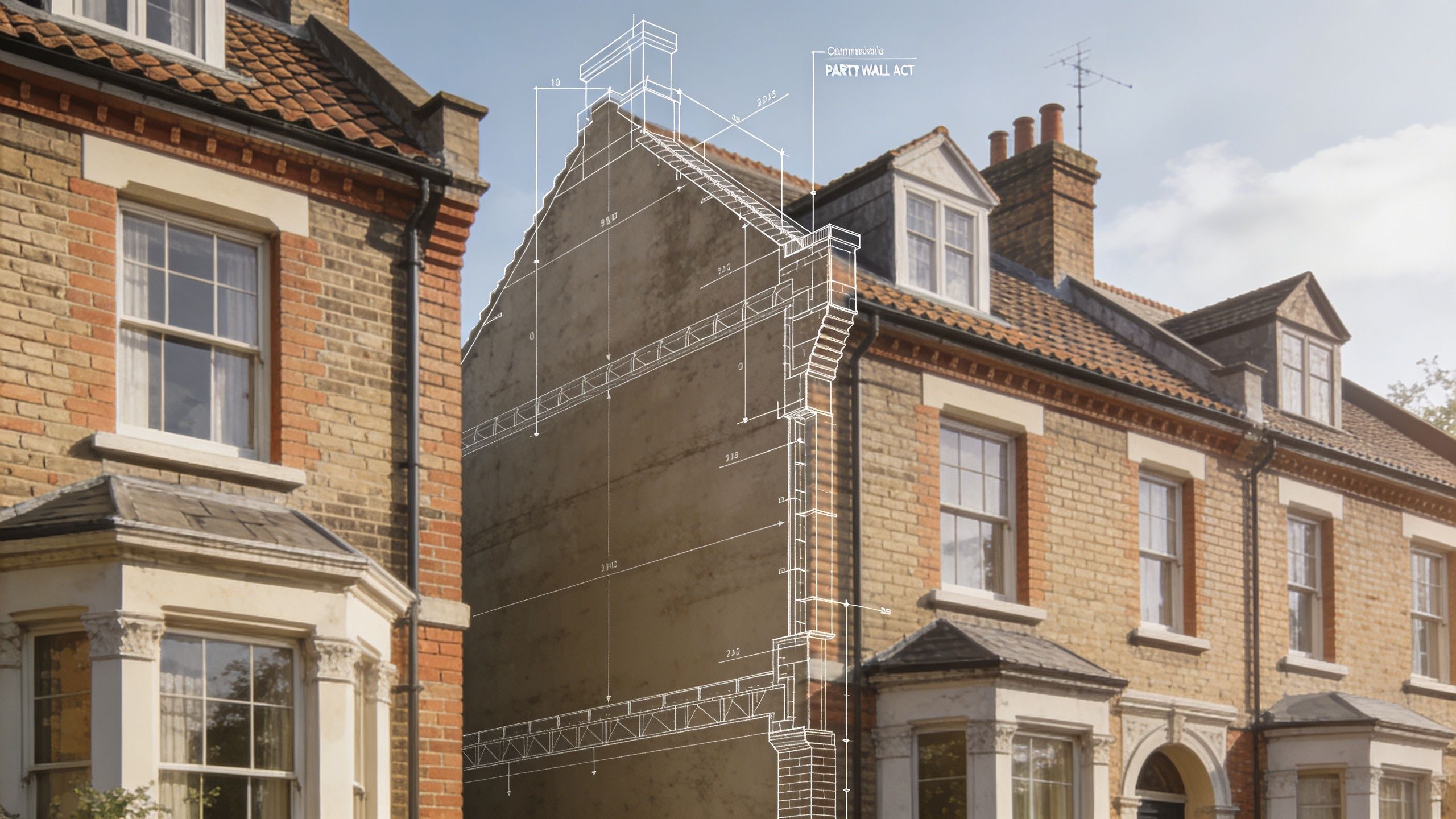
The easiest way to think about the Act is as a rulebook for work that could affect a neighbour’s property interest. It doesn’t give a neighbour a general right to stop development. It creates a mechanism for notice, assessment and protection where the proposed works fall within the Act.
A party wall isn’t only the wall between two terraced houses. Party wall matters can also involve a party structure, and in practical terms that may include parts of a building shared by adjoining owners. The legal definitions matter, but the everyday question is simpler. Will your work affect a shared element or take place close enough to a neighbouring structure that the Act is engaged?
Most residential instructions fall into three broad categories:
That last point catches many people out. A homeowner says, “I’m building on my side only,” but the foundations are close enough to the adjoining owner’s structure to require notice.
The Act is usually less about ownership arguments and more about managing risk before the first spade goes into the ground.
If you’re planning a loft conversion, side return, rear extension or basement, it’s worth checking the party wall position early. Waiting until the builder is booked often means the legal timescales start dictating the programme rather than supporting it.
The process starts with notice. Not with a surveyor, and not with a contractor turning up. The notice tells the adjoining owner what works are proposed and gives them the formal opportunity to respond.
A properly served notice is the legal trigger. It marks the beginning of the statutory timetable and gives the adjoining owner a chance to consider the work. The notice needs to be matched to the works in question. In practice, that may mean a Party Structure Notice, a Party Fence Wall Notice, or a Notice of Adjacent Excavation.
A Notice of Adjacent Excavation must be served at least one month before work begins for works within 3 to 6 metres of a neighbour’s foundation. Failure to follow the timetable can lead to injunctions and legal costs, which is why the statutory timing in the Party Wall etc. Act 1996 on legislation.gov.uk matters in real project planning.
A practical mistake I see often is homeowners relying on the builder’s start date rather than the legal notice period. If the excavation is notifiable, the notice period isn’t optional. It has to be built into the programme.
For a more specific breakdown of timing triggers, this guide on when to serve party wall notices is helpful.
Once the notice has been served, the adjoining owner has 14 days to respond. That response creates the next step.
There are three broad outcomes:
Consent in writing
The adjoining owner agrees. In straightforward cases, works can proceed without a dispute under the Act, though careful record keeping still matters.
Dissent
The adjoining owner does not consent. At that point, a dispute is deemed to have arisen and surveyor appointment is required.
No response
Silence also matters. If no reply is received within the 14-day period, a dispute arises under the Act and the surveyor process starts.
If there’s a dissent or no reply within 14 days, don’t keep negotiating informally and hope it goes away. That’s the point where formal surveyor appointment becomes necessary.
What works well here is prompt follow-through. Once a dispute arises, appointing a competent party wall surveyor quickly usually reduces drift and confusion. What doesn’t work is proceeding with works as if the absence of a reply means implied consent. It doesn’t.
Once a dispute arises, the surveyor’s role changes the tone of the matter. A party wall surveyor is not there as a cheerleader for the person who appointed them. Under the Act, the surveyor must act impartially in resolving the dispute and producing the Award.
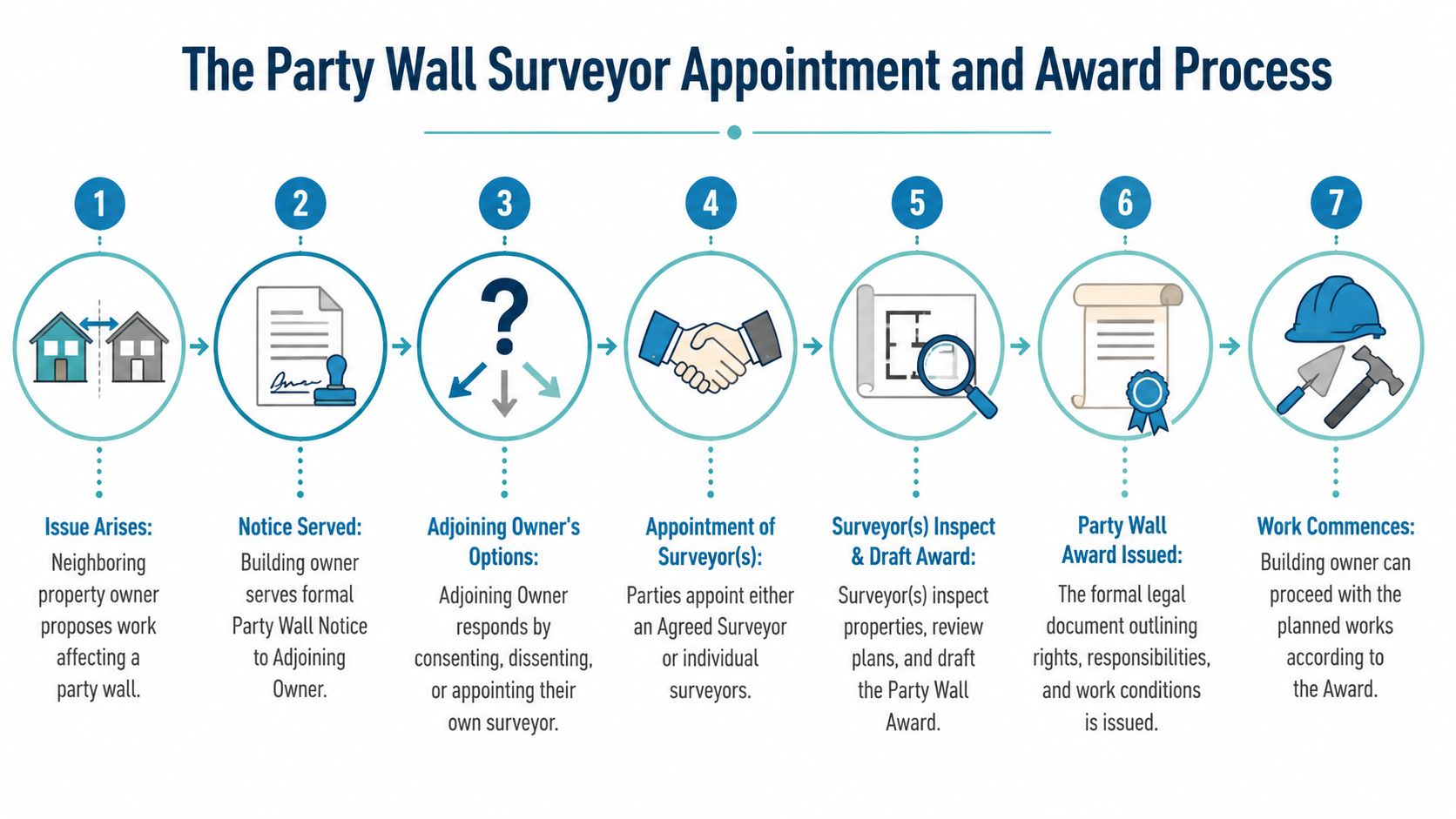
The first decision is whether both owners appoint the agreed surveyor, or whether each owner appoints their own surveyor.
An agreed surveyor can save 40 to 50% on fees, but an estimated 30% of disputes escalate because the adjoining owner fears bias where the building owner pays, according to Westville Associates’ discussion of common party wall surveyor questions. That concern is one reason many adjoining owners appoint their own surveyor even where the proposed works are modest.
Here’s the practical comparison.
| Appointment Model | How It Works | Best For | Potential Cost |
|---|---|---|---|
| Agreed Surveyor | One surveyor is appointed to act impartially for both owners | Low-risk works where both neighbours are comfortable with one appointment | Lower overall fee than two-surveyor route |
| Two Surveyors | Each owner appoints their own surveyor, who then agree the Award | Cases with neighbour concern, more complex works, or strained relations | Higher total cost because both surveyors are involved |
There isn’t a universally right model. For a routine loft conversion with good neighbour relations, one surveyor may be entirely sensible. For basement works, awkward access, or any atmosphere of mistrust, separate appointments are often worth the extra cost because both parties feel represented within the statutory framework.
You can see the structure of a formal document in this sample party wall agreement and award involving two surveyors.
The work usually unfolds in a practical sequence:
The Schedule of Condition is one of the most valuable parts of the process. It records existing cracking, finishes and defects before the builder starts. Without it, arguments about “that crack wasn’t there before” become far harder to resolve fairly.
A well-prepared Award doesn’t just authorise work. It sets boundaries around how the work is carried out so that both owners know where they stand.
In residential cases, the Award often deals with working hours, access arrangements, protection to finishes, and what happens if damage is alleged. Good surveyors draft clearly. Poor surveyors hide behind templates and leave practical questions unanswered.
Costs vary more than many homeowners expect. The same type of extension can be relatively straightforward in one location and significantly more involved in another, particularly where there are multiple adjoining owners, older buildings or restricted access.
Party wall surveyor costs in the UK vary by region. In 2026, average project costs for a single surveyor award are £900 to £1,200 for loft conversions and £1,200 to £1,500 for extensions, with London figures often 30 to 50% higher due to property complexity, according to Designing Buildings’ overview of party wall surveyor costs.
That doesn’t mean every loft conversion will fall neatly into the lower bracket or every extension into the higher one. It means those figures are useful planning ranges. The final fee is influenced by the number of notices, whether one or two surveyors are appointed, and how much negotiation the matter needs.
In practical budgeting terms, homeowners should think about cost in layers:
The trade-off is straightforward. Lower fees usually come from a smooth agreed surveyor appointment and clear, limited works. Higher fees tend to follow complexity, neighbour concern, or poor early administration.
Timelines matter as much as fees. Many delays happen before the surveyor even starts because the homeowner hasn’t left enough room for notice periods. The legal timetable comes first. Then the practical work starts.
A realistic programme usually includes:
If neighbours respond promptly and drawings are complete, the process can move efficiently. If plans change midway, appointments are delayed, or one side is suspicious from the outset, the timetable stretches. The best way to keep control is to deal with the party wall process at design stage, not after the builder has been promised a start date.
The Act allows a wide range of people to describe themselves as party wall surveyors. That flexibility helps in some circumstances, but it also creates a clear consumer risk. Homeowners often assume the title is protected in the same way as a regulated professional designation. It isn’t.

A significant risk is the rise of “party wall ambulance chasers” who send unsolicited letters to adjoining owners. These unqualified individuals can trap homeowners in irreversible appointments under Section 10 of the Act, which is why WL Building Surveyors’ article on the problem of rogue surveyors under the Party Wall Act is worth taking seriously.
The danger isn’t only poor manners or aggressive marketing. It’s poor decision-making. An unqualified or inexperienced surveyor may issue weak notices, prepare an inadequate schedule, mishandle impartiality, or create an Award that leaves both owners exposed to later argument.
What works is deliberate selection. Ask who they are, what qualifications they hold, what insurance they carry, and how often they deal with the type of work you’re proposing. A rear extension to a Victorian terrace is not the same as a detached new-build boundary wall, and a competent surveyor should be able to explain the difference clearly.
Use a simple filter before appointing anyone:
This short video gives a useful extra sense of what homeowners should watch for before appointing someone.
For homeowners who want a pre-vetted route, Survey Merchant connects clients with a panel of chartered surveyors for party wall matters and other property instructions. That doesn’t remove the need to ask questions, but it does reduce the risk of appointing someone solely because they were the loudest voice through the letterbox.
Most party wall disputes are not dramatic. They’re ordinary building arguments with legal consequences. A crack appears. Scaffolding needs access. The neighbour says the builders started too early or caused vibration. The value of the surveyor is that these issues are dealt with through evidence rather than accusation.

A common example is the hairline crack that becomes a major point of friction once excavation starts next door. The adjoining owner is convinced it’s new. The building owner insists it was pre-existing. The Schedule of Condition proves its worth in such situations.
In resolving disputes, surveyors may apply principles from legal precedents such as Pyramid v Domestic & General. They may also use technical methods such as Schmidt hammer tests or thermal imaging to distinguish new defects from pre-existing issues, and RICS guidance notes that this approach can reduce a building owner’s liability by 40 to 70% where evidence supports that conclusion, as noted in the RICS party wall guidance note.
That sounds technical, but the practical point is simple. Surveyors don’t decide these issues by instinct. They compare the pre-work record, inspect the alleged defect, consider causation and then decide whether the damage is attributable to the notified works.
When the record is detailed, many damage claims become easier to resolve because both owners can see what existed before work started.
Another frequent dispute has nothing to do with damage. It concerns access. The builder says scaffolding must go onto the adjoining owner’s land. The adjoining owner says no, or agrees only on restrictive terms.
The surveyor’s job is to bring this back to reasonableness and statutory rights. If access is necessary for authorised works, the Award can set the conditions under which it happens. That may include notice before access, protection to surfaces, and making good afterwards.
Timing disputes are just as common. The building owner wants to push on quickly. The adjoining owner objects to early starts, weekend disturbance or open-ended arrangements. A properly drafted Award should deal with these practical matters in clear terms.
What usually prevents escalation is specificity. Vague paperwork creates arguments. Detailed awards create boundaries. That doesn’t mean every neighbour leaves delighted, but it does mean both sides know the rules.
| Question | Answer |
|---|---|
| What if my neighbour ignores the notice? | If no response is received within the statutory period, a dispute is deemed to have arisen and the surveyor appointment route follows under the Act. |
| Do I always need a party wall surveyor? | No. If the adjoining owner consents in writing, a formal dispute may not arise. Whether that is sensible depends on the nature of the works and the level of risk. |
| Can one surveyor act for both owners? | Yes. That is the agreed surveyor route. It can be efficient where both owners trust the appointment and the works are relatively straightforward. |
| Who pays the surveyor’s fees? | In many ordinary residential cases, the building owner proposing the works pays the reasonable costs, but the detail depends on the facts and the conduct of the parties. |
| What is a Schedule of Condition? | It is a written and photographic record of the relevant parts of the adjoining property before work starts. It is one of the most important pieces of evidence if damage is later alleged. |
| Can my neighbour stop the works completely? | The Act is designed to regulate and protect, not to provide a general veto. If the works are notifiable, the process is about notices, dispute resolution and conditions, not automatic prevention. |
| What if I sell the property during the process? | The practical position should be checked carefully with the appointed surveyor, because the ownership position and the live status of notices or awards can affect how the matter needs to be handled. |
| Is a party wall surveyor the same as the building control inspector or project manager? | No. The party wall surveyor deals with the statutory party wall dispute process. They are not there to supervise the builder day to day or take over wider project duties. |
If you need a party wall surveyor, or you want an impartial introduction to someone suitable for your location and project type, Survey Merchant can connect you with a qualified surveying professional from its UK panel. That can help you move from uncertainty to a properly managed process, whether you’re serving notice, responding to one, or trying to resolve a dispute without making neighbour relations worse.
Survey Merchant provides vetted RICS surveyors across 100+ UK locations at fixed fees:
→ Level 2 Home Survey (HomeBuyer Report)
→ Level 3 Building Survey (full structural survey)
→ RICS Red Book property valuations
→ Party wall surveyors — notices, awards & schedules of condition
→ Expert witness surveyors — CPR Part 35 reports for property disputes